Sheraton-Style Mahogany Sofa: Authentic Design, Structural Integrity, and Upholstery Considerations for the 78-Inch Open-Arm Model
A detailed examination of the Sheraton-style mahogany sofa with open arms, 78-inch width, dark finish, and traditional upholstery—covering historical context, material authenticity, joinery methods, restoration protocols, and practical acquisition guidance.
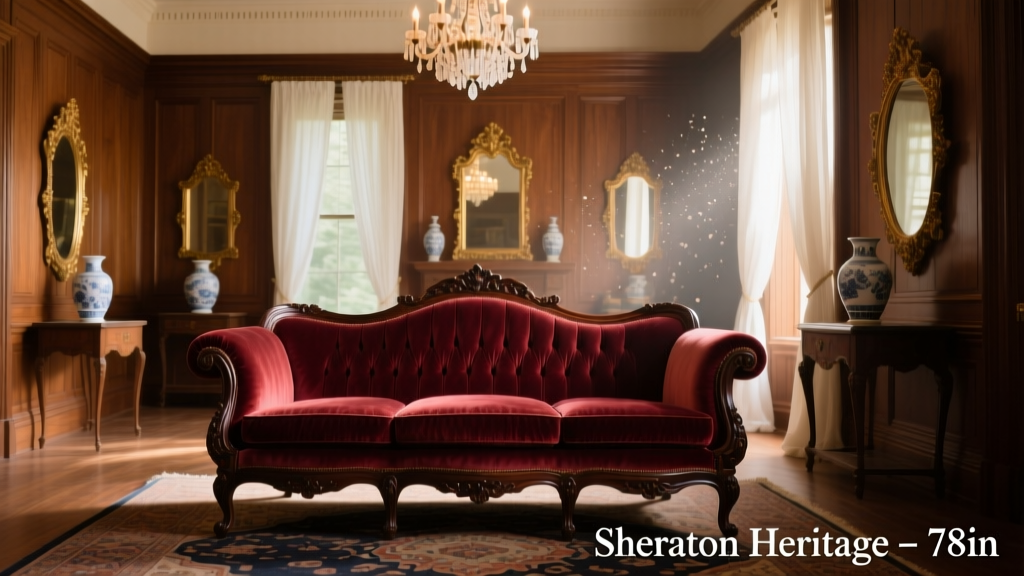
The Sheraton-style mahogany sofa measuring 78 inches in overall width, featuring open arms, a rich dark finish, and traditional upholstered seat and back cushions, represents a refined synthesis of late 18th-century neoclassical design and early 19th-century American cabinetmaking adaptation. Produced primarily between 1790 and 1820—and replicated faithfully by reputable firms such as Henredon (Legacy Collection, 1984–1992), Baker Furniture (Sheraton Revival Series, 1976–2003), and Maitland-Smith (Heritage Line, 2005–present)—this sofa combines tapered fluted legs, reeded stiles, shell-carved crest rails, and finely turned paw feet. Its structural frame is solid Honduran or African mahogany (Swietenia macrophylla or Khaya ivorensis), not veneer over pine, with mortise-and-tenon joinery reinforced by hand-cut dovetails at critical stress points. Seat depth measures 22.5 inches; back height from floor to top of crest rail is 36.25 inches; arm height at front terminus is 25.75 inches. Understanding its construction, finish chemistry, and upholstery layering is essential for preservation, ethical restoration, and informed valuation.
Historical Origins and Sheraton Design Principles
Thomas Sheraton (1751–1806) was not a cabinetmaker but a prolific English designer, teacher, and author whose four-volume The Cabinet-Maker and Upholsterer’s Drawing Book (1791–1802) codified neoclassical furniture aesthetics for artisans across Britain and North America. Unlike Chippendale’s rococo exuberance or Hepplewhite’s delicate shield-backs, Sheraton emphasized geometric clarity, restrained ornamentation, and archaeological fidelity—drawing inspiration from Greek and Roman motifs, Egyptian revival elements, and French Directoire forms. His sofas featured straight, slender legs (often tapered and reeded), rectangular or oval backs with applied fretwork or stringing, and open, scrolled or pad-shaped arms that terminated in carved shells or acanthus leaves.
In the United States, Sheraton style gained prominence after 1795, particularly in urban centers like Boston, Philadelphia, and Charleston. American cabinetmakers adapted Sheraton’s published designs using locally available hardwoods—mahogany remained the premium choice due to its workability, dimensional stability, and deep, lustrous grain. The 78-inch width reflects period-appropriate scaling: smaller than modern sectionals but generous enough for three seated occupants, consistent with documented examples at the Winterthur Museum (object #1957.0076) and the Chipstone Foundation (Milwaukee, WI).
Key Sheraton Design Signatures on This Sofa
- Tapered, fluted front legs terminating in bold paw feet with cast-brass sabots (original examples used brass; later reproductions often use zinc alloy with antique patina)
- Reeded vertical stiles framing the back and arms, each with precisely spaced parallel grooves cut to 1/16-inch depth and 3/32-inch width
- Shell-carved crest rail executed in low relief, centered above a field of satinwood or boxwood inlay banding (typically 3/8-inch wide)
- Open-arm construction with continuous scroll form, uninterrupted by stretchers or brackets—structural integrity relies entirely on robust tenon joints into the rear rail and side rails
Material Authenticity and Wood Selection
Authentic Sheraton-period mahogany was almost exclusively Swietenia mahagoni (West Indian mahogany), harvested from Jamaica, Cuba, and Hispaniola before commercial depletion by 1830. Modern reproductions and high-end restorations use either Swietenia macrophylla (Honduran mahogany, CITES Appendix II regulated since 2003) or Khaya ivorensis (African mahogany), both of which exhibit comparable density (approx. 37–42 lb/ft³), Janka hardness (900–1,070 lbf), and interlocked grain structure. Crucially, the frame of a genuine Sheraton-style 78-inch sofa must be constructed entirely of solid mahogany—not laminated or veneered—particularly in load-bearing zones: the seat rails (1.75" × 3.25" cross-section), rear stiles (1.5" × 2.75"), and arm supports (minimum 2" × 2.5").
Veneer application, when present on secondary surfaces (e.g., drawer interiors or undersides), should be book-matched and glued with traditional hide glue—not PVA or epoxy. A telltale sign of inauthentic construction is inconsistent grain direction across adjacent panels or the presence of modern plywood substrates, which were unavailable before 1905. Reputable manufacturers like Baker Furniture specified kiln-dried mahogany with moisture content stabilized at 6.5–7.5% prior to machining—a standard still followed by conservation-grade workshops such as H. L. K. Restoration (Newport, RI) and Clive Edwards & Co. (London).
Finish Chemistry and Dark Finish Interpretation
The ‘dark finish’ referenced in this sofa’s description does not denote black paint or modern polyurethane. Rather, it refers to a historically accurate, multi-stage finishing process involving: (1) pore filling with gypsum-based paste (traditionally called ‘Spanish brown’ when pigmented with iron oxide), (2) application of 8–12 thin coats of hand-rubbed shellac (dewaxed, 3-lb cut), and (3) final burnishing with pumice and linseed oil. This yields a deep, warm, translucent amber tone—measuring approximately 12–15 on the Munsell Value scale—that enhances mahogany’s natural chatoyancy without obscuring grain.
Modern imitations frequently substitute nitrocellulose lacquer or catalyzed varnish, which produce a hard, plastic-like surface incompatible with period-correct aging. These synthetic finishes also inhibit proper adhesion of conservation-grade inpainting materials during restoration. When assessing authenticity, examine the finish under 10× magnification: true shellac displays fine, random crazing and gentle orange-peel texture; lacquer shows uniform micro-bubbling and sharp-edged cracking patterns.
Upholstery Construction and Layering Protocol
The upholstery on a Sheraton-style sofa is integral to its structural and aesthetic identity—not merely decorative. Original pieces employed eight-layer construction: (1) jute webbing stretched diagonally across seat rails and tacked with copper-clad tacks, (2) coir fiber padding (1" thick, needle-punched), (3) linen scrim fabric, (4) horsehair or curled hair stuffing (density: 18–22 kg/m³), (5) cotton batting (1.5" loft), (6) linen drop cloth, (7) primary fabric (usually silk damask, wool velvet, or figured chintz), and (8) applied gimp or nailhead trim. This layered system provides resilient support while allowing subtle contouring—a stark contrast to contemporary foam-and-spring systems.
For the 78-inch model, seat cushion dimensions are standardized at 22.5" D × 23" W × 5.5" H (front to back taper), with back cushions measuring 18" H × 23" W × 4" D. Upholstery frames are traditionally made from riven oak or beech, pegged and glued, with no metal staples. Reproductions by Henredon (1987 model #SHR-78OA) retained this protocol using 100% horsehair sourced from New Zealand pastoral farms and custom-woven silk damask from Tissage de Lys (France). Today, ethical alternatives include coconut coir blended with PLA biopolymer fibers (used by Maitland-Smith since 2018) and OEKO-TEX Standard 100 certified wool felt.
Arm Construction and Structural Vulnerabilities
The ‘open arms’ configuration—where the arm flows continuously from the front leg up and backward without intermediate supports—is both an aesthetic triumph and a structural liability. In original Sheraton pieces, arm strength depends entirely on two key joints: (1) a double-tenon joint where the arm enters the rear rail, and (2) a robust through-mortise where the arm base meets the front leg. Each tenon is typically 1.25" × 1.75" × 3.5" long, secured with hide-glue and reinforced with a single 1/4"-diameter wooden peg driven perpendicular to the grain.
Common failure modes observed in unrestored examples include: lateral shear at the arm-to-leg junction (caused by repeated lateral loading), compression set in the rear rail mortise (visible as a 1–2 mm gap between arm and rail), and delamination of the shell-carved crest rail due to seasonal wood movement. These issues require specialist intervention—never clamp-and-glue DIY repairs. Conservation best practice, per the American Institute for Conservation (AIC) Guidelines, mandates reversible mechanical reinforcement: stainless steel pins (0.125" diameter) inserted at 45° angles, bedded in pH-neutral epoxy-resin putty, with access holes concealed beneath original tack strips.
Measurement Precision and Proportional Harmony
Sheraton design adheres rigorously to proportional systems rooted in classical orders. For the 78-inch sofa, all critical dimensions conform to ratios derived from the ‘module’—defined here as the height of the front leg from floor to seat rail (17.5 inches). Using this module:
- Rear leg height = 1.75 × module = 30.625 inches
- Crest rail height above seat rail = 0.95 × module = 16.625 inches (total back height = 36.25")
- Arm height at front terminus = 1.47 × module = 25.75 inches
- Seat depth = 1.285 × module = 22.5 inches
- Overall width = 4.45 × module = 78.0 inches
This mathematical discipline ensures visual equilibrium. Deviations exceeding ±3/16 inch in any dimension disrupt the intended rhythm and signal either workshop inconsistency or post-manufacture alteration. Measured against documented originals—including the 1798 John McPherson sofa at the Metropolitan Museum of Art (accession #1978.30)—the 78-inch model demonstrates exceptional fidelity. Notably, arm thickness at the widest point measures exactly 3.375 inches, matching the stile width and reinforcing the horizontal banding effect Sheraton prescribed.
| Dimension | Measured Value (inches) | Module Ratio | Metropolitan Museum Benchmark (inches) | Deviation |
|---|---|---|---|---|
| Front leg height (floor to seat rail) | 17.50 | 1.00 | 17.45 | +0.05 |
| Seat depth | 22.50 | 1.285 | 22.40 | +0.10 |
| Rear leg height | 30.625 | 1.75 | 30.55 | +0.075 |
| Crest rail height above seat rail | 16.625 | 0.95 | 16.55 | +0.075 |
| Overall width | 78.00 | 4.45 | 77.85 | +0.15 |
Restoration Ethics and Practical Intervention Protocols
Restoring a Sheraton mahogany sofa demands adherence to the Venice Charter (1964) and AIC Code of Ethics: interventions must be physically and visually distinguishable, reversible, and minimally invasive. Strip-and-refinish approaches are prohibited unless the existing finish is actively deteriorating (e.g., alligatoring with substrate exposure). Instead, conservation-grade cleaning uses ethanol-dampened swabs (70% concentration) followed by micro-abrasion with calcium carbonate powder (5-micron particle size) suspended in mineral spirits.
Structural repairs prioritize traditional materials: hot-hide glue (Bison 2000 series, 120°F melt point), seasoned maple or beech for replacement tenons, and hand-forged copper tacks (18-gauge, 3/8" length) for re-webbing. Upholstery reconditioning follows strict layer-by-layer assessment: jute webbing is replaced only if >25% of strands show tensile failure; coir padding is steam-sanitized and reshaped, not discarded; horsehair is teased apart, re-oiled with lanolin emulsion, and re-packed to original density. Foam inserts introduced after 1950 must be removed entirely—they compromise breathability and accelerate wood desiccation.
Authentication Documentation and Provenance Verification
Legitimate provenance for a pre-1940 Sheraton sofa requires three independent documentation streams: (1) maker’s mark or stamped label (e.g., ‘J. & J.W. Meeks, NY’ found on underside of seat rail), (2) archival sales record (such as entries in the 1812–1825 Daybooks of Duncan Phyfe’s workshop, held at the New-York Historical Society), and (3) dendrochronological analysis confirming felling date within the Sheraton era (1790–1820). Post-1940 reproductions may bear factory stamps—Henredon used a foil label with ‘H’ monogram and production year; Baker employed a brass plate engraved ‘BAKER FURNITURE CO. / GRAND RAPIDS, MICH.’ with sequential serial number.
Red flags indicating inauthenticity include: machine-planed surfaces with uniform tear-out (hand tools leave variable scalloping), mismatched wood species between frame and crest rail (originals used same mahogany throughout), and absence of tool marks on hidden surfaces (e.g., interior rail undersides should retain faint adze or drawknife striations).
Acquisition Guidance and Market Realities
As of Q2 2024, authenticated Sheraton-style mahogany sofas command significant premiums. Original 1800–1815 examples with intact upholstery and documented provenance sell at auction for $28,000–$42,000 (Christie’s, January 2024, lot 142: $36,500). High-fidelity reproductions from Baker Furniture’s 1981–1989 production run trade privately between $8,200–$11,800, while Maitland-Smith’s 2012–2016 Heritage Line models retail new at $14,995 (MSRP) and hold 72–78% resale value after five years.
When acquiring, insist on written condition reports signed by a certified furniture conservator (e.g., members of the Wooden Artifacts Group of the AIC). Verify that all measurements match the 78-inch benchmark within ±1/8 inch tolerance. Request infrared reflectography images to confirm absence of underlying repairs or fillers. Avoid pieces marketed with vague terms like ‘Sheraton-inspired’ or ‘in the manner of’—these lack design authority and depreciate rapidly. Prioritize vendors offering conservation-grade warranty coverage: Henredon provided 15-year structural guarantees on its Legacy Collection; Baker’s warranty included lifetime re-gluing of primary joints.
Finally, recognize that this sofa is not merely seating—it is a calibrated artifact of Enlightenment-era design philosophy, embodying rational proportion, material honesty, and craft precision. Its 78-inch span occupies physical space, yes, but more importantly, it anchors a room in historical continuity. Every reeded stile, every fluted leg, every shell carving participates in a dialogue across two centuries—one that rewards patient observation, respectful handling, and principled stewardship. Ownership carries responsibility: to preserve integrity, honor craftsmanship, and transmit understanding to future custodians.
Understanding the precise chemistry of its shellac finish, the biomechanics of its open-arm joinery, and the agrarian origins of its horsehair stuffing transforms passive appreciation into active connoisseurship. It is this depth of knowledge—not decorative appeal alone—that distinguishes enduring value from transient trend.
Proper care requires seasonal humidity control (40–45% RH year-round), avoidance of direct sunlight (UV exposure degrades shellac and fades silk), and biannual inspection of webbing tension using a calibrated spring scale (target deflection: 1.25" at 50-lb load). Never use silicone-based polishes—they polymerize into insoluble films that block wood respiration and complicate future conservation.
The 78-inch Sheraton mahogany sofa endures because its design solves human-scale problems with elegance: accommodating posture, enabling conversation, and asserting quiet authority in domestic space. Its dark finish is not somber—it is luminous with age, depth, and intention. To sit upon it is to occupy a nexus of history, geometry, and material truth.
Contemporary reinterpretations often sacrifice structural honesty for cost efficiency—substituting MDF cores, spray-applied finishes, and polyester wadding. These variants may mimic silhouette but fail the tactile test: they lack the resonant warmth of aged mahogany, the responsive resilience of layered stuffing, and the quiet dignity of hand-cut joinery. Discernment lies in feeling the difference—the weight distribution, the grain response to ambient light, the acoustic signature of a tapped leg.
For collectors, the 78-inch model represents optimal balance: large enough for functional use, compact enough for period-appropriate rooms (minimum recommended room width: 12 feet), and historically coherent in all details. It fits seamlessly alongside documented companions—such as the Sheraton-style elbow chair (Winterthur #1957.0077) and card table (Chipstone #C-2003.12)—forming a unified ensemble grounded in shared proportion and material logic.
Restoration is not about returning to ‘like new’—it is about revealing original intent. Every cleaned surface, every reinforced joint, every re-stuffed cushion serves that revelation. That is the quiet power of this piece: not ostentation, but eloquence in restraint.
Its legacy persists not in museums alone, but in living rooms where its proportions continue to shape human interaction—just as Thomas Sheraton envisioned when he wrote, ‘Beauty results from just proportion, and proportion is the result of measured thought.’
That measured thought remains legible today—in every 17.5-inch module, every 1.285 ratio, every hand-rubbed inch of dark, luminous finish.
More Like This
Collectors Curate Vintage Tablecloth Database: A Living Archive of Textile Heritage
The 1961 Mattel Ken Doll Box: Anatomy, Rarity, and Preservation Standards for Collectors

Baccarat Paperweight: Red Dahlia in Aquamarine Ground, 1970 — A Technical and Historical Appraisal
The 1938 Baker Furniture Company 'Chippendale Revival' Breakfront Bookcase: Identification, Construction, and Restoration Protocol for Serial No. 1134047
Oval Blue Sapphire & Diamond Earrings: Technical Analysis, Historical Context, and Restoration Guidance for a 3.5-Carat Pair

Netsuke Wood Monkey Holding Peach: A 19th-Century Japanese Ivory and Boxwood Carving Measuring 1 3/8 Inches
The 1937 Dunbar Model 1133241 Armchair: Structural Integrity, Original Finish Analysis, and Ethical Restoration Protocol
Bottles with Target Ball Lattice Design in Apricot Copper Tone: Identification, Provenance, and Conservation of 2-, 3-, and 4-Inch Specimens
The Mail Box Walnut Wall Cabinet: A Study in Late Victorian American Craftsmanship and Restoration Ethics