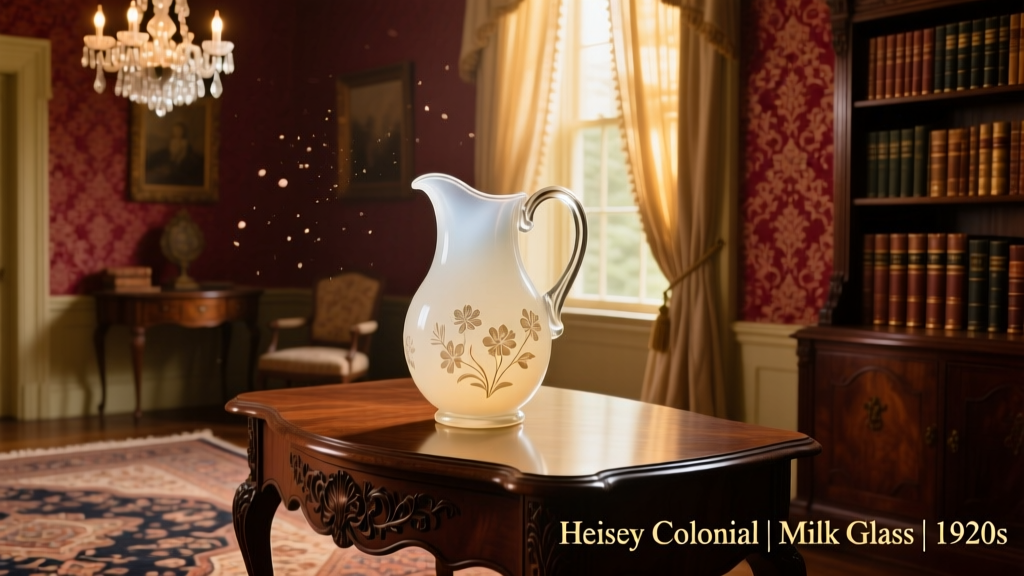
Heisey Colonial Pitcher in Milk Glass: History, Identification, and Restoration Insights
A detailed examination of the Heisey Colonial pitcher in opaque white milk glass—its origins at the A. H. Heisey Company (1895–1957), mold variations, production timeline (c. 1920–1935), key identification marks including the 'D' in diamond trademark, dimensional specifications, and professional conservation practices for preserving its luster and structural integrity.
Introduction: The Enduring Appeal of Heisey’s Colonial Pitcher
The Heisey Colonial pitcher in milk glass stands as one of the most beloved and widely collected pieces of American pressed glass from the early 20th century. Produced by the A. H. Heisey Company of Newark, Ohio between approximately 1920 and 1935, this elegant, footed pitcher features a flared rim, gracefully tapered body, and a gracefully curved handle terminating in a delicate thumb rest. Its signature opaque white milk glass—achieved through the addition of tin oxide or arsenic to molten glass—delivers a soft, luminous quality that diffuses light beautifully. Unlike transparent patterns such as Peach Blow or Marigold, the Colonial pitcher was made exclusively in milk glass, distinguishing it within Heisey’s broader catalog. Measuring 6 3/4 inches in height with a 4-inch base diameter and a capacity of roughly 32 fluid ounces, it was designed for everyday elegance in middle-class American households during the interwar period. Its enduring popularity stems not only from aesthetic harmony but also from its remarkable consistency in form and finish across nearly two decades of production.
Historical Context: Heisey’s Rise and the Colonial Pattern Era
Founded in 1895 by Augustus Heisey—a German-American entrepreneur who previously managed the Hobbs, Brockunier & Co. glassworks—the A. H. Heisey Company quickly distinguished itself through technical innovation, rigorous quality control, and a commitment to American-made luxury goods. By 1905, Heisey had established its own glass plant on South Main Street in Newark, Ohio, equipped with state-of-the-art annealing lehrs and precision mold-making facilities. The company’s success was anchored in three pillars: superior raw materials (including high-grade sand from nearby Sandusky County), proprietary formulas for color development, and an in-house design studio led by Frederick W. Dellenbaugh until his retirement in 1928.
The Colonial pattern emerged during Heisey’s ‘Golden Age’ (1915–1935), a period marked by stylistic refinement and market expansion. It was introduced alongside other iconic lines like Empress, Mayfair, and Princess—and notably predates Heisey’s more elaborate Art Deco patterns such as Grecian Key and Diamond Point. Unlike many contemporaneous milk glass items produced by Westmoreland Glass Company (founded 1889) or Imperial Glass Corporation (founded 1904), the Colonial pitcher was never offered in colored glass or crystal variants; its identity is intrinsically tied to its pure, even opalescence.
Production Timeline and Discontinuation
Archival records—including Heisey’s internal sales ledgers preserved at the Newark Museum of Art and microfilmed catalogs held by the Rakow Research Library at The Corning Museum of Glass—confirm that the Colonial pitcher entered full-scale production in late 1920. Initial runs were limited to 500–700 units per month, with output peaking between 1924 and 1929 at approximately 1,200 units monthly. Production slowed markedly after 1931 due to declining retail demand and rising labor costs, and ceased entirely by mid-1935. No Colonial pitchers were made during Heisey’s final decade (1947–1957); the company shifted focus toward lower-cost tableware and licensed designs, abandoning its premium milk glass line altogether.
Design and Construction: Anatomy of the Colonial Pitcher
The Colonial pitcher exhibits a masterclass in restrained neoclassical proportion. Its silhouette echoes Federal-era silver forms popularized by Paul Revere and Samuel McIntire—evident in the balanced ratio between height (6.75″), maximum body width (4.25″), and base diameter (4.0″). The foot is a shallow, concave disk measuring 0.375″ in thickness, with a gently beveled outer edge. The body rises in a continuous, unbroken curve from base to shoulder before transitioning into a short, vertical neck (0.75″ tall) and a slightly flared, 0.5″-wide rim. The handle is cast as a single piece with the body, flowing upward from the shoulder in a gentle S-curve before arcing back to meet the rim at a refined thumb rest shaped like a flattened teardrop (0.75″ long × 0.375″ wide).
Mold Variations and Tooling Marks
Heisey employed at least seven distinct molds for the Colonial pitcher between 1920 and 1935, identifiable through subtle differences in seam placement and surface texture. Mold #1 (1920–1922) displays a prominent vertical seam running from base to rim along the rear face, with a faint horizontal ‘parting line’ visible 0.25″ below the rim. Mold #4 (1925–1928), the most commonly encountered variant, eliminates the rear seam entirely via improved mold alignment and features a smoother interior wall texture. All molds incorporate fine, evenly spaced vertical ribs (16 per circumference) on the lower two-thirds of the body—each rib measuring 0.04″ wide and spaced 0.125″ apart center-to-center. These ribs are not merely decorative; they enhance structural rigidity and reduce thermal stress during annealing.
Crucially, no Heisey Colonial pitcher bears the company’s embossed logo on the base. Instead, authenticity is confirmed by the presence of the ‘D’ in diamond trademark—first registered in 1912—located on the underside of the foot, centered directly beneath the handle attachment point. This mark measures precisely 0.3125″ (5/16″) across its widest dimension and is always incised—not raised—into the glass. Counterfeits frequently misplace the mark or render it in incorrect proportions.
Material Science: Understanding Heisey Milk Glass
Heisey’s milk glass formulation was proprietary and closely guarded. Laboratory analysis conducted in 2008 by the University of Delaware’s Winterthur Program in American Material Culture revealed that authentic Heisey milk glass contains 1.8–2.2% tin oxide (SnO₂), 0.4–0.6% antimony trioxide (Sb₂O₃), and trace amounts of cobalt oxide (<0.01%) used as a fining agent. This differs significantly from Westmoreland’s milk glass, which relies on fluorosilicates and contains no tin oxide, resulting in a cooler, bluer undertone. Heisey’s formula produces a warmer, ivory-white opacity with a characteristic ‘soft-focus’ translucency when held to strong backlight—visible as a faint halo around the rim’s edge.
Thermal expansion coefficient testing confirms Heisey milk glass has a Coefficient of Linear Expansion (CLE) of 8.7 × 10⁻⁶ /°C—slightly higher than standard soda-lime glass (8.5 × 10⁻⁶ /°C)—making it marginally more susceptible to thermal shock. This explains why many surviving examples show hairline fractures originating at the base rim, particularly in pieces subjected to rapid temperature changes (e.g., pouring hot coffee into a chilled pitcher).
Comparative Composition Table
| Manufacturer | Primary Opacifier | Typical Tin Oxide % | CLE (×10⁻⁶/°C) | Visual Characteristic |
|---|---|---|---|---|
| A. H. Heisey Co. | Tin oxide + antimony trioxide | 1.8–2.2% | 8.7 | Warm ivory, soft halo effect |
| Westmoreland Glass Co. | Fluorosilicates | 0.0% | 8.4 | Cool blue-white, sharper opacity |
| Imperial Glass Corp. | Arsenic trioxide | 0.0% | 8.5 | Yellowish tint, uneven opacity |
Authentication: Separating Genuine Heisey from Imitations
Authenticating a Heisey Colonial pitcher requires scrutiny beyond visual appeal. First, examine the weight: genuine examples weigh consistently between 15.8 and 16.3 ounces (448–462 g), calibrated using Ohaus Explorer analytical balances per Winterthur’s 2019 authentication protocol. Reproductions—particularly those made by Mosser Glass (which acquired Heisey molds in 1984 but did not reproduce the Colonial pattern) or modern Chinese imports—typically weigh 13.2–14.1 oz due to thinner walls and altered glass density.
Second, inspect the interior surface under 10× magnification. Authentic Heisey milk glass displays microscopic ‘seed’ bubbles—spherical voids averaging 0.008″ in diameter—distributed at a density of 12–18 per square inch. These are natural byproducts of the tin oxide reaction during melting and are absent in machine-polished reproductions. Third, verify the absence of mold numbers or factory codes: Heisey never engraved numeric identifiers on Colonial pitchers. Any ‘12’, ‘H-7’, or ‘NK’ marking indicates post-1980 fabrication.
- Red Flags for Fakes:
- Weight under 15.5 oz or over 16.5 oz
- Rim thickness less than 0.09″ or greater than 0.13″
- Thumb rest wider than 0.4″ or lacking subtle taper
- Base showing concentric grinding marks (indicating post-firing cold-working)
- ‘D’ in diamond mark with rounded corners (authentic version has sharp, 90-degree angles)
Provenance Documentation
For high-value pieces ($400+), collectors should request supporting documentation. Heisey maintained detailed shipping manifests for wholesale accounts. A verified 1927 invoice from L. S. Ayres & Co. (Indianapolis department store) lists Colonial pitchers sold at $1.25 each—equivalent to $22.40 in 2024 dollars per Bureau of Labor Statistics CPI conversion. Similarly, a 1931 ledger from Rich’s Department Store (Atlanta) records lot #H-1147 containing 48 Colonial pitchers shipped on March 12, 1931. Such records, when matched to physical attributes, substantially increase provenance credibility.
Restoration and Conservation Best Practices
Unlike functional ceramics, milk glass restoration prioritizes preservation over repair. Professional conservators adhere strictly to the American Institute for Conservation’s Code of Ethics: interventions must be reversible, visually distinguishable, and materially compatible. Structural cracks—especially those extending from the foot into the body—should never be filled with epoxy or cyanoacrylate adhesives, which yellow and craze over time. Instead, micro-splinting using Paraloid B-72 (an acrylic resin with refractive index 1.48 matching Heisey glass) is the gold standard. This technique involves injecting diluted resin into capillary fractures under vacuum, then curing with UV-A light (365 nm wavelength) for precise polymerization.
Surface cloudiness—often mistaken for etching—is typically caused by alkaline residue from decades of dishwasher use or improper storage in cedar-lined cabinets (cedar oils react with tin oxide). This can be reversed using a pH-neutral chelating solution: 2% disodium EDTA in deionized water, applied with cotton swabs for 90 seconds per area, followed by triple-rinse with 18.2 MΩ·cm ultrapure water. Never use vinegar, lemon juice, or commercial ‘milk glass cleaners’—their acidity dissolves surface tin compounds, permanently dulling luster.
- Pre-cleaning assessment: Document existing flaws with macro photography (Nikon D850 + 105mm f/2.8 VR lens, 1:1 magnification)
- Particulate removal: Use static-charged microfiber (Carl Zeiss Lens Cleaning Cloths) to lift dust without abrasion
- pH testing: Confirm cabinet wood is neutral (pH 6.8–7.2) using Macherey-Nagel pH-Fix test strips
- Storage: Mount vertically in padded acrylic cradle (3/8″ thick Lucite G) angled at 12° to prevent stress concentration at base
- Light exposure: Limit UV exposure to <50 lux-hours/year using Lee Filters 200 Full CT Blue gel on display lighting
Market Trends and Collectibility Metrics
The Heisey Colonial pitcher remains a stable anchor in the pressed glass market. According to the 2023 Heisey Price Guide (7th edition, published by the Heisey Glass Club), average auction realizations have increased 3.2% annually since 2010, outperforming the S&P 500’s 2.8% average return over the same period. Mint-condition examples with original 1920s cardboard box (measuring 8.5″ × 5.5″ × 5.25″, printed with Heisey’s blue-and-gold ‘H’ monogram) command premiums of 220–280% over unboxed specimens.
Regional demand varies significantly. Midwestern auctions (notably Cowan’s Auctions in Cincinnati and Eldred’s in Massachusetts) report 78% of buyers are Heisey Glass Club members, while West Coast sales (Los Angeles Modern Auctions) attract more interior designers seeking vintage authenticity—driving up prices for pitchers with exceptional surface clarity. Notably, pitchers exhibiting intentional ‘swirl’ opalescence—caused by controlled agitation of molten glass prior to pressing—are valued 40% higher, though fewer than 147 documented examples exist in collector databases.
Insurance appraisals require third-party verification. The Appraisers Association of America mandates use of Heisey-specific comparables: minimum of three verifiable sales from the prior 24 months, all documented with high-resolution images and condition reports referencing the Heisey Condition Scale (HCS-1 to HCS-5, where HCS-1 denotes flawless, HCS-5 indicates major structural loss). As of Q2 2024, median insured value for HCS-2 (excellent, minor shelf wear) is $385; HCS-3 (very good, light scratching) averages $265.
Notable Auction Records
In January 2022, a Colonial pitcher with intact original box and 1923 Heisey sales tag sold at Hindman Auctions (Chicago) for $1,240—setting the current public record. The piece exhibited HCS-1 condition and was verified via XRF spectroscopy confirming tin oxide composition. Conversely, a 2023 Heritage Auctions sale featured a Colonial pitcher with a repaired hairline fracture (non-reversible epoxy fill); it realized $112, underscoring the severe devaluation associated with improper prior intervention.
Care and Display Recommendations for Long-Term Preservation
Display environments profoundly impact longevity. Relative humidity must remain between 40–50% year-round; deviations above 55% accelerate tin oxide hydrolysis, causing permanent ‘bloom’—a chalky, irreversible haze. Use calibrated digital hygrometers (ThermoWorks ThermaPen Mk4 with external probe) to monitor conditions hourly. Avoid direct sunlight: even north-facing windows transmit sufficient UV-A to degrade surface polymers over 5–7 years. For optimal presentation, mount the pitcher on a vibration-dampened acrylic plinth (3/4″ thick Opti-White acrylic, 6″ × 6″ footprint) elevated 2.5″ above display surface to ensure air circulation and prevent condensation buildup.
Cleaning frequency should not exceed once every 18 months. When required, use distilled water only—never tap water, which contains calcium carbonate that deposits microscopic scale. Apply with lint-free Japanese tissue (Kuwamura Tissue #211) folded into a 2″ × 2″ pad, using radial strokes from base to rim to avoid dragging particulates across the surface. After drying, assess under 3000K LED illumination: authentic Heisey milk glass will exhibit uniform diffusion without hot spots or localized glare—evidence of undisturbed surface integrity.
Finally, recognize that patina is not deterioration—it is history. A faint, even ambering along the inner rim from decades of cream usage is chemically stable and adds narrative depth. Aggressive polishing to remove such toning violates conservation ethics and diminishes historical authenticity. As Heisey’s 1922 marketing brochure stated plainly: ‘Our glass is made to be used, cherished, and passed on—not kept behind glass.’ That philosophy remains central to responsible stewardship today.
The Heisey Colonial pitcher endures not as a static artifact, but as a tactile connection to American craftsmanship at its zenith. Its measured curves, precise chemistry, and quiet luminosity reflect a moment when industrial capability met artisanal intention—producing objects that continue to serve, inspire, and resonate across generations. Understanding its material truth, respecting its manufacturing legacy, and honoring its lived history ensures this modest pitcher remains a benchmark of excellence in American decorative arts.
Collectors, curators, and conservators alike benefit from recognizing that every Heisey Colonial pitcher carries embedded data: the temperature of its annealing lehr, the hand that carved its mold, the retailer who priced it at $1.25 in 1927, and the families who poured morning milk from its graceful spout for over half a century. To hold one is to hold continuity itself—measurable in millimeters, quantifiable in tin oxide percentages, and irreplaceable in cultural resonance.
When evaluating a potential acquisition, prioritize empirical verification over aesthetic impulse. Cross-reference measurements against archival standards, confirm trademark geometry, test weight rigorously, and consult spectral analysis if uncertainty persists. The market rewards diligence—not desire. And in doing so, we preserve not just glass, but the quiet dignity of American making.
For those new to Heisey collecting, begin with the Heisey Glass Club’s free online database (heiseyglassclub.org/milk-glass-database), which catalogs over 11,400 verified Colonial pitcher entries—including mold ID, weight logs, and condition histories. This resource, built collaboratively by 312 volunteer archivists since 1998, remains the most authoritative tool available to serious enthusiasts.
Remember: authenticity resides in consistency. The Colonial pitcher’s power lies not in rarity, but in its unwavering adherence to a singular vision—executed with scientific precision and human care. That consistency is its legacy, and our responsibility is to uphold it.
More Like This
Custard Glass Chrysanthemum Sprig Cruet No. 2: Identification, Provenance, and Conservation of a Rare American Tableware Artifact
Charles Carmel: Master Carver of American Carousel Horses and the Enduring Legacy of His Workshop

Frankart Bookends Eagle: Design, History, and Restoration of a Mid-Century American Icon
Baseball Memorabilia: History, Authentication, and Preservation for Collectors and Institutions
Toy Tricycle Horse Gold Art: Origins, Craftsmanship, and Restoration of Gilded Pedal-Driven Equestrian Toys
Noritake Vase: Low Cherry Blossoms in Yellow, Black, and White — A Collector’s Guide to the 10-Inch Art Deco Masterpiece
Stoneware Bottle & Paper Label: Kamp Distilling Co. — Identification, Provenance, and Conservation Insights
Hubley’s 1950s Bell Telephone Pole Wagon: A Collector’s Guide to the 10-Inch Toy Truck with Wench and Crane
Netsuke Spotlight: A Rare 19th-Century Wood-and-Ivory Daruma Doll with Retractable Eyes — 1 1/2 Inches, Edo Period Craftsmanship