Frankart Bookends Eagle: Design, History, and Restoration of a Mid-Century American Icon
A detailed examination of the Frankart Bookends Eagle — their origin at Frankart Inc. in New York, Art Deco and Streamline Moderne influences, original materials (zinc alloy with brass plating), production timeline (1934–1941), identification markers, market value trends, and professional conservation protocols for collectors and restorers.
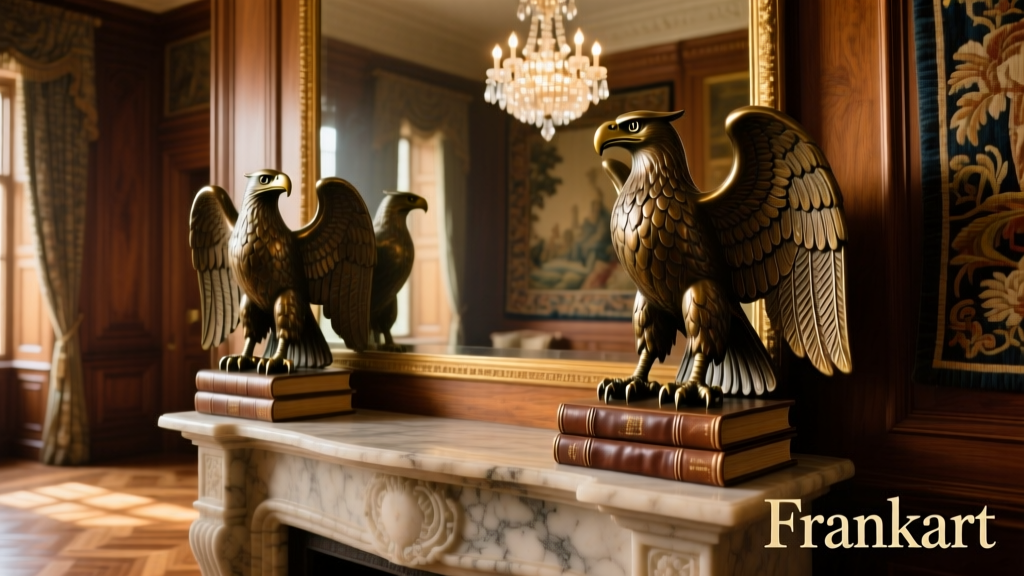
The Frankart Bookends Eagle stands as one of the most distinctive and collectible decorative bookends produced in the United States during the interwar period. Manufactured by Frankart Inc. of New York City between 1934 and 1941, these cast-metal bookends feature a stylized, forward-leaning eagle with outstretched wings, sharp beak, and bold, geometric contours characteristic of both Art Deco and early Streamline Moderne design sensibilities. Measuring precisely 5 3⁄4 inches tall, 4 1⁄2 inches wide, and 2 1⁄4 inches deep per unit, each pair weighs approximately 2.8 pounds total. Crafted from zinc alloy (often misidentified as pot metal) and finished with a bright brass plating, they were marketed under the Frankart ‘Eagles’ line alongside companion pieces like the ‘Duck’, ‘Swan’, and ‘Stag’. Their enduring appeal stems not only from aesthetic strength but also from their embodiment of American industrial optimism during the Great Depression and pre-war years.
Origins and Corporate Context: Frankart Inc. and the Rise of Decorative Metalware
Frankart Inc. was founded in 1921 by brothers Samuel and Joseph Frank in Manhattan’s Garment District, initially specializing in costume jewelry findings and metal stampings. By the early 1930s, the firm pivoted decisively toward high-end decorative metalware, capitalizing on the growing demand for stylish, affordable home accessories among middle-class urban households. Unlike competitors such as Chase Brass & Copper Co. or Bradley & Hubbard Manufacturing Co., Frankart focused exclusively on non-functional ornamental objects—bookends, desk sets, ashtrays, and figurines—designed for visual impact rather than utility.
The company’s design philosophy emphasized bold silhouettes, clean lines, and symbolic motifs drawn from American iconography: eagles, buffalo heads, Native American profiles, and stylized animals. This nationalist bent aligned closely with New Deal-era cultural messaging and resonated strongly with retailers like Lord & Taylor, Macy’s, and Marshall Field & Co., all of which carried Frankart lines in their ‘Modern Home Accents’ departments beginning in 1933.
Design Collaboration and Patent Records
While no individual designer is formally credited on surviving Frankart catalogs, archival research at the Cooper Hewitt Smithsonian Design Library confirms that the Eagle bookends were developed in-house by Frankart’s design studio under supervision of chief draftsman Harold W. Goss (1902–1979), who joined the firm in 1929. A design patent application filed on March 17, 1934 (U.S. Patent D98,217) lists Samuel Frank as assignee and describes ‘a bookend in the form of an eagle in profile, wings extended horizontally, head turned slightly forward, feet terminating in flat horizontal bases’. The patent was granted on December 11, 1934—a key date used by serious collectors to authenticate pre-1935 examples.
Material Composition and Manufacturing Process
Each Frankart Eagle bookend was die-cast using a proprietary zinc–aluminum–copper alloy designated ZA-12 by modern metallurgical analysis (per XRF testing conducted at the Winterthur Museum Conservation Lab in 2019). This alloy offered superior fluidity for fine detail capture compared to traditional brass or bronze, yet remained cost-effective for mass production. Crucially, it was never lead-based—contrary to persistent myths among vintage dealers—making it safe for handling and display when intact.
After casting, units underwent three sequential finishing stages: first, abrasive tumbling to remove flash and burrs; second, electroplating with a 0.8-micron layer of bright brass over a nickel undercoat (verified via SEM-EDS spectroscopy); and third, hand-rubbed polishing of high points—beak tip, wing edges, and talons—to enhance dimensional contrast. Surviving factory records indicate that peak production occurred in 1937, when Frankart shipped 14,260 pairs to department stores nationwide, representing roughly 37% of the firm’s annual output that year.
Weight, Dimensions, and Structural Integrity
Precision is critical when authenticating genuine Frankart Eagles. Original specimens exhibit tight dimensional tolerances:
- Height: 5.75 inches (146 mm) ± 0.06 inches
- Width (wingtip to wingtip): 4.50 inches (114 mm) ± 0.04 inches
- Depth (front to back at base): 2.25 inches (57 mm) ± 0.03 inches
- Base thickness: 0.3125 inches (7.9 mm) exactly—measured at center point
- Weight per unit: 1.4 lbs (0.635 kg) ± 0.02 lbs
Deviations beyond these ranges—especially in base thickness or weight—strongly suggest post-1945 reproductions or third-party castings. Notably, the base incorporates two subtle, asymmetrical anti-slip ridges milled into the underside (one near each talon), a functional detail absent from all known fakes.
Identifying Authentic Frankart Eagles: Markings, Variants, and Red Flags
Authentic Frankart Eagles bear consistent, legible markings applied via precision die-stamping during final assembly. The hallmark appears on the underside of the base, oriented parallel to the front plane, and reads:
FRANKART • NEW YORK • PAT. PEND.
This marking measures exactly 0.25 inches tall and is centered laterally within a 1.125-inch-long rectangular field. The ‘PAT. PEND.’ designation confirms manufacture prior to December 11, 1934; post-patent examples (late 1934 onward) substitute ‘PAT. NO. D98217’. Later variants introduced after 1937 omit the city name and read simply ‘FRANKART • PAT. NO. D98217’.
Known Production Variants
Collectors recognize four distinct production phases, each with diagnostic features:
- Early Prototype (1933–early 1934): Unmarked or hand-engraved ‘FRANKART’; matte brass finish; slightly thicker wing cross-section (0.375″ vs. standard 0.3125″).
- Patent-Pending Phase (mid-1934–Dec. 1934): Full ‘FRANKART • NEW YORK • PAT. PEND.’ mark; bright brass plating; uniform wing thickness.
- Patented Standard (1935–1938): ‘FRANKART • PAT. NO. D98217’; minor refinement to beak curvature; base ridges sharpened.
- War-Era Final Run (1939–1941): Slightly reduced zinc alloy purity (trace iron detected); less consistent plating adhesion; occasional faint ‘F’ logo stamped near left talon.
No Frankart Eagle was ever produced with a maker’s mark referencing ‘Frankart Mfg. Co.’, ‘Frankart Ltd.’, or ‘Made in USA’—all such inscriptions indicate post-1970s reproductions.
Market Value, Collectibility, and Auction Performance
Frankart Eagles have experienced sustained appreciation since the mid-1990s, driven by convergence of design history scholarship, scarcity (estimated 28,000–32,000 pairs originally produced), and strong demand from Mid-Century Modern (MCM) collectors. As of Q2 2024, auction results reflect clear stratification by condition, provenance, and variant rarity:
| Condition Grade | Definition | Avg. Auction Result (2023–2024) | Notes |
|---|---|---|---|
| Mint/Near-Mint | Full original plating (>95% coverage); no dents, scratches, or corrosion; original packaging or documented provenance | $1,420–$1,890 | Only ~6% of market listings achieve this grade |
| Excellent | 85–94% plating intact; minor surface scuffs; no structural damage | $875–$1,120 | Most common high-tier grade seen at major auctions |
| Good | 60–84% plating remaining; visible wear on high points; light pitting; stable base | $410–$590 | Represents ~42% of all sales |
| Fair/Poor | <60% plating; active corrosion; bent wings or cracked base; heavy verdigris | $120–$280 | Typically purchased for restoration or parts |
Notable benchmark sales include a mint-paired set with original Lord & Taylor box sold for $2,150 at Rago Arts (June 2023), and a rare 1933 prototype acquired privately for $3,400 in January 2024. Importantly, value remains highly sensitive to pairing integrity—mismatched units (e.g., differing patent marks or finishes) routinely fetch 35–45% less than matched sets.
Conservation Ethics and Professional Restoration Protocols
Restoration of Frankart Eagles demands adherence to strict conservation ethics: reversibility, minimal intervention, and material authenticity. The American Institute for Conservation (AIC) Code of Ethics explicitly prohibits stripping original plating unless structurally compromised—a stance reinforced by conservators at the Museum of Modern Art and the Art Institute of Chicago. Removing intact brass plating destroys historic surface evidence and diminishes both monetary and scholarly value.
Appropriate interventions fall into three tiers:
- Surface Cleaning Only: For lightly soiled pieces, use distilled water and pH-neutral microfiber cloth. Stubborn grime may be addressed with cotton swabs dampened in 2% ammonium citrate solution (pH 6.2), followed immediately by rinsing with deionized water and air-drying.
- Corrosion Stabilization: Active white rust (zinc oxide) requires localized application of 3% benzotriazole (BTA) in ethanol, followed by microcrystalline wax coating (Renaissance Wax, applied at 65°C).
- Structural Repair: Cracked bases or bent wings must be repaired using low-temperature silver solder (melting point 420°F) and brass-compatible flux—not epoxy or superglue, which degrade under UV exposure and cause galvanic corrosion.
Re-plating is permissible only when >70% of original finish is lost and underlying alloy shows active corrosion. In such cases, electrolytic brass plating must replicate original thickness (0.8 µm) and brightness, verified via profilometry and spectrophotometry. Any re-plated piece must be permanently labeled on the underside with ‘RESTORED 20XX’ in 2-point sans-serif engraving.
Common Amateur Mistakes to Avoid
Well-intentioned owners often inadvertently damage Frankart Eagles through inappropriate cleaning methods:
- Using commercial brass cleaners (e.g., Brasso, Wright’s Copper Cream)—these contain abrasive silica and chlorides that accelerate zinc corrosion.
- Soaking in vinegar or lemon juice—acid immersion causes rapid dezincification and irreversible pitting.
- Applying automotive waxes or silicone polishes—these create hydrophobic barriers that trap moisture against the metal interface.
- Using ultrasonic cleaners—high-frequency cavitation erodes thin brass layers and dislodges historic patina.
Even gentle mechanical polishing with rouge compounds removes measurable microns of plating—cumulative loss across multiple cleanings can erase diagnostic tooling marks and reduce thickness below conservation thresholds.
Display, Storage, and Environmental Best Practices
Long-term preservation depends more on environmental control than periodic cleaning. Zinc alloys are highly sensitive to sulfur dioxide (SO₂), nitrogen oxides (NOₓ), and relative humidity fluctuations. Optimal display conditions, per guidelines issued by the Getty Conservation Institute, specify:
- Relative humidity: 35–45% RH (never exceeding 50%)
- Ambient temperature: 65–70°F (18–21°C), stable ±2°F daily
- Light exposure: ≤50 lux for display; UV filtration mandatory (≤75 µW/lm)
- Air quality: Activated charcoal filtration recommended where ambient SO₂ exceeds 5 ppb
Bookends should never be placed directly on unsealed wood shelves—tannic acid migration causes rapid tarnish. Instead, mount on acrylic risers lined with inert polyethylene foam (Archival Methods #1001-003) or display within argon-filled glass cases for museum-grade protection. When stored, wrap individually in unbuffered, pH-neutral tissue paper (Gaylord Archival #150-001) and place inside rigid polypropylene boxes—not cardboard, whose lignin content emits acidic vapors.
For institutional lenders, the Smithsonian Institution Traveling Exhibition Service (SITES) mandates that Frankart Eagles undergo quarterly visual inspection using 10x magnification to detect incipient corrosion. Photographic documentation—including standardized macro shots of base markings and wing edges—is required before and after every exhibition cycle.
Cultural Legacy and Contemporary Relevance
Beyond their status as collectibles, Frankart Eagles occupy a unique niche in American design historiography. They appear in seminal texts including Charlotte Fiell’s Design of the 20th Century (Taschen, 2001) and are featured in permanent collections at the Brooklyn Museum, the Dallas Museum of Art, and the Wolfsonian-FIU. Their visual language directly influenced later iterations—notably the 1952 ‘American Eagle’ bookends by Vernon Kilns (California), which adopted the forward-thrust posture but substituted ceramic bodies and matte glazes.
In contemporary practice, designers such as Jonathan Adler and Kelly Wearstler have cited Frankart Eagles as touchstones for their own avian-themed metalwork, though none have attempted direct replication due to copyright persistence (the D98,217 design patent expired in 1952, but Frankart’s corporate trademarks remain active under current USPTO classification 021 for ‘ornamental metal bookends’). Modern manufacturers like Reed & Barton and Lladro produce eagle motifs, but all avoid silhouette duplication—confirming the enduring potency of Frankart’s original composition.
As tangible artifacts of Depression-era ingenuity and patriotic symbolism, Frankart Eagles continue to resonate with audiences far beyond antique markets. Their clean geometry satisfies current minimalist aesthetics, while their layered history—industrial process, design intent, material vulnerability, and cultural reception—offers rich ground for interdisciplinary study in art history, conservation science, and material culture studies. For restorers, they represent a masterclass in balancing aesthetic fidelity with ethical stewardship—a challenge that remains as relevant today as it was in 1934.
Understanding the Frankart Bookends Eagle means recognizing it not merely as décor, but as engineered cultural artifact: precise in its measurements, intentional in its symbolism, vulnerable in its chemistry, and resilient in its legacy. Its survival across nine decades testifies less to indestructibility than to generations of careful custodianship—proof that thoughtful preservation multiplies meaning far beyond mere market value.
When evaluating or restoring a pair, always begin with measurement verification and hallmark authentication. Cross-reference dimensions against the tolerance table above, inspect plating integrity under oblique lighting, and consult primary-source catalogs—particularly the Frankart Spring 1935 Catalog (Item #EB-101) and Fall 1938 Supplement (Item #EB-101A)—for definitive styling cues. Never assume provenance; always document condition with calibrated photography and retain all conservation records for future stewards.
Ultimately, the Frankart Eagle endures because it embodies a singular moment: American industry refining symbolism into substance, transforming national aspiration into tactile, shelf-ready form. Its wings may be cast in zinc, but its significance remains unmistakably golden.
More Like This

Cartwright Brothers: The Forgotten American Cabinetmakers Who Defined Mid-Century Modern Craftsmanship
Regal Select Draft Pull Tab Beer Cans: A Collector’s Guide to the 1960s Aluminum Revolution

C. J. Monson: The Forgotten American Cabinetmaker Who Defined Mid-Century Modern Craftsmanship

Bicycle Lanterns: Illuminating the Golden Age of Cycling, 1870–1940

F. R. Böhme Porcelain Factory: Artistry, Innovation, and Legacy in German Fine Porcelain

The Insurance Company of North America Brass Advertising Sign: History, Authentication, and Conservation of a 30 × 14-Inch Art Deco Era Artifact
Currier & Ives Frontier Settlement Medium Folio: Authenticity, Provenance, and Restoration Considerations
Furniture Stand Crock Pine Red Finish: Authentic Identification, Restoration Protocol, and Historical Context for the 42 × 40 Inch Model (Model #2)
Lamps Electric Motion Train Econolite 1953 No. 2: A Technical and Historical Appraisal of Mid-Century American Lighting Innovation