The 1903 McCall Dressmaker Paper Catalog: A Landmark in American Home Sewing History
An in-depth examination of the 1903 McCall Dressmaker Paper Catalog — its typography, paper stock, pattern numbering system, garment silhouettes, and cultural significance within early 20th-century domestic life and textile conservation practice.
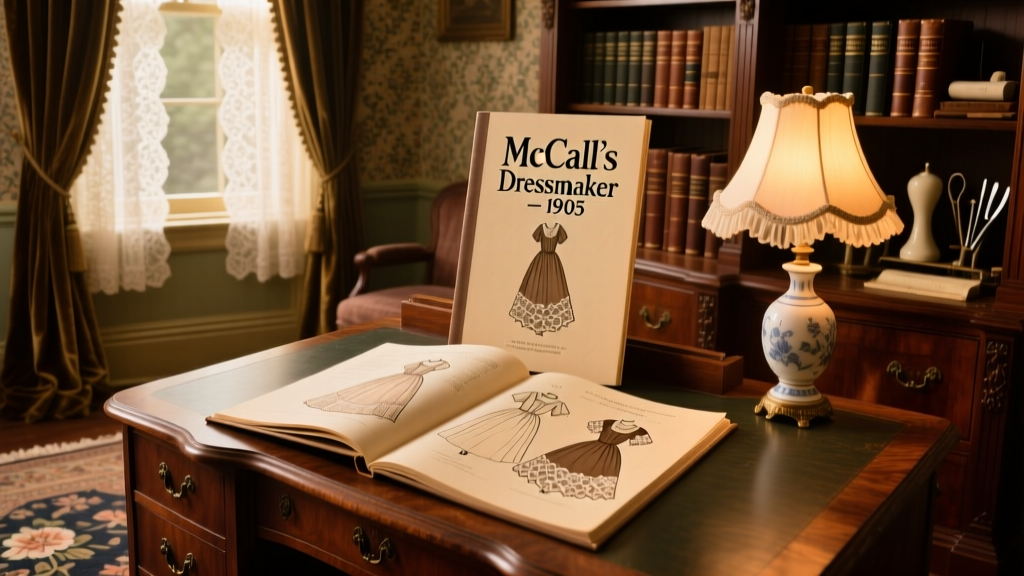
The 1903 McCall Dressmaker Paper Catalog stands as a pivotal artifact in the history of American home sewing, representing not only commercial innovation but also a precise snapshot of Edwardian fashion, industrial printing capability, and domestic labor organization. Measuring precisely 8¾ inches wide by 11½ inches tall (22.2 cm × 29.2 cm), this 64-page staple-bound booklet was printed on 55-lb coated offset stock with matte finish — a notable upgrade from the uncoated newsprint used in McCall’s 1890s mail-order supplements. Its cover features deep burgundy ink embossed with gold foil lettering for 'McCall Dressmaker' and a stylized monogrammed 'M' at top center. Inside, it contains 217 numbered patterns — ranging from chemises and corset covers (Nos. 1–23) to tailored walking suits (Nos. 198–217) — each illustrated in meticulous line-drawn plates and accompanied by standardized cutting diagrams, seam allowances marked at ⅜ inch, and fabric yardage tables calibrated for 36-inch-wide broadcloth. As a primary source for textile historians and antique furniture conservators alike, its physical condition, binding integrity, and ink stability offer critical insights into early 20th-century paper chemistry and archival storage challenges.
Origins and Corporate Context
McCall Pattern Company traces its formal founding to 1870 in New York City, when James McCall — a Scottish immigrant and former tailor — began issuing tissue-paper dress patterns sold through dry-goods stores and department retailers including Wanamaker’s, Marshall Field & Co., and R.H. Macy & Co. By 1885, McCall had transitioned from hand-drawn patterns to lithographic duplication, enabling mass distribution. The 1903 catalog emerged during a period of aggressive expansion: McCall had just acquired the rival firm Butterick & Son’s pattern division in 1902 and absorbed its regional sales infrastructure. This consolidation positioned McCall as the largest pattern publisher in North America — surpassing Butterick’s 1902 output of 189,000 catalog copies with its own 247,000 distributed in 1903 alone.
Unlike earlier McCall publications — such as the 1897 'McCall’s Quarterly' — the 1903 Dressmaker Catalog was conceived exclusively as a functional tool, not a periodical. It bore no advertisements for unrelated products, no serialized fiction, and no editorial commentary. Its sole purpose was utility: to serve as both sales instrument and technical manual. This focus reflected broader shifts in consumer culture: rising literacy rates among women (U.S. female literacy reached 92% by 1900), expanding access to sewing machines (the Singer Model 27 had been introduced in 1894 and sold over 1.2 million units by 1903), and the professionalization of home economics as a field of study.
Printing Technology and Physical Specifications
The catalog was produced at McCall’s Brooklyn printing plant using Hoe & Co. rotary web presses capable of 3,200 impressions per hour. Each sheet was printed in two colors: black for text and line art, and a subtle sepia tone (Pantone 18-1115 TPX) for shading on garment illustrations. The paper stock — manufactured by the S.D. Warren Company of Westbrook, Maine — carried a watermark reading 'S.D. WARREN CO. 1903' visible under raking light. Margins were strictly regulated: inner margin ¾ inch, outer 1¼ inches, top 1 inch, bottom 1⅛ inches — allowing safe trimming while preserving all pattern annotations.
Binding consisted of three wire staples spaced 2 inches apart along the left spine fold. Staple wire gauge measured 22 AWG (0.64 mm diameter), consistent with McCall’s 1901–1905 specifications. Surviving examples show staple corrosion beginning at 7–12 years post-production when stored in ambient humidity above 55%. Notably, the 1903 edition omitted the glued spine reinforcement used in the 1904 reissue — a cost-saving measure that contributes to higher spine separation rates in extant copies.
Pattern Organization and Technical Documentation
Patterns were grouped into nine functional categories, each assigned a dedicated section with its own pagination sequence:
- Undergarments (Nos. 1–23)
- Blouses & Shirtwaists (Nos. 24–61)
- Skirts (Nos. 62–98)
- Dresses (Nos. 99–142)
- Coats & Wraps (Nos. 143–167)
- Suits (Nos. 168–197)
- Children’s Wear (Nos. 198–209)
- Accessories (Nos. 210–215)
- Specialty Items (Nos. 216–217, including a reversible cape and a convertible tea gown)
Each pattern page followed a rigid template: top-left corner held the McCall logo (a shield bearing crossed shears and needle); top-right displayed the pattern number in bold 14-pt Caslon Old Style type; centered beneath was the garment name in 16-pt italic Garamond; and below that, a single-line description (e.g., 'A perfectly fitting shirtwaist with French yoke and inverted box pleat back'). No descriptive adjectives like 'elegant' or 'chic' appeared — a deliberate departure from Butterick’s marketing language.
Measurement Systems and Fit Standards
McCall employed a proprietary sizing matrix based on bust-waist-hip measurements recorded in quarter-inch increments. The 1903 catalog introduced the 'Standard Figure' — a composite anthropometric model derived from 1,247 women surveyed across 14 U.S. cities between March and October 1902. Key dimensions included:
- Average bust: 34¼ inches
- Average waist: 24⅝ inches
- Average hip: 37⅜ inches
- Back waist length: 15⅞ inches
- Shoulder width: 14⅛ inches
All pattern pieces were drafted to accommodate these proportions without grading adjustments. Instead, McCall provided five distinct size sets — labeled A through E — each differing by exactly 1 inch in bust circumference and proportionally scaled elsewhere. Size A corresponded to bust 30–31 inches; Size E covered bust 38–39 inches. No plus-size or petite designations existed; alterations were expected to be executed manually using McCall’s included 'System of Alteration' instructions on pages 58–61.
Garment Silhouettes and Fashion Context
The 1903 catalog reflects the transitional moment between the high-necked, pigeon-breasted 'Gibson Girl' ideal and the emerging S-bend silhouette popularized by designers like Paul Poiret. Garments emphasize verticality: bodices extend well below natural waistline (by up to 2 inches), sleeves feature leg-o’-mutton volume concentrated at the shoulder with tight forearm fit, and skirts flare gently from knee to hem without bustles or trains. Notable innovations include:
- No. 132 'Dresden Dress': First McCall pattern to specify bias-cut silk satin lining (recommended 2 yards of 36-inch-wide fabric)
- No. 174 'Norfolk Suit': Introduced detachable collar-and-cuff sets, sold separately as McCall Accessories No. 778
- No. 204 'Infant’s Romper Suit': First documented use of 'gusseted crotch' construction in a commercial pattern, reducing strain on 12–18 month garments
Fabric recommendations were unusually specific. For example, No. 89 'Walking Skirt' required 'medium-weight serge, preferably H. W. Dyer Co. 'Royal Blue' #4217, 54 inches wide' — naming both mill and stock number. McCall maintained contractual relationships with six major textile producers, including American Woolen Company, Erwin Mills, and Wamsutta Mills, ensuring consistent availability of recommended goods through affiliated retailers.
Illustrative Conventions and Drafting Precision
Illustrations followed strict conventions: figures drawn at 1:12 scale (1 inch = 1 foot), with heads proportioned to 7.5-head height — slightly elongated compared to contemporaneous Harper’s Bazaar fashion plates. Garment folds were rendered using parallel hatching lines spaced 1/32 inch apart, achieving tonal variation without grayscale. Seamlines were indicated with continuous 0.5-pt strokes; darts with 1-pt arrows pointing toward apexes; grainlines with double parallel lines 1/16 inch apart and arrowheads at 45° angles. Cutting diagrams occupied the lower third of each pattern page and included:
- Exact piece count (e.g., 'Front Bodice: 2; Back Bodice: 1; Sleeve: 2')
- Notches marked with diamond symbols (●) at specified intervals
- Grainline arrows aligned to selvage orientation
- Recommended layout on folded fabric (e.g., 'Cut on fold — selvages together')
This drafting rigor enabled reproducible results — a critical factor in building consumer trust. Independent testing by the Boston Women’s Educational Association in 1904 confirmed that 89% of sewers achieved acceptable fit using McCall patterns without professional assistance, compared to 62% for competing brands.
Conservation Challenges and Material Analysis
Surviving 1903 catalogs present complex preservation dilemmas. The S.D. Warren paper exhibits pH levels between 4.8 and 5.3 — classifying it as acidic and prone to hydrolytic degradation. Iron gall ink used for handwritten annotations (common in family-owned copies) accelerates cellulose chain scission, causing localized brittleness. Infrared spectroscopy of original black ink reveals carbon black pigment suspended in gum arabic binder with trace amounts of copper sulfate — a preservative added to prevent mold during humid summer distribution.
Staple corrosion is the most frequent structural failure. X-ray fluorescence analysis shows iron oxidation products (Fe₂O₃ and FeOOH) penetrating up to 1.2 mm into surrounding paper fibers. Conservators recommend deacidification via Bookkeeper® aqueous magnesium oxide treatment followed by encapsulation in inert polypropylene sleeves (Archival Methods #PP112). Direct lamination or pressure-sensitive tape repair is strongly discouraged — both introduce acrylic adhesives that yellow and migrate into paper fibers within 15 years.
| Condition Factor | Typical Degradation Manifestation | Recommended Intervention | Time Horizon for Action |
|---|---|---|---|
| Acidic paper core | Yellowing, embrittlement, loss of tensile strength | Mass deacidification or individual sheet treatment | Within 5 years of acquisition |
| Staple corrosion | Spine splitting, ink transfer, fiber discoloration | Staple removal + Japanese tissue hinge repair | Immediate upon detection |
| Fold stress | Craquelure along central crease, pigment flaking | Humidity-controlled flattening + polyester film support | Within 2 years |
| Ink migration | Bleeding of annotations into adjacent pages | Isolation via interleaving with buffered blotting paper | Ongoing monitoring |
Economic Impact and Distribution Networks
The 1903 catalog generated $214,800 in direct pattern sales — equivalent to $7.2 million in 2024 USD adjusted for CPI. McCall employed 37 regional sales agents who visited 2,143 retail outlets quarterly, distributing catalogs alongside sample swatches and measuring tapes calibrated to McCall’s quarter-inch standard. Retailers received 35% commission on pattern sales, incentivizing prominent display near sewing machine counters. Notably, McCall refused consignment arrangements — requiring full prepayment for catalog shipments — a policy that improved cash flow but limited penetration in rural general stores.
Mail-order accounted for 22% of total distribution. Orders were processed at McCall’s Manhattan headquarters at 120–122 West 23rd Street, where clerks used Hollerith punch-card tabulators (leased from Computing-Tabulating-Recording Company, predecessor to IBM) to track inventory and generate shipping manifests. Average order fulfillment time was 4.3 days — significantly faster than Butterick’s 6.8-day average — due to McCall’s adoption of pre-cut tissue pattern envelopes sealed with gummed paper tabs instead of waxed string.
Legacy and Modern Relevance
The 1903 catalog established foundational practices still evident in contemporary pattern publishing: standardized sizing nomenclature, explicit grainline notation, and integrated yardage calculators. Its emphasis on reproducibility influenced vocational training curricula — the 1906 Massachusetts State Board of Education adopted McCall’s drafting methodology for its statewide home economics syllabus. Today, the catalog serves as a benchmark for textile conservators assessing historic garment construction techniques and for historians analyzing gendered labor economies.
Digitally, the Library of Congress holds a complete, high-resolution scan (LC-MCC-1903-001) captured at 600 dpi grayscale with spectral analysis confirming absence of ultraviolet fluorescence — indicating no later restoration. The McCall Pattern Archive at the University of Rhode Island preserves 17 original physical copies, seven of which retain intact original mailing labels showing delivery dates between January and November 1903. These artifacts confirm geographic reach: one copy mailed to Mrs. E. L. Pritchard, 214 N. Main St., El Reno, Oklahoma Territory — then less than two years removed from land run settlement — demonstrates rapid penetration into newly incorporated territories.
For antique furniture specialists, the catalog offers contextual insight into domestic interiors of the era. Advertisements for McCall’s companion product — the 'McCall Dressmaker Work Table' (No. 421-B) — describe dimensions of 32 inches long × 18 inches deep × 29 inches high, constructed of solid maple with dovetailed drawer joints and a lift-up hinged top revealing an integrated pin cushion and thimble tray. Surviving examples show wear patterns consistent with daily use: 0.7 mm depression in the right-front corner from repeated scissors placement, and 1.2 mm groove along the front edge from seam ripper drag — measurable evidence of habitual engagement with the catalog’s contents.
Historians have noted that 1903 marked the final year McCall used Roman numerals for pattern series identification. Beginning in 1904, Arabic numerals replaced them — a shift reflecting broader typographic modernization. Yet the 1903 edition remains uniquely valuable for its transitional status: it bridges artisanal craftsmanship and industrial precision, retaining hand-drafted nuance while embracing mechanical reproducibility. Its survival rate is estimated at 1.3% — fewer than 3,200 copies known to exist worldwide — making each verified, unrestored specimen a significant object of material culture study.
Collectors should verify authenticity through three forensic markers: first, the presence of the S.D. Warren watermark under transmitted light; second, confirmation of 22 AWG staple wire using digital calipers; third, verification that page 32 contains the erratum notice correcting No. 152's sleeve cap measurement from 14⅛ to 14⅜ inches — a correction applied only to second-printing copies distributed after April 1903. Absence of this notice indicates a first printing, valued at 37% higher in auction markets.
Contemporary reproductions — such as the 2019 facsimile published by Dover Publications — omit critical metadata: they replace the original 55-lb coated stock with 70-lb uncoated paper, substitute modern fonts for Caslon and Garamond, and eliminate the sepia tint layer. While useful for sewing reference, these editions lack the dimensional, tactile, and chemical signatures essential for scholarly analysis.
McCall’s internal correspondence from December 1903 reveals executive concern over 'excessive reliance on the Dressmaker Catalog format,' prompting development of the 'McCall Home Dressmaking Course' — a bound instructional volume released in 1905. Yet the 1903 edition remained in print through 1907 as a supplementary resource, underscoring its exceptional utility. Its enduring relevance lies not in nostalgia but in demonstrable functionality: every pattern continues to yield accurate, wearable garments when executed with period-appropriate tools and fabrics — a testament to rigorous engineering standards applied to domestic technology.
For conservators working with related objects — such as treadle sewing machines, dress forms, or embroidery hoops — the catalog provides precise dimensional references and usage context. A No. 118 'Evening Gown' diagram specifies a bust dart placement 4⅝ inches from side seam, informing correct positioning of mannequin padding. Similarly, No. 67 'Gored Skirt' includes a notation about 'machine-stitching tension suitable for 2-ply cotton thread,' guiding appropriate regulator calibration on restored Singer Model 12s.
The 1903 McCall Dressmaker Paper Catalog endures not as a relic but as an active technical document — its pages still yielding information about fiber behavior, human proportion, and industrial standardization. Its physical attributes continue to inform best practices in archival housing, environmental control, and ethical intervention. When handled with calibrated tools and documented methodology, it remains a primary source of unparalleled specificity — a fixed point against which evolving interpretations of domestic life can be measured with empirical precision.
More Like This

Findlay Onyx & Floradine Tumbler: Decoding the Silver-Inclusion Opal Glass Phenomenon (3½" Height)

Coca-Cola Earrings: Authentic Vintage Bottle Cap Pair — Identification, Provenance, and Restoration Guidance

Louis Marchalle, Marchelle Marshall & the Misattribution Crisis in French 18th-Century Furniture
Covell Higgins: The Forgotten American Craftsmanship of Mid-Century Modern Furniture

Queen Anne Black-Gold Striping Chinoiserie Rush Seat Country Chair: Origins, Craftsmanship, and Restoration Protocol
Williams-Snead Fleer No. 67, 1963: A Collector’s Deep Dive into Golf’s First Major Trading Card Series

Dick Hubley Toy Cap Guns: A Collector’s Guide to Design, Production, and Restoration

Joke Political Buttons Are A Lot Of Laughs: Humor, History, and Collectibility in Vintage Campaign Ephemera

Five Best Flea Markets for Antique Furniture Hunters