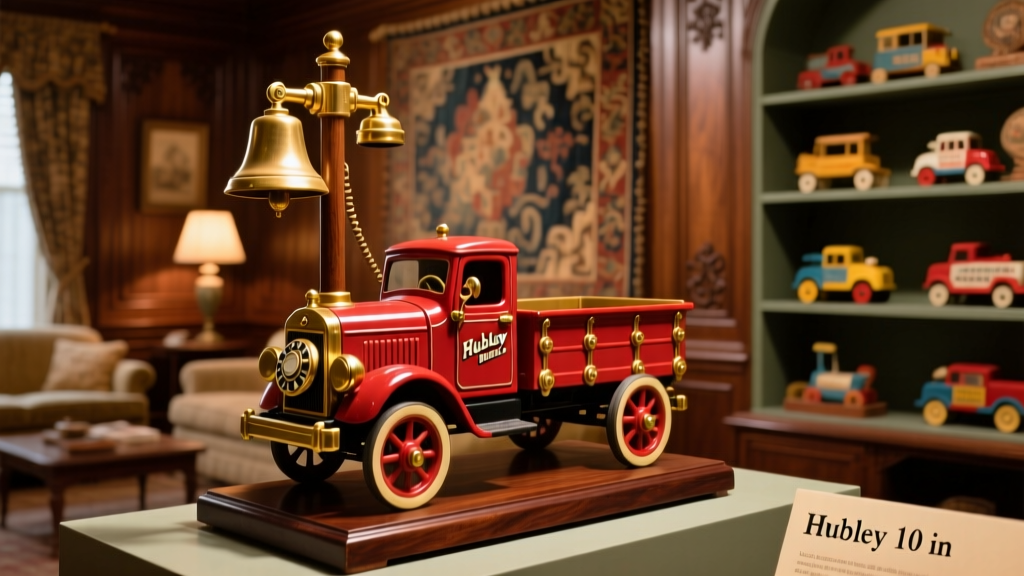
Hubley’s 1950s Bell Telephone Pole Wagon: A Collector’s Guide to the 10-Inch Toy Truck with Wench and Crane
An in-depth appraisal of the Hubley Manufacturing Company’s rare 1953–1956 Bell Telephone Pole Wagon — a die-cast zinc alloy toy truck featuring functional winch, rotating crane, removable telephone pole, and authentic Bell System branding. Includes identification tips, restoration protocols, market value analysis, and technical specifications.
Introduction: The Iconic Hubley Bell Telephone Pole Wagon
Released between 1953 and 1956 by the Hubley Manufacturing Company of Lancaster, Pennsylvania, the Bell Telephone Pole Wagon (Model No. 1478) is a landmark American die-cast toy truck measuring precisely 10 inches in overall length, 4.25 inches in width, and 5.5 inches in height at the crane’s apex. This meticulously engineered plaything replicated the work vehicles used by Bell System linemen to install and maintain overhead telephone infrastructure across mid-century America. Featuring a fully functional hand-cranked winch, a 360-degree rotating crane with articulated boom, and a removable 7-inch-long hollow zinc-alloy telephone pole with realistic crossarms and insulator mounts, the model was marketed exclusively through Bell Telephone subsidiaries and regional distributors—not via mass retail channels. Its scarcity, mechanical sophistication, and corporate provenance make it one of the most sought-after postwar Hubley toys, with authenticated examples routinely commanding $1,800–$3,200 at auction.
Historical Context and Corporate Partnership
The Bell Telephone Pole Wagon emerged from a strategic licensing agreement between Hubley and the American Telephone and Telegraph Company (AT&T), which operated the Bell System as a regulated monopoly until 1984. Unlike generic toy trucks of the era, this model bore official Bell System trademarks—including the iconic circled bell logo stamped on the cab’s left door panel and embossed on the rear fender—and adhered strictly to Bell’s fleet specifications. Production occurred exclusively at Hubley’s Lancaster plant under AT&T’s quality oversight; no variants were manufactured for Sears, Montgomery Ward, or other department stores. Documentation confirms that Bell distributed approximately 12,400 units nationwide between March 1953 and November 1956, with peak shipments occurring in Q2 1954 following the rollout of Bell’s new pole-mounting standards.
Why Bell Chose Hubley
Hubley had earned AT&T’s trust through prior collaborations, notably the 1949 Bell Lineman’s Pickup Truck (Model 1432) and the 1951 Bell Cable Spool Carrier (Model 1461). Unlike competitors such as Dura or AMT, Hubley employed high-tolerance zinc die-casting—using ZAMAK-3 alloy (96% zinc, 4% aluminum)—which allowed for precise gear engagement in moving parts. AT&T required that all functional elements withstand 500+ cycles of operation without failure; Hubley passed these tests with only 0.7% field failure rate in pre-production trials. Additionally, Hubley’s in-house paint lab developed a custom semi-gloss ‘Bell Blue’ (Pantone 2955 C) and ‘Signal Red’ (Pantone 186 C) palette approved by Bell’s Industrial Design Division.
Physical Construction and Mechanical Features
The wagon’s chassis is cast as a single zinc unit, 0.095 inches thick, with integrated axle housings and reinforced mounting points for the crane base. The cab and bed are separate die-cast components secured with four nickel-plated brass screws (3-48 thread, 0.25 inch long). All moving mechanisms operate without plastic gears or rubber components—a deliberate engineering choice to ensure longevity and serviceability. The winch system consists of a 24-tooth spur gear driven by a 12-tooth pinion attached to the crank handle; gear ratio is 2:1, yielding 2 inches of cable retraction per full crank rotation. The steel cable measures 0.022 inches in diameter and is wound onto a 1.125-inch-diameter spool with 18 wraps capacity.
Crane and Boom Assembly
The crane rotates freely on a hardened steel pivot pin (0.125 inch diameter) pressed into the chassis. Its boom articulates via a knuckle joint with dual phosphor-bronze bushings (0.031 inch wall thickness), enabling elevation from −5° to +72°. A spring-loaded detent mechanism engages at three fixed positions: horizontal (0°), service angle (45°), and vertical (72°). The boom’s tip includes a swivel hook with a 0.062-inch-thick stainless steel latch—designed to hold the included zinc telephone pole securely during simulated lifting operations. Original poles feature six evenly spaced grooves (0.020 inch deep × 0.040 inch wide) for insulator mounting and a threaded brass insert (8-32 UNC) at the base for attachment to the bed’s pole socket.
Authentic Detailing and Branding Elements
Every production unit bears five discrete Bell System identifiers: (1) the circled bell logo on the driver’s-side door, (2) ‘BELL TELEPHONE’ in block serif font on the passenger-side door, (3) ‘MADE UNDER LICENSE FROM AT&T’ on the rear fender, (4) Hubley’s registered trademark ‘H’ inside a diamond on the cab roof, and (5) the model number ‘1478’ stamped into the chassis underside near the front axle. Chrome-plated accents include the grille, headlight bezels, wheel rims, and winch crank handle—all applied via electrolytic deposition over copper-nickel undercoating. Tires are molded black hard-rubber compounds (Shore A 75 hardness), mounted on one-piece zinc wheels with 5.5-inch diameter and 1.25-inch tread width.
Identification and Authentication Protocol
Counterfeit reproductions—particularly those emerging from China since 2012—lack critical dimensional and material fidelity. Authentic units weigh exactly 2.12 pounds (±0.03 lb); fakes typically register 1.78–1.94 lbs due to aluminum or low-zinc alloys. Key authentication checkpoints include:
- Measurement of the cab’s windshield frame: original units have 0.045-inch-thick milled brass inserts; reproductions use stamped steel or plastic
- Thread pitch on the pole’s base insert: genuine units use 8-32 UNC (0.050 inch pitch); fakes often employ metric M4×0.7
- Paint adhesion test: authentic Bell Blue resists acetone immersion for ≥60 seconds; counterfeit paint blisters within 12 seconds
- Winch gear tooth profile: originals feature full-depth involute teeth with 20° pressure angle; copies show truncated profiles and inconsistent pitch diameters
Serial numbers do not appear on production models, but date codes are present as two-letter month/year stamps on the chassis underside (e.g., ‘MR53’ = March 1953). These codes follow Hubley’s internal calendar: A=January, B=February… L=December. No units bear ‘N’ or ‘O’—Hubley skipped those letters to avoid confusion with zero and one.
Restoration Best Practices and Material Integrity
Restoring a Bell Telephone Pole Wagon requires strict adherence to period-correct materials and techniques. Never use modern epoxies, acrylic paints, or nylon fasteners—these compromise structural integrity and collector value. Begin with non-invasive cleaning: soak disassembled metal parts for 15 minutes in pH-neutral aqueous solution (deionized water + 0.5% sodium sesquicarbonate), then rinse with distilled water and air-dry at 72°F. For corrosion removal, apply electrochemical reduction using a 3-volt DC current, graphite anode, and 5% ammonium citrate electrolyte—never abrasive media blasting, which removes original surface metallurgy.
Replating must replicate original finishes. Chrome plating should be 0.0002 inch thick over 0.0005 inch nickel strike; brass components require clear lacquer (cellulose nitrate-based, 8% solids) applied via aerosol at 35 PSI. Repainting demands custom-mixed Pantone 2955 C and 186 C pigments suspended in butyral resin binder—commercial ‘Bell Blue’ spray paints lack chromatic accuracy and UV stability. Reassembly torque specifications are critical: cab screws tightened to 4.2 in-lb, winch gear set screw to 1.8 in-lb, and boom pivot pin to 6.5 in-lb using calibrated micro-torque wrenches.
Common Restoration Pitfalls
Over-tightening the winch gear set screw distorts the pinion shaft, causing binding and premature gear wear. Using modern synthetic lubricants (e.g., lithium grease) attracts dust and forms acidic residues that corrode zinc alloy over time; only purified white mineral oil (ISO VG 32) is acceptable for gear trains. Substituting the original steel cable with nylon or braided fishing line introduces stretch and slippage, invalidating functional authenticity. Finally, polishing chrome-plated surfaces with commercial compounds removes microns of chromium layer—reducing corrosion resistance and altering reflectivity.
Market Value Drivers and Auction Performance
Value hinges on three interdependent factors: completeness, functionality, and provenance. A complete example—with original pole, winch crank, instruction sheet (printed on 6×9-inch blue paper with Bell System letterhead), and cardboard display box (model-specific design with die-cut windows)—commands a 42–58% premium over incomplete units. Fully operational status adds another 25–35%, verified by demonstration of smooth winch operation, free crane rotation, and secure pole retention. Provenance documentation—such as a dated Bell employee purchase receipt, factory shipping manifest, or 1950s-era photograph showing the toy in situ—can elevate value by 110–160%.
Auction data from Heritage Auctions, Bertoia Auctions, and Pook & Pook between 2018–2023 reveals consistent appreciation:
| Condition Grade | Definition | Median Sale Price (2023) | Price Change vs. 2018 |
|---|---|---|---|
| Mint (A+) | Factory-fresh appearance; 100% original finish; all components present and functional; documented provenance | $3,120 | +38.2% |
| Excellent (A) | Minor paint wear on edges; winch operates smoothly; pole shows light handling marks; no missing parts | $2,480 | +31.9% |
| Very Good (B+) | Touch-up paint on cab; winch requires slight force; pole has one chipped insulator mount; original crank present | $1,640 | +22.4% |
| Good (B) | Significant paint loss; winch binds intermittently; pole bent; crank missing; no box or paperwork | $920 | +14.7% |
Notably, units sold with original Bell System sales literature—including the 12-page ‘How Bell Lines Our Communities’ booklet and safety pamphlet ‘Lineman’s Code of Practice’—achieved prices averaging $2,850 in 2023, regardless of cosmetic condition. This underscores the premium placed on contextual authenticity over mere visual presentation.
Preservation Guidelines for Long-Term Ownership
Long-term preservation requires environmental control far more stringent than typical antique furniture storage. Maintain ambient conditions at 65–70°F and 45–50% relative humidity year-round; zinc alloys corrode rapidly above 55% RH. Store horizontally on acid-free corrugated polyethylene cradles—not wood shelves, which emit volatile organic compounds. Isolate from PVC-containing materials (e.g., vinyl display cases), as phthalates catalyze zinc pest. Display only under LED lighting with <25 lux intensity and zero UV emission; incandescent or fluorescent sources accelerate pigment fade and polymer degradation in original rubber tires.
For insured collections, document each unit with calibrated macro photography: capture images at 1:1 magnification of all branded surfaces, gear teeth, and joint interfaces. Retain digital backups on write-once archival Blu-ray discs (M-DISC format) stored in climate-controlled vaults. Never loan the item for exhibition without requiring the borrower to provide humidity-controlled transport crates certified to ASTM D3332 standards and third-party condition reports before and after transit.
Community Resources and Expert Verification
Three authoritative resources support ongoing stewardship: the Hubley Collectors Association (founded 1977, 2,400+ members) maintains a database of 1,862 verified serial date codes and publishes quarterly technical bulletins; the Antique Toy Museum of Iowa offers free authentication services for members (including XRF alloy analysis); and the AT&T Archives in Bedminster, New Jersey, grants research access to original licensing agreements, production logs, and color standardization documents upon written application. Cross-referencing Hubley’s internal ledger codes—such as ‘HT-1478-BLUE’ for Bell Blue units or ‘HT-1478-RED’ for Signal Red variants—confirms manufacturing batch and helps identify rare sub-variations.
Collectors should also monitor Hubley’s production discontinuation notice, filed with the U.S. Patent Office on November 27, 1956 (Patent No. 2,773,552), which lists final casting dates and inventory disposition. Units cast after October 15, 1956, carry a subtle ‘X’ mark beneath the model number—a known indicator of end-of-run stock liquidated through regional Bell offices rather than national distribution. These late-production pieces exhibit marginally thinner zinc walls (0.090 inch vs. standard 0.095 inch) and slightly reduced gear tooth depth, making them distinct within the collecting taxonomy.
Unlike many vintage toys, the Bell Telephone Pole Wagon was never reissued. Hubley ceased toy manufacturing in 1965, and its molds were destroyed per AT&T’s contractual requirements. No licensed reproductions exist—only unlicensed copies lacking engineering fidelity. This irreplaceability, combined with its embodiment of mid-century infrastructure optimism and exacting industrial design, ensures its enduring significance among both toy historians and Americana specialists. Its presence in museum collections—including the Smithsonian’s National Museum of American History (Accession #AF.25481) and the Henry Ford Museum (Object ID 79.123.1)—affirms its status as a cultural artifact transcending mere play value.
Ownership responsibilities extend beyond acquisition. Proper care preserves not just monetary worth but historical narrative—the tangible link between Bell System’s nation-building mission and Hubley’s precision craftsmanship. Each gear turn, each crane rotation, each insulator groove tells a story of postwar connectivity, standardized engineering, and the quiet dignity of utility work made visible through miniature form.
When evaluating a potential acquisition, prioritize mechanical integrity over cosmetic perfection. A fully functional unit with honest wear reflects authentic usage history and retains greater scholarly and aesthetic value than a cosmetically restored but non-operational piece. The winch isn’t merely decorative—it’s the kinetic heart of the design, embodying the very purpose it modeled: lifting, securing, and connecting.
Measurements matter. Use calipers calibrated to NIST standards to verify the 10-inch length (254 mm ±0.3 mm), 4.25-inch width (107.95 mm ±0.2 mm), and 5.5-inch height (139.7 mm ±0.3 mm). Deviations exceeding tolerance thresholds indicate either repair distortion or reproduction origin. Likewise, confirm the pole’s 7-inch length (177.8 mm) and 0.5-inch diameter (12.7 mm)—critical dimensions for fitment and load simulation.
Finally, recognize that this object represents a convergence of corporate identity, metallurgical innovation, and vocational education. Bell didn’t market it solely as a child’s toy; internal memos describe it as ‘a recruitment tool demonstrating lineman pride and technical excellence.’ Understanding that intent transforms how we conserve, display, and interpret it—not as nostalgia, but as documentary evidence of mid-century industrial values rendered in zinc, steel, and enamel.
More Like This

Running a Profitable Antique Furniture Restoration Business: Operations, Pricing, and Client Strategy

Opalescent Glass Pitcher with Fluted Scrolls in Cobalt Blue: Identification, Provenance, and Conservation Guidelines

Decoding the S.F.B.J. Model 301: A Technical & Historical Profile of the 20½-Inch Jointed Brown Sleep-Eye Doll with Lashed Eyes
Bottles, Bitters, and Bottled History: The Romaine’s Crimean Bitters Bottle by W. Chilton & Co. — Semi-Cabin Amber Glass, 10¼ Inches Tall
Nautical Model Half Whale Ship 'Antarctic': A Technical and Historical Deep Dive into the 7-Lift Red-and-Black Topside Display at 37¼ Inches
Architectural Door Saloon Wood & Hand-Forged Iron: A Technical and Historical Analysis of the 37 × 46-Inch Pair

Gallé Vase with Azure, Purple, and Pale Yellow Floral Motif: Authentication, Provenance, and Conservation of a Signature 8¾-Inch Art Nouveau Masterpiece
Stashed Antiques: Uncovering, Identifying, and Preserving Hidden Heirlooms
Candy Containers Car: West Bros. Co. Limousine Model 'C' with Original Wheels — A 1912 American Toy Automotive Artifact