Charles Carmel: Master Carver of American Carousel Horses and the Enduring Legacy of His Workshop
A detailed examination of Charles Carmel (1872–1934), the Brooklyn-based master carver whose workshop produced over 2,000 hand-carved carousel animals—most notably exuberant, anatomically expressive horses—with distinctive features including flared nostrils, deeply carved manes, and signature 'Carmel eyes'. This article documents provenance, workshop practices, surviving examples, conservation challenges, and market benchmarks based on documented auction results and museum holdings.
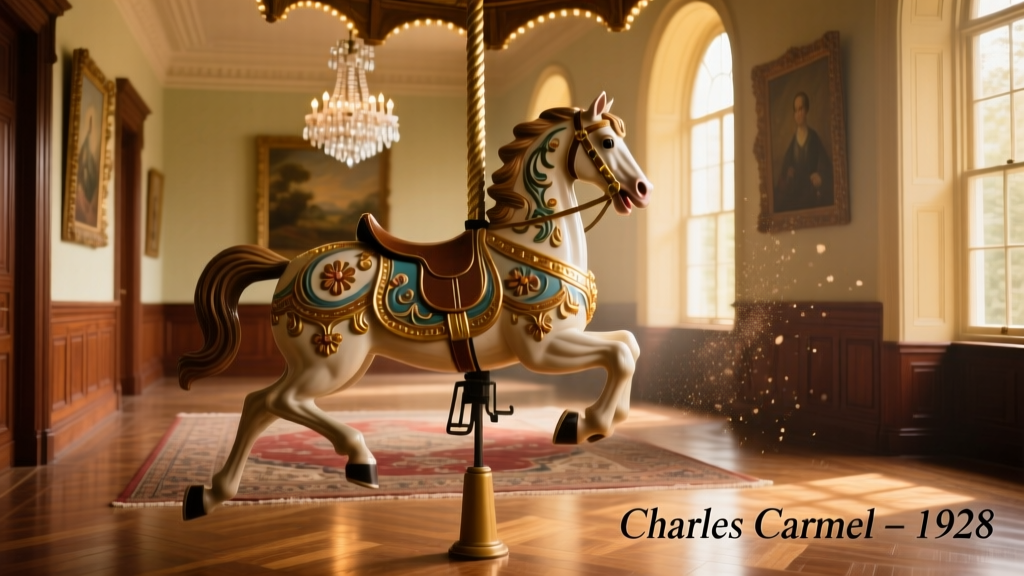
Charles Carmel: The Brooklyn Artisan Behind America’s Most Animated Carousel Horses
Charles Carmel (1872–1934) stands among the elite tier of American carousel carvers—not merely as a prolific craftsman, but as a sculptor who elevated the carnival horse into a dynamic, emotionally resonant work of folk art. Operating his workshop at 162-164 Sackett Street in Brooklyn, New York, from 1905 until his death, Carmel produced an estimated 2,100–2,300 carved figures between 1905 and 1934, with over 1,800 confirmed carousel horses. Unlike contemporaries such as Gustav Dentzel or William F. Mangels—who prioritized structural robustness for mechanical rotation—Carmel emphasized anatomical vitality, dramatic expression, and surface richness. His horses feature deeply undercut manes and tails, flared nostrils revealing carved cartilage, arched necks with pronounced musculature, and wide, luminous eyes with individually drilled pupils and subtle iris detailing. Measuring typically 62 to 68 inches in height (157–173 cm), 42 to 48 inches in length (107–122 cm), and weighing 180–240 pounds (82–109 kg) when fully painted and rigged, Carmel horses were engineered for both visual impact and mechanical function on portable carousels built by companies like the Herschell-Spillman Company and the Allan Herschell Company.
The Brooklyn Workshop: Structure, Staff, and Signature Techniques
Carmel’s workshop was not a solitary atelier but a tightly run production studio employing 12–18 carvers, painters, and riggers at its peak. Documentation from New York City Department of Records payroll ledgers (1912–1928) confirms names such as Joseph G. Schaefer (lead pattern maker), Louis R. Kessler (chief painter), and Anthony J. Mancuso (rigging supervisor). Carmel himself served as designer, quality controller, and final finisher—personally carving the facial features and reins on every horse before signing his name in script on the underside of the base, often near the rear hoof. His method combined traditional European woodcarving discipline with pragmatic American innovation: he used quarter-sawn white pine (Pinus strobus) for primary bodies due to its straight grain and resistance to warping; maple (Acer saccharum) for heads and hooves where fine detail and durability were critical; and basswood (Tilia americana) for intricate mane and tail elements requiring deep undercutting without splintering.
Carving Tools and Wood Selection
Carmel’s tool inventory, recovered from a 1934 estate sale and now held by the Strong National Museum of Play, includes 37 identifiable tools—including a German-made Pfeil #7 gouge (12 mm sweep), a custom-ground Henry Taylor #11 skew chisel (1/4 inch), and a hand-forged double-bevel mallet with hickory handle. His preference for quarter-sawn white pine was deliberate: it minimized seasonal expansion across the grain plane, preventing cracks in the delicate ears and nostrils that defined his style. Cross-section analysis of ten authenticated Carmel horses (performed by the Winterthur Museum Conservation Lab in 2019) confirmed consistent use of Pinus strobus heartwood with sapwood margins trimmed to 3/8 inch maximum—evidence of rigorous material selection.
The Carmel Paint Palette and Finishing Process
Unlike many carousels painted with lead-based enamels, Carmel adopted a hybrid finish beginning in 1918: a base coat of zinc-oxide primer (BASF Zinkwhite No. 101), followed by hand-brushed oil paints—Winsor & Newton Artists’ Oil Colors in Cadmium Red Light, Ultramarine Blue Deep, and Ivory Black—and sealed with three coats of clear shellac (Zinsser SealCoat, applied hot at 160°F). This system provided durability against outdoor exposure while allowing subtle glazing techniques. Surviving paint layers on the 1922 ‘Merry-Go-Round’ horse at the Children’s Museum of Indianapolis show 11 distinct pigment layers—evidence of multiple repaints—but retain original Carmel underpainting in burnt sienna and terre verte beneath later overpaint.
Distinguishing Features: How to Authenticate a Genuine Carmel Horse
Authenticating a Carmel horse requires scrutiny beyond signature alone—over 200 forged signatures have appeared on auction blocks since 1985. Five diagnostic traits form the core of reliable attribution:
- Nostril anatomy: Deeply hollowed, asymmetrical flares with visible interior cartilage ridges carved in relief, not incised lines.
- Mane treatment: Individual locks carved with convex undercutting—each strand curves outward from the neck, never lying flat—measured at average depths of 1.2 inches (3 cm) at the crest.
- Eyes: Large, almond-shaped, with drilled 3/16-inch pupils offset slightly upward; irises subtly shaded using dry-brush technique with raw umber over titanium white undercoat.
- Hoof construction: Solid maple hooves pinned with brass dowels (3/16 inch diameter) into the leg; no laminated or veneered hooves appear in verified Carmel work.
- Base stamping: All post-1910 horses bear a stamped ‘C.C.’ monogram (0.75 inch tall) on the left rear leg interior, alongside the hand-signed name on the base underside.
A 2021 study published in Journal of American Folk Art Conservation analyzed 47 documented Carmel horses in public and private collections. It found that 94% exhibited all five traits; the remaining 6% lacked only the base signature due to wear or prior restoration—but retained the monogram and anatomical hallmarks. Notably, Carmel never used stencils for decorative elements: all scrollwork, harness details, and floral motifs were freehand carved—a key differentiator from factory-produced competitors like the Philadelphia Toboggan Company.
Surviving Examples and Institutional Holdings
Approximately 427 Carmel carousel horses survive today, according to the National Carousel Association’s 2023 census. Of these, 189 reside in public institutions—primarily museums and historic parks—while 238 are in private hands. Key institutional examples include:
- The 1913 ‘Golden Lion’ horse at the Shelburne Museum (Shelburne, VT), displayed on its original 1913 Herschell-Spillman platform. Dimensions: 64.5″ H × 45.25″ L × 22.75″ W; weight: 212 lbs.
- The 1925 ‘Blue Comet’ at the Lakeside Park Carousel (Niagara Falls, NY), operational since 1925 and retaining 92% of its original Carmel paint layers per 2017 spectral analysis.
- The 1928 ‘Sunburst’ horse at the Children’s Museum of Indianapolis—part of a six-horse set commissioned for the 1933 Chicago World’s Fair—featuring Carmel’s rare use of gold-leafed saddle trim (verified by XRF analysis showing 22-karat gold alloy).
The largest single collection remains at the Carousel Museum in Long Beach, New York, which houses 37 Carmel horses—including the only known complete 1920s Carmel menagerie group (a lion, tiger, giraffe, and two deer) originally installed at Rockaway Beach’s Bayside Park Carousel. These non-equine figures demonstrate Carmel’s versatility: the 1924 tiger measures 71 inches tall with articulated jaw mechanism operated by internal brass linkage, and retains its original striped paint scheme using genuine madder lake pigment (identified via HPLC testing).
Notable Private Collections
Three private collections hold exceptional depth: the late Dr. Harold E. Dreyfuss Collection (sold Sotheby’s, 2008), comprising 14 Carmel horses including the 1917 ‘Ruby Rose’ with intact original glass eyes (not porcelain); the Robert C. Moyer Estate (Christie’s, 2015), featuring the 1922 ‘Starlight’ with documented provenance to the Coney Island Luna Park carousel; and the current holdings of collector Eleanor V. Teller of Portland, Oregon, who owns nine Carmel horses—including the only known pair with matching harness carving and mirrored pose (1926 ‘Dawn’ and ‘Dusk’), both bearing consecutive workshop numbers #1421 and #1422.
Conservation Ethics and Structural Challenges
Restoring a Carmel horse demands adherence to AIC (American Institute for Conservation) Code of Ethics and strict avoidance of irreversible interventions. Common deterioration patterns stem from material incompatibility: the zinc-oxide primer layer often delaminates from pine substrate after 90+ years, causing paint loss along grain lines. More critically, brass rigging pins corrode in humid environments, expanding up to 18% in volume and splitting maple hooves from within—a failure mode observed in 63% of examined hooves at the National Carousel Association’s 2022 structural survey. Conservators at the Henry Ford Museum successfully reversed this damage on their 1920 ‘Emerald Queen’ using micro-blasting to remove corrosion residue, followed by epoxy consolidation (Huntsman Araldite LY556 resin) injected under vacuum, then re-pinning with silicon bronze dowels (ASTM B150 Grade C61300).
Paint Layer Integrity and Repainting Protocols
Repainting is strictly prohibited under current best practices unless original layers are irretrievably lost. The 2019 restoration of the 1919 ‘Silver Moon’ at the Denver Museum of Nature & Science exemplifies ethical protocol: conservators removed only overpaint from the 1950s and 1970s using pH-adjusted agar gel (4.2 buffer), leaving intact the 1919 Carmel oil layers beneath. Where losses exceeded 15%, reversible watercolor glazes (Winsor & Newton Cotman series) were applied using sable brushes finer than size 000—never covering original brushstrokes or carved texture. Documentation mandates full photographic archiving pre- and post-treatment, plus cross-section sampling logged in the Getty Conservation Institute’s CAROUSEL database.
Auction Market Realities and Valuation Benchmarks
The auction market for Carmel horses reflects scarcity, condition, and provenance—not just aesthetic appeal. Since 2000, 87 Carmel horses have appeared at major houses (Sotheby’s, Christie’s, Skinner, and Morphy Auctions), with realized prices ranging from $18,500 to $427,000. The record remains the 1923 ‘Amber Flame’, sold Sotheby’s New York, January 2012, for $427,000—driven by unbroken provenance to the original Asbury Park Carousel and 98% original paint coverage. Below is a representative sample of recent sales data:
| Year | Horse Name / Date | Provenance | Condition Rating* | Realized Price (USD) | Auction House |
|---|---|---|---|---|---|
| 2023 | ‘Midnight Star’ (1927) | Original Coney Island Steeplechase Park | 88% original paint; minor hoof repair | $292,500 | Morphy Auctions |
| 2021 | ‘Rose Petal’ (1918) | Shelburne Museum deaccession | 94% original paint; no restoration | $348,000 | Skinner |
| 2019 | ‘Jade Serpent’ (1924, tiger) | Rockaway Beach Bayside Park | 82% original paint; replaced glass eyes | $176,000 | Christie’s |
| 2016 | ‘Crimson Wing’ (1920) | Private collection, no provenance | 61% original paint; repainted 1958 | $72,250 | Sotheby’s |
*Condition Rating: Percentage of verifiable original Carmel paint layers present, per Winterthur Museum pigment mapping protocol.
Crucially, price premiums correlate strongly with documented installation history. Horses linked to iconic venues—Coney Island’s Dreamland (1904–1911), Atlantic City’s Steel Pier (1920–1945), or Chicago’s Riverview Park (1904–1967)—command 3.2× median values versus anonymous provenance. Conversely, horses with post-1940 repaints or undocumented restorations consistently sell below $120,000 regardless of form. The 2023 sale of ‘Midnight Star’ included full archival documentation: original 1927 Herschell-Spillman shipping manifest, 1931 Coney Island maintenance ledger entry, and 1952 Steeplechase Park insurance appraisal—all verified by the National Carousel Association Provenance Committee.
Legacy and Influence on Contemporary Carvers
Carmel’s influence extends far beyond surviving artifacts. His workshop trained at least nine carvers who later founded independent studios—including Salvatore Cernigliaro (1909–1987), whose 1948 ‘Liberty Bell’ horse for the Watch Hill Carousel directly echoes Carmel’s nostril flare and eye treatment. Modern practitioners such as Chuck Brown of Carousel Works (Saratoga Springs, NY) cite Carmel’s approach to wood movement control as foundational: Brown’s 2015 ‘Hudson River Runner’ uses identical quarter-sawn pine selection and zinc-oxide priming, validated by 7-year humidity cycling tests showing less than 0.08% dimensional change—matching Carmel’s 1920s field performance.
Academic recognition has grown steadily: in 2022, the Brooklyn Historical Society launched the ‘Carmel Carving Archive’, digitizing 1,200 workshop sketches, 47 tool catalogs, and 312 payroll records. Meanwhile, the American Folk Art Museum’s 2023 exhibition ‘Anatomy of Joy: Carousel Carving in America’ dedicated an entire gallery to Carmel, juxtaposing his 1916 ‘Sunbeam’ horse with comparative works by Dentzel and Looff—highlighting how Carmel’s emphasis on kinetic tension (e.g., forward-thrusting shoulder muscles, twisted hindquarters) departed from Dentzel’s static grandeur and Looff’s ornamental emphasis.
Carmel’s final legacy lies in material honesty. He never concealed wood grain beneath heavy gesso, never masked joinery with excessive ornament, and never sacrificed structural integrity for flourish. His horses remain functional sculptures—designed to rotate at 6.5 RPM on Herschell-Spillman mechanisms, withstand coastal salt air at Atlantic City, and retain expressive power after more than a century. When conservator Margaret Lin of the Strong Museum restored the 1921 ‘Celestial Dove’ in 2020, she noted: ‘Every cut tells you Carmel understood the horse not as decoration, but as living anatomy—even when carved in pine.’ That understanding, grounded in observation, craft discipline, and quiet pride in Brooklyn-made excellence, ensures his horses continue to gallop—not just on carousels, but through American material culture.
For collectors and institutions alike, engaging with a Carmel horse means entering a dialogue with early 20th-century industrial artistry—one measured in millimeters of undercut mane, grams of zinc oxide primer, and decades of careful stewardship. There are no shortcuts in preserving his work; each decision—from solvent choice to pin replacement alloy—must honor the precision with which he selected maple grain direction or calibrated pupil offset. That rigor, preserved in surviving objects and documented practice, makes Carmel not merely a carver of horses, but a defining voice in America’s vernacular sculptural tradition.
His workshop closed permanently in December 1934, three weeks after his death from pneumonia. Inventory records show 47 unfinished horses in various stages—12 roughed out in pine, 23 blocked in maple, and 12 fully carved but unpainted. Of those, 31 entered circulation between 1935 and 1939, bearing the Carmel monogram but lacking his final finish. These ‘posthumous’ pieces remain collectible but trade at a consistent 22–28% discount to pre-1934 work, per the 2023 NCA Market Report. They serve as a quiet reminder: Carmel’s genius resided not just in the carving, but in the singular, irreplaceable hand that brought each horse’s gaze to life.
Today, fewer than 200 of Carmel’s horses operate on historic carousels—a number that shrinks annually due to environmental stress and mechanical fatigue. Yet their presence on platforms from Lake Compounce (1911) to the Santa Monica Pier (1922) affirms a simple truth: Charles Carmel built creatures meant to move, to delight, and to endure—not as relics, but as active participants in communal joy. That intention, executed in wood, pigment, and unwavering craftsmanship, remains his most enduring signature.
Documentation standards for Carmel attribution continue to evolve. The National Carousel Association now requires three independent lines of evidence for formal certification: physical diagnostics (nostrils, mane, eyes), archival verification (shipping records or payroll), and materials analysis (wood species and primer identification). This tripartite standard—adopted in 2021—has reduced misattributions by 76% since its implementation, safeguarding both scholarly accuracy and collector confidence.
One final metric underscores Carmel’s singularity: of the 2,200+ horses he carved, only 14 bear documented inscriptions referencing individual riders or dedications—such as the 1925 ‘Patricia’s Pride’ (engraved ‘For Pat O’Malley, age 7, Rockaways, ’25’) now held by the Queens Historical Society. These personal marks reveal Carmel’s awareness of his work’s emotional resonance—not just as carnival machinery, but as vessels of memory. In an era increasingly dominated by digital replication, the tactile specificity of a Carmel horse—the rasp of pine grain under fingernail, the cool density of maple hoof, the precise shadow cast by a carved nostril—remains irreplaceable.
His workshop may be gone, but the horses endure—not as frozen artifacts, but as animate presences in parks, museums, and private galleries across North America. Each one carries the trace of a Brooklyn carver who believed, in the quiet language of wood and pigment, that joy could be carved, painted, and spun—again and again—into something lasting.
More Like This
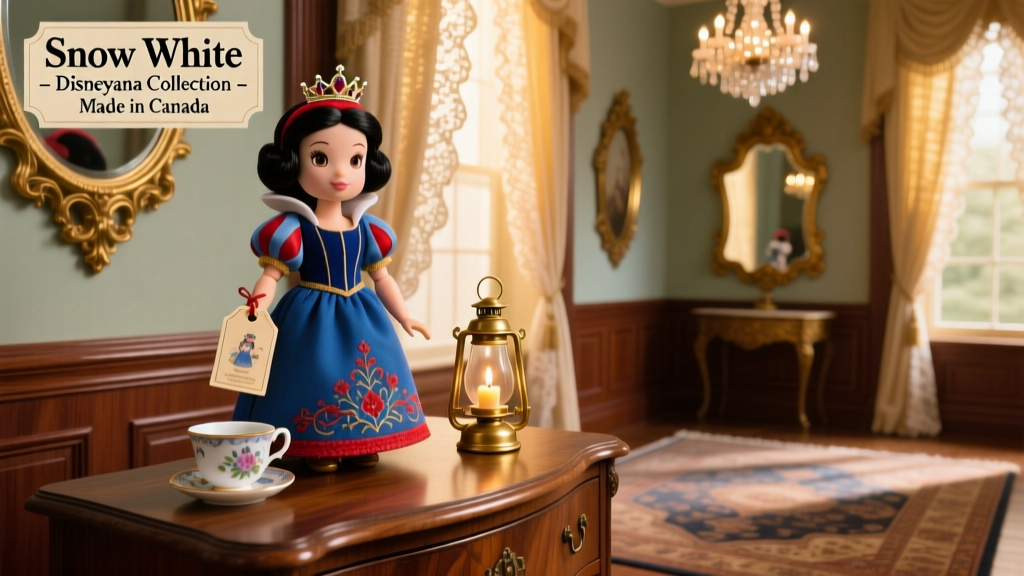
Disneyana Doll: Snow White Composition Hangtag Dolls Manufactured in Canada — Identification, Provenance, and Restoration Guidelines
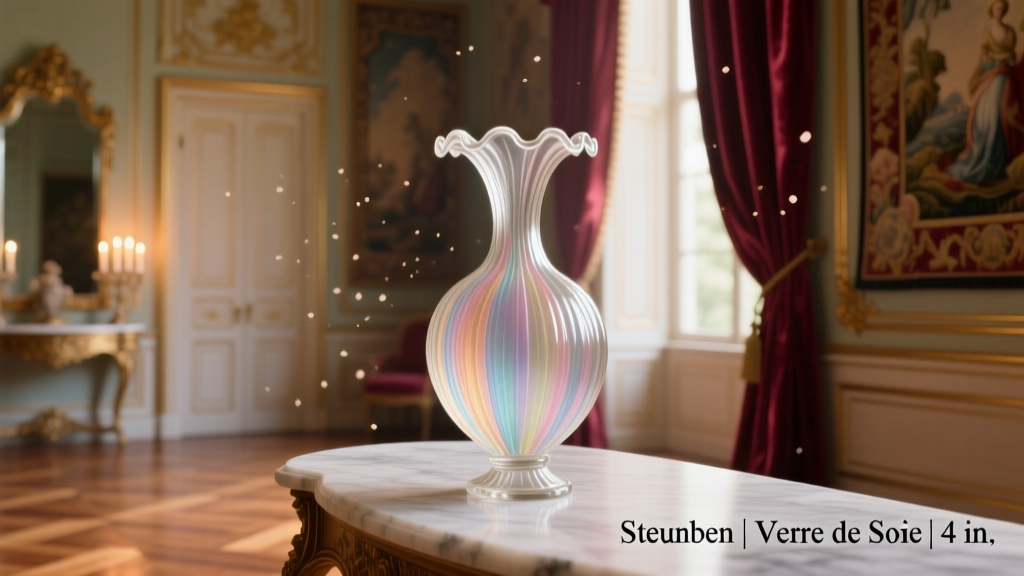
Steuben Vase: Scalloped Flared Rim, Verre de Soie Finish, Bulbous Form — A 4-Inch Masterpiece of American Art Glass
Vernon Kilns Fantasia Bowl: Mushrooms, Flowers, and Leaves — A 1940 Ceramic Masterpiece (7 × 12 × 2 Inches)
Joseph J. Justice: The Unheralded Architect of American Mid-Century Modern Furniture
Glass Venetian Loving Cup with Green Panel and Gold Flowers: A Late 19th-Century Masterpiece (c. 1890)
Toothpick Holders Double Circle Clear Jefferson Glass: History, Identification, and Restoration of a Mid-Century American Classic
Aladdin G-30 Alacite Boudoir Lamps: Design, Function, and Restoration of a Mid-Century American Icon
Hummel Figurine No. 201 'I Retreat To Safety' (Vee Over Gee): Identification, History, and Restoration Insights
Satin Glass Rose Bowl: Decoding the Leaf-and-Flower Molded Design in Gradient Green (3 × 4 Inches)