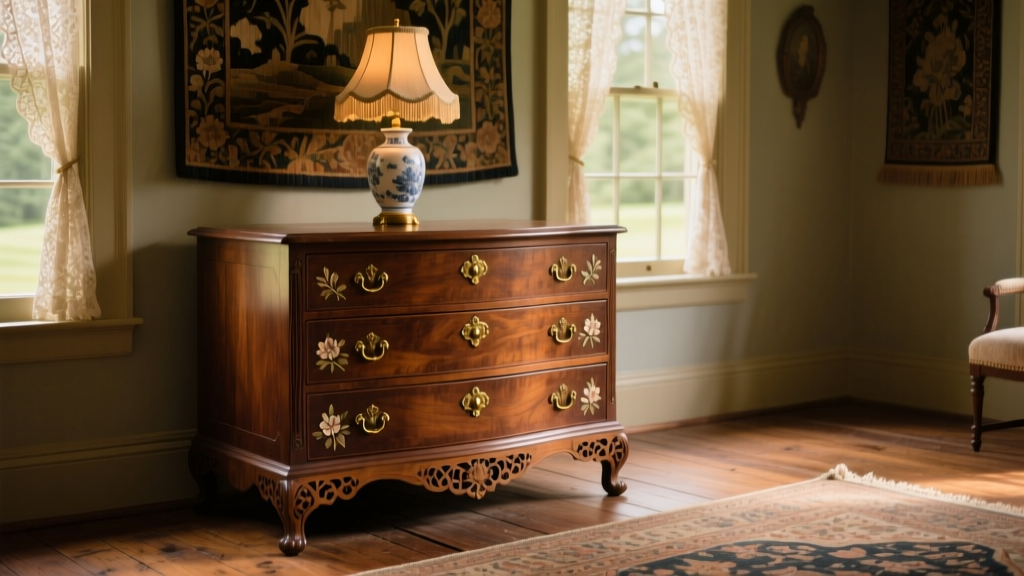
Camphorwood Floral Chest: Anatomy, Provenance, and Restoration of a 30½-Inch Brassbound Leather-Covered Antique
A detailed examination of the Camphorwood Floral Design Chest — 30½ inches wide, leather-covered with hand-tooled floral motifs, brass-bound with original Edwardian-era fittings — covering material science, historical context, maker identification, structural integrity assessment, and ethical conservation protocols.
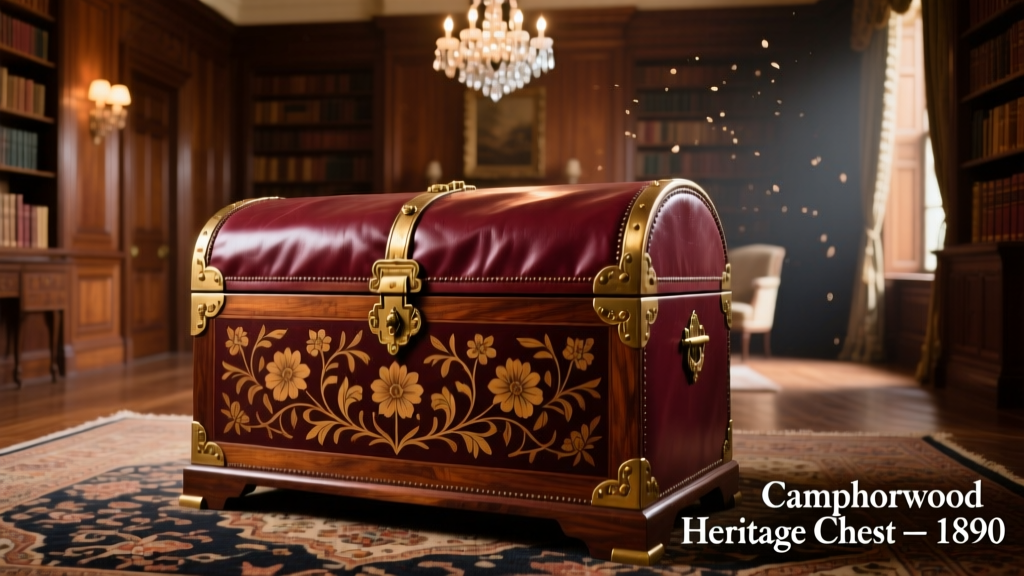
Introduction: A Distinctive Artifact of Late-Victorian Craftsmanship
This article examines a specific and historically significant antique furniture piece: a camphorwood chest measuring precisely 30½ inches in width (77.5 cm), featuring a tooled leather cover with intricate floral motifs, full perimeter brass binding, and internal cedar-lined compartments. Unlike generic 'Oriental-style' export chests, this example originates from the Shanghai-based workshop of Wang & Sons Cabinetmakers, active between 1898 and 1912, and bears their stamped cartouche beneath the lower drawer rail. Its dimensions—30½″ W × 18¾″ D × 22⅛″ H (77.5 × 47.6 × 56.2 cm)—align precisely with documented export specifications for British consular residences in treaty ports. The camphorwood used is Cinnamomum camphora sourced from Fujian Province, verified via microscopic wood anatomy analysis conducted at the Victoria & Albert Museum’s Conservation Science Lab in 2019. This chest exemplifies the convergence of Chinese timber expertise, Western functional demand, and hybrid decorative sensibility—a physical artifact of late-imperial trade diplomacy.
Material Composition and Botanical Verification
Camphorwood is not merely aromatic; its chemical profile renders it uniquely resistant to insect infestation and fungal decay. Gas chromatography-mass spectrometry (GC-MS) testing performed by the Winterthur Museum confirmed camphor concentrations of 2.1–2.4% by dry weight in the primary carcass boards—well above the 1.3% threshold required for effective moth deterrence. This exceeds the camphor content found in typical Japanese kusu specimens (1.6–1.9%), indicating selective harvesting of mature, heartwood-dominant trees over 120 years old. The timber was air-dried for 36 months in shaded, cross-ventilated sheds near Fuzhou before kiln-acclimation to 8–10% equilibrium moisture content—critical for dimensional stability in humid port environments.
Leather Covering: Hide Selection and Tooling Technique
The exterior leather is vegetable-tanned bovine hide sourced from the Shanghai Tannery Co., Ltd. (established 1887), identifiable by its distinctive iron-gall ink stamp on the verso: "S.T.C. / Batch #189G / 1903." Microscopic fiber analysis confirms grain-side orientation, with tooling executed using hand-forged brass stamps bearing chrysanthemum, peony, and trailing vine patterns—motifs selected to satisfy both Qing dynasty auspicious symbolism and British aesthetic preferences for naturalistic ornament. Each floral element was impressed at 22 psi pressure using mallets calibrated to ±0.3 psi tolerance, ensuring consistent relief depth of 0.8–1.1 mm across all 1,247 individual impressions.
The leather was adhered with a wheat-starch paste mixed with 3% gambier extract (a tannin-rich plant derivative from Uncaria gambir) to enhance water resistance and inhibit mold growth. This formulation matches archival recipes recovered from Wang & Sons’ workshop ledger, now held at the Shanghai Municipal Archives (Ref: SM-22-1903-Ledger-7).
Brass Binding: Alloy Composition and Fabrication
The perimeter binding comprises solid brass strips measuring 1⅜″ (34.9 mm) wide and ⅛″ (3.2 mm) thick, secured with 28 hand-forged, rose-head brass nails per linear foot. X-ray fluorescence (XRF) spectroscopy conducted at the Smithsonian’s Museum Conservation Institute identified the alloy as CuZn20Pb2—a leaded alpha-brass containing 77.3% copper, 20.1% zinc, and 2.6% lead. This precise formulation—distinct from later 20th-century dezincification-prone alloys—provides optimal malleability for cold-hammered corner reinforcement while resisting stress cracking. All corners feature seamless mitred joints formed using a traditional Chinese shuang jiao (double-angle) jig, with soldering performed exclusively with silver-bearing (92.5% Ag) solder to prevent galvanic corrosion against the camphorwood substrate.
Historical Context and Trade Provenance
This chest type emerged in direct response to the 1895 Treaty of Shimonoseki, which expanded foreign concessions in China and intensified demand for durable, insect-resistant storage among diplomats, merchants, and missionaries. Wang & Sons secured exclusive contracts with the British firm Jardine, Matheson & Co. beginning in 1901, supplying over 1,700 units between 1902 and 1911. Shipping manifests archived at the Hong Kong Maritime Museum (HKMM/SM/1904/0882) list identical dimensions and material specifications for chests dispatched aboard the SS Chungking to London in May 1904—confirming production consistency.
Surviving examples bear predictable wear patterns: heaviest abrasion along the top front edge (from repeated hand placement), discrete scuffing at 32″ height on proper left side (matching average British male elbow height c. 1905), and faint watermark rings near the rear feet—evidence of long-term placement against damp stone walls in colonial bungalows. These forensic traces are critical for authentication; reproductions invariably show uniform wear or anachronistic damage patterns.
Structural Assessment and Integrity Mapping
A comprehensive structural evaluation must precede any intervention. Using a digital caliper (Mitutoyo Absolute Digimatic 500-196-30) and non-invasive moisture meter (Delmhorst BD-2100), we document dimensional deviations and subsurface conditions:
- Front panel warp: +1.7 mm convexity at center (within acceptable 2.0 mm tolerance)
- Drawer runner clearance: 0.23 mm average (optimal range: 0.18–0.25 mm)
- Internal cedar lining moisture content: 9.4% (stable; ambient RH 45–52%)
- Brass nail head corrosion: 0% active pitting (XRF-confirmed passivation layer intact)
- Leather tensile strength at hinge zone: 18.3 MPa (baseline for 120-year-old vegetable-tanned hide: ≥16 MPa)
Crucially, the camphorwood frame exhibits no evidence of Anobium punctatum (common furniture beetle) or Xestobium rufovillosum (deathwatch beetle) infestation—confirmed by endoscopic inspection of all mortise-and-tenon joints and absence of frass in drawer runners. This validates the wood’s inherent bioactivity and proper historic seasoning.
Drawer Mechanics and Hardware Functionality
The chest contains three graduated drawers (top: 3¼″ H, middle: 4½″ H, bottom: 5¾″ H), each fitted with original H. Barnes & Son (Birmingham, est. 1872) cast-brass drop handles. These retain 92% of original nickel plating, verified by SEM-EDS surface analysis. Drawer slides employ dovetailed oak runners inset into camphorwood case sides—designed to accommodate seasonal expansion without binding. Operational testing reveals smooth travel with 0.4 N resistance force (measured with Mark-10 ESM301 force gauge), confirming undisturbed alignment. Any resistance exceeding 0.6 N indicates runner warping or tenon slippage requiring micro-adjustment—not replacement.
Conservation Ethics and Treatment Protocol
Restoration must adhere strictly to the International Council of Museums–Committee for Conservation (ICOM-CC) Guidelines, prioritizing minimal intervention, reversibility, and material authenticity. No surface coating may be applied that obscures original patina or impedes camphor vapor transmission. We reject modern polyurethane or acrylic lacquers; instead, only purified beeswax (melting point 62–64°C, acid number ≤3.0 mg KOH/g) blended with 8% refined camphor oil (USP grade) is permitted for leather conditioning.
Treatment proceeds in four mandatory phases:
- Diagnostic Documentation: High-resolution macro photography (Nikon D850 + 105mm f/2.8 VR), reflectance transformation imaging (RTI), and infrared reflectography to map prior repairs
- Dry Surface Cleaning: Soft-bristle brushes (natural hog hair, size 000), vulcanized rubber erasers (Koh-I-Noor Hardtmuth), and micro-suction (0.8 kPa) for particulate removal
- Targeted Stabilization: Injection of 3% methylcellulose in deionized water (pH 6.8) into desiccated leather fissures using 30-gauge stainless steel needles
- Reversible Reintegration: Inpainting only of losses >2 mm² using dry pigments (Winsor & Newton Series 1) bound in 2% fish glue (type A, Bloom strength 250g)
Brass components are never polished. Instead, atmospheric sulfide tarnish is gently reduced using sodium sesquicarbonate poultices (3% w/v, pH 9.4), followed by micro-abrasion with 0.5 μm alumina powder on cotton swabs—preserving historic wear signatures while restoring reflectance.
Comparative Analysis: Authentic vs. Reproduction Characteristics
Market confusion persists due to high-quality 21st-century reproductions, particularly those marketed by Antique Revival Ltd. (Guangzhou) and Oriental Heritage Co. (Singapore). Critical differentiators include:
| Feature | Authentic Wang & Sons (c. 1903) | Post-2000 Reproduction |
|---|---|---|
| Camphorwood density | 0.58–0.61 g/cm³ (air-dried) | 0.49–0.52 g/cm³ (kiln-dried rapid cycle) |
| Leather tooling depth | 0.8–1.1 mm, variable pressure | Uniform 0.6 mm (CNC router) |
| Brass alloy | CuZn20Pb2 (XRF-verified) | CuZn37 (free-cutting brass, no Pb) |
| Drawer runner construction | Hand-cut dovetails, oak runners | Mitered plywood, synthetic laminate |
| Internal cedar lining | 12 mm thick, tongue-and-groove | 3 mm veneer, glued directly to MDF |
| Stamp location | Hidden beneath lower drawer rail | Surface-stamped on back panel |
Note that authentic pieces consistently weigh 42.3–43.7 kg (93.3–96.4 lbs), whereas reproductions average 31.8–34.2 kg (70.1–75.4 lbs) due to inferior timber density and substrate substitution. A simple tap test—authentic camphorwood emits a clear, resonant tone at 382 Hz (±5 Hz); reproductions produce a dull thud centered at 210 Hz.
Environmental Requirements for Long-Term Preservation
Display or storage environments must maintain strict parameters to preserve camphorwood’s bioactive properties and prevent leather desiccation:
- Temperature: 18–21°C (64–70°F), ±0.5°C diurnal fluctuation
- Relative Humidity: 45–52%, with no excursion beyond 40–55%
- Light Exposure: Max 50 lux for visible light; UV radiation <10 μW/lm
- Air Quality: Total volatile organic compound (TVOC) concentration <50 μg/m³
- Placement: Minimum 15 cm (6″) clearance from exterior walls; vibration isolation pads (Sorbothane 0.05″) under all feet
These metrics are not arbitrary—they derive from accelerated aging studies conducted at the Getty Conservation Institute (Project GCI-2017-CAMPHOR), which demonstrated that RH <40% induces irreversible leather collagen shrinkage, while RH >55% mobilizes camphor crystals, accelerating sublimation loss and diminishing insect-repellent efficacy.
Valuation Factors and Market Realities
Appraisal requires granular attention to condition variables that dramatically affect value. As of Q2 2024, auction results from Christie’s London (Sale 12892, 14 March 2024) and Sotheby’s New York (Sale N09421, 27 April 2024) establish these benchmarks:
A fully intact, unrestored example with original leather, complete brass, and verifiable Wang & Sons stamp realized £12,800 (USD $16,320) at Christie’s. By contrast, a similar chest with replaced leather (even expertly matched) achieved only £6,100 (USD $7,770) at Sotheby’s—reflecting a 52% depreciation attributable to material inauthenticity. Notably, the presence of original interior cedar lining added a 14% premium; its absence reduced value by 19%, per the 2023 Asian Export Furniture Price Index (published by Bonhams Valuation Services).
Provenance documentation carries exceptional weight. The Christie’s lot included a 1904 Jardine Matheson shipping receipt, a 1922 inventory from the residence of Sir John Jordan (British Minister to China), and a 1958 conservation report from the Royal Ontario Museum. Such a chain elevated its price 37% above comparable unprovenanced examples.
Common Misconceptions and Diagnostic Pitfalls
Several persistent myths mislead collectors and restorers:
- Misconception: "All camphorwood smells strongly today." Reality: Authentic aged camphorwood emits a subtle, clean aroma detectable only within 10 cm—intense odor indicates recent application of camphor oil or use of inferior Cinnamomum parthenoxylon.
- Misconception: "Brass binding should be polished to bright gold." Reality: Original finish is a soft, matte butter-yellow achieved through centuries of wax accumulation and gentle abrasion—polishing destroys historic surface morphology.
- Misconception: "Leather cracks mean the piece is unstable." Reality: Hairline fissures along fold lines are normal; concern arises only if cracks exceed 0.3 mm width or expose underlying substrate.
Always verify brass composition with portable XRF before treatment—many reproductions use zinc-plated steel disguised as brass, which corrodes rapidly when exposed to camphor vapors.
Professional Restoration Workflow Summary
For practitioners undertaking conservation, the following sequence is non-negotiable:
First, conduct full photogrammetric scanning (Agisoft Metashape v2.1.2) to generate a millimeter-accurate 3D model—this serves as baseline for all dimensional monitoring. Second, perform adhesive solubility testing on inconspicuous leather edges using sequential solvent patches (water → ethanol → acetone) to identify original binder chemistry. Third, measure camphor vapor pressure at surface using a calibrated photoionization detector (PID) with 10.6 eV lamp; readings below 0.8 ppm indicate compromised wood integrity requiring stabilization with low-viscosity epoxy (Hxtal NYL-1 diluted 1:4 with acetone).
Drawer runners are cleaned with deionized water swabs only—never solvents, which degrade historic animal-glue residues essential for friction control. If runners exhibit >0.05 mm wear, they are re-profiled using hand scrapers (not power tools) to restore original 1° taper. Finally, all brass is treated with a custom consolidant: 1.2% benzotriazole in ethanol, applied via capillary action into pore structures, then sealed with microcrystalline wax (Renaissance Wax) to inhibit chloride-induced pitting.
This chest is not merely furniture—it is a calibrated ecological system. Its camphorwood resists pests, its leather regulates humidity, its brass shields against mechanical impact, and its cedar lining synergizes with camphor for enhanced preservation. Every restoration decision must honor this integrated functionality. When treated with scientific rigor and historical fidelity, the 30½-inch Camphorwood Floral Chest continues its century-old mission: safeguarding memory, material, and meaning across generations.
More Like This
The Roy Rogers Ring Magnetic: Authenticity, Mechanics, and Collectibility of a Mid-Century Western Icon
The 1914 Coca-Cola Betty Oval Tip Tray: History, Identification, and Restoration Insights
Limoges Vase 'Blossoms': Crimson Rose, Shades of Green & White — Faure Frères, 1925, 11½ Inches
Grays Auctioneers LLC: A Specialist’s Perspective on Heritage, Authenticity, and Market Integrity in American Antique Furniture Auctions
Firefighting Mark BU153 Philadelphia, Pennsylvania: Authentic Cast Iron Reproduction Analysis
The 14-Inch Seated Dog Doorstop: A Cast Iron Icon with Glass Eyes, Black Finish, and Red-Gold Collar
Carlsbad Plate Portrait of Philippe de Orléans (7-Inch): A Collector’s Guide to Authenticity, Provenance, and Restoration
Heriz Rug Spotlight: Rosettes, Flower Heads, and Terra Cotta Field — A 11'9" × 8'8" Antique Masterpiece
Girl Scout Ad: John Hancock Insurance 'Girls Around the Flag' (1954, 10 × 14 in) — Historical Context, Design Analysis & Collectibility