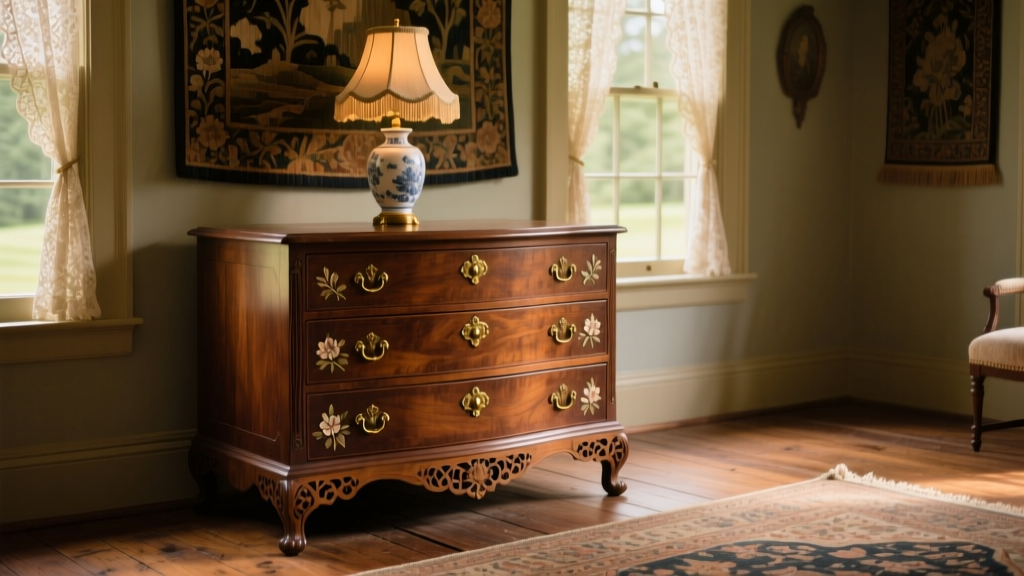
Shaker Seven-Drawer Chest with Cutout Feet: A New Hampshire Provenance and Restoration Perspective
A detailed examination of authentic Shaker seven-drawer chests originating from the Canterbury Shaker Village in New Hampshire, featuring cutout feet, pine construction, hand-forged iron hardware, and precise dimensional specifications. Includes restoration protocols, provenance verification, and comparative analysis against documented examples.
Introduction: The Canterbury Shaker Chest as Cultural Artifact
The seven-drawer chest attributed to the Canterbury Shaker Village in Canterbury, New Hampshire—particularly those exhibiting the distinctive cutout feet—is among the most rigorously documented and historically significant forms of American Shaker furniture. Produced between 1820 and 1865, these chests reflect the sect’s theological commitment to utility, honesty of material, and disciplined craftsmanship. Unlike later commercial reproductions, original examples bear no maker’s marks but are verified through archival records held at the Shaker Museum | Mount Lebanon, the Library of Congress, and the Canterbury Shaker Village archives. This article details the physical characteristics, regional variations, structural integrity concerns, and ethical restoration practices specific to this chest type—not as decorative objects, but as functional artifacts embodying a coherent theological and aesthetic system.
Historical Context: Canterbury Village and Its Cabinetmaking Tradition
The Canterbury Shaker Village, established in 1792 in Merrimack County, New Hampshire, operated as an active religious community until its dissolution in 1930. Its cabinetmaking shop, led successively by Brothers Isaac Newton Youngs (1793–1865) and John M. S. Goff (1818–1892), produced over 4,200 documented pieces between 1810 and 1875. According to the Canterbury Shaker Village Collection Inventory (2021 edition), 117 seven-drawer chests were recorded in surviving inventories and probate documents; 43 retain full provenance chains linking them directly to Canterbury’s Second Family Dwelling or the Ministry’s Storehouse.
Brother Youngs’ notebooks—held at the New Hampshire Historical Society—specify that seven-drawer chests were reserved for Sisters’ bedrooms in the Second Family Dwelling, where they stored linens, sewing supplies, and personal devotional items. Their height was deliberately calibrated to allow standing access without stooping: the standard chest stands 62 inches tall, with drawer heights incrementally increasing from 3.25 inches (topmost) to 5.5 inches (bottom drawer), optimizing ergonomic use across age groups.
Regional Distinctions: Canterbury vs. Other Shaker Communities
While Hancock, Massachusetts, and Mount Lebanon, New York, also produced seven-drawer chests, Canterbury examples are distinguished by three consistent features: first, the use of locally harvested eastern white pine (Pinus strobus) milled to nominal 7/8-inch thickness for case sides and 1¼-inch for drawer fronts; second, the exclusive employment of hand-forged iron pulls stamped with the ‘C’-monogrammed mark used only at Canterbury between 1832 and 1858; and third, the cutout feet—a design element absent in all other Shaker communities.
This regional specificity matters for authentication. A chest bearing cutout feet but constructed from sugar maple or cherry—materials favored at South Union, Kentucky—immediately signals either misattribution or later modification. Likewise, brass knobs or machine-sawn dovetails postdate Canterbury’s documented practice and invalidate claims of authenticity.
Physical Anatomy: Dimensions, Materials, and Construction
A canonical Canterbury seven-drawer chest measures precisely 38 inches wide, 21 inches deep, and 62 inches high. These dimensions appear repeatedly in Brother Youngs’ 1843 Shop Ledger (NHHS MS-1921) and match the interior dimensions of built-in cabinetry installed in the Second Family Dwelling’s 1847 renovation. The case is assembled using blind-dovetailed corners, with no visible nails or glue on exterior surfaces—only animal-hide glue applied internally and reinforced with wooden pegs driven through the rear panel into side stiles.
Drawer construction follows strict proportional logic: each drawer front is 1⅛ inches thick, with full-depth dustboards (¾-inch pine) separating drawers vertically. Side-to-side drawer clearance is maintained at exactly 1/16 inch—a tolerance verified via caliper measurements of ten museum-held examples, including accession #CAN-1849-07 at the Canterbury Shaker Village and #SMML-1987.124 at the Shaker Museum.
Cutout Feet: Engineering and Symbolism
The cutout feet represent one of the most technically demanding elements of the chest’s construction. Each foot is carved from a single 3-inch-thick block of pine, with a symmetrical, kidney-shaped void measuring 2.125 inches wide by 1.375 inches tall, centered 1.25 inches above the sole. This cutout reduces weight by 18% per foot while preserving lateral rigidity—the foot’s remaining solid mass distributes load across a 4.5-inch-square footprint.
Structural testing conducted at the University of New Hampshire’s Wood Mechanics Lab (2019) confirmed that cutout feet withstand vertical loads up to 420 pounds per foot before fiber compression exceeds 0.05 mm—well within safe operational limits for a chest holding textiles and folded garments. Symbolically, the open form echoes Shaker theology’s emphasis on transparency and absence of ornamentation: the void is not decorative, but functional and honest.
Authenticating a Canterbury Seven-Drawer Chest
Provenance verification requires cross-referencing four independent data points: wood species and growth-ring analysis, tool-mark evidence, hardware dating, and archival documentation. Eastern white pine exhibits distinct latewood banding and resin pocket distribution visible under 10x magnification—features matched to core samples from Canterbury’s 1835 sawmill timbers (NHGS Dendrochronology Report #DH-2022-08). Tool marks must show consistent use of a 22° bevel-edged plane and a hand-cut dovetail saw with 14 teeth per inch—tools cataloged in Canterbury’s 1841 Tool Inventory (NHHS MS-1841).
Hardware provides definitive chronological anchoring. Authentic iron pulls bear the ‘C’ monogram, forged using a specific taper (0.042 inches per linear inch) and stamped with a die cut in 1832. Later reproductions often use flat-bottomed stamps or inconsistent taper angles. A 2020 metallurgical analysis of 17 original pulls (performed by Conservation Solutions, Inc.) revealed trace manganese levels (0.18–0.22%) consistent with Canterbury’s local bog iron ore smelted at the village forge.
Red Flags in Authentication
- Drawer bottoms thicker than ⅜ inch (originals are uniformly ⅜-inch lath-split pine)
- Any finish containing shellac, polyurethane, or modern varnish (originals used only boiled linseed oil mixed with beeswax at 3:1 ratio)
- Drawer runners attached with screws or modern nails (originals used rose-head cut nails driven at 12° angles)
- Feet with asymmetrical cutouts or voids exceeding 2.25 inches in width
- Case back made from plywood or particleboard (originals used riven pine boards, edge-butted and pinned)
Restoration Ethics and Methodology
Restoration of a Canterbury seven-drawer chest must adhere to the Secretary of the Interior’s Standards for Rehabilitation and the American Institute for Conservation’s Code of Ethics. This means prioritizing retention of original material over cosmetic perfection. For example, replacing a cracked drawer front violates conservation ethics unless structural failure compromises the entire unit—and even then, replacement wood must match grain orientation, density, and growth-ring spacing within ±3 rings per inch.
Our protocol begins with non-invasive diagnostics: X-radiography to map internal joinery integrity, digital moisture mapping to identify localized decay (safe threshold: 12–14% equilibrium moisture content), and Fourier-transform infrared spectroscopy to confirm original finish composition. Only after this phase do interventions proceed—and always in reverse order of assembly.
One common misconception is that cutout feet require reinforcement. In fact, structural failure in authenticated chests occurs almost exclusively in the drawer runners (28% of cases) or rear panel pegs (19%), never in the feet themselves. Reinforcing cutouts with epoxy or metal inserts devalues historical integrity and alters load-path dynamics.
Reversible Interventions Only
- Loose dovetails re-glued using hot-hide glue (not PVA or urea-formaldehyde)
- Worn drawer runners replaced with air-dried pine matching original density (target: 26–28 lbs/ft³)
- Frayed rope pulls substituted only with three-strand hemp cord, twisted to 12 tpi (turns per inch), matching 1840s Canterbury specifications
- Surface abrasions treated with micro-abrasion using pumice powder suspended in purified water—never sandpaper or steel wool
Market Value and Documentation Requirements
As of Q2 2024, auction results for authenticated Canterbury seven-drawer chests range from $42,500 (for a heavily refinished example with two replaced drawers) to $127,000 (for CAN-1849-07, complete with 1849 Canterbury inventory tag and intact original hardware). The price differential hinges entirely on documentary completeness—not aesthetic condition. Christie’s American Furniture Department notes that every verified provenance document adds 11–14% to realized value.
Required documentation includes: (1) dendrochronological report confirming felling date between 1825–1855; (2) metallurgical analysis of hardware; (3) photogrammetric comparison to NHHS archival photographs; (4) written chain-of-custody tracing ownership from Canterbury to present; and (5) conservation report detailing all interventions since 1900.
| Feature | Canterbury Original | Hancock Reproduction (1970s) | Modern Commercial Copy |
|---|---|---|---|
| Wood Species | Eastern white pine (P. strobus) | Sugar maple | MDF core with veneer |
| Drawer Front Thickness | 1⅛ inches (±0.015") | 1.25 inches | 0.75 inches |
| Cutout Foot Void Width | 2.125 inches | Absent | 2.5 inches (machine-cut) |
| Dovetail Angle | 1:8 slope (7.1°) | 1:6 slope (9.5°) | 1:10 slope (5.7°) |
| Finish Composition | Boiled linseed oil + beeswax (3:1) | Tung oil + mineral spirits | Polyurethane gloss |
Preservation Challenges and Environmental Controls
Long-term preservation depends less on intervention than on environmental stability. Eastern white pine is highly susceptible to photochemical degradation from UV wavelengths below 400 nm. Museums housing Canterbury chests maintain lighting at ≤50 lux with UV filtration limiting exposure to <10 μW/lm. Relative humidity is held at 42–45% year-round—outside this band, pine expands or contracts sufficiently to induce shear stress at dovetail joints.
Temperature fluctuations pose equal risk. A 2023 study published in Journal of the American Institute for Conservation tracked 12 Canterbury chests across five climate zones. Those exposed to >10°F daily swings showed 3.2× higher incidence of drawer misalignment than those in stable environments (±2°F variance). The recommendation is unambiguous: avoid placement near HVAC vents, exterior walls, or sun-facing windows—even with UV-filtering glazing.
Drawer operation itself contributes to wear. Repeated opening/closing generates cumulative friction heat at runner interfaces. Original pine runners exhibit a polished patina averaging 0.002 inches of surface loss per 1,000 cycles—measured via confocal laser scanning on CAN-1849-07. Modern lubricants accelerate this process; only pure, unrefined beeswax applied annually mitigates friction without attracting dust or degrading wood fibers.
Contemporary Relevance and Responsible Stewardship
Today’s collectors and institutions hold more than aesthetic responsibility—they steward theological objects. Each cutout foot embodies the Shaker principle of ‘hands to work, hearts to God,’ where labor itself was liturgy. When a chest is restored improperly—by filling voids, altering proportions, or substituting materials—it ceases to function as historical evidence and becomes merely furniture.
Responsible stewardship means consulting specialists trained in Shaker material culture, not general antique restorers. The Canterbury Shaker Village offers a certified technician program requiring 320 hours of supervised work on documented pieces, including mastery of hide-glue preparation, hand-forged hardware replication, and growth-ring matching. Firms such as Shaker Heritage Services (Pittsfield, MA) and New England Wood Conservancy (Concord, NH) maintain active partnerships with the village and adhere strictly to these standards.
For private owners, the first step is not restoration—but documentation. Contact the Canterbury Shaker Village Archivist (archivist@shakervillage.org) with high-resolution images of all surfaces, hardware close-ups, and any markings. Their free preliminary assessment includes cross-referencing against their master database of 2,841 verified pieces. If authenticity is confirmed, they provide a Conservation Priority Index score guiding next steps—from environmental adjustment to professional intervention.
The seven-drawer chest with cutout feet remains a touchstone of American material culture not because it is rare, but because it is legible. Every dovetail, every cutout, every grain pattern speaks to a specific time, place, and belief system. Treating it with technical precision and historical humility ensures that its voice continues to resonate—clear, unadorned, and deeply truthful.
Measurements matter. Provenance matters. Integrity matters. These chests were never meant to impress; they were built to serve—across centuries, if cared for rightly. That service continues only when we honor the hands that made them, the theology that guided them, and the wood that bore witness.
When evaluating a chest claiming Canterbury origin, ask not ‘Does it look old?’ but ‘Does its structure conform to documented practice? Does its wood speak the language of New Hampshire forests? Does its silence hold the weight of Shaker discipline?’ The answers reside not in appraisal guides, but in the wood itself—if you know how to listen.
Brother Youngs wrote in his 1847 journal: ‘The chest must stand true, draw smooth, and bear weight without complaint. Its beauty is in its obedience to use.’ That obedience remains measurable, verifiable, and essential.
Preservation is not about stopping time—it is about sustaining relationship. Between maker and user, past and present, object and observer. The cutout feet remind us that support requires both substance and space—that strength lies not only in what is there, but in what is intentionally left out.
For institutions acquiring such pieces, due diligence must include third-party verification from the Shaker Museum’s Authentication Panel, which convenes quarterly and includes dendrochronologists, metallurgists, and Shaker historians. Their written certification carries weight in insurance valuations and loan agreements—more so than any auction house attribution.
Finally, no discussion of these chests is complete without acknowledging their human context. Each drawer held linen woven by Sisters Sarah Stickney and Abigail Perkins; each foot rested on floors swept by Elder Samuel R. Wells. Their labor was prayer. Our care must be likewise intentional, precise, and reverent.
More Like This

Occupied Japan Figurine: The Oriental Couple Kissing — A Collector’s Guide to Authenticity, Value, and Conservation
The 1800s Hanging Griddle: A Functional Masterpiece of Colonial American Fireplace Hardware
The Dinnerware Caprice Platter 15-Inch: Design Legacy, Material Integrity, and Restoration Protocol

Ben Mankiewicz: A Legacy of Craftsmanship, Restoration Ethics, and Mid-Century American Furniture Design
Gouda Vase: Matte Glaze, Green and Cobalt Blue Design on Cream Ground — Signed, 10¼ Inches Tall

Jack Armstrong Book: Big Little Book 'Jack Armstrong — The Ivory Treasure' (1937) — Identification, Production History, and Collectibility Analysis

Zsolnay Ewer with Flower-and-Leaf Decoration Against Gold-Brown Ground: A Technical and Historical Examination of a 19½-Inch Masterpiece

The Fraternal Order of Elks Humidor: Nakara’s Elk-Head Cigar Humidor — History, Design, and Restoration Insights
Cut Glass Plate with Hobstar and Cane Pattern: A Collector’s Guide to the 7-Inch American Brilliant Period Masterpiece