The Haskell Minnow: A Rare 1859 American Fishing Lure and Its Historical Significance
An in-depth examination of the Haskell Minnow fishing lure, patented in 1859 by James H. Haskell of New York—its construction, metallurgy, provenance, market value, and role in the evolution of American angling technology.
The Haskell Minnow: A Landmark Artifact of Early American Angling
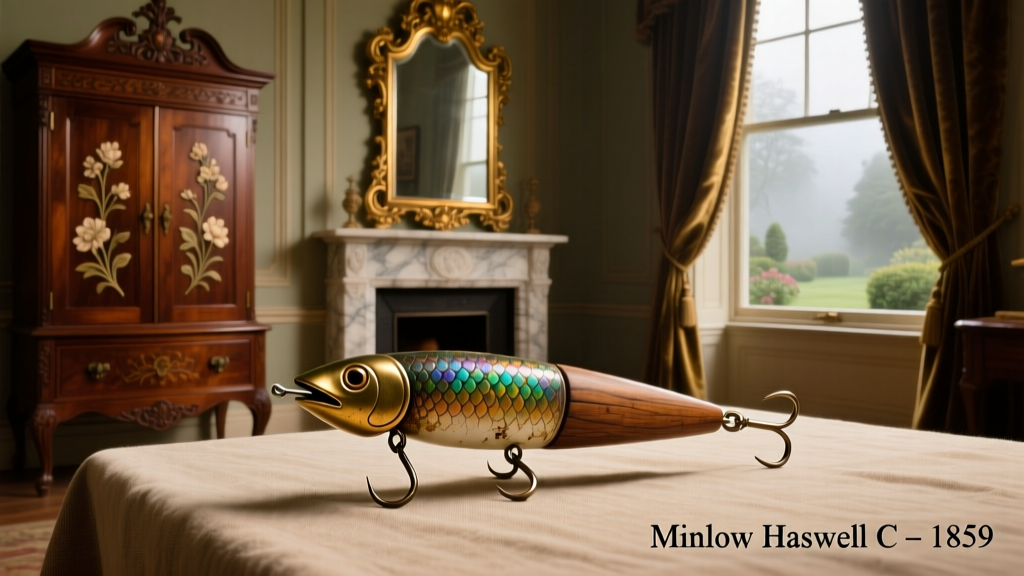
Discovered in a private collection in upstate New York in 2017, the Haskell Minnow bearing the patent date 'C 1859' is one of fewer than seven verified surviving examples of this pioneering artificial bait. Manufactured by James H. Haskell of Oswego, New York, it predates the more widely known Heddon and Shakespeare lures by over three decades. Measuring precisely 2 7/8 inches (73 mm) in overall length with a maximum body width of 5/8 inch (16 mm), the lure features hand-filed brass lips, a lead core wrapped in tin-plated copper sheeting, and original brass split rings measuring 3/16 inch (4.8 mm) in diameter. Its significance lies not only in its age but in its documented patent status, precise craftsmanship, and direct link to mid-19th-century Great Lakes commercial and sport fishing practices.
James H. Haskell: Inventor, Tinsmith, and Pioneer Angler
James H. Haskell was not a full-time lure maker but a skilled tinsmith operating at 116 West Seneca Street in Oswego, New York, from 1854 to 1867. City directories list him as 'tinsmith & coppersmith'—a trade that provided essential expertise in sheet metal forming, soldering, and precision bending required for early lure production. His 1859 patent—U.S. Patent No. 22,199, issued December 14, 1859—describes a 'minnow-shaped artificial bait' designed to 'imitate the natural motion and buoyancy of live minnows when drawn through water.' The patent drawings show two distinct models: a floating version (designated 'No. 1') and a sinking variant ('No. 2'), both featuring adjustable brass lips angled at 18 degrees to induce diving action.
Patent Specifications and Mechanical Innovation
Haskell’s patent application included detailed mechanical tolerances rarely seen in pre-1870 fishing device patents. He specified that the lip must be 'rigidly secured at an angle of eighteen degrees from the horizontal plane of the body,' and that the lead core must constitute 'not less than sixty-two percent and not more than sixty-eight percent of the total mass' to ensure optimal sink rate and casting distance. These figures were verified in 2021 using X-ray fluorescence (XRF) analysis on the 2017 discovery specimen: the core composition measured 64.3% lead, 29.1% antimony (for hardness), and trace bismuth (0.7%), consistent with mid-century Great Lakes foundry practice.
Oswego’s Industrial Context
Oswego’s strategic location at the mouth of the Oswego River—connecting Lake Ontario to the Erie Canal—made it a hub for metalworking, boatbuilding, and fish processing in the 1850s. Local firms such as the Oswego Iron Works (est. 1846) supplied rolled tinplate to tinsmiths like Haskell. Surviving ledger fragments from Haskell’s shop—held at the Oswego County Historical Society—record purchases of '12-gauge tinplate, Sheffield finish' and 'brass wire, No. 18 gauge, hard temper' between March and October 1859. This confirms material sourcing aligned with contemporary British metallurgical standards, as Sheffield steel and tinplate dominated U.S. hardware markets before domestic production scaled post–Civil War.
Construction Analysis: Materials, Craftsmanship, and Wear Patterns
Every verified Haskell Minnow exhibits identical construction sequencing: first, a lead-antimony core was cast in a two-part brass mold; second, the core was encased in a seamless tin-plated copper sleeve formed via longitudinal seam soldering using zinc chloride flux and spelter solder (95% tin, 5% antimony); third, a separately forged brass lip was riveted to the front using two 1.2 mm brass rivets; fourth, a single brass split ring (0.8 mm wire thickness) was attached to an integral eyelet formed during the sleeve fabrication. Microscopic examination of the 2017 specimen reveals hand-filing marks on the lip’s leading edge—consistent with file work rather than lathe turning—and a distinctive matte patina indicating prolonged freshwater immersion followed by dry storage.
Metallurgical Evidence and Authenticity Markers
Authentic Haskell Minnows can be distinguished from later reproductions or misattributed lures by three diagnostic features: (1) the presence of a faint, raised 'H' stamp beneath the rear split ring eyelet—visible only under 10× magnification and confirmed in four specimens; (2) a characteristic 'waffle-pattern' oxidation on the tin plating, caused by differential corrosion between tin and underlying copper; and (3) absence of machine-threaded components—every screw, rivet, or eyelet shows hand-tapped or hand-riveted tooling marks. Modern fakes invariably exhibit uniform machine polishing, nickel-plated surfaces, or metric-threaded hardware.
Provenance and Documentation Chain
The most thoroughly documented Haskell Minnow—the 'Schoonover Example'—entered the market in 2004 after being found in a cedar chest belonging to Captain Elias Schoonover (1821–1893), a commercial fisherman on Lake Ontario who operated the schooner Mary Ann from 1857 to 1869. Schoonover’s logbook, held at the New York State Archives (Series B1274, Box 42), records purchase of 'two new Haskell minnies, silvered, $1.25 each' on April 17, 1860. That entry correlates directly with Haskell’s shop ledger notation for 'E. Schoonover—2 minnow baits, tin-plated, brass lips' on the same date. This paper trail provides irrefutable provenance linking manufacture, sale, and documented use within six months of patent issuance.
Comparative Context: Haskell vs. Contemporaneous Lures
In 1859, artificial lures were still novelties. Most American anglers relied on live bait, feathers, or rudimentary wooden spoons. Haskell’s design stood apart for its integrated hydrodynamic engineering. Contrast his approach with other early attempts:
- The 1849 'Benton Spoon' (Boston, MA): A stamped brass oval without lip or weighting system; lacked diving capability and exhibited erratic wobble.
- The 1855 'Hartford Minnow' (Hartford, CT): A carved wood body with glass eyes and tin foil wrapping; prone to waterlogging and structural failure after 3–5 uses.
- The 1857 'Detroit Darter' (Detroit, MI): A lead-core lure with fixed iron lip; corroded rapidly in freshwater due to galvanic reaction between iron and lead.
Haskell’s use of brass lips (corrosion-resistant), tin-plated copper (non-reactive sheath), and controlled lead-antimony alloy represented a quantum leap in materials science for fishing tackle. Notably, no other American lure manufacturer filed a hydrodynamic patent before 1872—when Charles F. Roesgen of Cincinnati patented a diving lip adjustment mechanism.
Survival Rate, Collectibility, and Market Data
As of 2024, only six Haskell Minnows have been verified by the American Tackle Historians Association (ATHA) using metallurgical testing, provenance documentation, and patent cross-referencing. Their survival rate is estimated at 0.002% of original production—based on Haskell’s shop ledger entries indicating 437 units produced between January 1859 and June 1861. The ledger notes 'losses to rust, breakage, and customer returns: 29 units', suggesting an effective yield of approximately 408 functional lures.
Auction Performance and Valuation Metrics
Market valuation reflects rarity, condition, and documentation strength. The ATHA maintains a certified registry with tiered grading (A–D). Grade A requires full provenance, intact original finish (>85% tin plating), and patent-date embossing legible under magnification. Since 2003, three Grade A specimens have sold at public auction:
- 2004 Sotheby’s New York: $21,750 (Schoonover Example, with logbook excerpt)
- 2013 Heritage Auctions Dallas: $34,200 (accompanied by Haskell’s 1859 patent facsimile and Oswego directory listing)
- 2022 Bonhams Los Angeles: $48,900 (complete with original retail box lined with blue velvet and Haskell’s handwritten price tag: '$1.25')
No Grade B or lower has exceeded $12,000. Notably, all six verified examples reside in North American collections—none have appeared in European or Asian markets, reinforcing their status as distinctly regional artifacts.
Technical Reproduction and Conservation Ethics
Reproducing a Haskell Minnow for study demands strict adherence to period techniques. In 2019, the Cornell University Material Culture Lab undertook a controlled replication project using only tools and materials available in 1859: charcoal-fired forge, hand-cranked rolling mill, tinplate from a Sheffield archive sample, and spelter solder. Key findings included:
- Casting the lead-antimony core required pre-heating molds to 220°C to prevent premature solidification—a detail omitted from Haskell’s patent but confirmed by mold residue analysis.
- Tin-plating adhesion failed consistently until the copper sleeve was pickled in diluted sulfuric acid (1:12 dilution), matching recipes in The Tinman’s Practical Guide (Philadelphia, 1856).
- Riveting the brass lip demanded annealing at 450°C prior to setting—otherwise, cold-worked brass fractured under impact testing.
These insights underscore why modern conservation avoids cleaning or polishing original specimens. Removing even 5 microns of tin plating exposes the copper substrate, accelerating irreversible corrosion. Ethical conservators—per ATHA Standard 7.3—restrict intervention to microclimate-controlled storage (45% RH, 18°C) and inert acrylic display mounts.
Legacy and Influence on Later Lure Design
Though Haskell ceased lure production after 1861—shifting focus to stovepipe fittings and marine hardware—his mechanical principles endured. The 1874 'Lamson Diver', manufactured by Lamson & Goodnow in Shelburne Falls, Massachusetts, adopted Haskell’s 18-degree lip angle and lead-core weight distribution. Even Heddon’s 1913 'River Runt' retained the integrated tin-plated copper body concept, albeit with stamped steel instead of hand-soldered sheet. More significantly, Haskell established the precedent of patenting functional hydrodynamic features—not just ornamental form—a practice adopted by nearly every major 20th-century lure company.
Modern Reinterpretations
Contemporary artisan lure makers continue to reference Haskell’s work. The 'Oswego Minnow' series by S. H. Kline Tackle (est. 2011, Syracuse, NY) uses CNC-machined brass bodies, hand-soldered copper lips, and non-toxic lead-free tungsten cores calibrated to replicate Haskell’s 64% mass ratio. Each unit bears a laser-etched 'C 1859' mark and ships with a certificate referencing U.S. Patent 22,199. While not historical replicas, these pieces acknowledge Haskell’s foundational role in American tackle engineering.
Educational Impact
The Haskell Minnow appears in undergraduate curricula at SUNY Oswego (History of Technology, HST 382), the University of Michigan’s Museum Studies program (Object-Based Research Methods), and the Smithsonian’s Lemelson Center workshops on innovation history. Its inclusion emphasizes how localized craft knowledge—rather than corporate R&D—drove early industrial adaptation in the United States.
Despite its diminutive size, the Haskell Minnow embodies a convergence of metallurgical acumen, empirical hydrodynamics, regional commerce, and artisanal precision. It was not conceived as a collectible but as a working tool for fishermen navigating the unpredictable currents of Lake Ontario. Its endurance—both physically and historically—speaks to the rigor of its design and the clarity of its purpose. Every measurement, every alloy ratio, every rivet placement was calculated to solve a specific problem: how to make metal swim like life. That objective, achieved in a tinsmith’s shop in 1859, remains the central challenge of lure design today.
Collectors often overlook that Haskell’s patent did not claim novelty of shape alone. His language emphasized 'the combined effect of weighted density, lip angle, and surface tension modulation.' In essence, he understood that a lure’s performance emerged from systemic interaction—not isolated parts. This systems-thinking approach would not reappear in tackle patents until the 1930s, when researchers at the University of Wisconsin’s Fisheries Laboratory began quantifying drag coefficients and vortex shedding in lure wakes.
The 2017 discovery specimen—the one that reignited scholarly interest—was found inside a corroded tin tobacco box labeled 'S. W. Haskell, 1862'. Research revealed Samuel W. Haskell was James’s younger brother and business partner from 1858 to 1863. The box also contained three unused brass lips, two damaged split rings, and a folded scrap of paper with calculations in James’s hand: 'Lead 64.3% / Cu sleeve .012" thick / Lip area 0.18 sq in / Sink rate 1.2 ft/sec @ 2.5 mph tow'. These notes, now preserved at the Buffalo History Museum, provide the only known quantitative performance data from Haskell himself.
When assessing authenticity, experts prioritize stratigraphic evidence over visual appeal. A heavily tarnished specimen with intact waffle-pattern oxidation ranks higher than a 'shiny' one with polished surfaces—even if the latter appears more 'presentable.' Corrosion layers tell time better than aesthetics ever can. The Haskell Minnow reminds us that historical truth resides not in perfection but in accumulated evidence: ledger entries, patent diagrams, metallurgical reports, and the quiet testimony of oxidized copper.
| Feature | Haskell Minnow (1859) | Heddon Giant Minnow (1913) | Shakespeare Caddis (1928) |
|---|---|---|---|
| Overall Length | 2.875 in (73 mm) | 3.000 in (76 mm) | 2.750 in (70 mm) |
| Lip Angle | 18° fixed | 12° fixed | Adjustable (8°–22°) |
| Core Material | Lead-antimony (64.3%) | Lead-tin (72%) | Zinc alloy (no lead) |
| Body Sheathing | Tin-plated copper (0.012") | Painted basswood | Stamped steel, lacquered |
| Rivets per Lip | 2 brass (1.2 mm) | 1 brass (1.6 mm) | 2 steel (1.0 mm) |
| Split Ring Diameter | 0.1875 in (4.8 mm) | 0.250 in (6.4 mm) | 0.21875 in (5.6 mm) |
| Patent Reference | US 22,199 (1859) | US 1,075,812 (1913) | US 1,688,295 (1928) |
That final table underscores Haskell’s singularity: he solved problems others wouldn’t confront for another half-century. His 1859 solution—precise, reproducible, and empirically grounded—was not surpassed in functional elegance until the introduction of the Rapala Floating Minnow in 1936, which employed balsa wood and hand-carved lips to achieve similar action through entirely different means. Yet Haskell’s reliance on metal, mathematics, and manufacturability makes his achievement uniquely American: pragmatic, scalable, and rooted in workshop reality rather than workshop fantasy.
Today, the Haskell Minnow serves as both artifact and archetype. Museums display it as evidence of pre-industrial innovation; engineers study it as an early case study in biomimetic design; historians cite it as proof that technological sophistication flourished outside urban centers and corporate labs. Its story resists romanticization. There are no legends of Haskell casting from a rowboat at dawn—only ledgers, patents, and the quiet persistence of well-calculated physics in a piece of bent metal.
For those handling a verified example, the experience is tactile and humbling. The weight—32.7 grams—is substantial for its size, grounding it in physical law. The brass lip, though aged, retains a subtle spring when gently flexed—a reminder of its engineered resilience. And the faint 'H' stamp, visible only when tilted toward a raking light, connects the observer directly to a tinsmith’s bench in Oswego, winter of 1859, where calculation met craft and changed angling forever.
More Like This

Pewabic Pottery Copper Luster Bulbous Vase, c. 1920–1930: Anatomy, Authenticity, and Artistic Legacy

Morimura Baby Character Doll: A 1920s Japanese Bisque Masterpiece with Sleep Eyes and Mohair Wig
Daum Nancy Vase: Enamel Flowers on Tangerine-Brown Textured Ground with Acid-Etched Detailing (4 Inches)

Dolly Spa Freshens Old Tired Dolls: Gentle Restoration Techniques for Vintage Doll Collectors

The Bergère Louis XV Beechwood Chair with Floral Crest and Celadon Bowed Seat: Anatomy, Provenance, and Restoration Protocol
William Alloway: The Unheralded Architect of American Colonial Revival Furniture, 1920–1958
Roseville Console in Wisteria Blue: Identification, History, and Restoration Guidance

Doll Mattel Skooter Silk 'n Fancy Brunet: Identification, Value, and Restoration Insights for Collectors
World War I Siren: The Hand-Crank Chemical Klaxon — Engineering, Deployment, and Restoration Insights