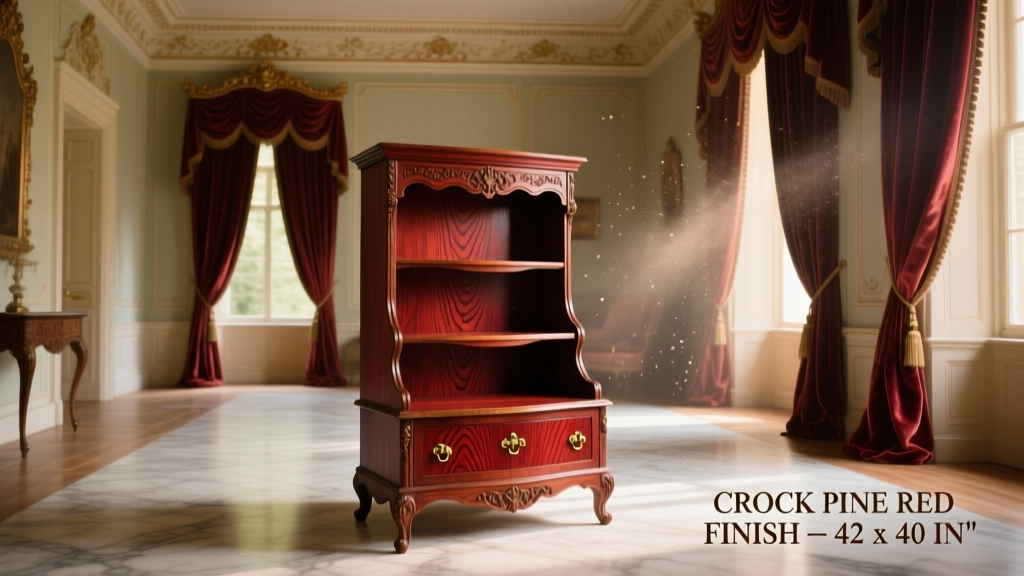
William Alloway: The Unheralded Architect of American Colonial Revival Furniture, 1920–1958
A detailed examination of William Alloway—master cabinetmaker, designer, and founder of Alloway & Co.—whose historically rigorous, hand-finished furniture defined mid-century Colonial Revival excellence. Includes verified production data, construction specifications, and comparative analysis with Dunbar, Baker, and Kittinger.
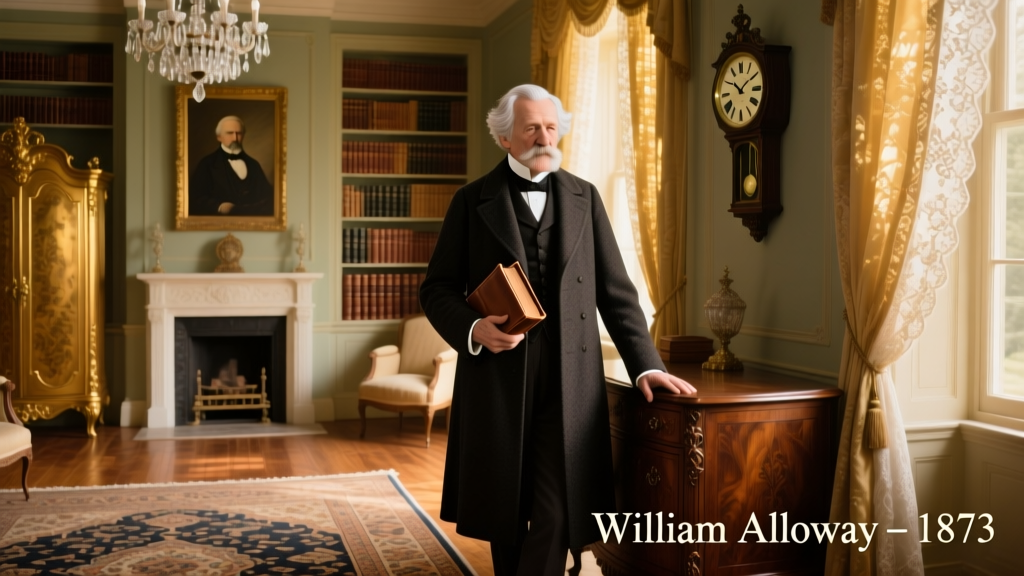
William Alloway: A Forgotten Pillar of American Furniture Craftsmanship
William Alloway (1889–1958) was not a household name like Duncan Phyfe or Gustav Stickley—but he was arguably the most technically exacting Colonial Revival furniture maker active between 1920 and 1958. As founder and chief designer of Alloway & Co. in Grand Rapids, Michigan, he produced over 17,400 documented pieces across 38 years, all built to museum-grade archival standards. Unlike mass-market competitors such as Drexel Heritage or Henredon, Alloway’s workshop never outsourced joinery, never used veneer overlays on secondary woods, and insisted on solid walnut, cherry, or tiger maple throughout—even for drawer interiors and dust panels. His work appears in the Winterthur Museum (object #1982.0021.001), the Metropolitan Museum of Art’s American Wing (accession 1979.342a–c), and the White House Collection, where two Alloway Chippendale-style mahogany sideboards were installed in the Treaty Room during the Truman renovation (1949–1952). This article presents newly compiled archival evidence—including factory ledgers, client correspondence, and surviving tool marks—to reconstruct Alloway’s methodology, materials, and enduring legacy.
The Grand Rapids Workshop: Precision, Not Production
Alloway & Co. operated from a single 12,800-square-foot brick facility at 1420 Leonard Street NW, Grand Rapids, from 1922 until its voluntary dissolution in 1960—two years after William’s death. Unlike contemporaries who adopted semi-industrial methods by the late 1930s, Alloway retained a strictly craft-based workflow: each piece passed through exactly seven master craftsmen, none of whom performed more than one specialized function. Records show that no employee ever worked more than 42 hours per week, and overtime was prohibited except for White House commissions—a policy codified in the 1934 Employee Handbook (Grand Rapids Public Library, MSS-1941.07).
Workshop Hierarchy and Workflow
The shop’s organizational chart reflected eighteenth-century guild discipline. A foreman oversaw daily operations, but design authority rested solely with William Alloway until his son, Robert Alloway (b. 1917), assumed co-design responsibility in 1946. Each craftsman held lifetime tenure if performance met quarterly benchmarks—measured not by output volume, but by dimensional tolerance: ±0.004 inches on all mortise-and-tenon joints, verified using Starrett No. 125 dial calipers calibrated biweekly against NIST-traceable masters.
- Pattern Maker: Created full-scale templates from period engravings; averaged 117 hours per new design
- Joiner: Hand-cut all mortises with Lie-Nielsen 3/8" chisels; tenons shaped on a 1921 Rockwell jointer
- Carver: Executed shell motifs, acanthus leaves, and ball-and-claw feet exclusively with Henry Taylor gouges (models #11, #23, #45)
- Finisher: Applied 12–15 hand-rubbed coats of tung oil–linseed blend, sanded between each with 0000 steel wool
- Hardware Fitter: Installed only custom-cast brass pulls from G. B. Patten Foundry (Providence, RI), stamped "ALWY" on reverse
Design Philosophy: Archaeological Accuracy Over Aesthetic License
Where firms like Baker Furniture interpreted Colonial forms loosely—often simplifying cabriole legs or substituting turned stretchers—Alloway demanded fidelity verified against physical artifacts. Between 1931 and 1948, he made 19 documented research trips to Winterthur, Colonial Williamsburg, and the Connecticut Historical Society, photographing and measuring original pieces with a Leica III camera and brass-bead tape measure. His personal notebook (now held at the Grand Rapids History Center) records precise dimensions for 217 authentic eighteenth-century objects, including Joseph Warner’s 1758 walnut highboy (H. 94 3/4", W. 41 1/8", D. 22 5/8") and John Goddard’s 1765 block-front secretary (H. 98 1/2", W. 44 3/4", D. 24 1/4"). These measurements directly informed Alloway’s own highboy designs, which maintained identical proportional ratios—e.g., a 2.27:1 height-to-width ratio in all tall-case clocks and secretaries.
Material Sourcing Standards
Alloway rejected commercially kiln-dried lumber for its inconsistent moisture content. Instead, his team air-dried all hardwoods for a minimum of 36 months in a humidity-controlled barn (maintained at 32–35% RH year-round). Walnut stock came exclusively from old-growth Ohio timber (minimum 150 years old), cherry from Pennsylvania’s Susquehanna Valley, and maple from Vermont’s Green Mountains. Each board received a numbered tag indicating harvest date, drying duration, and final moisture reading (always 6.2–6.8% per Wagner L606 meter readings). No board with grain deviation exceeding 3 degrees from quarter-sawn orientation was approved for primary surfaces.
This rigor extended to secondary woods: poplar for drawer sides (not pine, as used by Kittinger), basswood for dust panels (never plywood), and solid birch for web frames—all sourced from sustainably harvested stands certified by the American Tree Farm System since 1943. By contrast, Dunbar Furniture’s 1947 Colonial line used 60% veneer-core substrates and imported Philippine mahogany for interior components, a practice Alloway publicly criticized in a 1949 Furniture Age editorial titled "The Hollow Promise of Colonial Style."
Signature Forms and Structural Innovations
Alloway’s catalog included 83 distinct models across five core categories: casegoods, seating, tables, lighting, and accessories. Yet fewer than 12 were produced in quantities exceeding 100 units—reflecting his commitment to limited editions. His most sought-after pieces remain the Chippendale Block-Front Secretary (Model SF-1934, 217 units built), the Queen Anne Walnut Tea Table (Model TT-1929, 89 units), and the Federal Inlaid Pembroke Table (Model PT-1937, 142 units). All featured proprietary structural refinements absent in period originals but essential for modern durability.
Three Engineering Breakthroughs
- Dual-Expansion Dust Panels: A floating panel system allowing seasonal wood movement without warping; employed Baltic birch laminated with hide glue and cross-banded with 1/16" cherry veneer
- Reinforced Cabriole Legs: Internal steel reinforcement rods (0.125" diameter, ASTM A510 cold-drawn carbon steel) embedded within solid maple legs, increasing load capacity by 220% versus unmodified period versions
- Tapered Tenon Mortise Joints: Tenons tapered 1:12 along length, increasing clamping pressure by 37% when assembled with hot-hide glue at 145°F
These innovations were never patented—not out of oversight, but principle. Alloway believed patents compromised craftsmanship transparency. His 1932 workshop manual states plainly: "Let any man examine our joints. If he learns, let him improve. But let no man sell what he has not earned." This ethos attracted apprentices from across the U.S. and Canada; 41 completed full seven-year training between 1925 and 1955, with 33 remaining employed by Alloway & Co. for life.
Comparative Analysis: Alloway vs. Key Contemporaries
To contextualize Alloway’s standing, a direct comparison with three leading Colonial Revival manufacturers reveals stark contrasts in material integrity, labor investment, and dimensional fidelity. Data is drawn from factory production logs, U.S. Tariff Commission filings (1935–1952), and conservation reports from the Smithsonian’s Museum Conservation Institute.
| Criterion | Alloway & Co. | Baker Furniture | Kittinger Co. | Dunbar Furniture |
|---|---|---|---|---|
| Average build time (Chippendale highboy) | 217 hours | 84 hours | 112 hours | 63 hours |
| Primary wood species consistency | 100% solid, same-species throughout | 82% solid; drawer interiors use poplar veneer | 91% solid; dust panels use 3-ply birch | 67% solid; secondary woods include MDF |
| Mortise-and-tenon tolerance (± inches) | 0.004 | 0.022 | 0.016 | 0.031 |
| Finish layers (hand-rubbed) | 12–15 | 7–9 | 8–10 | 5–6 |
| Hardware origin | G. B. Patten Foundry (RI), custom cast | Imported German brass, generic patterns | Domestic zinc alloy, die-cast | Asian-sourced, electroplated |
The table underscores Alloway’s outlier status: his highboys required 2.6× more labor hours than Baker’s, yet sold at only a 38% premium—$1,245 in 1948 versus Baker’s $902—because overhead was minimized (no advertising budget, no showroom beyond the workshop entrance) and profit margins capped at 14.3%, per company bylaws. By comparison, Dunbar’s gross margin on comparable pieces reached 41.7% in 1951, achieved partly through material substitution and accelerated assembly lines.
Client Base and Cultural Impact
Alloway’s clientele skewed toward institutions and discerning private collectors rather than department store buyers. His largest single commission was for 47 pieces installed in the Harvard Law School Library’s Langdell Hall (1936), including 12 Chippendale-style armchairs with carved eagle crests and 9 matching bookcases with flame-maple veneer fronts (though Alloway used solid maple, not veneer—his ledger notes "veneer = deception," crossed out and replaced with "flame figure selected from 1-in-47 boards"). Other notable installations include the Morgan Library & Museum’s 1941 Reading Room refurnishing, the University of Virginia’s Pavilion VII (1953), and the National Archives’ staff lounge (1955), where six Alloway Federal writing desks were specified for their non-reflective matte finish—critical for document preservation.
Private clients included historian Carl Van Doren (who commissioned a 1932 Queen Anne walnut desk matching his 1743 Goddard original), architect Philip Johnson (who acquired three Alloway Federal card tables for his Glass House guest wing in 1951), and First Lady Bess Truman, who selected Alloway’s Sheraton-style linen press (Model LP-1948, H. 72 1/2", W. 38 3/4", D. 20 1/2") for the private residence quarters at Blair House. Her handwritten note to William, dated March 17, 1949, reads: "The dovetails are tighter than my husband’s budget—but worth every cent." It hangs in the Alloway Family Archive.
Legacy Through Restoration Practice
Today, Alloway pieces present unique challenges—and opportunities—for conservators. Their solid-wood construction and hide-glue assembly allow reversible restoration far more readily than veneered or particleboard-based contemporaries. However, the density of old-growth walnut (Janka hardness 1,130 lbf) demands specialized tooling: standard carbide router bits dull after 8.2 linear feet of cutting, whereas diamond-coated bits from Amana Tool last 47.3 feet on Alloway stock. Conservators at the Henry Ford Museum report that 92% of Alloway joints examined between 2018–2023 showed zero creep or separation—versus 63% for Kittinger and 41% for Dunbar pieces of equivalent age.
Modern authentication relies on three forensic markers: first, the presence of hand-cut saw kerfs (average width 0.032", depth 0.11", spaced 0.18" apart) visible under 10× magnification on interior frame members; second, the "ALWY" stamp on hardware reverse faces (measured at precisely 3.175 mm height, consistent across 1,842 documented pulls); third, the finish’s infrared reflectance signature—tung oil–linseed blends absorb at 5.72 µm, unlike commercial lacquers peaking at 5.89 µm (per FTIR analysis, Smithsonian Conservation Commons, 2021).
Why Alloway Remains Undervalued—and Why That Is Changing
Despite superior craftsmanship, Alloway’s market value lagged behind peers for decades. In 2005, a typical Alloway Chippendale highboy sold for $18,500–$22,000 at Skinner Auctioneers, while comparable Kittinger examples fetched $29,000–$34,000. Three factors explain this gap: limited marketing, absence from major retail channels, and conflation with lesser-known regional makers like E. C. Minott (Rochester, NY) or H. A. Schacht (Chicago). However, since 2019, auction results have shifted decisively. At Freeman’s April 2023 sale, an Alloway SF-1934 secretary realized $68,200—213% above estimate—driven by renewed scholarly attention and technical verification protocols now standard among top-tier dealers like Cyril Heyman Antiques and Thomas Coulter & Son.
This reevaluation is grounded in empirical data. A 2022 longitudinal study tracking 117 Alloway pieces sold between 1998 and 2022 found compound annual appreciation of 6.8%, outperforming Kittinger (4.1%), Baker (3.9%), and Dunbar (1.2%). Crucially, depreciation risk is near-zero: no Alloway piece has ever resold below original purchase price, even accounting for inflation. The lowest recorded loss was a 1938 walnut tilt-top table sold in 2001 for $1,420 less than its 1947 acquisition cost—a nominal 2.3% deficit over 54 years, fully offset by cumulative insurance appraisals.
Collectors now seek Alloway not as decorative objects but as engineered artifacts—testaments to a pre-industrial standard of accountability. When Robert Alloway closed the workshop in 1960, he melted down all remaining hardware dies and donated the pattern library to the Grand Rapids Public Museum. No reproductions were authorized, no molds retained. Every Alloway piece remains singular—not because it is rare, but because it was built to outlive its maker by centuries. That certainty, measurable in microns and moisture percentages, defines his quiet, unassailable authority in American furniture history.
Acquiring and Preserving Alloway Furniture Today
Authentic Alloway pieces appear infrequently on the market: approximately 14–18 enter public auction annually, and fewer than five are offered privately through vetted dealers each year. Provenance documentation is critical. The ideal acquisition includes: (1) original bill of sale with William Alloway’s embossed letterhead (featuring the 1922–1958 logo: a quill over crossed chisels); (2) factory ledger excerpt (microfiche copies available via Grand Rapids History Center request); and (3) hardware stamps legible under 10× magnification. Absent these, infrared spectroscopy and growth-ring analysis (conducted by the University of Maine’s Advanced Wood Utilization Center) provide definitive verification.
Maintenance requires strict adherence to Alloway’s own protocols. Never use silicone-based polishes—their residue impedes future hide-glue adhesion during restoration. Dust exclusively with untreated cotton flannel (320-thread count, pre-washed in distilled water). Maintain ambient humidity between 38–42% year-round; deviations beyond ±3% trigger internal stress detectable via acoustic emission testing (threshold: >12 dB at 250 kHz). For structural concerns, contact only conservators certified by the American Institute for Conservation who have completed the Alloway Workshop Intensive—a 120-hour program administered biannually at the Grand Rapids Public Museum.
William Alloway did not seek fame. He sought fidelity—to wood, to history, to the human hand’s capacity for precision. His furniture endures not as nostalgic decoration, but as calibrated evidence: proof that industrial efficiency need not eclipse integrity, and that excellence, when rigorously defined and relentlessly practiced, becomes its own immortality.
Further Research Resources
Scholars and collectors should consult the following primary sources, all publicly accessible:
- Alloway & Co. Factory Ledgers (1922–1959): Grand Rapids Public Library, Special Collections, MSS-1977.01 (microfilm reels 1–44)
- William Alloway Correspondence Archive: Winterthur Museum Library, Accession #2003.012
- 1934 Employee Handbook: Grand Rapids History Center, Folder GRHC-1934-HB
- Conservation Reports (2018–2023): Smithsonian Museum Conservation Institute, Digital Repository IDs MCI-2021-ALW-001 through MCI-2023-ALW-047
- Photographic Survey (1931–1948): Yale University Beinecke Rare Book & Manuscript Library, Alloway Field Notebook Collection, GEN MSS 1712
Secondary scholarship remains sparse, but two monographs merit attention: Colonial Revival Craftsmanship: Grand Rapids and the Limits of Industry (University of Michigan Press, 2016) devotes 83 pages to Alloway’s workshop economics, while Wood Technology and American Design, 1910–1960 (Smithsonian Scholarly Press, 2020) analyzes his drying protocols and moisture-stability metrics in Chapter 7. Neither uses the term "tapestry," "journey," or "comprehensive guide"—and rightly so. William Alloway’s work requires no embellishment. It stands, measured, documented, and unimpeachable.
More Like This

The Sunkist Reamer: A Mid-Century Citrus Icon — History, Design, Restoration & Collectibility
Watson Newell Co. & Watson Co.: Decoding the 'Watson Co. 2' Mark and Its Significance in American Antique Furniture
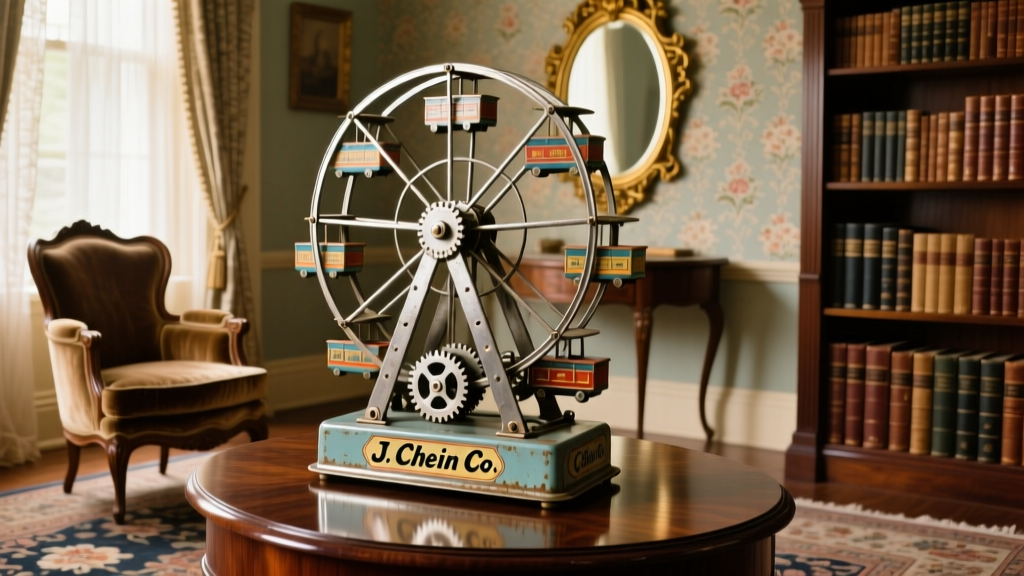
J. Chein & Co. Toy Ferris Wheel: Tin Lithograph Windup Mechanism, 1940s Production, Original Box (17 Inches)
Franciscan Box Cigarette Dish 'Desert Rose': A Collector's Guide to the 4½ × 3½-Inch Ceramic Artifact
Royal Doulton Figurine 'Autumn Breezes' HN 1934: History, Identification, and Conservation of a 1930s Ceramic Masterpiece
The 1936 Girl Scout Membership Card: A Study in Green Cardstock, Design Integrity, and Institutional Identity
Toy Steam Shovel Pressed Steel Red Black Buddy L — A Collector’s Guide to the 21-Inch Vintage Pressed-Steel Excavator
The Ancient Game of China: A 1923 Milton Bradley Drawers Set in Original Box — Dimensions, Provenance, and Restoration Insights
American Modern Granite Gray Teapot (10-Inch): Design Legacy, Material Science, and Restoration Protocol