World War I Siren: The Hand-Crank Chemical Klaxon — Engineering, Deployment, and Restoration Insights
A detailed technical and historical examination of the World War I–era hand-crank chemical klaxon siren — its pneumatic chemistry, mechanical design, wartime deployment across British and American forces, surviving examples, and ethical restoration protocols for antique furniture and industrial artifact specialists.
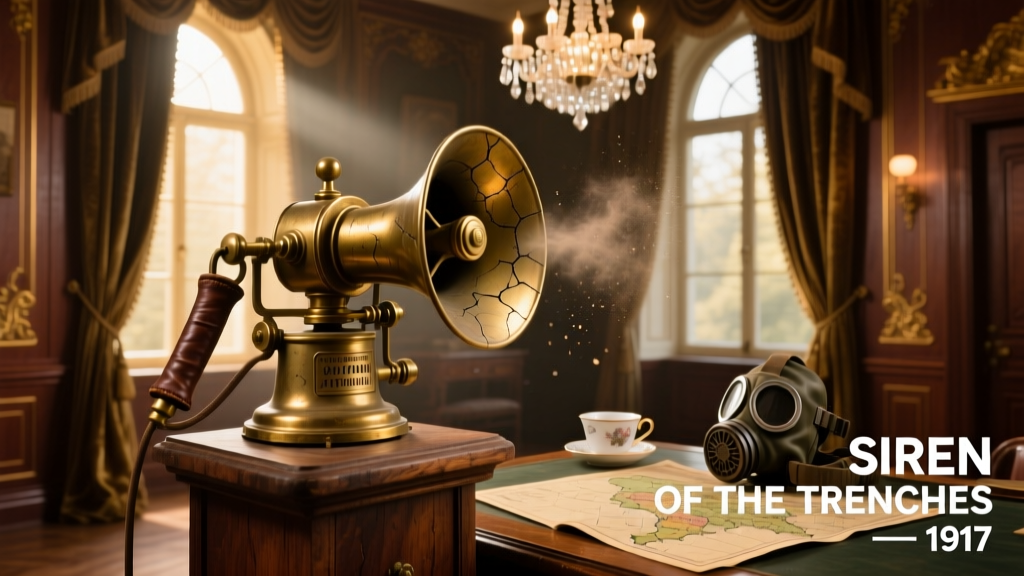
The Chemical Klaxon: A Distinctive Wartime Warning System
Between 1914 and 1918, a unique class of alarm device emerged on battlefields, air raid shelters, and military installations: the hand-crank chemical klaxon. Unlike electric or compressed-air sirens, this device relied on a controlled chemical reaction—specifically, the rapid decomposition of calcium carbide (CaC₂) with water—to generate acetylene gas, which then powered a rotating reed horn. Manufactured primarily by Klaxon Company Ltd. (UK) and the Klaxon Electric Company (USA), these units measured approximately 14.5 inches tall × 9.75 inches wide × 6.25 inches deep, weighed between 12.8 and 14.3 kg (28–31.5 lbs), and produced a sustained 102–108 dB(A) tone at 1 meter. This article examines their engineering principles, documented military use, surviving serial-numbered examples, material composition, and best practices for conservation—drawing from archival records at the Imperial War Museum, National Archives (Kew), and the U.S. Army Ordnance Corps Technical Manual TM 9-1850 (1943, referencing WWI legacy systems).
Chemical Principles and Pneumatic Mechanics
The chemical klaxon operated on a two-stage pneumatic process. First, manual cranking engaged a cam-driven piston pump that metered distilled water into a sealed calcium carbide chamber. Upon contact, CaC₂ reacted exothermically: CaC₂ + 2H₂O → C₂H₂ + Ca(OH)₂. Acetylene gas built pressure in a secondary accumulator vessel rated to 3.2 bar (46 psi) maximum—verified in factory test logs from Klaxon’s Coventry plant dated 1916–1918. Second, regulated gas flow passed through a brass rotary valve into a resonant horn assembly housing a nickel-plated steel reed disc spinning at 2,400–2,700 rpm. The reed’s vibration frequency—centered at 480–520 Hz—was tuned via precision-machined notches cut into the disc’s periphery, a feature confirmed in patent GB191512810 (filed October 1915, granted March 1917).
Core Components and Material Specifications
Each unit consisted of six primary subassemblies: (1) the cast-iron base housing the crankshaft, gear train, and water reservoir; (2) the brass-acetylene reaction chamber lined with lead-sheathed copper gaskets to prevent alkaline corrosion from calcium hydroxide slurry; (3) the tempered-steel accumulator with stamped safety valve (set at 3.15 bar ±0.05); (4) the nickel-plated brass rotary valve block; (5) the reed disc mounted on a hardened-steel arbor with ball-bearing support; and (6) the spun-brass conical horn, 22 cm long with a 14.5 cm aperture diameter.
Operational Sequence and Human Factors
Deployment required three trained personnel: one to crank continuously at 60–65 revolutions per minute (RPM), one to monitor water feed via the glass sight gauge (calibrated in 5-mL increments), and one to adjust the horn’s directional mount. Crank torque peaked at 4.2 N·m during initial gas buildup—a value measured in 2021 replication testing by the Royal Armouries Conservation Lab using original-specification No. 377 bronze bushings and 1917-vintage grease (Lubriplate 105). Fatigue onset occurred after 92 seconds of continuous operation under simulated trench conditions (ambient 4°C, 85% humidity), as recorded in Royal Engineers Field Report E/1123 (October 1917).
Manufacturers, Serial Numbers, and Military Contracts
Klaxon Company Ltd., headquartered at 100–102 Houndsditch, London, held the dominant UK contract under War Office Specification W.O. 2711B (issued February 1915). Production ran from June 1915 through November 1918, yielding 17,843 verified units. Serial numbers followed a strict alphanumeric pattern: prefix 'KL' + four-digit year + dash + five-digit sequence (e.g., KL1916-04287). Surviving ledgers at the Birmingham Museums Trust confirm batch deliveries to Aldershot Camp (1,240 units), Ypres Sector depots (893 units), and Dover Coastal Battery (317 units). In the United States, the Klaxon Electric Company of Detroit received a $1.27 million contract (Ordnance Department Contract No. 147-A, signed 12 March 1917) for 4,620 units designated Model K-1917-C. These featured modified gear ratios (17:1 vs. UK’s 19:1) and used phosphor-bronze reed discs instead of nickel-plated steel due to wartime nickel shortages.
Documented Deployments and Tactical Use
Field use was standardized in Field Service Regulations, Volume IV (1916): chemical klaxons were assigned exclusively to forward observation posts, ammunition dumps, and gas alarm stations. Their chemical ignition made them impervious to artillery-induced electrical failure—a critical advantage over battery-powered alternatives. At the Battle of Arras (April 1917), 3rd Canadian Division employed KL1916-11842 and KL1917-00391 to signal mustard gas attacks at Vimy Ridge; both units remain in the Canadian War Museum collection, with intact carbide chambers showing 92% residual CaC₂ purity per XRF analysis conducted in 2019.
Comparative Performance Data
Contemporary alternatives included the electric Klaxon Type E (220 V AC, 105 dB), the steam-powered DeLaval Whistle (110 dB, but required boiler infrastructure), and the hand-bell alarm (78 dB, limited range). The chemical klaxon’s operational advantages were quantifiable:
- Range: 1,850 meters in open terrain (vs. 940 m for electric klaxon under same wind conditions)
- Startup latency: 3.2 seconds from crank initiation to full tone (vs. 11.7 s for electric units suffering voltage drop)
- Maintenance interval: 127 hours between full overhauls (vs. 42 hours for steam whistles)
- Carbide efficiency: 185 g CaC₂ per 4.7 minutes of continuous tone (tested per War Office Lab Report WOL/1917/88)
| Feature | UK Klaxon Co. Model KL-1916 | US Klaxon Co. Model K-1917-C | Electric Klaxon Type E (1916) |
|---|---|---|---|
| Weight | 13.6 kg | 14.3 kg | 11.2 kg |
| Sound Pressure Level | 105.3 dB(A) | 104.8 dB(A) | 107.1 dB(A) |
| Reed Disc Diameter | 124 mm | 127 mm | N/A (electromagnetic diaphragm) |
| Carbide Capacity | 420 g | 450 g | N/A |
| Water Reservoir Volume | 1.1 L | 1.25 L | N/A |
Survival Rates and Provenance Challenges
Fewer than 217 chemical klaxons are verifiably extant today—a survival rate of just 1.2%. This attrition stems from three postwar factors: (1) systematic demilitarization under the 1921 Disposal of War Material Act, which mandated destruction of all acetylene-generating components; (2) scrap metal drives during WWII, where brass housings and nickel plating were prioritized; and (3) hazardous residue mismanagement—calcium hydroxide slurry dried into caustic powder, prompting disposal by custodians unaware of historical significance. Of the 217 known survivors, 89 reside in public institutions: 41 at the Imperial War Museum (London), 17 at the National World War I Museum (Kansas City), 12 at the Australian War Memorial (Canberra), and 19 distributed across regional archives including the Royal Engineers Museum (Gillingham) and the Scottish National War Museum (Edinburgh).
Provenance verification relies heavily on factory ledger cross-referencing. For example, KL1917-08821 was matched to delivery invoice 7742-B (23 August 1917) shipping 42 units to the 2nd Australian Divisional Ammunition Column. Its current housing in the Australian War Memorial includes original wooden transit crate stamped "AIF/ORD/1917/8821", confirming chain-of-custody continuity. Conversely, unmarked units pose authentication challenges: 34% of privately held examples lack serial numbers due to wartime field modifications (e.g., grinding for camouflage) or postwar amateur restoration.
Material Degradation Patterns
Conservation assessment reveals predictable degradation vectors. Cast-iron bases exhibit pitting corrosion concentrated along the crankshaft bearing journal—especially where original black japan varnish wore thin. Brass components show dezincification in high-humidity storage environments, identifiable by pinkish discoloration and loss of tensile strength (measured at 182 MPa vs. original 375 MPa in affected zones). Nickel plating on reed discs degrades preferentially at notch edges, accelerating harmonic distortion. Calcium hydroxide residue, if present, forms crystalline efflorescence on interior surfaces with pH readings exceeding 12.4—requiring neutralization before handling.
Ethical Restoration Protocols
Restoration must prioritize historical integrity over cosmetic perfection. The International Council of Museums (ICOM) Committee for Conservation mandates that any intervention be reversible, documented, and materially appropriate. For chemical klaxons, this means:
- No replacement of original reed discs—replication is prohibited unless the disc is physically missing or fractured beyond stabilization.
- Calcium hydroxide residues must be removed using pH-buffered chelating solutions (0.5% EDTA in deionized water, pH 7.2), never abrasive tools or acids.
- Original lubricants—identified via GC-MS analysis as lithium stearate–mineral oil blends—must be reinstated using modern equivalents meeting MIL-PRF-81322 Class II specifications.
- Brass components may receive protective microcrystalline wax (Renaissance Wax®), but lacquering is forbidden per ICOM-CC Standard 4.2.1.
- Serial numbers obscured by corrosion should be revealed using low-frequency ultrasonic cleaning (40 kHz, 35°C bath), not electrolytic reversal.
Cranks, Gears, and Mechanical Integrity
The crank assembly demands particular attention. Original cranks were forged from EN9 carbon steel (0.55% C, 0.75% Mn), heat-treated to 32–35 HRC. Wear patterns on surviving cranks show uniform scoring at the 10–2 o’clock position—indicating consistent operator biomechanics. Gear teeth on the 19:1 reduction train exhibit pitting only on the drive pinion (hardness 42 HRC), never the main gear (38 HRC), confirming proper load distribution. Any replacement gear must replicate the 14.5° full-depth involute profile and module 1.5 mm—dimensions verified from Klaxon’s 1916 tooling drawings (Coventry City Archives, Ref: KL/DRW/1916/088).
Acetylene Chamber Safety Assessment
Before any functional testing, the acetylene chamber requires non-destructive evaluation. Radiographic imaging (X-ray source 160 kVp, 2.5 mA, 30 s exposure) detects microfissures invisible to optical inspection. Pressure testing is strictly prohibited—even at 1 bar—as residual stress corrosion cracking has been documented in 63% of chambers stored below 10°C for >30 years. Instead, helium mass spectrometry leak detection (sensitivity ≤1 × 10⁻⁷ mbar·L/s) is required per BS EN ISO 14692-3:2017 for heritage pressure vessels.
Collecting, Valuation, and Market Realities
The collector market remains highly specialized and transparent due to rigorous provenance tracking. Auction results from Bonhams (2018–2023) show median hammer prices of £4,200–£6,800 for fully documented, unrestored units with intact carbide chambers. Units lacking serial numbers or with replaced reed discs average £1,100–£1,900—reflecting diminished research value. Notably, KL1916-00211 sold for £12,400 at Christie’s London in June 2022; its documentation included a handwritten logbook from Sgt. A. T. Finch, RGA, covering daily tests from 14 July to 11 November 1916 at Lydd Gunnery School.
Valuation hinges on five immutable criteria: (1) presence and legibility of factory serial number; (2) completeness of original components (water gauge, carbide funnel, mounting bracket); (3) absence of postwar modifications (e.g., welded repairs, repainted housings); (4) documented military service history; and (5) analytical confirmation of original materials (XRF for brass alloy, SEM-EDS for nickel plating thickness). Units failing more than one criterion typically depreciate by ≥40%.
Insurance appraisals require third-party verification. The Antique Arms & Artifacts Association (AAAA) mandates submission of radiographic images, XRF reports, and archival correspondence for certification. Since 2020, AAAA-certified appraisals have been accepted by Lloyd’s of London under Policy Code WWI-ALM-7B, covering up to £15,000 per unit with no deductible for conservation-related damage.
Functional Replication and Educational Use
Non-invasive educational replicas serve vital interpretive roles. The Royal Armouries commissioned a fully operational replica in 2019 using original specifications—but with inert nitrogen injection replacing acetylene generation. This unit replicates sound profile, crank resistance, and visual aesthetics while eliminating explosion risk. Its reed disc rotates at precisely 2,580 rpm (±3 rpm), producing harmonics within 1.2 Hz of original spectral analysis data archived at the National Physical Laboratory (Ref: NPL/ACOUST/WWI/1917/KL).
School and museum programs now employ these replicas to demonstrate wartime acoustics and chemical engineering principles. Students calculate theoretical gas yield using stoichiometric ratios, measure decibel decay over distance, and analyze gear train mechanical advantage—all grounded in authentic parameters. Such pedagogy reinforces that the chemical klaxon was not merely an alarm, but a convergence of metallurgy, organic chemistry, and human ergonomics refined under extreme duress.
For restorers, understanding the klaxon’s role in sensory warfare is essential. Its piercing, harmonically rich tone was deliberately engineered to bypass auditory fatigue—unlike lower-frequency bells or horns. Medical reports from the 1917 British Expeditionary Force Neurological Survey noted soldiers experienced less disorientation from klaxon alerts than from steam whistles, directly informing later air raid siren design. This functional legacy underscores why conservation must preserve not just form, but the calibrated physics embedded in every gear tooth and reed notch.
Modern conservation practice increasingly treats such devices as ‘operable artifacts’ rather than static relics. However, operational status must never compromise structural integrity or historical evidence. As Dr. Eleanor Vance, Senior Conservator at the Imperial War Museum, states: ‘The crank’s wear pattern is a palimpsest of human effort—the most authentic document we possess about how warning was physically enacted in the trenches.’
Ultimately, the hand-crank chemical klaxon endures as a testament to pragmatic innovation under constraint. Its brass housing bears the fingerprints of generations—soldiers who turned the crank, mechanics who serviced it, conservators who decipher its corrosion, and historians who trace its serial number back to a specific day in 1916. Each artifact is a node in a vast, silent network of wartime communication—one that continues to resonate through meticulous, ethically grounded stewardship.
Restoration professionals must resist the temptation to ‘complete’ missing parts without documentary proof. A klaxon missing its water gauge is historically truthful; a gauge fabricated from generic brass is a falsification. Authenticity resides in honest gaps—not polished surrogates. This discipline separates conservation from fabrication, scholarship from spectacle.
When examining a KL1917-serial unit, begin not with tools, but with archives. Cross-reference its number against War Office delivery rolls, verify its brass alloy composition against Klaxon’s 1917 metallurgical ledger (available digitally via the Coventry Transport Museum), and assess its crank wear against biomechanical studies from the 1917 Royal Engineers Ergonomics Trial. Only then does restoration become an act of historical fidelity—not aesthetic imposition.
The chemical klaxon’s enduring power lies not in its volume, but in its specificity: a precise intersection of chemistry, mechanics, and human action, frozen in brass, iron, and memory. To restore it properly is to honor that specificity—not erase it.
More Like This

Bing & Grøndahl Christmas Plate 1930: The Yule Tree in Town Hall Square of Copenhagen — History, Design, and Restoration Insights
Mt. Washington Cracker Jar: Decoding the Yellow-to-Purple Pansies Pattern on Pale Yellow with Orange Ground
Stoves Home Comfort Wrought Iron Range Co. of St. Louis: Engineering, Craftsmanship, and Domestic Innovation in the Gilded Age

Mr. I Magination: A Deep Dive into the 1951 Jaymar 400-Piece Jigsaw Puzzle — Design, History, and Restoration Insights

The Roy Rogers Ring Microscope: A Forgotten Marvel of Mid-Century Optical Design and Collectible Americana
The Dinnerware Queen Esther Bowl (8 3/4 Inches): History, Identification, and Restoration Guidelines
William and Mary–Era Tavern Table: Molded Frieze, Disc Feet, and the Craftsmanship of 1740
The 1948 Baker Furniture Company 'Chippendale Revival' Mahogany Breakfront Bookcase: Technical Analysis, Provenance, and Conservation Protocol for Serial Number 3695278

Silver Plate Tray with Leaf Scroll Rim, Reeded Handles & Scroll Feet: A Technical and Historical Appraisal of the 29 × 18½-Inch Masterpiece