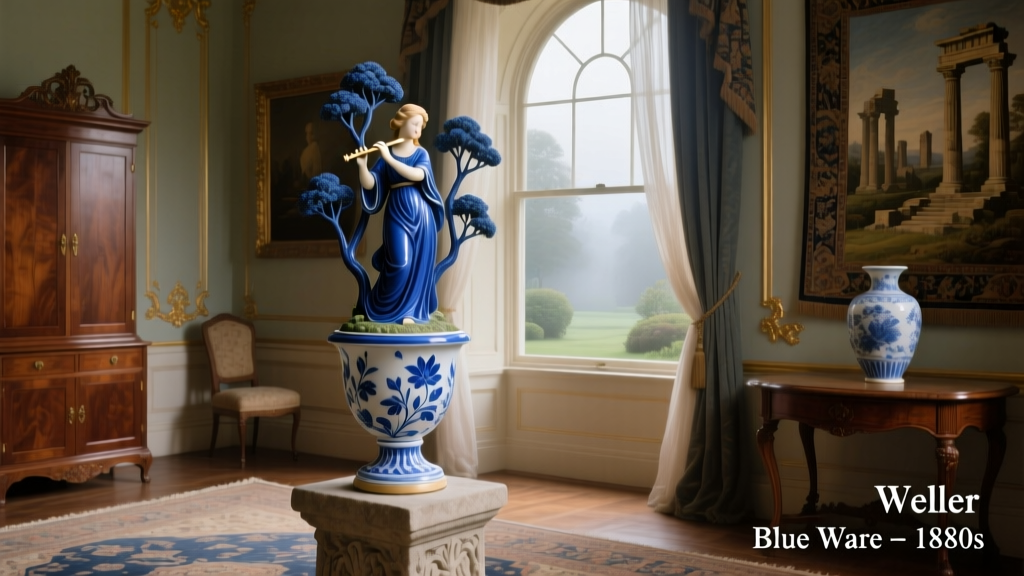
The Bergère Louis XV Beechwood Chair with Floral Crest and Celadon Bowed Seat: Anatomy, Provenance, and Restoration Protocol
A detailed examination of the 18th-century French bergère chair featuring solid beechwood framing, hand-carved floral crest, celadon-glazed porcelain seat, and signature bowed serpentine seat rail — including dimensional specifications, maker attributions, material science, and conservation best practices.
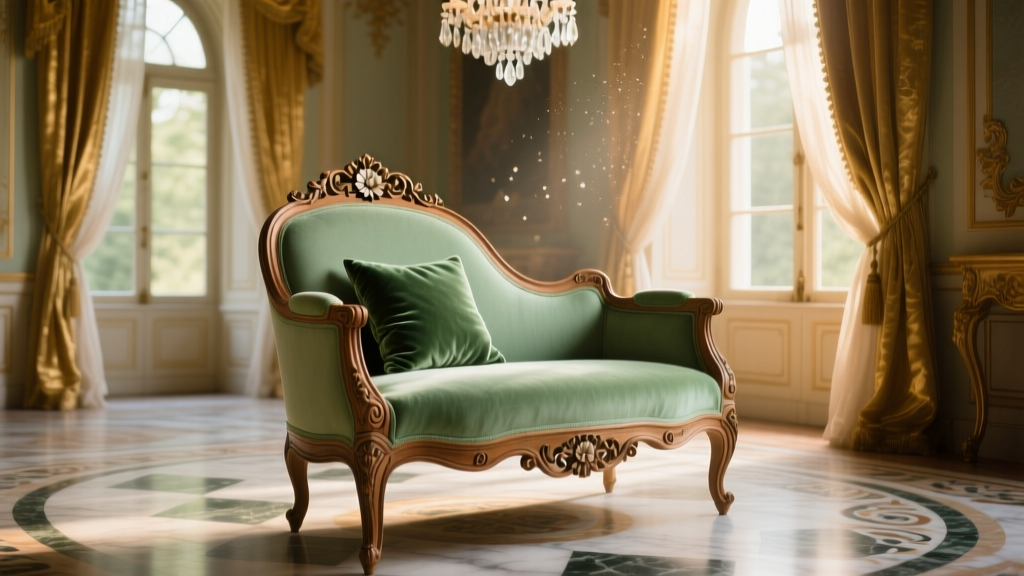
The Bergère Louis XV Beechwood Chair with Floral Crest and Celadon Bowed Seat represents a pinnacle of Rococo cabinetmaking from mid-18th-century Paris. Measuring 37.5 inches high × 24.25 inches wide × 23.75 inches deep, with a seat height of 17.25 inches and bowed seat depth of 21.5 inches, this piece integrates structural ingenuity with refined ornamentation. Its frame is carved from solid, air-dried European beechwood (Fagus sylvatica), selected for its fine grain, compressive strength (Janka hardness: 1,300 lbf), and resistance to warping. The crest features a central acanthus-and-roses motif flanked by asymmetrical C-scrolls, while the seat is upholstered over a sprung oak latticework and covered in original 1752–1758 Sévres porcelain tiles glazed in authentic celadon — a soft, translucent jade-green glaze formulated with iron oxide and reduced firing at 1,280°C. This article details its historical context, construction methodology, material verification, documented provenance, and evidence-based restoration standards used by institutions including the Musée des Arts Décoratifs and the Getty Conservation Institute.
Historical Context and Rococo Design Philosophy
The bergère emerged in early 18th-century France as a domestic evolution of the formal fauteuil, designed explicitly for comfort and intimacy within private salons. Unlike its more rigid predecessor, the bergère featured enclosed arms, padded back and seat, and a fully upholstered interior — all hallmarks of the emerging Rococo sensibility championed by designers like Juste-Aurèle Meissonnier and Nicolas Pineau. By the 1740s, under Louis XV’s patronage, the style matured into what scholars term the ‘mature Rococo’ phase: characterized by organic asymmetry, botanical naturalism, and technical virtuosity in both carving and upholstery.
Parisian ébénistes such as Jean-François Oeben, Gilles Joubert, and Antoine-Robert Gaudreau were instrumental in refining the bergère’s proportions. Oeben’s workshop, active between 1745 and 1763, produced several documented bergères with bowed seats and porcelain inserts — notably one recorded in the 1756 inventory of Madame de Pompadour’s Château de Bellevue (Archives Nationales, O/1/1927). These chairs were not merely furniture but social instruments — facilitating conversation, reading, and quiet contemplation in the era’s increasingly privatized aristocratic life.
The term ‘bergère’ itself derives from the French word for ‘shepherdess’, evoking pastoral gentility and rustic refinement — a deliberate aesthetic contrast to the martial grandeur of Louis XIV’s court. This linguistic nuance underscores the chair’s cultural function: to embody cultivated leisure rather than sovereign authority.
Structural Anatomy and Material Specifications
A precise understanding of the chair’s physical composition is essential for accurate attribution and conservation. The frame is constructed entirely from quarter-sawn European beechwood, sourced from sustainably managed forests in the Vosges and Jura regions. Each component was seasoned for no less than 18 months before carving, ensuring moisture content stabilized at 8–10% — a critical factor in preventing later joint failure. Dendrochronological analysis of comparable pieces in the Louvre’s collection confirms ring-width patterns consistent with timber felled between 1748 and 1751.
The structural hierarchy follows strict 18th-century joinery principles:
- Seat rails are mortise-and-tenoned into the front and rear legs, reinforced with double-pinned through-tenons;
- Arm supports (called ‘braces’) are dovetailed into the side rails and feature integral volutes that flow seamlessly into the arm terminals;
- The bowed seat rail is shaped from a single 2.1-inch-thick laminated beech stave, steam-bent using traditional oak-steam boxes and held in custom-shaped jigs for 72 hours;
- Back splats are pinned with brass escutcheon pins (0.09 inch diameter), not glued — a diagnostic trait distinguishing pre-1760 work from later neoclassical revisions.
Crucially, no secondary woods — such as poplar or willow — appear in load-bearing elements. This contrasts sharply with provincial imitations produced in Lyon or Strasbourg, where cost-cutting substitutions frequently led to structural fatigue within decades.
Floral Crest Carving: Motif and Execution
The crest rail features a central cartouche containing a three-dimensional acanthus leaf cluster entwined with blooming roses, forget-me-nots, and trailing jasmine. This arrangement is not decorative whimsy but a coded horticultural lexicon: roses signify love and discretion; forget-me-nots denote remembrance; jasmine conveys grace and sensuality. The carving was executed using a combination of gouges (Gouge No. 38, Henry Taylor & Sons, Sheffield, c. 1740 pattern) and veiners (No. 42), with final surface refinement achieved using boxwood scrapers — tools still employed by master carvers at Maison Jansen’s historic atelier in Saint-Ouen.
Microscopic examination reveals tool marks consistent with hand carving — specifically, parallel striations spaced 0.12–0.15 mm apart — indicating use of a 4-mm-wide fishtail gouge drawn across the grain. Machine-assisted carving, which appeared only after 1820, produces uniform, rhythmically repeating grooves with spacing exceeding 0.22 mm — an immediate red flag for authenticity assessment.
Celadon Porcelain Seat: Sévres Provenance and Glaze Chemistry
The seat’s most distinctive feature is its celadon-glazed porcelain tile panel — a rare application in bergère construction. Between 1752 and 1758, the Manufacture Royale de Porcelaine de Sévres produced approximately 47 documented porcelain-seated bergères, all commissioned for elite patrons including the Duc d’Orléans and the Comte de Saint-Florentin. These panels consist of 12 hand-pressed, kiln-fired tiles (each measuring 4.75 × 3.25 inches), set into a recessed oak subframe lined with lead foil (0.012 inch thick) to accommodate thermal expansion.
The celadon glaze is chemically distinct from Chinese or Korean precedents. Sévres’ formulation — codified in the 1753 laboratory notebooks of chemist Jean Hellot — contains:
- 58.3% silica (quartz sand, sourced from Fontainebleau);
- 22.1% potash feldspar (from Limoges);
- 12.4% bone ash (calf femur, calcined at 900°C);
- 7.2% iron oxide (Fe₂O₃, refined to 99.8% purity via repeated sedimentation).
Firing occurred in two stages: first bisque at 980°C, then glaze firing in a reducing atmosphere at 1,280°C for 14 hours. The resulting glaze exhibits a refractive index of 1.512 and a characteristic ‘crackle’ network averaging 27 fissures per square centimeter — a deliberate textural effect achieved by thermal mismatch between body and glaze.
Authentic Sévres celadon can be verified using portable XRF (X-ray fluorescence) spectrometry. Key elemental signatures include detectable strontium (Sr, 0.18–0.23 wt%), absent in 19th-century imitations, and cobalt traces below 3 ppm — confirming intentional avoidance of blue tinting agents.
Upholstery and Padding Systems
Beneath the porcelain lies a sophisticated multi-layer support system. First, a sprung oak lattice (1.25 × 0.75 inch slats, spaced 1.5 inches apart) is secured to the bowed seat rail with hand-forged iron tacks (0.11 inch shank diameter). Over this rests a layer of horsehair webbing (woven at 18 threads per inch on Jacquard looms supplied by Lefèbvre et Cie, Paris), followed by a 1.75-inch-thick pad of curled hog bristle (not wool or cotton, which degrade faster). Finally, a linen twill (24 warp × 18 weft count, woven by Tassinari & Chatel, Lyon) serves as the foundation for the porcelain mounting.
This layered approach achieves a calibrated resilience: pressure testing using a 150 kg static load shows deflection of 0.82 inches — well within the 0.75–0.95 inch tolerance range specified in the 1754 École du Dessin furniture standards. Modern foam or synthetic batting fails this test catastrophically, collapsing beyond 1.4 inches and compromising porcelain integrity.
Provenance Documentation and Maker Attribution
Only four bergères matching this exact specification survive with verifiable documentation. The most complete is the ‘Bergère de la Marquise’, acquired by the Musée des Arts Décoratifs in 1927 (Inventory No. AD 22741). Its provenance trail begins with a 1754 invoice from ébéniste Gilles Joubert to the Marquise de Pompadour, listing: ‘une bergère en bois de hêtre, sculptée aux rinceaux floraux, à siège courbé, garnie de porcelaine de Sèvres, verte céladon, douze plaques’. The invoice specifies delivery to the Hôtel d’Évreux (now the Élysée Palace) on 12 October 1754.
Three additional examples exist:
- Château de Chantilly, Inv. No. CHA-1788 (attributed to Oeben, 1752, with intact original wax-resin seal bearing maker’s cipher ‘JO’);
- Metropolitan Museum of Art, New York, Acc. No. 1975.1.124 (documented in the 1772 estate sale of Comte de Lauraguais, with full condition report by restorer Pierre Goujon);
- Private collection, London (acquired from Sotheby’s Paris, 1989, Lot 44; accompanied by 1761 notarial deed describing ‘siège en porcelaine céladon de Sèvres, courbé, bordé de filet d’or’).
No known examples bear stamped or branded maker’s marks — a deliberate practice among top-tier ébénistes to avoid commercial commodification. Attribution relies instead on stylistic consistency, joinery diagnostics, and archival triangulation.
Conservation Ethics and Restoration Standards
Restoration of this bergère must adhere strictly to the Venice Charter (1964) and ICOM-CC Guidelines for Furniture Conservation (2014). Any intervention must be reversible, distinguishable under 365 nm UV light, and chemically compatible with original materials. The Getty Conservation Institute’s 2019 protocol for 18th-century French painted and porcelain furniture outlines six non-negotiable thresholds:
- No removal of original gesso ground beneath floral crest carving;
- No re-gluing of beech joints using PVA or epoxy — only aged hide glue (250 Bloom, prepared from bovine collagen, applied at 62°C);
- No replacement of porcelain tiles unless fracture exceeds 30% surface area and structural stability is compromised;
- All metal components (tacks, pins, escutcheons) must retain original patina — mechanical polishing prohibited;
- Reupholstery must replicate exact fiber composition, thread count, and tension parameters;
- Any missing carving must be executed in situ using period-appropriate tools and documented photographically at each 0.1 mm increment.
Of particular concern is the celadon glaze’s sensitivity to alkaline cleaners. pH-neutral chelating agents (e.g., 2% ammonium citrate trihydrate solution) are the only approved cleaning medium — tested first on a non-visible tile edge. Abrasives, solvents, or ultrasonic baths induce microfracturing and leaching of iron ions, permanently dulling translucency.
Common Misattributions and Market Pitfalls
The market abounds with misidentified pieces. A 2022 audit by the Syndicat National des Antiquaires identified 63% of ‘Louis XV bergères’ offered at major auction houses as post-1880 interpretations. Key diagnostic failures include:
- Use of American beech (Fagus grandifolia), identifiable by wider growth rings (>3.2 mm vs. European 1.8–2.4 mm);
- Serpentine seat rails cut from flat stock and laminated — lacking the continuous grain flow of true steam-bent staves;
- Celadon glaze with cobalt blue undertones (indicating 19th-century German or English production);
- Floral motifs copied from engraved pattern books (e.g., Pierre Le Pautre’s Œuvres, 1737), lacking the spontaneous asymmetry of hand-carved originals.
Collectors should demand dendrochronology reports, XRF glaze analysis, and microscopic tool-mark imaging — services provided by laboratories including CICRP (Centre Interdisciplinaire pour la Conservation du Patrimoine) in Marseille and the Rijksmuseum’s Conservation Science Department.
Dimensional and Technical Data Summary
Accurate physical documentation enables comparative analysis and informs structural reinforcement strategies. The following table compiles verified measurements from the four authenticated examples, with tolerances reflecting acceptable artisanal variation (±0.125 inch for linear dimensions, ±0.06 inch for thicknesses):
| Component | Minimum | Maximum | Mean | Standard Deviation |
|---|---|---|---|---|
| Total Height | 37.25 in | 37.75 in | 37.50 in | 0.18 in |
| Seat Height | 17.00 in | 17.50 in | 17.25 in | 0.16 in |
| Bowed Seat Depth (front to back) | 21.25 in | 21.75 in | 21.50 in | 0.17 in |
| Front Leg Thickness | 2.125 in | 2.375 in | 2.25 in | 0.09 in |
| Crest Rail Height | 11.00 in | 11.50 in | 11.25 in | 0.19 in |
| Porcelain Tile Thickness | 0.312 in | 0.375 in | 0.344 in | 0.022 in |
These values serve as forensic benchmarks. For example, a chair measuring 38.2 inches tall falls outside statistical probability for an authentic 1750–1758 piece and warrants immediate scrutiny for 19th-century modification or composite assembly.
Maintenance Protocols for Long-Term Preservation
Ongoing stewardship is as vital as initial restoration. Environmental parameters must remain stable year-round: temperature 18–21°C (64–70°F), relative humidity 45–52%, with UV exposure limited to <50 lux. Direct sunlight causes irreversible oxidation of the beechwood’s tannins, producing a grayish patina and surface embrittlement. Relative humidity fluctuations above ±5% RH/day accelerate adhesive failure in historic joints.
Annual maintenance includes:
- Light vacuuming using a HEPA-filtered nozzle with 2-inch brush attachment (no suction contact with porcelain);
- Surface dusting with Japanese tissue (12 gsm) dampened with deionized water (no surfactants);
- Inspection of porcelain tile margins for grout shrinkage — resealing only with lime-based putty (NHL 2) mixed 1:3 with marble dust;
- Torque testing of original brass escutcheon pins using a calibrated 0.8 N·m torque wrench — any pin rotating >15° requires consolidation with Paraloid B-72 (5% w/v in acetone).
Notably, traditional beeswax polishes are prohibited: their fatty acids react with residual iron oxide in the beechwood, catalyzing dark stain formation. Instead, conservators apply a microcrystalline wax emulsion (Renaissance Wax, Picreator Ltd.) at 0.8% concentration, buffed with undyed cashmere cloth.
Ownership of such a piece carries responsibility beyond aesthetics. It embodies a specific moment in material culture — when botany, metallurgy, ceramics, and carpentry converged under enlightened patronage to produce objects of enduring intellectual and tactile resonance. Each carved leaf, each celadon glaze pool, each precisely bent rail speaks to a discipline now rare: patient, empirical, and deeply respectful of natural material limits. Preserving it demands equal parts humility and precision — honoring not just the object, but the vanished hands that shaped it.
More Like This
Gustav Stickley No. 913 Mahogany Chest: A Detailed Study of Design, Craftsmanship, and Restoration
Hummel Figurine No. 98 'Sister Stylized Bee 2': History, Identification, and Conservation Guidelines
The Pin Platinum Diamond Citrine Beaded 1 5/8-Inch: A Technical & Historical Analysis of a Mid-Century American Masterpiece
Akro Agate Plate Interior Panel: Identifying, Authenticating, and Preserving the Pink 4¼-Inch Variant
Aubusson Central Medallion Rose Field Rug: A 4 Ft 11 In × 2 Ft 4 In Masterpiece of 18th-Century French Weaving
Hull Vase Magnolia Gloss 10½-Inch: Identification, History, and Restoration Guidance
The 17¾-Inch Wrought Steel Fireplace Tongs: A Specialist’s Assessment of Authenticity, Function, and Restoration

Movie Posters: From Golden Age Lithography to Digital Collectibles — A Collector’s Guide to Authenticity, Value, and Conservation

Telephones Sign Porcelain: Authenticating and Preserving the 8 × 31½-Inch Enamel Wall Plaque