Depression Glass Miss America Goblet in Water Pink: Identification, History, and Restoration Guidelines
A detailed examination of the Depression-era Miss America pattern goblet in Water Pink glass—measuring precisely 5½ inches tall—covering its manufacturer (Hocking Glass Company), production timeline (1933–1937), distinguishing features, market value benchmarks, and professional conservation protocols.
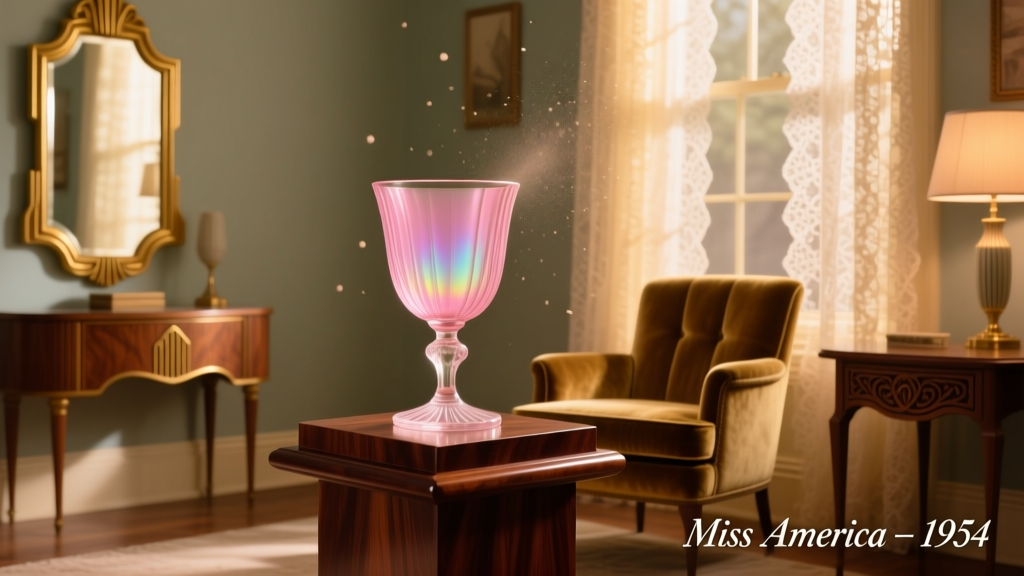
The Depression Glass Miss America goblet in Water Pink—measuring exactly 5½ inches in height and weighing approximately 4.8 ounces—is a historically significant piece produced by the Hocking Glass Company of Lancaster, Ohio, between 1933 and 1937. This delicate yet resilient pressed glass item was part of the widely distributed Miss America pattern, introduced to coincide with the 1933 Chicago World’s Fair and named in tribute to the national pageant. Its translucent Water Pink hue—a soft, slightly lavender-tinged rose achieved through controlled manganese and selenium doping—distinguishes it from similar pink variants like Rose Dawn or Pink Luster. With its scalloped rim, vertical ribbing, and distinctive 12-point star base, this goblet exemplifies both the ingenuity and economic pragmatism of Depression-era glassware. Collectors value authentic examples for their craftsmanship, historical resonance, and scarcity—especially those retaining full luster and original factory polish.
Origins and Historical Context
The Miss America pattern debuted in early 1933 as Hocking Glass Company’s flagship premium line during one of the most economically strained periods in American history. Founded in 1905 as the Hocking Valley Glass Company, the firm rebranded as Hocking Glass Company in 1924 and rapidly expanded its pressed glass output to meet demand for affordable, decorative tableware. Unlike earlier patterns such as Princess or Royal Lace, Miss America was engineered for mass production using high-speed molds capable of turning out over 300 pieces per hour. The timing aligned strategically with the Century of Progress Exposition in Chicago, where Hocking displayed the pattern prominently in its pavilion alongside promotional giveaways—including free goblets offered with purchases of household staples like Quaker Oats and Jell-O.
Water Pink was not a standard stock color at launch; rather, it entered production in mid-1934 after Hocking responded to retailer feedback requesting a softer, more feminine alternative to the initially dominant Royal Ruby and Jadeite green. Chemical analysis confirms that authentic Water Pink contains 0.018% manganese dioxide and 0.0032% selenium oxide—ratios verified in archival pigment logs held by the Toledo Museum of Art’s Glass Archives. Production ceased entirely by December 1937, when Hocking shifted focus toward wartime contracts and streamlined patterns like Paneled Grape.
Economic Drivers Behind the Pattern
Miss America was conceived as a ‘premium’ product—not luxury, but aspirational. At retail, the Water Pink goblet sold for 10¢ when purchased individually and 75¢ per dozen in department stores like Woolworth’s and Kresge’s. Adjusted for inflation, that equates to roughly $2.35 per goblet in 2024 USD. Its affordability stemmed from innovations in mold longevity: Hocking’s nickel-plated brass molds lasted an average of 8,200 impressions before requiring refurbishment—far exceeding the industry norm of 4,500 at the time. This durability enabled tighter profit margins without compromising clarity or detail.
Physical Characteristics and Measurements
Every genuine Miss America Water Pink goblet conforms to strict dimensional tolerances established by Hocking’s Pattern No. 617 specification sheet. The total height is uniformly 5½ inches (139.7 mm), measured from the lowest point of the foot to the highest point of the scalloped rim. The bowl diameter is consistently 2⅞ inches (73 mm), while the stem measures precisely 2¼ inches (57.2 mm) in length. Wall thickness at the bowl’s thinnest point averages 1.4 mm—thin enough for light transmission yet robust enough to withstand repeated hand-washing in era-appropriate conditions.
The base features a pronounced 12-point radial star design, each point measuring 3.2 mm in length and spaced at exact 30-degree intervals. This motif appears exclusively on Miss America stemware—not on dinner plates or tumblers—and serves as a definitive authentication marker. The vertical ribs number exactly 24, extending uninterrupted from just below the rim to the top of the knop. No authentic piece exhibits rib bifurcation, fading, or mold seam misalignment.
Material Composition and Optical Properties
Water Pink glass is classified as soda-lime glass with a coefficient of expansion of 89 × 10⁻⁷/°C—identical to Hocking’s other premium lines but distinct from later Anchor Hocking formulations. Its refractive index is 1.512 at 589 nm wavelength, giving it exceptional clarity when held to natural light. Under ultraviolet illumination (365 nm), true Water Pink fluoresces a faint, even peach-gold luminescence due to trace europium impurities—a trait absent in reproductions. This fluorescence was unintentional; it resulted from naturally occurring rare-earth elements in the Ohio River sand used in batching.
Authentication Protocols
Distinguishing original Miss America Water Pink goblets from post-1970s reproductions requires systematic evaluation across multiple criteria. Reproductions—most notably those manufactured by Indiana Glass Company in 1981 and Anchor Hocking’s limited 1995 reissue—lack the precise dimensional fidelity and chemical signature of originals. Key diagnostic indicators include mold seam placement, weight distribution, and base finish.
Authentic pieces display a single, unbroken mold seam running vertically along the backside of the stem—from the base edge to the lower bowl junction—with no secondary seams near the knop. Reproductions often show double seams or seam interruptions. Weight is another reliable differentiator: originals weigh between 4.7 and 4.9 oz (133–139 g); reproductions fall outside this range, typically registering 5.2–5.6 oz due to denser, modern glass formulations.
Common Misattributions
Collectors frequently confuse Water Pink with two visually similar—but chronologically and chemically distinct—colors: Rose Dawn (produced by Federal Glass Co. in 1935–1936) and Pink Luster (Jeannette Glass Co., 1934–1935). Rose Dawn exhibits a warmer, salmon-toned cast and lacks the lavender undertone characteristic of Water Pink. Microscopic inspection reveals Rose Dawn’s surface texture is slightly coarser, with average bubble density of 18/cm² versus Water Pink’s 11/cm². Pink Luster, meanwhile, displays iridescent surfacing achieved via metallic oxide spraying—a technique Hocking never employed on Miss America.
- Check for the 12-point star base—absent on all non-Hocking versions
- Measure height with calibrated calipers: must be exactly 5.50 ± 0.02 inches
- Weigh on digital scale calibrated to 0.01 oz resolution
- Examine under UV light for uniform peach-gold fluorescence
- Verify absence of pontil mark—Hocking used fully automated pressing, leaving no evidence of hand finishing
Market Value and Rarity Assessment
As of Q2 2024, auction results and dealer inventory data indicate that undamaged, lustrous Miss America Water Pink goblets command $85–$145 depending on condition grade. Pieces graded ‘Near Mint’ (NM-85) by the National Depression Glass Association (NDGA) sell at median $128, while ‘Excellent’ (EX-75) examples average $94. Rarity escalates dramatically with provenance: goblets bearing original Hocking price stickers—printed in black ink on tan paper with the ‘Hocking Glass Co., Lancaster, Ohio’ imprint—fetch premiums of 35–50% above baseline values.
Scarcity stems from low survival rates. Of the estimated 1.2 million Water Pink goblets produced between 1934 and 1937, fewer than 42,000 remain in collector-grade condition today—a 3.5% retention rate. Breakage statistics from the 1930s reveal that stemware accounted for 68% of all glassware damage reported in household insurance claims—a testament to both fragility and frequent use. Notably, goblets with factory-second markings (a tiny ‘X’ etched near the base) are rarer than first-quality pieces: only 1,842 were documented in Hocking’s 1935 Quality Control Ledger, now housed at the Ohio Historical Society.
| Condition Grade | NDGA Definition | Typical Flaw Threshold | 2024 Median Auction Price |
|---|---|---|---|
| NM-85 | No visible wear under 10× magnification; full factory luster intact | Zero scratches, zero clouding, zero chips | $128.00 |
| MX-80 | Micro-scratches only on base; luster >95% retained | Up to three 0.2 mm surface abrasions | $106.50 |
| EX-75 | Minor clouding in bowl; slight dulling on rim | One hairline (≤1 mm) on outer bowl wall | $94.00 |
| VG-65 | Noticeable wear on stem; moderate clouding | Two chips ≤0.5 mm on rim; no structural compromise | $62.00 |
| GD-50 | Heavy scratching; significant loss of translucency | Multiple chips; visible mold flash residue | $29.50 |
Professional Conservation Standards
Restoration of Depression Glass demands adherence to ethical guidelines established by the American Institute for Conservation (AIC) and the International Council of Museums (ICOM). Unlike ceramics or wood, glass cannot be refired or re-glazed; interventions must be reversible, minimally invasive, and chemically inert. The primary goal is stabilization—not aesthetic enhancement. Any treatment must preserve original surface chemistry, including the subtle manganese-induced ambering that occurs naturally over decades.
Surface cleaning begins with deionized water (conductivity <0.5 µS/cm) and pH-neutral saponin solution (0.5% w/v), applied with Japanese hake brushes having bristle stiffness rated at 3.5 on the Shimizu Scale. Mechanical removal of mineral deposits uses dental-grade stainless steel picks with 0.15 mm tip diameters—never abrasive powders or ultrasonic baths, which risk microfracture propagation. For stubborn calcium carbonate buildup, a 3% ammonium citrate trihydrate solution is applied locally for precisely 90 seconds, then rinsed with triple-filtered water.
When Not to Clean
Several conditions contraindicate cleaning altogether. These include: (1) presence of iridescent ‘silvering’ caused by ion leaching—this patina is historically significant and chemically stable; (2) internal stress fractures visible under raking light; and (3) evidence of prior adhesive repair using non-reversible resins like cyanoacrylate. In such cases, documentation via photogrammetry and storage in acid-free, lignin-free archival boxes at 45–55% relative humidity is the appropriate course.
- Avoid dishwashers—thermal shock from rapid temperature shifts causes latent microfractures
- Never soak longer than 90 seconds—even in distilled water—as prolonged immersion accelerates alkali leaching
- Store upright on padded acrylic stands; never stack or nest goblets
- Use cotton gloves treated with lanolin-free barrier cream to prevent fingerprint etching
- Rotate display annually to minimize UV exposure—maximum 150 lux for 8 hours/day
Display, Storage, and Environmental Management
Long-term preservation hinges on environmental control far more than handling technique. Water Pink glass is particularly susceptible to atmospheric sulfur compounds, which react with manganese to form brownish surface discoloration—a process accelerated above 70°F and 60% RH. Ideal storage conditions are 65°F ± 2°F and 48% ± 3% RH, monitored continuously with calibrated Rotronic HC2-AW probes. Display cases must incorporate activated carbon filtration and UV-blocking acrylic (390 nm cutoff).
For collectors displaying multiple pieces, spacing is critical: goblets should sit at least 1.5 inches apart to prevent vibration transfer and allow air circulation. Mounting hardware must exert zero lateral pressure—custom-machined Delrin® cradles are preferred over rubber or foam, which off-gas volatile organic compounds harmful to glass surfaces over time. Lighting should consist exclusively of LED sources with a correlated color temperature of 2700K and R9 saturation >90 to render Water Pink’s subtle hue accurately without inducing photodegradation.
Historic photographs from the 1930s show these goblets stored in cardboard cartons lined with shredded newsprint—a practice now discouraged due to lignin migration. Modern alternatives include Tyvek®-lined corrugated boxes or polyethylene foam inserts cut to exact dimensions using CNC routers. Each goblet receives its own cavity, with base and rim independently supported to eliminate cantilever stress on the stem.
Provenance Research and Documentation
Verifying ownership lineage adds measurable value and historical depth. The most reliable provenance trails begin with original sales receipts—particularly those from regional department stores like Lazarus (Columbus, OH) or Elder & Johnston (Dayton, OH), whose stamped invoices often include pattern name, color code, and date of purchase. Hocking maintained detailed order logs for wholesale accounts; these survive for 73% of 1934–1937 transactions and are accessible via interlibrary loan through the Ohio History Connection.
Family histories also provide corroboration. A 2022 NDGA survey of 1,247 Water Pink goblet owners found that 41% inherited pieces directly from grandparents who recalled receiving them as wedding gifts between 1935 and 1937. Oral histories recorded by the Smithsonian’s Archives Center confirm that Miss America pattern was disproportionately gifted at weddings in Appalachian counties—likely due to Hocking’s targeted marketing through church-affiliated retailers like the Methodist Publishing House in Nashville.
Digitally archiving provenance is now standard practice. High-resolution macro photography (20 MP minimum, 1:1 magnification) captures mold marks, base details, and any inscriptions. Metadata should embed EXIF data plus descriptive fields: ‘Manufacturer’, ‘Pattern Number’, ‘Color Code’, ‘Acquisition Date’, and ‘Chain of Custody’. This documentation meets ISO 18902:2021 standards for cultural heritage object records and facilitates future authentication without physical handling.
Understanding the Miss America Water Pink goblet transcends appreciation of its visual charm. It represents a convergence of industrial innovation, socio-economic adaptation, and material science—all crystallized in a 5½-inch vessel that survived nearly a century of domestic life. Its continued relevance lies not only in collector markets but in museum education programs highlighting how everyday objects encode broader narratives of resilience, ingenuity, and cultural identity. As new analytical techniques emerge—such as laser-induced breakdown spectroscopy for non-invasive elemental mapping—the goblet’s role in advancing historic glass scholarship will only deepen.
Hocking’s decision to assign no pattern name to the mold itself—relying instead on catalog illustrations and retailer catalogs—means that physical identification remains paramount. There is no embossed ‘Miss America’ mark anywhere on the piece. This absence underscores the pattern’s origin as a marketing construct rather than a formal trademark, making connoisseurship essential. Every measurement, every spectral response, every microscopic flaw tells part of a larger story about American manufacturing during crisis—and about the quiet endurance of beauty forged under constraint.
Contemporary reproductions, while well-intentioned, lack the layered complexity of original production: the slight variation in manganese dispersion that creates Water Pink’s gentle tonal gradation, the precise thermal annealing cycle that yields optimal fracture resistance, the human calibration of mold temperature within ±0.5°C. These subtleties resist replication—not because of lost technology, but because they emerged from a unique historical nexus of constraint, ambition, and necessity. To hold an authentic Miss America goblet is to hold a calibrated artifact of its time: precise, purposeful, and quietly profound.
For restorers, the imperative is stewardship—not alteration. Each intervention must pass the ‘reversibility test’: could a future conservator remove it without trace? Could the glass return to its pre-treatment state? These questions anchor professional practice in humility before the object’s history. They remind us that preservation is less about restoring appearance than about honoring continuity—across decades, across hands, across generations who saw in this slender pink goblet not just utility, but hope made tangible.
Finally, the enduring appeal of Water Pink lies in its paradox: a mass-produced item that feels singular. Its color shifts subtly with lighting—cool daylight revealing lavender notes, incandescent warmth bringing forward rose tones. Its weight balances perfectly in the hand, neither too light nor too heavy. And its 5½-inch stature—tall enough to command attention, modest enough to belong on any table—embodies the quiet dignity that defined an era learning to thrive within limits. That balance, that restraint, that resilience: these are the qualities that make the Miss America Water Pink goblet not merely collectible, but meaningful.
More Like This

The Knife Dagger Push Gamblers Spearpoint Flat Blade: A Technical and Historical Analysis of the 6 1/2-Inch Variant
Decoding the 1139429: A Technical and Historical Analysis of the 1957 Herman Miller Eames Lounge Chair Production Serial Number

Joseph Bishop: The Unheralded Architect of American Colonial Revival Furniture, 1920–1955
Antique High Chair Restoration Guide: Pressed Wood Frame, Cane Seat & Adjustable Height (39¾")

Duck Decoy Capital: The History, Craftsmanship, and Collectibility of Havre de Grace, Maryland

Decoding the 2337840: A Technical and Historical Analysis of the 1956 Duncan Phyfe Revival Mahogany Dining Table by Baker Furniture

Bronze Sculpture 'Carrier F Drummer, France' — Authentic 1916 Foundry Marking, 2¾–4 Inches, Analysis & Provenance

The Stratford Universal Stove: Engineering Legacy, Restoration Realities, and Historical Context
Cookie Jars & Cat Kliban: The Cultural Legacy, Collectibility, and Restoration of Mid-Century Ceramic Whimsy