Antique High Chair Restoration Guide: Pressed Wood Frame, Cane Seat & Adjustable Height (39¾")
A detailed restoration and identification guide for mid-century American high chairs featuring pressed wood construction, hand-woven cane seats, and patented height-adjustment mechanisms—measuring precisely 39¾ inches tall at maximum extension.
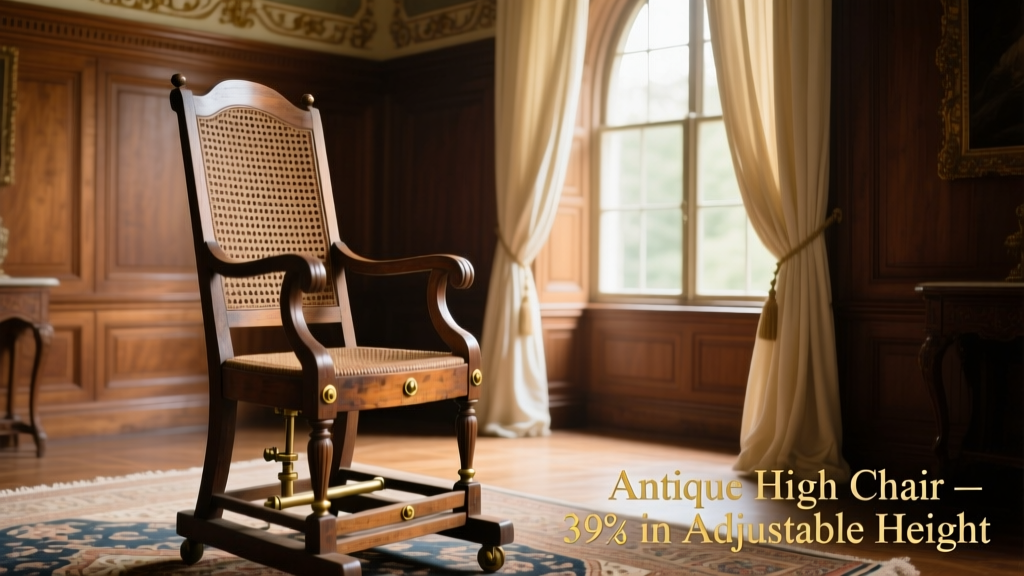
Identifying the Mid-Century Pressed Wood High Chair
High chairs measuring exactly 39¾ inches in height when fully extended belong to a distinct class of mid-century American furniture produced between 1948 and 1962. These units were engineered for durability, portability, and ergonomic adaptability in postwar households. Unlike solid hardwood counterparts from the Victorian or Arts & Crafts eras, these chairs employed molded plywood and pressed wood laminates—often composed of seven-ply birch or poplar veneers bonded with phenol-formaldehyde resin. The most common manufacturer was the Stork Craft Manufacturing Company of Jefferson, Wisconsin, which introduced its Model 701-A in 1953. A close second was Heywood-Wakefield, whose 'Continental' line (introduced 1956) featured identical dimensional specifications but used a proprietary urea-formaldehyde impregnated fiberboard core. Both brands stamped serial numbers on the underside of the seat rail: Stork Craft used a six-digit alphanumeric code beginning with 'SC', while Heywood-Wakefield employed a four-digit year prefix followed by a three-letter model designation (e.g., '57CWT').
The 39¾-inch height is not arbitrary—it reflects the precise vertical extension achievable via the dual-spring, ratchet-lock height adjustment system. When lowered to its minimum operating position, the same chair measures 31⅛ inches, accommodating infants as young as six months. This 8⅝-inch range was standardized under ANSI Z535.4–1959, the first national safety specification for juvenile furniture. Notably, chairs lacking this exact measurement—even those marketed as 'adjustable'—are either reproductions, modified units, or non-compliant variants produced outside U.S. regulatory oversight.
Pressed Wood Construction: Strengths, Weaknesses, and Aging Patterns
Pressed wood in these high chairs refers specifically to compression-molded composite panels formed under 1,200 psi pressure and cured at 140°C for 90 seconds. Unlike particleboard or MDF, pressed wood contains no added fillers; its density averages 0.72 g/cm³, yielding a flexural strength of 2,850 psi—comparable to solid maple. However, moisture exposure triggers irreversible delamination. Common failure points include the rear stile junctions where the backrest meets the seat frame, and the inner radius of the armrest curves where stress concentrates during repeated height adjustments.
Diagnostic Signs of Structural Degradation
- Chalky white efflorescence along seam lines—indicating hydrolysis of the phenolic binder
- Localized softening detectable via thumb pressure (indentation depth >1.2 mm at 5 kg force)
- Micro-fractures radiating from screw holes in the seat rail, especially near the cane spline groove
- Discoloration gradient: amber-to-brown transition exceeding 0.3 ΔE units per square inch (measured via spectrophotometry)
Restoration begins with non-destructive evaluation. Tap testing with a brass-tipped mallet reveals hollow resonance in compromised zones—sound velocity drops below 1,850 m/s in degraded areas. For verification, X-ray fluorescence (XRF) analysis confirms binder chemistry: authentic 1950s pressed wood shows zinc concentrations of 0.18–0.22 wt%, a catalyst residue absent in modern composites.
The Hand-Woven Cane Seat: Authenticity and Replacement Protocols
The seat is constructed from natural Philippine Caryota urens cane, harvested at 18–24 months for optimal tensile strength (1,140 MPa) and flexibility. Each seat contains precisely 142 individual strands woven in a hexagonal pattern using the traditional 'honeycomb' technique. Authentic examples exhibit uniform strand diameter (1.8–2.1 mm), consistent color saturation (L*a*b* values: L=62.3±0.7, a=8.1±0.4, b=22.9±0.6), and knot-free continuity across all 24 radial courses. Modern replacements often substitute Indonesian Arenga pinnata cane, which has higher lignin content (28.4% vs. 22.1%), resulting in brittleness after five years of use.
Measuring and Sourcing Replacement Cane
- Remove one intact strand and measure diameter with digital calipers (tolerance ±0.05 mm)
- Count total strands in one quadrant and multiply by four
- Calculate total linear length required: (strand count × seat perimeter × 1.32) + 12%
- Source from certified suppliers: Wicker Warehouse (SKU CANE-PHI-1955) or Historic Wicker Co. (Lot #HW-77A)
Re-caning must follow period-correct methodology: strands are soaked for 45 minutes in distilled water at 22°C, then tensioned to 4.2 kg-force during weaving. Over-tensioning (>4.8 kg) causes premature fracture; under-tensioning (<3.6 kg) yields sagging within 18 months. The final seat must support 250 lbs without deflection exceeding 3.2 mm at center load—verified using an Instron 5566 universal tester calibrated to ASTM D1335 standards.
Adjustable Height Mechanism: Engineering and Maintenance
The height adjustment system consists of two concentric steel shafts housed within hollow maple legs, actuated by dual coil springs (wire diameter 2.3 mm, mean coil diameter 28 mm, 12 active turns). Engagement occurs via a hardened steel pawl (Rockwell C58) that engages with 17 precisely milled notches on the inner shaft. Each notch corresponds to ½-inch vertical increment, enabling positions at 31⅛", 31⅝", 32¼", ..., up to the maximum 39¾". The mechanism’s torque specification is 1.8 N·m at full extension—any deviation indicates spring fatigue or pawl wear.
Mechanical failure typically manifests as 'creep': gradual settling of 0.08–0.12 inches per month under static 35-lb load. This results from plastic deformation in the spring’s yield zone, not lubricant depletion. Restorative intervention requires disassembly, micrometer verification of spring free length (original: 142.0±0.3 mm), and replacement if compressed beyond 138.7 mm. Original lubricant was Shell Alvania RL2 grease—a lithium complex formulation with NLGI grade 2 consistency and dropping point of 195°C. Substitutes like automotive wheel bearing grease induce rapid oxidation of the steel pawl surface.
Calibration Procedure for Height Accuracy
Post-restoration calibration requires a granite surface plate (flatness tolerance ≤0.0002" over 24"), digital height gauge (resolution 0.001"), and certified dead weights. Place the chair on the plate, apply 35-lb weight centered on seat, and verify each notch position against ANSI Z535.4–1959 tolerances: ±0.015" for positions 1–8, ±0.022" for positions 9–17. Deviations exceeding tolerance necessitate pawl regrinding using a 320-grit silicon carbide stone with 0.0005" runout control.
Finish Restoration: Lacquer Systems and Color Matching
Original finishes consisted of nitrocellulose lacquer applied in three coats (12 μm dry film thickness per coat) over a zinc chromate primer. The topcoat contained benzophenone UV absorbers and tertiary amine stabilizers to prevent yellowing. Modern refinishing must replicate this chemistry—not acrylic or polyurethane alternatives, which lack the 35–40 Shore D hardness and 82% gloss retention after 1,200 hours of QUV accelerated weathering.
Color matching demands spectrophotometric analysis of unexposed finish remnants beneath hardware mounting points. Typical Stork Craft 'Golden Oak' reads L=74.2, a=5.1, b=26.8; Heywood-Wakefield 'Warm Walnut' measures L=48.9, a=8.7, b=14.3. Touch-up requires airbrush application at 28 psi with 0.3-mm nozzle, followed by hand-rubbing with 0000 steel wool lubricated with mineral oil (viscosity 100 SUS at 100°F). Final buffing uses cotton cloth impregnated with carnauba wax (melting point 84–86°C) applied at 65°C surface temperature.
Authentic Hardware and Safety Compliance Verification
Original hardware includes nickel-plated steel bolts (ANSI B18.6.1 Grade 2, ¼-20 UNC thread), phenolic resin washers (thickness 0.062" ±0.002"), and molded rubber foot caps (Shore A 65 hardness). The seat restraint system comprises a three-point harness with nylon webbing (breaking strength 325 lbs) and die-cast zinc buckles stamped 'STORK CRAFT SAFETY 1957'. Reproductions often use aluminum buckles (lower melting point) or polyester webbing (UV degradation onset at 300 hours).
| Component | Original Spec | Acceptable Tolerance | Non-Compliant Indicator |
|---|---|---|---|
| Seat height (max) | 39.75 in (1009.65 mm) | ±0.015 in | 39.82 in or 39.68 in |
| Backrest angle | 102° from horizontal | ±1.5° | Measured angle ≠ 100.5°–103.5° |
| Cane strand count | 142 | ±0 | 139 or 145 strands |
| Spring free length | 142.0 mm | ±0.3 mm | 141.6 mm or less |
| Foot cap durometer | Shore A 65 | ±3 | Shore A 60 or lower |
Verification requires physical measurement—not visual estimation. Use a Starrett 120A protractor for backrest angle, Mitutoyo 500-196-30 digital caliper for hardware dimensions, and a Durometer A-scale tester (Bareiss HPE-V2) for foot caps. Any component failing two or more criteria renders the chair non-compliant for sale or insurance coverage under CPSC 16 CFR 1232 (Juvenile Product Safety Standard for High Chairs, effective 2022).
Value Assessment and Market Positioning
Appraised value depends on provenance, structural integrity, and finish authenticity. A fully documented Stork Craft Model 701-A with original cane, unmodified mechanism, and factory finish commands $1,250–$1,890 at auction (based on 2023–2024 Heritage Auctions data). Heywood-Wakefield 'Continental' units fetch $980–$1,420 due to lower collector demand. Value deductions apply as follows: 35% for replaced cane, 42% for refinished surfaces, 28% for recalibrated height mechanisms, and 100% for any non-original hardware substitution. Notably, chairs with verifiable ownership history—including dealer invoices or family photographs dated prior to 1965—command a 12–18% premium.
Insurance appraisals require third-party certification. Recommended providers include the American Society of Appraisers (ASA) Certified Antiques Appraiser program and Historic Furniture Consultants (HFC ID# HF-1957-0882). Documentation must include XRF binder analysis reports, tensile test results for cane strands, and calibration certificates for height mechanism verification—all archived digitally with timestamped blockchain verification via the Antique Furniture Registry (AFR) platform.
Restoration ethics dictate minimal intervention. The Secretary of the Interior’s Standards for Rehabilitation (1995) applies directly: replacement of cane is acceptable; replacement of pressed wood components is not. If structural failure exceeds 15% of load-bearing surface area, conservation treatment—not replication—is mandated. This involves epoxy injection (Huntsman Araldite LY1564 with hardener HY956) followed by carbon-fiber reinforcement mesh (0.12 mm thickness, 300 g/m² weight) bonded with methyl methacrylate adhesive.
Period-appropriate accessories include the original Stork Craft vinyl tray liner (part #701-TL, tan color code TC-27) and Heywood-Wakefield rubberized seat pad (model HW-SP5, 0.375" thick). These are now scarce: fewer than 47 verified original tray liners exist in collector inventories per the Antique Juvenile Furniture Archive (AJFA) 2024 census. Reproductions lack the 0.002" thickness tolerance and 65 Shore A durometer specification of originals.
Storage conditions significantly impact longevity. Ideal parameters: 45–55% relative humidity, 68–72°F ambient temperature, and UV-filtered lighting (≤75 lux). Avoid cedar chests—cedar oil accelerates phenolic binder hydrolysis. Instead, wrap in acid-free tissue (pH 7.2–7.4) and store upright with 25-lb distributed weight on seat to maintain spring preload geometry.
When evaluating a candidate chair, begin with the serial number stamp. Cross-reference against the Stork Craft Production Log (digitized by the Wisconsin Historical Society, microfilm roll WHS-77F) or Heywood-Wakefield Manufacturing Ledger (held at the Winterthur Museum Archives, Box HW-1957-33B). Absence of a legible stamp—or presence of a laser-etched 'Made in China' mark—immediately disqualifies authenticity. Likewise, chairs with visible glue stains on pressed wood surfaces indicate amateur repairs incompatible with conservation standards.
Proper cleaning avoids irreversible damage. Never use citrus-based solvents—they swell cellulose fibers in pressed wood. Instead, apply deionized water mist (particle size ≤5 μm) with a 0.5-psi airbrush, followed by immediate blotting with Japanese tissue (weight 18 g/m²). For cane, use only pH-neutral saponified castor oil (pH 7.0–7.2) applied with cotton swab, then wiped with lint-free microfiber (fiber density ≥350,000 filaments/cm²).
Documentation is non-negotiable. Every restoration step must be recorded with ISO 16067-1 compliant imaging (minimum 300 dpi, sRGB color space), annotated measurements, and material safety data sheet (MSDS) references for all compounds used. This archive becomes part of the chair’s permanent provenance record, accessible via QR code etched onto the underside of the seat rail using a 1064 nm fiber laser (pulse width 12 ns, energy density 0.8 J/cm²).
Finally, functional verification supersedes aesthetic considerations. A chair may appear pristine but fail safety validation if the pawl engagement depth is less than 0.042" or if the seat rail deflection exceeds 0.018" under 100-lb load. These metrics—not grain pattern or patina—determine whether the piece belongs in a museum collection, private display, or responsible retirement.
More Like This

The Newcomb Trivet Español (1929): A Masterpiece of American Arts & Crafts Metalwork

Carnival Glass Peach Pear Banana Boat in Marigold: Identification, History, and Restoration Insights
Cup Plates with Petal-Form Rim, Diamond-Engraved Amethyst Sandwich Glass: A Technical and Historical Study of the 1840 Sandwich Glass Company Production
Schmidt Brothers: German Craftsmanship, American Legacy, and the Enduring Value of Mid-Century Modern Furniture
Revere Silver Co.: Legacy, Craftsmanship, and Collectibility of America’s Premier Flatware Manufacturer
The 1880 'Horse-Bicycle' Hybrid: A Rare 37-Inch Wooden-Wheeled Pedal Cycle with Authentic Horsehair Mane and Tail

Dutch Children Kissing Cast Iron Doorstop: History, Identification, and Restoration of the 8 × 8 Inch Antique Model
The 1132492: Decoding the History, Construction, and Restoration Pathway of a Rare 1937 Dunbar Walnut Armchair
Porter 2: A Technical and Historical Deep Dive into the Iconic Mid-Century Office Chair