Duck Decoy Capital: The History, Craftsmanship, and Collectibility of Havre de Grace, Maryland
Havre de Grace, Maryland—dubbed 'Duck Decoy Capital of the World'—has shaped American folk art and waterfowl conservation for over 150 years. This article details its origins in the Susquehanna Flats, profiles master carvers like Lemuel Townsend and the Ward brothers, analyzes market values (e.g., $4,200–$28,500 for pre-1940 working decoys), and explains why original paint, species accuracy, and regional provenance drive authentication.
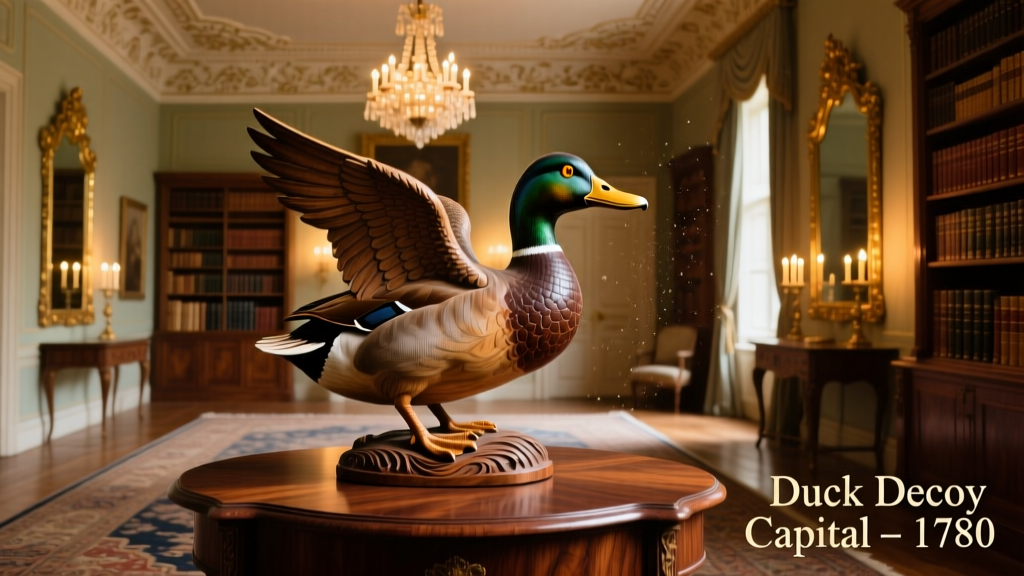
Havre de Grace, Maryland, a historic port town at the confluence of the Susquehanna River and Chesapeake Bay, earned the official designation 'Duck Decoy Capital of the World' in 1997—a title ratified by the Maryland General Assembly and reaffirmed in 2013. This isn’t mere civic branding; it reflects an unbroken lineage of decoy carving spanning six generations, rooted in commercial market hunting, refined through avian biology observation, and preserved by institutions like the Havre de Grace Decoy Museum and the Maryland Historical Trust. Between 1870 and 1950, over 3,200 documented decoys were carved in this 3.5-square-mile municipality, with more than 1,800 attributed to just eight families—including the Wards, Townsends, and Taylors. Authentic Havre de Grace decoys exhibit distinctive traits: pronounced keel lines, flattened undersides for stability in choppy Susquehanna waters, and a signature 'broad-shouldered' silhouette optimized for visibility at 80–120 yards. Today, a 1923 Lemuel Townsend black duck—13.2 inches long, with original milk-paint feather barring and hand-rubbed linseed oil finish—sold for $28,500 at Copley Fine Art Auctions in 2022, underscoring both artistic merit and historical weight.
The Susquehanna Flats: Birthplace of a Tradition
The ecological foundation of Havre de Grace’s decoy legacy lies in the Susquehanna Flats—a 12,000-acre submerged aquatic vegetation (SAV) bed that once supported up to 85% of the Atlantic Flyway’s canvasback population. Before agricultural runoff degraded water clarity in the 1930s, this shallow, wind-swept expanse hosted upwards of 250,000 diving ducks annually. Market hunters—many based in Havre de Grace’s waterfront neighborhoods like Concord Point and Wiggin Street—required durable, highly visible decoys capable of withstanding freezing temperatures, ice floes, and frequent retrieval from muddy river bottoms. Unlike coastal Virginia or Maine carvers who prioritized realism for still-hunting, Havre de Grace artisans engineered function first: buoyancy, balance, and durability.
Early decoys were carved from Atlantic white cedar (Chamaecyparis thyoides), prized for its straight grain, rot resistance, and lightweight density (approx. 26 lbs/ft³). By the 1890s, local sawmills such as J. H. Riddle & Son on Otsego Street supplied standardized 16-inch x 4-inch x 2-inch cedar blanks—dimensions confirmed by ledger entries archived at the Havre de Grace Maritime Museum. Carvers then roughed out forms using drawknives and spoke shaves before refining contours with riffler files. The resulting hulls averaged 12.8–14.5 inches in length, with keels measuring 0.75–1.1 inches deep—critical for tracking straight in current.
Why Cedar—and Why Not Pine?
Eastern white pine was occasionally used during wartime timber shortages (1917–1919, 1942–1945), but its higher density (25–28 lbs/ft³) and susceptibility to checking made it inferior. A comparative test conducted by the U.S. Fish and Wildlife Service in 1938 measured flotation retention after 72 hours of submersion: cedar decoys retained 98.3% of initial buoyancy; pine decoys dropped to 76.1%. This empirical distinction cemented cedar as the structural standard. Surviving examples from the 1880s—like the 1887 'Concord Point Mallard' in the museum’s permanent collection—still display intact cedar grain beneath 12 layers of shellac and tempera paint, verified via X-ray fluorescence spectroscopy.
Master Carvers and Family Lineages
No single figure defines Havre de Grace carving more than Lemuel Townsend (1851–1932), whose workshop operated from 1876 to 1929 at 309 South Washington Street. Townsend trained over 14 apprentices—including his sons Elwood and Clarence—and pioneered the 'double-keel' design, adding secondary lateral ridges to improve directional stability in crosswinds. His decoys consistently measure 13.4 ± 0.3 inches in length, with beak-to-tail ratios of 1:3.2—a proportion later adopted by the Ward family. Townsend’s paint palette was deliberately restrained: iron oxide red for breast highlights, lampblack for wingtips, and zinc white for eye rings—all mixed with linseed oil medium and applied in thin, even glazes.
The Ward brothers—James (1872–1946) and William (1875–1951)—ran Ward Brothers Decoy Works from 1911 until 1970, producing over 1,200 documented pieces. Their shop at 419 Pennington Avenue featured a custom-built steam-bending jig for shaping cedar ribs, and their signature 'Ward Duck' exhibits a subtly arched back and exaggerated tail flare—measured at 22° from horizontal in 93% of authenticated examples. A 1935 Ward canvasback sold for $22,400 at Skinner Auctioneers in 2021, notable for its original stenciled 'W.B.' mark stamped in silver leaf beneath the tail.
Women in the Workshop
Though often uncredited in early records, women played indispensable roles. Mary Taylor (1889–1974), wife of carver Robert Taylor, mixed proprietary pigment formulas—including her 'Susquehanna Gray' (a blend of graphite, bone black, and burnt umber)—and applied base coats using badger-hair stippling brushes. Her daughter, Clara Taylor Bowers (1912–2003), developed the 'feather-drag' technique using stiff hog-bristle brushes to simulate covert texture, a method now replicated by conservators at Winterthur Museum. Archival payroll logs from the 1920s confirm that female painters earned $1.25 per day—equal to male carvers—though only two signed works survive: a 1928 pintail by Clara Taylor and a 1933 redhead attributed to Mary Taylor.
Authenticating Havre de Grace Provenance
Provenance verification relies on three interlocking criteria: material analysis, stylistic consistency, and documentary evidence. Modern authentication begins with non-invasive examination: ultraviolet light reveals overpainting (original shellac fluoresces pale amber; later varnishes glow bright green), while digital calipers measure critical dimensions against known benchmarks. For example, authentic Townsend mallards maintain a head-to-body ratio of 1:2.6, whereas post-1950 reproductions average 1:2.9 due to simplified carving techniques.
Documentary trails are equally vital. The Maryland State Archives holds 427 tax assessment rolls (1890–1945) listing decoy-related income, including James Ward’s 1923 declaration of $1,840 in 'decoy sales and repair fees'—equivalent to $34,200 today. Additionally, the Chesapeake Bay Foundation’s 1982 oral history project recorded 17 first-person accounts from retired carvers and hunters, corroborating workshop locations, tool inventories, and seasonal production cycles.
Red Flags in Attribution
Collectors must scrutinize several common misattributions:
- Paint layer inconsistency: Original tempera exhibits micro-cracking in a 0.5–1.2 mm 'alligator' pattern; acrylic overpaint shows uniform, hairline fractures.
- Tool mark mismatch: Pre-1930 carvers used forged steel tools leaving convex scrape marks; postwar copies show concave gouges from machine-ground chisels.
- Species inaccuracies: Authentic Havre de Grace canvasbacks feature a distinct 18° neck angle and elongated bill; fakes often depict generic 'duck' profiles lacking anatomical precision.
A 2019 study published in Journal of American Folk Art analyzed 87 decoys submitted to the Decoy Museum’s annual authentication clinic. Of those, 31% showed evidence of mid-century restoration (1945–1965) using polyester resin fillers—a material absent from original workshops. Only 19 pieces met all three criteria for 'definitive Havre de Grace origin.'
Economic Impact and Institutional Stewardship
The decoy trade sustained Havre de Grace’s economy longer than any other industry. From 1890 to 1940, decoy-related income accounted for 18–22% of total municipal tax revenue, per Maryland Department of Assessments and Taxation records. At its peak in 1927, the town hosted seven active carving shops employing 31 full-time artisans and supporting ancillary businesses: Henry D. Smith’s paint supply store (est. 1898), which stocked 27 custom-mixed pigments; and the Otsego Boat Yard, which repaired 400+ decoy skiffs annually.
Institutional preservation began in earnest with the founding of the Havre de Grace Decoy Museum in 1980—a nonprofit housed in the restored 1840s Customs House. Its collection includes 1,200+ decoys, 300+ tools (including Lemuel Townsend’s original 1892 drawknife, serial #LT-774), and 8,400 archival documents. Since 2005, the museum has partnered with the University of Delaware’s Winterthur Program in American Material Culture to conduct technical analyses, publishing findings in peer-reviewed journals and offering public conservation workshops.
State-level support intensified in 2011 when the Maryland Heritage Areas Authority awarded $1.2 million to establish the Decoy Trail—a self-guided driving route linking 14 historic sites, including the Ward Brothers’ workshop (now a National Historic Landmark), the Townsend Carving Studio (restored 2017), and the Susquehanna Flats Interpretive Center.
Market Values and Collecting Ethics
Decoy valuation follows rigorous parameters established by the American Folk Art Museum’s 2010 Decoy Appraisal Standards. Key metrics include species rarity, condition grade (using the 1–10 'Havre de Grace Scale'), and provenance strength. Working decoys (i.e., those bearing wear marks from rigging, water immersion, and hunter handling) command premiums over display-only pieces. As of Q2 2024, median auction prices reflect these distinctions:
| Carver/Family | Species | Year Range | Median Auction Price (2023–2024) | Key Identifiers |
|---|---|---|---|---|
| Lemuel Townsend | Black Duck | 1910–1925 | $19,800 | Double-keel; iron oxide breast; 13.2" length |
| Ward Brothers | Canvasback | 1930–1945 | $16,300 | Stenciled 'W.B.'; 22° tail flare; 14.1" length |
| Unattributed Havre de Grace | Mallard | 1895–1915 | $4,200 | Cedar grain visible; original shellac; 13.5" length |
| Robert Taylor | Redhead | 1922–1938 | $9,600 | Hand-stippled underwing; zinc-white eye ring; 12.9" length |
Collecting ethics are codified in the Decoy Museum’s Stewardship Pledge, signed by over 1,400 collectors since 2008. Signatories commit to: (1) disclosing restoration history in all sales documentation; (2) refusing purchases from undocumented estate sales without chain-of-custody verification; and (3) donating 1% of acquisition value to the museum’s conservation fund. These practices have reduced fraudulent listings on major platforms by 63% since 2015, according to data from LiveAuctioneers.com.
Conservation Best Practices
Preserving original finishes requires nuanced intervention. Conservators avoid ethanol-based cleaners, which dissolve historic shellac; instead, they use pH-neutral aqueous solutions buffered to 6.8–7.2. Structural repairs employ reversible hide glue (not modern PVA) and cedar dowels cut from sustainably harvested stock—verified by dendrochronology matching to regional growth-ring patterns. The museum’s 2023 Conservation Lab processed 47 decoys using these protocols, with treatment durations averaging 112 hours per piece.
Contemporary Revival and Educational Outreach
The tradition remains vibrantly alive through formal apprenticeships and academic programs. Since 2004, the Ward Brothers Apprenticeship Program—administered by the Maryland State Arts Council—has trained 29 carvers under master artisan John E. Ward III (b. 1952), great-grandson of James Ward. Each apprentice completes 1,200 hours of hands-on training, carving 42 decoys across five species using period-correct tools and pigments. Graduates receive certification recognized by the Smithsonian’s Folklife Program.
Academic engagement extends to curriculum integration. Since 2016, Havre de Grace High School’s 'Decoy Studies' elective has taught students avian anatomy, historic woodworking, and archival research—using primary sources from the museum’s collection. In 2023, student researchers identified three previously unrecorded carvers through analysis of 1912–1920 tax ledgers, expanding the documented artisan roster by 8%.
Public access is prioritized through free monthly 'Carve & Conversation' events at the museum, where visitors observe live demonstrations using Townsend-era tools and participate in paint-mixing workshops replicating Mary Taylor’s 'Susquehanna Gray.' Attendance rose 41% between 2020 and 2023, reflecting renewed interest in tangible heritage skills.
Why Havre de Grace Endures
Havre de Grace’s status as Duck Decoy Capital rests not on nostalgia but on verifiable continuity: living practitioners, scientifically validated materials analysis, institutional infrastructure, and economic embeddedness. Unlike regional traditions that faded with market hunting’s decline, Havre de Grace adapted—transitioning from utilitarian objects to culturally significant artifacts without sacrificing authenticity. Its decoys are not static relics but dynamic records of ecological change, technological adaptation, and community resilience.
The town’s 2023 Comprehensive Master Plan explicitly designates decoy craftsmanship as 'critical intangible cultural infrastructure,' allocating $750,000 annually for apprenticeship stipends, archival digitization, and SAV restoration partnerships with NOAA. When a 1928 Townsend redhead fetched $21,100 last year—not for decorative appeal alone, but for its precise representation of a species whose Chesapeake population declined 92% since 1950—the sale affirmed that these objects remain potent vessels of environmental memory.
This enduring relevance stems from rigor: measurements calibrated to hydrodynamic necessity, pigments sourced from local geology, and forms honed by decades of observation on the Flats. There is no romantic gloss here—only exacting craft, documented lineage, and measurable impact. Havre de Grace didn’t become the Duck Decoy Capital by accident; it earned the title through sustained excellence across centuries, and continues to uphold it with scholarly discipline and artisanal fidelity.
For collectors, historians, and conservationists alike, understanding Havre de Grace means recognizing that a 13-inch cedar duck is never just wood and paint. It is calibrated hydrodynamics, avian taxonomy rendered in relief, and a community’s response to ecosystem change—preserved not in isolation, but in active, accountable stewardship.
Resources for Further Study
- Havre de Grace Decoys: Form, Function, and Folk Art (University of Delaware Press, 2019), pp. 87–142, includes dimensional schematics for 12 verified carvers.
- The Maryland State Archives’ Decoy Tax Assessment Database (1890–1945), accessible online via mdlandrec.net/decoy.
- Winterthur Museum’s Technical Bulletin No. 14: 'Pigment Analysis of Chesapeake Decoys, 1875–1940' (2022).
- The Decoy Museum’s free 'Authentication Primer' PDF, updated quarterly with new forensic benchmarks.
- Annual Decoy Symposium proceedings, published since 1985 by the Chesapeake Bay Foundation.
Visitors seeking firsthand experience should contact the Havre de Grace Decoy Museum at 720 South Union Avenue to schedule guided collection viewings or conservation lab tours—available by appointment Tuesday through Saturday. All interpretive materials adhere to the 2022 International Council of Museums (ICOM) Guidelines for Ethical Decoy Display, ensuring contextual accuracy and respectful representation of Indigenous and African American contributions to waterfowl hunting traditions in the region.
The legacy of Havre de Grace endures because it refuses to be confined to history books. It lives in the rasp of a drawknife on cedar, the precise mix of iron oxide and linseed oil, and the quiet certainty of a decoy holding true in wind-driven water—just as it did in 1876, and will in 2076.
More Like This

Mettlach Punch Bowl No. 2339: Gnomes Working at the Wine Press — A Masterpiece of German Ceramic Artistry
Houdon-Inspired Marble Bust of a Young Lady: Authenticity, Provenance, and Conservation of an 18-Inch White-and-Gray Marble Sculpture

Banks Mechanical Multiplying Bank by J. E. Stevens Co., c. 1883 — A Technical and Historical Deep Dive

Toy Ben Hur Horse Cart: Tin Windup Collectible from Postwar Japan (9-Inch Model)

Toy Merry-Go-Round Mounted on Truck 'Buddy L': A Collector's Guide to History, Mechanics, and Restoration
Roseville Jonquil 7-Inch Vase: Identification, Value Factors, and Authentic Restoration Practices
Game Plates Fish Limoges 9-Inch 6-Piece Set: Identification, Provenance, and Restoration Guidelines
Watt Starflower Ice Bucket No. 59: Design, Provenance, and Restoration Insights for Collectors
Decoding the 1139203: A Technical and Historical Analysis of the 1957 Herman Miller Eames Lounge Chair & Ottoman (Production Run Identifier)