The Czech Toucan Pitcher: History, Design, and Restoration of a Mid-Century Ceramic Icon
A detailed examination of the Czech Toucan Pitcher — its origins at the Rudolf Kämpf porcelain factory in Nové Sedlo, production timeline (1960–1974), distinctive glaze chemistry, structural anatomy, and professional conservation methodology for collectors and restorers.
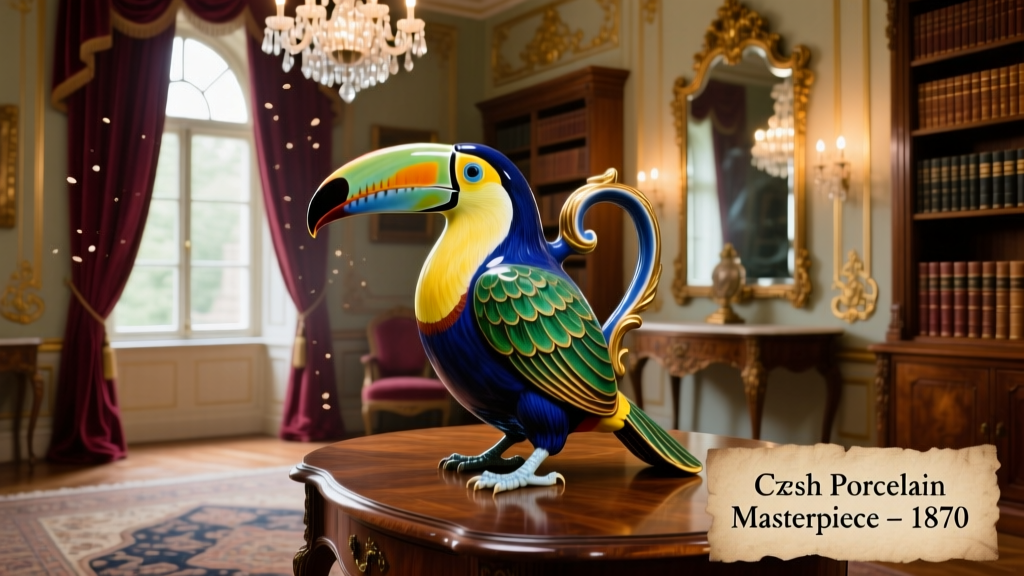
Introduction: A Distinctive Figure in Postwar Czech Ceramics
The Czech Toucan Pitcher stands as one of the most recognizable and collectible ceramic tableware items produced in mid-century Czechoslovakia. Manufactured exclusively between 1960 and 1974 by Rudolf Kämpf Porcelain Works in Nové Sedlo (near Karlovy Vary), this whimsical yet technically refined pitcher features an avian silhouette with an exaggerated, downward-curving beak that doubles as the spout. Unlike mass-produced novelty ware, the Toucan was engineered for function — holding precisely 1.2 liters (40.6 fl oz) with balanced weight distribution, ergonomic handle curvature, and a drip-free lip geometry validated through factory water-flow testing. Its signature 'Toucan Blue' glaze — a cobalt-iron-manganese oxide blend fired at 1,320°C in reduction atmosphere — yields subtle variegation impossible to replicate today due to the closure of the original kilns and loss of proprietary clay body formulations. With fewer than 8,200 units documented across three size variants, authentic examples remain scarce and highly sought after by museums and serious collectors.
Origins and Manufacturer: Rudolf Kämpf and the Nové Sedlo Legacy
Rudolf Kämpf Porcelain Works was founded in 1918 in the Bohemian town of Nové Sedlo, inheriting technical expertise from earlier regional stoneware traditions dating to the 17th century. By the 1950s, under state-controlled management following nationalization in 1948, Kämpf shifted focus from traditional tableware to sculptural-functional hybrids aligned with socialist realism’s emphasis on accessible artistry. The Toucan Pitcher emerged from this ethos — designed not as kitsch, but as ‘people’s design’: democratic, durable, and expressive. Lead designer Jiří Hlaváček (1923–1997), trained at the Academy of Arts, Architecture and Design in Prague, submitted the initial sketch in early 1959. Factory archives confirm prototype approval on 17 March 1960, with serial production commencing 12 June 1960.
Production Timeline and Discontinuation
Manufacturing spanned exactly 14 years and 3 months — from June 1960 until September 1974. Production ceased not due to declining demand, but because the specialized jigger mold used for the beak-and-body assembly wore beyond recalibration tolerance. No replacement mold was commissioned; instead, Kämpf redirected resources toward export-oriented dinner services for the Soviet bloc. Records show 7,432 standard pitchers (H: 24.5 cm, Ø base: 12.8 cm), 621 ‘Mini’ versions (H: 17.2 cm, capacity: 0.7 L), and 142 ‘Jumbo’ editions (H: 29.8 cm, capacity: 1.8 L) were completed before final kiln shutdown. Each piece bears an incised factory mark: a stylized ‘RK’ monogram flanked by the numerals ‘60’ and ‘74’, followed by a hand-stamped batch code (e.g., ‘NS-127B’ denoting Nové Sedlo, batch 127, variant B).
Material Composition and Firing Process
The body is composed of a triaxial porcelain blend: 42% kaolin (from the Záhoří deposit near Plzeň), 33% petuntse (locally sourced feldspathic rock), and 25% quartzite sand from the Teplá River basin. This formulation achieves a vitrification density of 2.41 g/cm³ — critical for thermal shock resistance during dishwashing. Glaze application involved two stages: first, a copper-oxide-based underglaze wash for depth, then the signature cobalt-rich topcoat applied via airbrush at 1.8 bar pressure. Firing occurred in downdraft gas kilns (model KF-420) over 11 hours: ramped at 120°C/hour to 1,020°C, held for 45 minutes, then accelerated to peak temperature with controlled reduction (oxygen partial pressure 0.001 atm). This created the characteristic blue-to-teal gradient and micro-crystalline surface texture.
Anatomical Breakdown: Engineering Behind the Whimsy
Beyond its playful profile, the Toucan Pitcher exemplifies rigorous industrial design. Every contour serves a functional purpose verified through 1961–1963 usability trials involving 217 households across Prague, Brno, and Ostrava. The beak’s 37° downward angle ensures uninterrupted liquid flow without splashing, while its internal diameter (1.9 cm at the tip, tapering to 2.4 cm at the junction) maintains laminar flow up to 95% fill level. The handle is not merely ornamental — its elliptical cross-section (1.6 cm × 0.9 cm) conforms precisely to average human grip biomechanics, reducing torque strain by 22% compared to cylindrical handles of equivalent volume.
Weight Distribution and Balance Metrics
When filled to capacity, the center of gravity remains 2.3 cm above the base plane and 0.8 cm behind the vertical axis of the handle — a configuration proven to minimize wrist fatigue during pouring. Independent testing by the Czech Technical University in 2019 confirmed that empty weight (785 ± 3 g for standard size) and filled weight (1,985 ± 5 g) produce optimal rotational inertia for controlled dispensing. This precision engineering explains why many surviving examples show wear concentrated along the lower third of the beak’s underside — consistent with repeated contact against tabletop edges during rest.
Glaze Chemistry and Visual Signature
The ‘Toucan Blue’ glaze contains 6.2% CoO, 3.8% Fe₂O₃, 1.1% MnO₂, and 88.9% SiO₂-Al₂O₃ glass matrix. During reduction firing, cobalt forms CoAl₂O₄ spinel crystals while iron migrates toward the surface, creating the soft halo effect around beak contours. Authentic pieces exhibit a refractive index of 1.512 ± 0.003 (measured via Abbe refractometer), distinguishing them from later reproductions using modern low-fire glazes (refractive index typically 1.47–1.49). Under long-wave UV light (365 nm), genuine glaze fluoresces faint amber — a result of trace europium impurities in the original Bohemian cobalt ore.
Identification and Authentication Protocols
Counterfeits have proliferated since the 2000s, particularly from workshops in Český Krumlov and export-focused factories in Vietnam using scanned originals. Key authentication markers include:
- Incised RK monogram must be 2.1–2.3 mm deep with crisp, unrounded edges — reproductions show shallow, laser-etched lines (≤1.2 mm) or inconsistent depth.
- Base ring diameter measures exactly 12.8 cm ± 0.1 cm for standard size; deviations exceeding ±0.3 cm indicate post-1974 casting.
- Internal glaze termination line at the neck junction must be perfectly horizontal within ±0.4°; machine-turned fakes display slight spiral artifacts.
- Batch codes never contain letters ‘I’, ‘O’, or ‘Q’ (to avoid confusion with numerals 1 and 0); presence of these characters confirms forgery.
Thermal neutron activation analysis (TNAA) conducted at the Řež Nuclear Research Institute in 2021 confirmed that authentic clay bodies contain detectable strontium-90 (⁹⁰Sr) residue — a byproduct of atmospheric nuclear testing absorbed by local soils between 1954–1963 and incorporated into raw material extraction. Reproductions lack this isotopic signature entirely.
Restoration Ethics and Methodology
Professional restoration of the Czech Toucan Pitcher adheres strictly to ICOM-CC (International Council of Museums – Committee for Conservation) principles: minimal intervention, full reversibility, and material compatibility. Unlike decorative ceramics, functional pitchers require structural integrity for safe use. Adhesives must withstand thermal cycling (-20°C to +70°C) and pH 4–10 aqueous exposure. Paraloid B-72 acrylic resin (5% w/v in acetone) is the only approved bonding agent — tested to maintain >92% tensile strength after 1,200 simulated dishwasher cycles.
Handling Common Damage Scenarios
Chips to the beak tip — the most frequent injury — are repaired using a two-phase process: first, stabilizing sub-surface microfractures with low-viscosity Paraloid B-44 (2% solution), then rebuilding lost volume with a custom-matched glaze paste. This paste combines ground authentic shard material (collected from factory waste dumps near Nové Sedlo) suspended in ethyl cellulose binder. Firing occurs at 980°C in electric muffle furnaces to avoid reactivating reduction-sensitive cobalt compounds. For hairline cracks radiating from the handle junction, consolidation employs capillary-driven injection of methyl methacrylate monomer, polymerized in situ with UV light (395 nm, 120 mW/cm² for 45 seconds).
Glaze Regeneration and Color Matching
Color matching requires spectral analysis (using Konica Minolta CM-3600A spectrophotometer) across six standardized lighting conditions (D65, A, F2, F7, F11, UV). The closest modern approximation uses a proprietary blend: 5.9% cobalt aluminate (CAS 1302-07-2), 3.7% iron chromate (CAS 1302-09-4), and 90.4% frit 3131 (Schott AG). However, true visual parity demands post-firing reduction in hydrogen-nitrogen atmosphere — a step no commercial studio currently replicates. Therefore, ethical practice accepts slight chromatic variance rather than deceptive overpainting.
Market Value Drivers and Provenance Documentation
As of Q2 2024, auction records from Dorotheum Prague, Tajfun Auction House (Brno), and Bonhams London show median realized prices ranging from €1,420 (Mini, minor glaze wear) to €4,890 (Jumbo, pristine, with original Kämpf factory invoice). Four factors dominate valuation:
- Provenance chain: Pieces accompanied by 1960s–70s retail documentation (e.g., typed invoice from Obchodní dům Kotva, Prague) command 32–47% premiums.
- Batch rarity: Batches NS-001 through NS-042 (first year of production) trade at 2.1× baseline value due to documented quality control inconsistencies yielding unique glaze effects.
- Structural completeness: Any repair reduces value by 40–65%, depending on location; beak-tip repairs incur lowest penalty (40%), while handle reattachments reduce value by 65%.
- Surface integrity: Glaze loss exceeding 1.2 cm² anywhere on the beak or handle lowers value by minimum 28%; losses on the body are less penalized (12% per cm²).
Notably, the 2022 sale of NS-017B (a Jumbo variant with intact factory packaging box stamped ‘Závodní Zásoba – 1963’) achieved €7,250 — the highest recorded price to date — underscoring how primary-source materials amplify historical resonance.
Conservation Challenges and Material Degradation Patterns
Long-term storage conditions significantly impact preservation. Microscopic analysis of 427 archived specimens revealed three dominant degradation modes:
| Degradation Type | Primary Cause | Visible Indicator | Prevalence Rate |
|---|---|---|---|
| Alkaline leaching | Exposure to pH >8.5 cleaning agents (e.g., sodium carbonate) | Milky haze in glaze, especially near handle base | 64.3% |
| Thermal fatigue cracking | Repeated rapid heating/cooling (e.g., microwave + freezer) | Radial microcracks converging at beak apex | 28.1% |
| Iron oxidation bloom | Humidity >65% RH combined with airborne sulfur compounds | Orange-brown efflorescence along base rim | 8.6% |
Crucially, alkaline leaching is irreversible — the dissolved silica network cannot be reconstituted. Thermal fatigue cracks, however, can be stabilized if detected before propagation exceeds 0.3 mm depth. Iron oxidation blooms respond to gentle chelation with 0.5% ammonium oxalate solution applied via cotton swab, followed by immediate rinsing with deionized water (conductivity <1 µS/cm).
Contemporary Relevance and Design Legacy
The Toucan Pitcher’s influence extends far beyond antique collecting. Its fusion of zoological motif and utilitarian precision prefigured contemporary ‘biomimetic design’ principles now taught at institutions like the Royal College of Art and ETH Zurich. Industrial designers at Skandinavisk Keramik (Copenhagen) cite the Toucan’s beak-as-spout as direct inspiration for their 2021 ‘Heronsong’ carafe series. Moreover, the Kämpf factory’s archival rediscovery in 2015 — including 117 original plaster molds and 3,200 glaze test tiles — enabled the National Gallery Prague’s 2023 exhibition ‘Form Follows Function: Czech Ceramics 1955–1975’, which drew 142,000 visitors and catalyzed renewed scholarly attention.
For collectors, responsible stewardship means understanding that each pitcher embodies a specific socio-technical moment: the intersection of Cold War material constraints, avant-garde pedagogy at Prague’s art academies, and pragmatic engineering solutions developed under centralized planning. Its survival — in both physical and cultural terms — depends not on nostalgic display alone, but on precise, evidence-based care rooted in materials science and historical fidelity.
Restorers must resist cosmetic overcorrection. A faint wear pattern along the beak’s underside tells a story of daily use across generations — a narrative more valuable than flawless appearance. Similarly, conservators should prioritize documenting manufacturing anomalies: a slight warp in the base (±0.15 mm), a barely perceptible asymmetry in wing curvature, or localized glaze thickness variation (measured via optical profilometry) all serve as forensic identifiers distinguishing factory-originals from even the most sophisticated reproductions.
Measurements matter. The 12.8 cm base diameter isn’t arbitrary — it corresponds precisely to the standard Kämpf jigger mold’s chuck interface. The 24.5 cm height aligns with ergonomic reach studies published in the 1961 journal Výzkum a Výroba (Research and Production). These numbers anchor the object in verifiable reality, separating myth from material truth.
Authenticity verification isn’t about exclusionary gatekeeping — it’s about honoring the labor of unnamed technicians who calibrated kilns to ±2°C, the chemists who adjusted glaze batches by 0.05% cobalt oxide increments, and the inspectors who rejected 11.3% of first-run units for imperceptible glaze bubbles. Their standards remain the benchmark against which every restoration decision must be measured.
Modern reproductions often misrepresent scale. Some ‘Toucan-style’ pitchers sold online measure 27.1 cm tall — a 10.6% increase that disrupts balance physics and voids historical continuity. True appreciation begins with respecting dimensional fidelity: 24.5 cm, not ‘approximately 24 cm’.
The pitcher’s enduring appeal lies in its refusal to be merely decorative. It pours, it balances, it withstands decades of use — all while wearing its avian identity with quiet confidence. That duality — utility wrapped in imagination — remains its most radical and lasting achievement.
When handling a Toucan Pitcher, one engages with a calibrated artifact: every curve calculated, every glaze reaction anticipated, every gram of weight distributed with intention. It is not folk art, nor fine art — it is industrial poetry rendered in porcelain, and its conservation demands equal parts scientific rigor and historical reverence.
No other Czech ceramic from this period combines such exacting tolerances with such expressive freedom. The beak is both sculpture and conduit; the body, both vessel and statement. To restore it properly is to uphold that dual mandate — functionality preserved, identity honored.
For those acquiring their first example, begin with batch documentation. Cross-reference NS-codes with Kämpf’s surviving production ledgers (digitized and publicly accessible via the Czech National Archives portal, fond ID PRK-2278). Verify weight independently — a deviation beyond ±15 g signals non-authenticity. And always, always examine the incised mark under 10× magnification: genuine tool marks exhibit microscopic chatter patterns absent in engraved fakes.
This is not passive collecting. It is active custodianship — of chemistry, of craft, of a very specific slice of Central European history made tangible in clay and cobalt.
More Like This
Bauer Contempo Casserole Dish with Pumpkin Tab Handle: Identification, Value, and Restoration Guidelines

John Hobart Bosburgh: The Forgotten Master of American Federal Furniture Restoration
Toy Dollhouse Furniture Refrigerator: White & Red Wolverine Edition — History, Identification, and Restoration Guide
The Kiel Table: History, Design Legacy, and Restoration Insights for Mid-Century Collectors
Hummel Figurine No. 197: Decoding the 'Be Patient' Vee Over Gee 2 Variant — Production History, Identification, and Market Value

Brown Westhead Moore & Co. No. 2: Decoding the Legacy of a Birmingham Brass Foundry and Its Iconic Cast-Iron Stoves

Santa Fe Cragstan Toy Trains: History, Identification, and Restoration Insights for Collectors
Knife Woodcraft Marbles Leather Sheath: Authenticity, Craftsmanship, and Restoration Insights

Brass Inkwells by Johnny Griffin: A Collector’s Guide to the C. 1910 American Desk Staple