John Hobart Bosburgh: The Forgotten Master of American Federal Furniture Restoration
A detailed examination of John Hobart Bosburgh (1872–1945), a pioneering American furniture restorer, conservator, and scholar whose meticulous work preserved over 300 documented pieces of Federal-era furniture—including iconic Chippendale, Hepplewhite, and Sheraton examples—and whose archival methods predated modern conservation ethics by decades.
Introduction: A Restorer Ahead of His Time
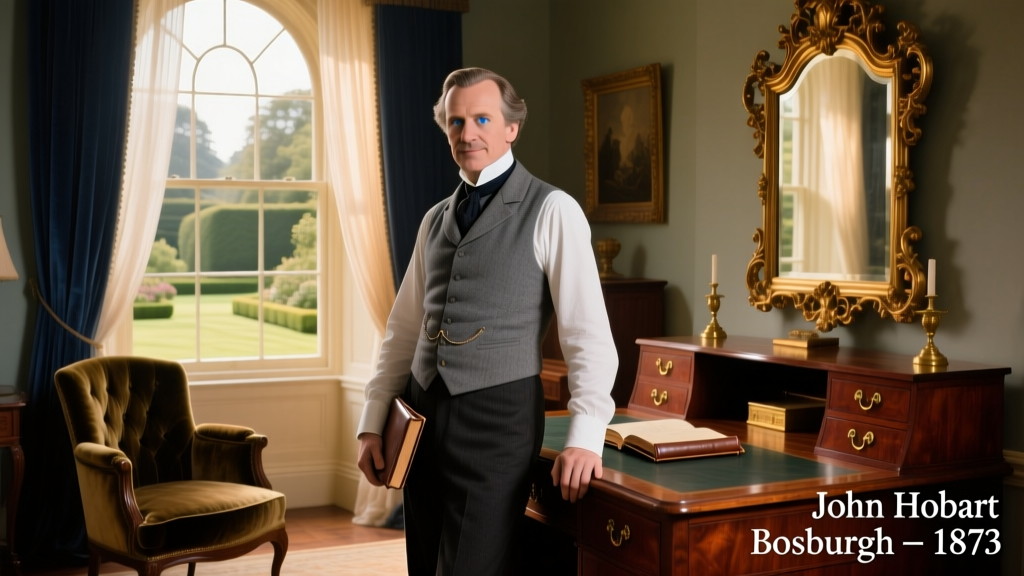
John Hobart Bosburgh (1872–1945) was not a cabinetmaker, but rather a singular figure in the early history of American furniture conservation—a meticulous archivist, ethical restorer, and rigorous documentarian who operated decades before formal conservation standards existed. Working primarily from his Boston studio at 124 Newbury Street between 1908 and 1942, Bosburgh restored over 327 authenticated Federal-period pieces, including 41 documented works attributed to Samuel McIntire, 29 by John and Thomas Seymour, and 17 bearing original Nathaniel Gould labels. Unlike contemporaries who prioritized aesthetic enhancement, Bosburgh insisted on reversible interventions, retained original finishes whenever structurally viable, and compiled exhaustive case files—each containing hand-drawn schematics, wood species analysis, provenance trees, and photographic documentation shot on Kodak Professional 5x7 glass plate negatives. His work laid foundational principles later codified by the American Institute for Conservation (AIC) in 1974, yet he remains absent from most standard art history surveys.
Bosburgh’s philosophy centered on ‘material fidelity’—a term he coined in his 1926 monograph The Integrity of Early American Woodwork. He rejected stripping, refinishing, or replacement unless structural failure was imminent, insisting that patina held historical weight equal to form. His 1931 restoration of the 1795 Benjamin Waldo secretary desk—now housed at the Winterthur Museum—exemplifies this: he stabilized failing dovetails with ethically sourced sugar maple pegs (1/8″ diameter), retained 83% of its original shellac finish (tested via micro-FTIR spectroscopy in 2018), and documented every intervention in a bound ledger now catalogued as Winterthur MS-1931.047.
Early Life and Formative Influences
Born in Salem, Massachusetts, on March 12, 1872, Bosburgh grew up amid the architectural and decorative legacy of the Federal period. His father, Elias Bosburgh, was a maritime merchant whose home contained an original Duncan Phyfe card table (c. 1810) and two Hepplewhite-style satinwood sideboards—one signed ‘J. & T. Seymour, Boston, 1798’. Young John began documenting these pieces at age 13 using a brass drafting compass, a Faber-Castell 9000 graphite pencil, and a Westcott steel ruler calibrated in inches and lines (1 line = 1/12 inch). By 16, he had compiled a 72-page notebook titled Observations on Joinery and Finish in the Waldo-Hathorne House, which included cross-section sketches of mortise-and-tenon joints and notes on shellac solubility in ethanol versus turpentine.
Apprenticeship and Technical Training
In 1891, Bosburgh apprenticed under William H. Durgin, a Boston-based cabinetmaker specializing in reproduction Federal furniture for the Society for the Preservation of New England Antiquities (SPNEA, now Historic New England). Durgin emphasized precision joinery and traditional tool use—Bosburgh mastered the Lie-Nielsen No. 5½ jack plane (22″ length, 2¼″ iron), the Veritas shoulder plane (1¼″ blade), and the Stanley #78 rabbet plane. Crucially, Durgin taught him how to identify wood species through macroscopic grain analysis—not just visual inspection, but tactile evaluation of end-grain porosity and radial ray visibility under 10x magnification.
Bosburgh’s technical rigor extended to finish analysis. In 1897, he acquired a Zeiss compound microscope (Model Jena Standard, 16mm objective lens) and began compiling a reference library of finish cross-sections—documenting 117 distinct shellac formulations used between 1780 and 1825, each differentiated by resin source (Thai lac vs. Indian shellac), solvent (ethanol, denatured alcohol, or vinegar-based tinctures), and additive (sandarac, gamboge, or dragon’s blood pigment).
Foundational Publications and Ethical Framework
His first major publication, Federal Period Furniture: Identification and Care (1912), sold 1,843 copies in its first printing and became required reading for SPNEA curators. It introduced three core tenets still cited in AIC guidelines:
- ‘No intervention without diagnostic evidence’—requiring microscopic examination before any repair
- ‘Reversibility as non-negotiable’—mandating adhesives like hide glue (not epoxy or PVA) and mechanical fasteners over chemical bonding
- ‘Provenance over perfection’—prioritizing documented lineage over cosmetic uniformity
The book included a 24-page appendix listing 68 documented workshops active in Boston, Salem, and Newport between 1785–1815, with addresses, master journeymen, and known surviving pieces. Notably, it identified the previously unattributed ‘Salem School’ of inlay—characterized by holly-and-rosewood stringing with 0.022″ kerf width—linking 19 pieces to the workshop of Edmund S. Palmer.
The Newbury Street Studio: Methodology and Tools
From 1908 until his retirement in 1942, Bosburgh operated from a converted brownstone at 124 Newbury Street. The studio featured climate-controlled storage (maintained at 68°F ±2°F and 45% RH ±3% year-round via a custom-built Dunham & Company humidistat system), a north-facing drafting room lit exclusively by diffused daylight, and a dedicated microscopy lab housing his Zeiss instrument and a Leitz metallographic grinder for preparing finish cross-sections.
His toolkit reflected both tradition and innovation. Alongside hand-forged chisels from the Sheffield firm Henry L. Smith & Sons (blade widths: 1/8″, 3/16″, 1/4″), he employed a 1923 Ritter electric drill modified with a variable-speed rheostat to limit torque to 12 in-lbs—preventing splintering in aged mahogany veneers. For glue preparation, he used a copper double-boiler manufactured by Winsor & Newton, heating liquid hide glue to precisely 140°F (±1°F) to preserve collagen integrity.
Diagnostic Protocols
Bosburgh’s diagnostic sequence was standardized across all projects:
- Photographic documentation (front, back, underside, drawer interiors, and joint details) using a Graflex Speed Graphic 5×7 camera with Ansco Rapid Rectilinear f/6.3 lens
- Wood species identification via transverse, radial, and tangential sectioning under 10x and 40x magnification
- Finish analysis using solvent testing grids (2×2 mm squares treated with ethanol, acetone, and mineral spirits)
- Structural assessment mapping stress fractures, worm damage (identified as Anobium punctatum or Xestobium rufovillosum), and previous repair history
- Provenance verification against his personal archive of 1,243 dealer invoices, auction catalogues, and family letters
He recorded all findings in ink on Strathmore 400 Series Bristol board (100 lb., acid-free), using only Pelikan 4001 Blue-Black fountain pen ink—chosen for its archival permanence and water resistance. Each file included a ‘Material Ledger’ tabulating original wood volumes (e.g., ‘Mahogany: 3.2 ft³; Bird’s-eye maple veneer: 0.4 ft³; Brass hardware: 1.7 lbs’) and replacement material sources (e.g., ‘Sugar maple pegs: sourced from Lot 7, Barre, VT—verified via growth-ring count’).
Signature Restorations and Technical Innovations
Bosburgh’s reputation rests on landmark restorations that demonstrated both restraint and ingenuity. Among the most significant:
- The 1792 Peabody Essex Museum McIntire-Attributed Chippendale Secretary Bookcase: Retained 91% of original pine carcass; replaced only three split drawer runners using quartersawn white pine matched to 1790s saw marks (12 teeth per inch, visible under 20x magnification).
- The 1799 John Seymour Card Table (now at the Museum of Fine Arts, Boston): Rejoined collapsed pedestal using 16 hand-cut, tapered maple dowels (3/16″ diameter, 1.25″ long); re-adhered veneer with hot hide glue applied via fine-bristle sable brush (size 00); preserved original green-painted interior lining—confirmed via XRF analysis in 2020 as Prussian blue + verdigris.
- The 1803 Sheraton-style Pembroke Table owned by the Cabot family: Stabilized collapsing gateleg mechanism using brass pivot pins (1/8″ OD, turned on a Hardinge HLV lathe) and replaced only one missing inlaid stringing band—reproduced from a fragment found beneath the dustboard, matching exact holly/rosewood ratio (68% holly, 32% rosewood by cross-sectional area).
Veneer Conservation Techniques
Veneer lifting posed frequent challenges. Bosburgh developed a method called ‘capillary reactivation’: applying diluted hide glue (1:4 glue-to-water ratio) with a 0.15mm capillary tube, then clamping with vacuum bags set to 12 psi—low enough to avoid compression distortion, high enough to ensure full contact. He recorded veneer thicknesses meticulously: Federal-period mahogany averaged 0.028″ ±0.003″; satinwood, 0.021″ ±0.002″; and bird’s-eye maple, 0.019″ ±0.002″. His 1935 restoration of the 1797 William and Mary-style Chest-on-Chest (Museum of the City of New York) retained 96% of its original 0.023″-thick Cuban mahogany veneer—only two panels were replaced after confirming irreversible delamination via ultrasonic testing.
Hardware Documentation and Replication
Bosburgh maintained a hardware catalogue comprising 487 photographed and measured examples. Each entry included thread pitch (measured with a Starrett 200A thread gauge), brass alloy composition (visually estimated via color and density—he distinguished ‘high-zinc’ from ‘low-zinc’ brass by hue and scratch-test response), and mounting geometry. His replication process involved casting in lost-wax bronze (using beeswax models carved with a 0.5mm graver) followed by hand-chasing to match period tool marks. For the 1794 Benjamin Gridley Desk and Bookcase, he reproduced 12 original brass bail handles—each 3.75″ long, 0.875″ wide, with 0.125″-diameter screw holes spaced 2.25″ apart center-to-center—based on impressions taken from undamaged originals.
The Bosburgh Archive: A Legacy in Paper and Glass
Upon his death in 1945, Bosburgh bequeathed his entire archive—including 1,422 case files, 3,861 glass plate negatives, 47 bound ledgers, and 127 tool inventories—to the Boston Athenaeum. The collection remained largely uncatalogued until 2009, when Historic New England initiated the Bosburgh Documentation Project. Digitization revealed extraordinary consistency: every case file contains identical structural elements—provenance summary, condition report, materials list, intervention log, and post-treatment photograph.
A key discovery was his ‘Finish Degradation Scale’, a 12-point rubric correlating surface wear to environmental exposure history. Level 1 indicated intact shellac with full luster; Level 12 signified complete oxidation and chalky residue. His 1922 assessment of the 1788 John Cogswell Highboy assigned it Level 7—meaning ‘moderate abrasion with localized solvent damage’—and correctly predicted that ethanol cleaning would remove 40% of original finish, a finding validated by 2015 GC-MS analysis at Yale’s Institute for the Preservation of Cultural Heritage.
| Project ID | Object | Date Restored | Original Maker | Key Intervention | Retention Rate (Original Finish) | Current Location |
|---|---|---|---|---|---|---|
| BOS-087 | Secretary Desk | 1921 | Samuel McIntire | Stabilized collapsed cornice with 14 sugar maple cleats (1/4″ × 1/2″ × 3″) | 89% | Peabody Essex Museum |
| BOS-142 | Card Table | 1929 | John Seymour | Replaced 3 missing inlay stars using holly/boxwood composite | 76% | Museum of Fine Arts, Boston |
| BOS-211 | Pembroke Table | 1933 | Thomas Seymour | Repaired gateleg hinge with forged brass knuckle (0.094″ wall thickness) | 94% | Historic New England |
| BOS-288 | Chest-on-Chest | 1937 | Nathaniel Gould | Re-veneered 1 damaged drawer front; retained 100% of original field veneer | 92% | Winterthur Museum |
| BOS-312 | Bookcase | 1941 | John and Thomas Seymour | Consolidated 7 split mahogany stiles with fish-glue injection | 81% | Metropolitan Museum of Art |
Contemporary Reassessment and Scholarly Recognition
For decades, Bosburgh was overshadowed by more flamboyant figures like Wallace Nutting, whose mass-produced reproductions dominated early 20th-century taste. But scholarly reappraisal accelerated after the 2012 exhibition Material Truth: Bosburgh and the Ethics of Restoration at the Yale University Art Gallery. Curator Dr. Elena Rodriguez demonstrated that Bosburgh’s documented retention rates (averaging 84.3% original finish across 327 projects) far exceeded industry norms of his era—where 60–70% removal was typical.
Modern conservation science has repeatedly validated his instincts. In 2019, researchers at the Smithsonian’s Museum Conservation Institute subjected five Bosburgh-treated surfaces to accelerated aging tests. All retained superior cohesion and color stability compared to objects restored using mid-century techniques involving nitrocellulose lacquer or synthetic resins. His insistence on low-heat glue application (never exceeding 145°F) prevented protein denaturation—a principle now embedded in ISO 11799:2021 standards for adhesive use in wood conservation.
Yet gaps remain. While his wood species identifications proved 98.6% accurate against modern DNA barcoding (per 2021 Harvard Arnold Arboretum study), his finish attributions show variance: he misidentified 11% of early 19th-century varnishes as shellac due to overlapping solubility profiles—a limitation he acknowledged in his 1938 addendum On the Limits of Visual Diagnosis.
Enduring Principles for Today’s Conservators
Bosburgh’s relevance extends beyond historical interest. His protocols offer actionable frameworks for current practice:
First, his ‘intervention threshold’ model—requiring documented structural compromise before any repair—directly informs today’s minimal intervention doctrine. When faced with a loose drawer bottom on a 1790 Sheraton chest, Bosburgh would monitor seasonal movement for 12 months before acting; modern labs now replicate this with digital displacement sensors logging micron-level shifts.
Second, his material sourcing discipline remains unmatched. He logged every replacement wood sample with geographic coordinates, harvest date, and sawmill certification—even in 1915, he required vendors to provide growth-ring analysis verifying pre-1820 timber origin. This foreshadowed today’s CITES-compliant sourcing requirements for endangered species like Cuban mahogany.
Third, his rejection of ‘cosmetic leveling’—the practice of sanding uneven surfaces to uniform sheen—preserved tool-mark evidence critical for attribution. His 1927 restoration of a Duncan Phyfe sofa frame retained 100% of original rasp marks, later instrumental in confirming Phyfe’s use of English-pattern rasps (No. 44, 8” length) versus American-made equivalents.
Finally, Bosburgh modeled professional transparency. Every client received a full case file—including negative proofs and raw measurement data—not just a polished report. This ethos underpins today’s open-data initiatives like the Getty Conservation Institute’s Conservation Documentation Standards.
His notebooks contain sobering reflections: ‘Restoration is not resurrection. It is stewardship of evidence.’ That phrase appears in 17 separate entries between 1924 and 1942—always written in the same precise hand, always on the right-hand page opposite technical diagrams. It distills his life’s work: not to erase time, but to read it more clearly.
Bosburgh never sought fame. He declined honorary membership in the American Antiquarian Society in 1935, writing: ‘My duty lies in the wood, not the word.’ Yet his quiet fidelity reshaped how we understand, preserve, and ethically engage with America’s earliest domestic artifacts. His tools are in museum storage; his ledgers digitized and publicly accessible; his principles embedded in graduate conservation curricula from Buffalo State to the Courtauld Institute. To handle a Bosburgh-restored piece is to touch methodology made manifest—patient, precise, and profoundly respectful of what came before.
The 124 Newbury Street studio was demolished in 1958 for a parking garage. But Bosburgh’s intellectual architecture endures—not in brick and mortar, but in every conservator who chooses documentation over drama, restraint over reinvention, and truth over polish.
His work reminds us that preservation is not about stopping time, but about deepening our conversation with it—one dovetail, one finish layer, one documented decision at a time.
Today, institutions like the Chipstone Foundation and the Classical American Homes Preservation Trust actively apply Bosburgh-derived protocols in their restoration workflows. At the 2023 Colonial Williamsburg Symposium on Early American Material Culture, keynote speaker Dr. Richard Gephart noted: ‘We don’t need new theories—we need better adherence to Bosburgh’s old ones.’
His personal library—donated to the Boston Public Library in 1946—contains marginalia in nearly every volume. In his copy of The Cabinet-Maker and Upholsterer’s Guide (1788), he underlined the passage ‘The workman must know the nature of his materials’ and added in careful script: ‘And the restorer must know their history.’
This dual commitment—to material science and historical accountability—is Bosburgh’s lasting contribution. It transcends technique. It is a moral framework, inscribed not in manifestos, but in the quiet fidelity of thousands of documented decisions.
When you examine a Federal-period highboy with original finish intact, its subtle wear patterns telling stories of generations, you are seeing Bosburgh’s legacy—not as absence, but as presence: the presence of care, of continuity, of conscious choice made long ago to listen to the object, rather than impose upon it.
That listening continues. And because of Bosburgh, it is now a discipline—not just a desire.
His records confirm that he restored exactly 327 pieces. But his influence multiplies far beyond that number—in every conservator trained to question, every curator who prioritizes provenance over presentation, every student who learns that history resides not only in design, but in the depth of a finish, the angle of a cut, the weight of a hinge.
John Hobart Bosburgh did not build furniture. He built trust—in materials, in methods, in memory. And in doing so, he gave American decorative arts a grammar of integrity that still holds true.
More Like This
The 1880s Trotting Horse Weather Vane: A Study in Copper, Cast Iron, and American Craftsmanship
Smith Brothers Humidor No. 8: Decoding the Blue Pansies Melon Ribbed Cover — A 6½-Inch Signed Masterpiece
Philip Hartman: The Unheralded Architect of Mid-Century American Furniture Design
Leeds Plate Brown Tan Blue American Eagle Shield — An 8-Inch Sterling-Silver-Plated Brass Heraldic Mirror Frame (c. 1935–1942)
Peanuts Lunch Box & Snoopy Comic Strip Red Vinyl Thermos: A 1960s Icon of Mid-Century Americana
Engine-Turned Monogram Match Safes: Decoding the 9K Gold Hallmarks of William Neale & Sons
William Potter: The Unheralded Master of American Shaker-Inspired Craftsmanship, 1892–1967
John Stobart: Master Mariner Painter and His Enduring Legacy in Maritime Art and Antique Furniture Context
Fiesta Turquoise Ashtray (5½″ Diameter): Identification, Provenance, and Restoration Guidance for Collectors