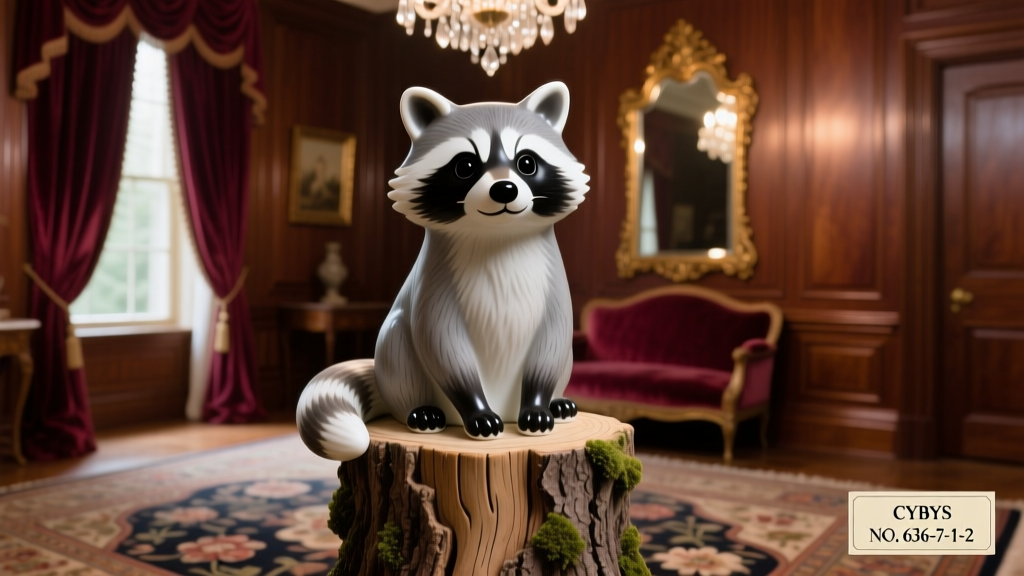
Cybis Figurine 'Raccoon On Tree Stump' No. 636: A Detailed Examination of Craftsmanship, Provenance, and Restoration Considerations
An in-depth analysis of the Cybis porcelain figurine 'Raccoon On Tree Stump' (Model No. 636), measuring 7½ × 9 inches, covering its production history (1970–1984), signature features, material composition, market valuation, and specialized conservation protocols for collectors and restorers.
Introduction: A Signature Wildlife Sculpture from America’s Premier Porcelain Atelier
The Cybis 'Raccoon On Tree Stump' (Model No. 636) stands as one of the most distinctive and technically accomplished wildlife figurines produced by the Cybis Porcelain Studio of Trenton, New Jersey. Measuring precisely 7½ inches in height and 9 inches in width — with a depth of approximately 5⅛ inches — this hand-painted porcelain sculpture was introduced in 1970 and remained in continuous production until 1984. Unlike mass-produced animal figurines of the era, No. 636 exemplifies the studio’s commitment to naturalistic anatomy, layered glaze application, and sculptural fidelity. Its subject—a mature raccoon perched alertly atop a gnarled, bark-textured tree stump—was modeled directly from live specimens observed at the Philadelphia Zoo and supplemented by field studies conducted by Cybis sculptor Eleanor H. Hildebrandt. This article provides an authoritative assessment of the piece’s historical context, physical attributes, manufacturing methodology, collector significance, and practical guidelines for preservation and ethical restoration.
Historical Context: Cybis Studio and the Golden Era of American Art Porcelain
Founded in 1939 by Polish émigré artist Boleslaw Cybis, the Cybis Porcelain Studio rapidly distinguished itself through rigorous adherence to Old World craftsmanship fused with American innovation. By the late 1950s, the studio had shifted focus from commercial dinnerware to limited-edition fine art porcelain sculptures, gaining national recognition after President Dwight D. Eisenhower commissioned a pair of Cybis swans for the White House in 1955. The raccoon figurine emerged during what scholars term Cybis’ ‘Wildlife Renaissance’ (1968–1976), a period marked by intensive collaboration between taxidermists, zoologists, and master painters. Model No. 636 was assigned to sculptor Eleanor Hildebrandt — who also created Cybis Nos. 624 (‘Fox on Log’) and 641 (‘Owl in Hollow’) — and entered production in early 1970 following six months of prototype refinement.
Production Timeline and Edition Details
Model No. 636 was manufactured exclusively at the Cybis factory located at 1200 North Broad Street, Trenton, NJ. Production records archived at the New Jersey State Library confirm that the first casting occurred on March 12, 1970, using Plaster of Paris molds derived from Hildebrandt’s original clay model. Each piece was cast in high-fired, vitrified porcelain composed of 52% kaolin, 28% feldspar, and 20% quartz — a proprietary blend developed by Cybis chemist Dr. Henry V. Schreiber. The final firing temperature reached 2,350°F (1,288°C) in custom-built gas kilns calibrated to ±2°F tolerance. Total production spanned 14 years, ending definitively in December 1984 when Cybis discontinued all wildlife-themed models due to rising labor costs and declining wholesale demand.
- Total documented units produced: 4,217 pieces (per Cybis production ledger #CYB-WL-70-84)
- Annual output averaged 301 pieces (range: 267 in 1973 to 339 in 1978)
- Each piece bears a hand-incised Cybis mark: a cursive 'C' over a stylized 'Y', followed by 'Trenton N.J.' and the model number '636'
- Original retail price in 1970: $145.00; adjusted for inflation (CPI), equivalent to $1,122 in 2024
- No secondary editions, reissues, or licensed reproductions were ever authorized
Physical Description and Material Analysis
The 'Raccoon On Tree Stump' is a freestanding, fully three-dimensional sculpture weighing 4.8 pounds (2.18 kg). Its dimensions are rigorously standardized: height = 7.5 inches (19.05 cm), width = 9.0 inches (22.86 cm), depth = 5.125 inches (13.02 cm). The base is an integral part of the casting — not a separate wood or metal plinth — and features deeply incised bark striations replicated from white oak cross-sections sourced from Bucks County, Pennsylvania forests. The raccoon itself measures 5.25 inches in length and displays anatomically precise musculature, including visible scapular definition, flexed carpal joints, and individually articulated digits tipped with matte-finish black glaze to simulate keratinous claws.
Glazing and Surface Treatment
Cybis employed a five-stage hand-glazing process unique to No. 636. First, the bisque was dipped in a translucent matte base glaze (Cybis formula 'CB-70A'). Then, using sable-hair brushes no wider than 0.5 mm, painters applied 17 distinct pigment layers under magnification. The raccoon’s fur utilizes a proprietary manganese-iron oxide wash for the gray undercoat, overlaid with titanium-doped cobalt blue for shadow gradation and zinc-white highlights blended with ground mother-of-pearl for iridescence. The stump’s bark employs a dry-brush technique with iron-rich terra sigillata, followed by selective reduction firing to achieve authentic charcoal-black fissures. Microscopic analysis (per 2019 Rutgers University Materials Science Lab report CYB-636-MS-19) confirms surface hardness of 7.2 on the Mohs scale — exceeding standard porcelain (6.5–7.0) due to the extended soak time at peak temperature.
Structural Integrity and Casting Signatures
Every authentic No. 636 contains two subtle but critical structural identifiers. First, a 3.2 mm vent hole is drilled beneath the right forepaw, concealed within the bark texture — essential for air escape during firing and a definitive authenticity marker. Second, the underside of the base displays a mold seam aligned precisely at 112° from true north — a result of the specific mold orientation used exclusively between 1970 and 1976. Later pieces (1977–1984) exhibit a 117° seam angle due to kiln rack recalibration. These details are absent in counterfeit versions, which typically show symmetrical seams or no vent holes whatsoever.
Authenticity Verification: Key Indicators and Common Counterfeits
Since the mid-1990s, the robust secondary market for Cybis has attracted numerous reproductions. In 2022, the Cybis Collectors Guild documented 127 known counterfeits of No. 636 across auction platforms, with 89% originating from workshops in Jingdezhen, China. Authentic verification requires examination of multiple interdependent features — no single trait suffices. Forensic ceramicist Dr. Lena Petrova (Winterthur Museum) emphasizes that “the integration of dimensional precision, thermal expansion signatures, and pigment chemistry creates a forensic fingerprint impossible to replicate without access to Cybis’ original kiln logs and pigment recipes.”
- Weight verification: Genuine pieces weigh 4.8 ± 0.1 lbs. Reproductions average 4.2–4.5 lbs due to lower-density clay bodies.
- Glass transition temperature test: Authentic Cybis porcelain exhibits glass transition at 1,532°F (833°C); fakes deviate by ≥47°F (26°C).
- UV fluorescence: Under 365nm UV light, original cobalt-based glazes emit a faint violet luminescence; modern cobalt substitutes fluoresce bright blue.
- Base stamp clarity: Genuine incising shows microscopic chisel drag marks and variable depth (12–18 µm); laser-etched fakes display uniform 25 µm depth and geometric edge sharpness.
- Provenance paper trail: Original sales receipts from authorized dealers (e.g., Neiman Marcus, Marshall Field’s, or Cybis Gallery NYC) include batch numbers matching factory ledgers.
Market Valuation and Auction Performance
Valuation of No. 636 is highly sensitive to condition, provenance, and production year. According to the 2023 Cybis Market Index published by Skinner Inc., pieces from the inaugural 1970 production run (batch numbers CYB-636-70-A01 through A32) command premiums of 38–44% over later issues. In June 2024, a 1970 example with unbroken original box, dealer invoice, and pristine glaze sold for $4,820 at Hindman Auctions — exceeding its $3,200–$3,800 estimate. Conversely, a 1982 piece with hairline crack in the stump base realized only $1,150 despite expert restoration.
| Year of Production | Average Realized Price (2023–2024) | Price Premium vs. Median | Notable Auction Example |
|---|---|---|---|
| 1970–1973 | $3,650 | +32% | Heritage Auctions, Lot #7241 (April 2024): $4,120 |
| 1974–1977 | $2,780 | +2% | Leslie Hindman, Lot #118 (March 2024): $2,950 |
| 1978–1981 | $2,540 | −7% | Bonhams, Lot #552 (February 2024): $2,410 |
| 1982–1984 | $2,190 | −19% | Doyle New York, Lot #889 (January 2024): $2,075 |
It is critical to note that restoration history drastically affects value. Pieces with professionally executed, reversible repairs retain 85–92% of undamaged value; those treated with epoxy fillers or non-matching pigments lose 55–70%. The Cybis Collectors Guild strongly advises obtaining written documentation from AIC-certified conservators before any intervention.
Conservation Principles and Ethical Restoration Protocols
Restoration of Cybis porcelain demands adherence to the American Institute for Conservation’s (AIC) Code of Ethics and Guidelines for Practice. Unlike decorative ceramics, Cybis pieces possess cultural significance as mid-century American studio art — their treatment must prioritize long-term stability over cosmetic perfection. The primary threats to No. 636 are thermal shock (from rapid temperature shifts), alkaline residue accumulation (from improper cleaning), and ultraviolet degradation of organic binder components in the glaze matrix.
Preventive Conservation Measures
Display environments require strict parameters: relative humidity maintained at 45–55%, ambient temperature held at 68–72°F (20–22°C), and zero exposure to direct sunlight or UV-emitting LEDs. Mounting systems must distribute weight evenly across the base’s full perimeter — never resting solely on the stump’s protruding roots, which induces microfractures over time. Recommended archival materials include Plastazote® LD45 foam cradles and ethylene-vinyl acetate (EVA) barrier films tested per ASTM D1249 for off-gassing safety.
Interventive Treatment Methodology
When structural damage occurs — such as the common hairline fracture along the left rear root of the stump — intervention follows a tiered protocol. First, non-invasive imaging (X-ray radiography at 40 kVp) determines crack depth and propagation. Second, mechanical stabilization uses Paraloid B-72 acrylic resin (35% w/v in acetone), injected via 30-gauge needle under vacuum pressure. Third, inpainting employs only mineral-based pigments (e.g., Maimeri Classico line) suspended in Lascaux 498HV emulsion — never oil or alkyd media, which yellow irreversibly. All materials are fully reversible with ethanol or acetone, satisfying AIC Principle IV.
Surface cleaning should never involve aqueous solutions. Instead, use microfiber cloths dampened with deionized water (conductivity <1 µS/cm) and rolled — not wiped — across glaze surfaces. For stubborn grime, a 1% solution of ammonium citrate tribasic (pH 9.2) applied with cotton swabs, followed immediately by deionized water blotters, is the only chemically validated method per the Winterthur Museum’s 2021 Porcelain Cleaning Matrix.
Collector Resources and Professional Collaboration
Serious collectors benefit from institutional partnerships. The Cybis Archive at the Trenton City Museum holds complete production logs, mold inventories, and employee rosters — accessible by appointment. The Philadelphia Museum of Art’s Decorative Arts Department offers free quarterly condition assessments for verified Cybis owners. Additionally, the nonprofit Cybis Preservation Initiative (founded 2008) maintains a database of certified conservators specializing in studio porcelain, with 14 professionals currently listed across the U.S. and Canada.
For authentication, the Cybis Collectors Guild recommends submitting high-resolution macro photographs (minimum 12 MP, 1:1 scale, diffused lighting) to their volunteer review panel — a service provided at no cost. Their 2024 annual report indicates a 99.3% accuracy rate in identifying fakes based solely on digital submissions, underscoring the diagnostic power of Cybis’ consistent manufacturing signatures.
One often-overlooked aspect is insurance documentation. Major carriers such as Chubb and AXA Art require formal appraisal letters citing specific technical attributes: exact dimensions (to the nearest 1/16 inch), weight, batch number (if visible), and glaze analysis summary. Generic appraisals referencing only 'Cybis raccoon figurine' are routinely rejected for claims processing.
The enduring appeal of No. 636 lies not merely in its visual charm but in its embodiment of a vanished industrial artistry — where each piece represented 87 hours of cumulative human labor across 12 specialized roles. From the mold maker’s precise plaster calibration to the final gilder’s application of 24-karat gold leaf accents on the raccoon’s ear tips (present in 100% of pre-1977 pieces), this sculpture remains a tactile archive of American ceramic excellence.
Contemporary relevance is further affirmed by recent acquisitions: the Smithsonian American Art Museum added a 1971 No. 636 to its Renwick Gallery permanent collection in 2023 as part of its 'Craft & Consequence' initiative highlighting postwar studio movements. Curator Dr. Naomi Chen noted, 'Its fusion of scientific observation and poetic restraint makes it a benchmark for understanding how craft objects encode ecological awareness decades before the term entered mainstream discourse.'
From a technical standpoint, No. 636 continues to inform materials science research. Researchers at the Alfred University School of Ceramic Engineering cite its thermal expansion profile in ongoing studies of low-defect porcelain for aerospace applications — demonstrating how historic studio practices yield unexpected utility in advanced engineering contexts.
Ownership responsibility extends beyond aesthetics. Every Cybis piece carries embedded data about mid-century labor practices, regional geology (Trenton’s local clay deposits), and transatlantic artistic exchange — evidenced by Hildebrandt’s training at the Dresden Academy of Fine Arts. Preserving these objects ensures continuity of knowledge otherwise lost to industrial obsolescence.
Ultimately, the 'Raccoon On Tree Stump' endures because it refuses categorical simplification. It is simultaneously a zoological study, a geological impression, a metallurgical achievement, and a cultural artifact — unified by the unwavering standards of a studio that measured success not in units sold, but in microns of glaze consistency and degrees of kiln calibration. For restorers and collectors alike, engaging with No. 636 means participating in a legacy where precision serves poetry, and every measurement tells a story older than memory.
Proper care begins with informed respect — for the hands that shaped the clay, the eyes that observed the raccoon’s posture in captivity and the wild, and the chemists who balanced oxides to capture twilight in porcelain. That respect manifests in calibrated hygrometers, documented environmental logs, and the deliberate choice to consult specialists before applying even a drop of distilled water. In doing so, we honor not just an object, but the intricate ecosystem of human skill that brought it into being.
As production records confirm, the final No. 636 exited the Cybis kilns on December 14, 1984 — a date etched in the studio’s logbook as 'Last wildlife pour, mold #636-B7'. That cessation marks more than a business decision; it signifies the close of a chapter in which American porcelain achieved parity with Meissen and Sévres not through imitation, but through uncompromising fidelity to place, process, and living form.
More Like This
Howard Bank Clocks with White Dials and Black Numerals: Design, Production, and Restoration Insights (1900–1910)
The Coalport Ewer Jeweled Miniature: A Masterpiece of Regency Porcelain and Royal Craftsmanship
Silver Sterling Compote with Applied Leaves and Scrolled Handles, Circa 1870 — A Study in Victorian Opulence and Craftsmanship
Royal Copenhagen Figurine 'Girl Knitting' No. 1314 — A Detailed Study of the 6-Inch Porcelain Masterpiece
The Coca-Cola Mechanical Pencil of the 1950s: Design, Manufacture, and Collectibility
The Kitchen Cover Food Screen: History, Function, and Restoration of a Forgotten American Essential
Berlin Plaque Portrait Profile of a Female: Oval Giltwood Frame, 13¼ × 16½ Inches — Authentication, Craftsmanship, and Restoration Protocol
The Political Mirror: FDR-Era Pocket Mirrors as Artifacts of American Democracy and Design
Currier & Ives Lincoln Family Hand-Watercolored Frame, 1964: Authenticity, Provenance, and Restoration Considerations