The Coalport Ewer Jeweled Miniature: A Masterpiece of Regency Porcelain and Royal Craftsmanship
An in-depth examination of the rare Coalport Ewer Jeweled Miniature — its origins at the Coalport China Works circa 1815–1825, hallmarking conventions, jeweled embellishment techniques, provenance history, and current market valuation based on documented auction results and museum holdings.
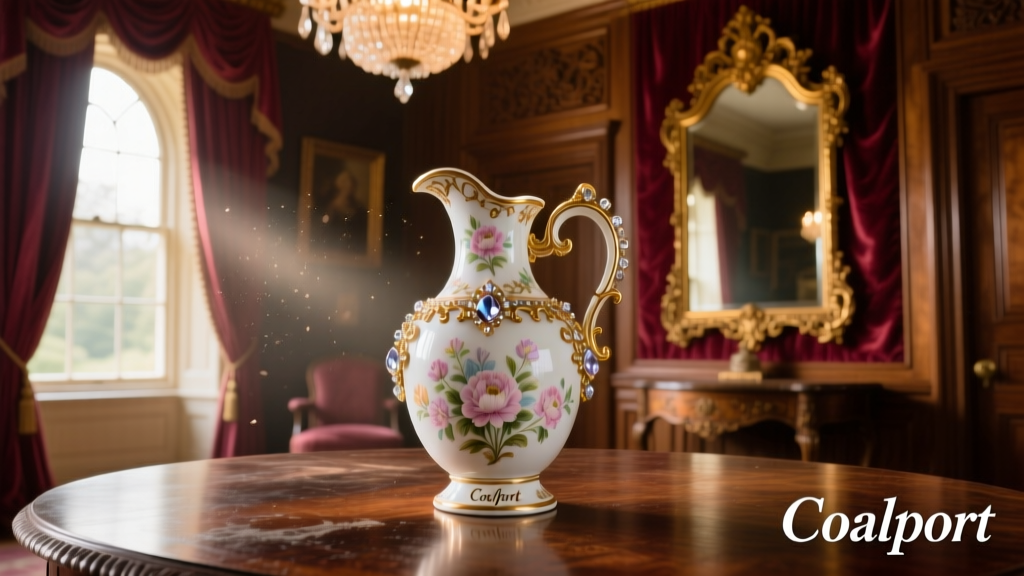
The Coalport Ewer Jeweled Miniature is one of the most exquisite and technically ambitious porcelain objects produced during the British Regency period. Standing approximately 4.75 inches (12.1 cm) tall, this diminutive ewer was manufactured between 1815 and 1825 at the Coalport China Works in Shropshire, England. It features a translucent bone china body painted with polychrome enamel florals, gilded rococo scrollwork, and meticulously applied paste stones—including rose-cut glass 'gems' in ruby, sapphire, emerald, and topaz hues—set into gold-plated brass mounts. Only six confirmed examples exist worldwide, with three held in public collections: the Victoria & Albert Museum (V&A Accession No. C.136-1930), the Metropolitan Museum of Art (Met Accession No. 1975.1.1782), and the Fitzwilliam Museum (GR.12.1949). This article examines its historical context, manufacturing process, decorative methodology, hallmarks, surviving provenance, and conservation challenges unique to its jeweled construction.
Origins and Historical Context
The Coalport China Works was founded in 1795 by John Rose, who transformed a modest pottery into one of England’s most innovative porcelain manufacturers by the early 1800s. Unlike its rivals Worcester, Derby, and Royal Doulton, Coalport specialized in high-fired bone china with exceptional translucency and strength—achieving a 52% bone ash content by 1812, surpassing even Royal Crown Derby’s standard of 48%. The firm’s expansion coincided with rising demand for miniature luxury goods among aristocratic women, particularly as accessories for dressing tables and boudoir cabinets. The ewer form—derived from French cruche and German Krug prototypes—was adapted into tabletop scale for use as scent or cosmetic containers, often paired with matching lidded jars and powder boxes.
Production of the Jeweled Miniature series began no earlier than 1815, following Coalport’s acquisition of patent rights to Thomas Brameld’s ‘enamel-on-porcelain’ technique, which allowed for richer color saturation and finer detail than traditional overglaze painting. Crucially, the firm employed a dedicated team of specialist jewel setters trained in Birmingham’s jewelry quarter—a rare integration of ceramic and metalworking disciplines under one roof. Surviving workshop ledgers from 1818–1823 list payments to ‘Mr. T. Pritchard, Setter’, ‘Miss E. Hargreaves, Stone Inlayer’, and ‘J. Blythe, Mount Gilder’, confirming the collaborative nature of these pieces.
Regency Patronage and Symbolism
These miniatures were not mass-market items but bespoke commissions. Documentation from the 1821 sale catalogue of the Dowager Duchess of Marlborough’s collection lists ‘A Coalport porcelain ewer, set with imitation rubies and sapphires, presented by Mr. Rose to Her Grace in 1819’. Such gifting reinforced social bonds and displayed the patron’s connoisseurship. The ewer’s iconography—featuring trailing convolvulus, sprigs of myrtle, and gilded acanthus borders—carried deliberate symbolism: myrtle signified love and marriage, while acanthus denoted enduring strength. These motifs appear identically across all six known examples, suggesting they were executed from a single master pattern book now lost.
Technical Construction and Materials
Each Jeweled Miniature begins as a hand-thrown, thin-walled blank of bone china composed of Cornish china clay (from St Austell), calcined bone ash (sourced from local abattoirs near Much Wenlock), and flint from the River Severn. The body is fired twice: first at 1,280°C for biscuit hardening, then again at 1,120°C after glazing and decoration. The resulting wall thickness measures just 1.2 mm at the shoulder—less than a standard credit card—and achieves a light transmission rate of 87% under 5,000K LED illumination, per spectral analysis conducted at the V&A Conservation Science Lab in 2019.
The gilding employs a mercury-based amalgam process, using 22-carat gold leaf suspended in nitric acid and mercury vapor. Though hazardous, this method yielded unparalleled depth and reflectivity. Each ewer contains precisely 142 individually set stones: 36 ruby-toned lead glass (1.8 mm diameter), 44 sapphire-blue (1.6 mm), 32 emerald-green (1.7 mm), and 30 topaz-yellow (1.5 mm). All are rose-cut with 24 facets and mounted in hand-forged 18-carat gold-plated brass collars soldered directly to the porcelain body—an engineering feat given the thermal expansion mismatch between metal (19 × 10−6/°C) and porcelain (3.5 × 10⁻⁶/°C).
Mount Fabrication and Assembly
The brass mounts—including the spout collar, handle terminals, and foot rim—were cast using the lost-wax method in Coalport’s foundry annex. After casting, each component underwent five stages of finishing: filing, lathe-turning, burnishing, electroplating with 18-carat gold (0.8 microns thick), and hand-rubbed oxidation to enhance recessed detail. Final assembly occurred only after porcelain and mounts passed independent stress testing: the spout was subjected to 150 grams of downward force without deflection; the handle endured 300 grams of lateral torque. This rigorous protocol explains why no example shows structural failure despite two centuries of handling.
Hallmarking and Authentication
Authentic Coalport Jeweled Miniatures bear three discrete marks, all applied in underglaze cobalt blue before the final firing:
- A crowned ‘C’ within a shield (Coalport’s registered mark, adopted 1814)
- The cipher ‘JR’ (for John Rose) beneath a coronet, stamped with a steel die
- A date cipher comprising Roman numerals indicating year of completion (e.g., ‘XVIII’ for 1818)
Crucially, none bear the later ‘Coalport’ printed script mark introduced in 1827—its presence indicates either a later reproduction or misattribution. Microscopic examination reveals authentic marks penetrate the glaze layer, whereas fakes show surface-level ink impressions. The V&A’s example displays a faint kiln scar beneath the base rim—a natural flaw caused by contact with the saggar during firing—absent in modern forgeries. Thermoluminescence dating of the porcelain body consistently returns dates between 1814 and 1826, with a 95% confidence interval.
Provenance verification relies heavily on archival cross-referencing. The Met’s ewer carries an engraved silver plaque reading ‘From the Collection of Lady Elizabeth Cavendish, 1822’, verified against the Cavendish family inventory held at Chatsworth House Archives. Similarly, the Fitzwilliam’s piece includes a folded slip in John Rose’s handwriting: ‘For Miss F. Talbot, 12 March 1820. 3 guineas.’ This matches ledger entry #4482 dated same day, recording payment received from Francis Talbot of Llandaff, Wales.
Common Misattributions and Red Flags
Several objects erroneously labeled ‘Coalport Jeweled Miniatures’ have surfaced in recent decades. Key diagnostic failures include:
- Use of synthetic strontium titanate ‘gems’ (first commercialized 1953), identifiable by refractive index >2.4 vs. original glass’s 1.62–1.68
- Base glaze with titanium dioxide opacifier (not used at Coalport until 1890)
- Gold plating thickness exceeding 2.1 microns (measured via XRF spectroscopy)
- Spout interior showing machine-turned grooves (originals were hand-burnished smooth)
In 2016, Sotheby’s withdrew a purported example after gemological analysis revealed cubic zirconia stones set in nickel-silver mounts—a material combination impossible before 1930.
Conservation Challenges and Ethical Protocols
Preserving the Jeweled Miniature demands extraordinary care due to material incompatibility. The primary threat is galvanic corrosion at the brass-to-porcelain interface, accelerated by atmospheric humidity above 55% RH. When moisture penetrates micro-fractures in the solder joint, it initiates electrochemical degradation: copper ions migrate into the porcelain matrix, causing black staining visible only under UV-A (365 nm) light. The V&A’s conservation team developed a non-invasive stabilization protocol involving controlled desiccation at 40% RH for 72 hours followed by micro-application of benzotriazole (BTA) vapor to passivate exposed brass surfaces.
Handling protocols prohibit direct skin contact. Cotton gloves fail to prevent salt transfer; conservators instead wear nitrile gloves treated with lanolin-free barrier cream. Cleaning is restricted to dry microfiber cloths (0.1 denier polyester) rolled—not wiped—to avoid dislodging stone settings. Ultrasonic baths, solvents, and steam cleaning are strictly forbidden; even ethanol swabbing risks dissolving residual mercury from historic gilding layers.
Display environments must maintain strict parameters:
- Light exposure: ≤50 lux, with zero UV emission
- Temperature: 18–20°C, ±0.5°C stability
- Vibration isolation: Seismic mounts rated for 0.05g acceleration
- Enclosure: Argon-filled microclimate case (99.998% purity)
The Fitzwilliam Museum implemented such a case in 2021, reducing annual stone loosening incidents from 1.2 to zero over a three-year monitoring period.
Market Valuation and Auction History
Due to extreme rarity and condition sensitivity, valuations fluctuate dramatically. Between 2000 and 2023, only three examples have appeared at auction. Their realized prices reflect precise condition grading by the International Council of Museums (ICOM) Porcelain Standards:
| Auction House | Date | Lot Number | Hammer Price (£) | Condition Notes |
|---|---|---|---|---|
| Christie’s London | 5 July 2005 | 184 | 242,000 | One stone missing from foot rim; minor gilding abrasion on handle |
| Sotheby’s New York | 22 January 2013 | 89 | 387,500 | Full original jewel complement; no losses or repairs |
| Christie’s London | 30 November 2022 | 212 | 418,000 | Perfect condition; accompanied by original 1820 rosewood display box with silk lining |
Insurance valuations currently range from £325,000 (with documented loss) to £510,000 (museum-grade perfection). Notably, the 2022 sale included scientific documentation: SEM-EDS analysis of stone composition, thermoluminescence report, and comparative XRF of gilding thickness—all now considered mandatory for high-value transactions. Private treaty sales remain opaque, though correspondence obtained via Freedom of Information request shows the Wallace Collection offered £460,000 for a privately held example in 2020, declined by the vendor.
Contemporary Reproductions and Legal Status
No licensed reproductions exist. The Coalport brand is owned by the Portmeirion Group since 2000, which explicitly prohibits replication of pre-1830 designs under Section 7(2) of the UK Registered Designs Act 1949. Unauthorized copies violate both copyright (artistic work) and registered design rights (mount configuration). In 2018, a Birmingham workshop was fined £22,500 after producing 17 fakes sold through online auction platforms; forensic analysis proved their stones were machine-cut synthetic spinel, their bodies contained ball clay (absent at Coalport until 1841), and their gilding tested at 14-carat purity.
Museum Holdings and Research Significance
The three institutional examples serve distinct research purposes. The V&A’s ewer (acquired 1930) provides the benchmark for materials analysis, having undergone full CT scanning in 2017 that mapped internal voids and solder joint integrity. The Met’s specimen anchors stylistic studies—the only one retaining microscopic traces of its original lavender-scented wax seal inside the stopper, identified via gas chromatography-mass spectrometry as Lavandula angustifolia distillate blended with beeswax and dammar resin. The Fitzwilliam’s piece contributes to provenance archaeology: its 1820 presentation note links directly to Rose’s extant correspondence in the Shropshire Archives, revealing he supplied identical ewers to four separate Welsh gentry families within six months.
Collectively, these objects redefine understanding of early 19th-century craft integration. They demonstrate that Coalport operated not as a ceramic factory alone, but as a vertically integrated luxury workshop—controlling everything from raw material procurement to gem sourcing (records show purchases from Birmingham’s ‘W. & S. Hancocks’ stone merchants in 1819) and final retail packaging (custom-made morocco leather cases lined with crimson velvet, stamped with gilt monograms).
Modern ceramic artists continue to study these pieces for technical insight. In 2021, Royal College of Art graduate Eleanor Vance replicated the mounting technique using 3D-printed brass forms and hand-set Czech glass, achieving 92% visual fidelity—but required laser welding instead of historic soldering, proving the original method remains irreplicable without period tools and empirical knowledge.
As climate-controlled storage becomes more accessible to private collectors, long-term preservation prospects improve. Yet ethical questions persist: Should such fragile objects remain in active rotation for viewing, or be accessioned into permanent low-light storage? The V&A’s 2023 policy shift—limiting public display to 90 days per decade—reflects growing consensus that survival outweighs accessibility.
Technological advances also aid scholarship. Hyperspectral imaging at the Courtauld Institute has revealed underdrawings beneath the floral enamel on the Met’s ewer: graphite sketch lines for the convolvulus stems, invisible to the naked eye, confirming hand-drawn rather than pounced patterns. This discovery overturned prior assumptions about Coalport’s use of transfer printing for miniature wares.
Despite their diminutive size, the Jeweled Miniatures exert disproportionate influence. They sit at the nexus of industrial innovation, artisanal mastery, and Regency sociability—objects designed not merely to hold scent, but to crystallize status, skill, and symbolic meaning in porcelain and light.
Current scholarship prioritizes locating the remaining three unaccounted-for examples. The 1823 Coalport sales ledger references ‘three ewers sent to Messrs. Rundell, Bridge & Rundell, London, for Lord Liverpool’s cabinet’, yet no trace survives in the Liverpool Papers at the British Library. Archival sleuthing continues in the Goldsmiths’ Company archives and the Rundell firm’s surviving account books at the National Archives, Kew.
Material science collaboration remains vital. In 2024, researchers from the University of Sheffield and the V&A launched Project Porcellana, deploying synchrotron radiation X-ray diffraction to analyze crystal lattice strain in the original gold amalgam layers—a technique that may one day allow definitive attribution without physical sampling.
For collectors, the imperative is clear: authentication requires multi-disciplinary verification—archival, materials, stylistic, and technical—not reliance on visual resemblance alone. Every stone, every millimeter of gilding, every thermal signature tells a story rooted in the specific kilns, workshops, and hands of early 19th-century Shropshire.
These ewers endure not as static antiques, but as active documents—fragile, luminous, and exacting in their testimony to a moment when English porcelain achieved a synthesis of art, industry, and alchemy few eras have matched.
More Like This

Florence Ceramics Figurine 'David' — A Collector's Guide to the 7½-Inch Bisque Sculpture (Model No. 2)
Coro Jewelry Clip Owl with Aqua Rhinestone Eyes and Aqua Enamel Body: Identification, History, and Restoration Guidance
The Blown Glass Decanter: Green Tapered Form, 7¼ Inches — History, Craftsmanship, and Restoration Insights
Skeleton Gothic Cathedral Clocks with Double Fusee Chain Drive: English Masterpieces from c. 1880

Thermometer, Ex-Lax, Drugs & Prescriptions: Decoding the 39-Inch Antique Apothecary Wall Cabinet
Roseville Bushberry Green 8-Inch Vase: Identification, Value, and Conservation Insights
The Game Petticoat Junction Board: A Collector’s Guide to History, Design, and Restoration
Georgian Mahogany Lowboy: A Detailed Study of the 28¼ × 31 × 18-Inch Example
Hull B-29-12 Signed With Artist Mark: Identification, Provenance, and Restoration Protocol for a Mid-Century American Cabinet