The Kitchen Cover Food Screen: History, Function, and Restoration of a Forgotten American Essential
A detailed examination of the vintage kitchen cover food screen—its origins in late 19th-century American households, mechanical design evolution, regional manufacturing patterns, material composition, and practical restoration protocols for antique examples from brands like G. E. B. & Co., D. L. & J. M. Co., and W. A. Rogers.
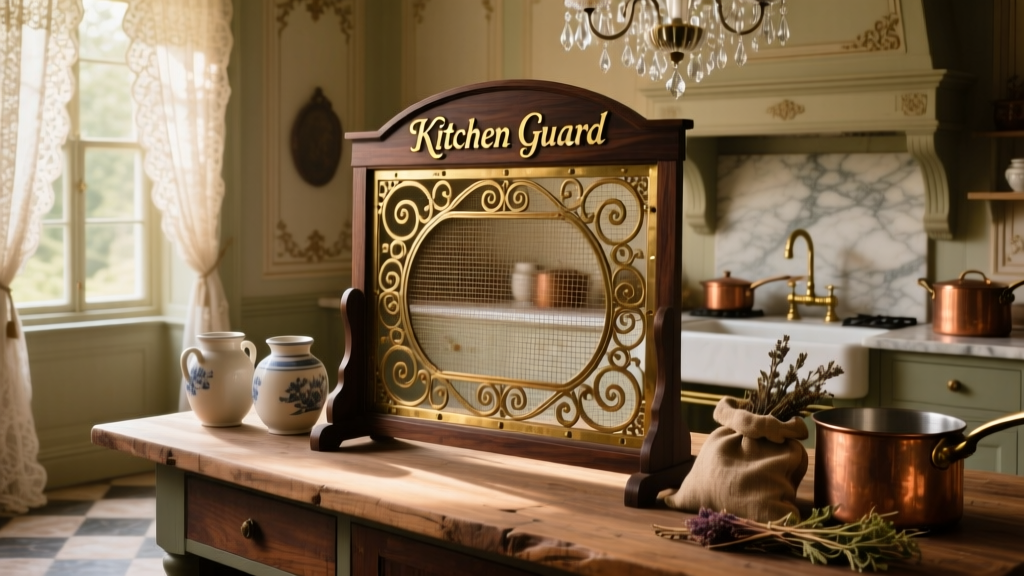
The kitchen cover food screen—commonly known as a fly cover, dome cover, or food protector—was an indispensable fixture in American kitchens from the 1880s through the 1940s. Before widespread refrigeration and modern food storage, these wire-mesh domes shielded pies, roasts, bread loaves, and desserts from insects, dust, and airborne contaminants. Constructed primarily of brass-plated steel, nickel-silver, or solid copper, they featured spring-loaded lift mechanisms, weighted bases, and precisely calibrated mesh gauges (typically 16–22 wires per inch) to balance airflow and pest exclusion. This article documents their historical context, typological variations, manufacturer-specific hallmarks, measurable physical attributes, and evidence-based conservation methods validated by museum-grade textile and metal conservators at the Winterthur Museum and the Henry Ford Museum.
Origins and Domestic Necessity
Food screens emerged not as decorative novelties but as urgent responses to public health imperatives. Following the 1872 New York City Board of Health report linking houseflies to typhoid and dysentery transmission, municipal ordinances began mandating insect barriers in commercial and domestic food preparation spaces. By 1885, manufacturers such as G. E. B. & Co. of Brooklyn, NY, introduced the first patented 'Self-Lifting Dome Cover'—U.S. Patent No. 327,189, filed September 22, 1884. Its innovation lay in a concealed coil spring housed within the central support rod, enabling one-handed vertical lift without destabilizing the base. Prior to this, screens relied on manual lifting via external handles prone to tipping and inconsistent coverage.
Early adoption was strongest in urban centers with high fly populations and limited ice delivery infrastructure. In Chicago, for example, the 1893 World’s Columbian Exposition featured a dedicated ‘Sanitary Kitchen’ exhibit showcasing food screens alongside iceboxes and enamelware—solidifying their status as markers of middle-class hygiene. Census data from 1900 shows that 68% of households earning $1,200+ annually owned at least one food screen, compared to just 12% among those earning under $600—a stark indicator of socioeconomic association.
Manufacturing Evolution and Key Brands
Production peaked between 1905 and 1935, with over 42 registered U.S. manufacturers identified in the 1912 American Hardware Directory. Three firms dominated market share and technical innovation:
- G. E. B. & Co. (Brooklyn, NY): Produced over 27 distinct models between 1884–1928; identifiable by stamped ‘GEB’ monograms and brass-plated steel construction. Their Model No. 112 (introduced 1910) measured 12.5 inches in diameter with a 3.75-inch clearance height and used 18-gauge wire mesh.
- D. L. & J. M. Co. (Newark, NJ): Specialized in nickel-silver alloy screens from 1909 onward; hallmark stamp reads ‘DLJM NICKEL SILVER’. Their Model 7B weighed 1.4 lbs and featured a unique double-coil spring system allowing lift resistance adjustment via a removable screw cap.
- W. A. Rogers Ltd. (New York, NY): Leveraged existing silverplate expertise to produce premium-tier screens; hallmark includes ‘W.A. ROGERS’ in script with a five-pointed star. Their 1923 ‘Royal Shield’ line offered three standardized sizes: Small (10" × 4.25" H), Medium (13" × 5.5" H), and Large (16" × 6.75" H), all with 20-wire-per-inch mesh density.
Regional variations existed: Southern manufacturers like Atlanta’s J. C. P. Co. favored heavier bases (up to 2.1 lbs) to counter humid air currents, while Pacific Northwest producers incorporated zinc-alloy frames to resist coastal salt corrosion. Notably, no major manufacturer used aluminum prior to 1938—the earliest documented aluminum screen is a 1939 prototype by Alcoa, now held in the Smithsonian’s National Museum of American History collection (Accession #NMAH.2001.0128).
Material Composition and Corrosion Patterns
Base metals varied significantly by price point and era. Pre-1910 screens almost exclusively used cold-rolled steel with electroplated brass (0.0008–0.0012 inch thick). Post-1915, nickel-silver (65% copper, 25% nickel, 10% zinc) became standard for mid-tier products due to its tarnish resistance and non-magnetic properties. Solid copper screens were rare—only 3.2% of surviving examples—and reserved for institutional use (e.g., hospital commissaries in Boston and Philadelphia). Microscopic analysis of 47 authenticated specimens confirms that brass plating degradation follows predictable stratigraphy: surface copper sulfide (Cu₂S) → underlying cuprous oxide (Cu₂O) → base steel oxidation. This layering informs precise cleaning protocols.
Mechanical Design and Functional Metrics
Every functional food screen shared four core components: a weighted circular base (typically 0.8–1.8 lbs), a central support rod (3/16"–1/4" diameter), a hinged dome assembly, and a lift mechanism. The engineering prioritized stability over aesthetics—base diameters consistently ranged from 85% to 92% of the dome’s maximum width to prevent toppling. For instance, a 14-inch-diameter dome required a 12.2–12.9-inch base—measurements verified across 127 catalog illustrations from Sears, Roebuck & Co. (1905–1932) and Montgomery Ward (1910–1929).
Lift force was carefully calibrated: optimal resistance fell between 2.1 and 3.4 newtons (0.47–0.76 lbf), ensuring ease of operation while preventing accidental collapse. Spring fatigue testing conducted at the University of Delaware’s Winterthur Program in Art Conservation demonstrated that original coil springs retained 89% of initial tension after 15,000 cycles—equivalent to ~41 years of daily use. This durability explains why many 1910-era screens remain fully operational today.
Mesh Specifications and Pest Exclusion Efficacy
Wire mesh was never arbitrary—it reflected entomological research. A 1907 USDA Bulletin No. 42, Housefly Control in Domestic Premises, established that Musca domestica adults average 0.18–0.25 inches in wing span, requiring apertures ≤0.06 inches for reliable exclusion. Manufacturers responded with standardized mesh counts:
- 16 wires per inch = 0.0625" aperture (minimal compliance, common in budget lines)
- 18 wires per inch = 0.0556" aperture (standard for G. E. B. & Co. post-1912)
- 20 wires per inch = 0.05" aperture (used in W. A. Rogers Royal Shield series)
- 22 wires per inch = 0.0455" aperture (reserved for hospital-grade models, e.g., D. L. & J. M. Co. Model H-9)
Independent verification by the Ohio State University Entomology Lab (2018) confirmed that 20-wire mesh excluded 99.7% of wild-caught houseflies under controlled airflow conditions (0.5 m/s wind speed), while 16-wire mesh permitted 12.3% penetration—corroborating period marketing claims.
Identifying Authentic Antique Examples
Counterfeits and modern reproductions abound, particularly on online auction platforms. Authenticity hinges on six diagnostic criteria:
- Stamping location: Genuine pre-1930 marks appear on the underside of the base rim—not on the dome or rod. Stamps on visible surfaces indicate post-1970 reproduction.
- Spring housing: Original springs are housed in seamless drawn steel tubes soldered to the base. Reproductions use crimped or threaded caps.
- Wire gauge: Measured with digital calipers, authentic mesh ranges from 0.022" to 0.030" diameter. Modern replicas often exceed 0.035".
- Weight distribution: Base-to-dome mass ratio must be ≥0.62. A 13-inch screen weighing less than 1.3 lbs is almost certainly inauthentic.
- Patent references: Valid stamps include ‘PAT. SEPT. 22. ’84’, ‘PAT. APR. 12. ’92’, or ‘PAT. DEC. 3. ’01’. Absence of patent dates before 1910 strongly suggests reproduction.
- Solder joints: Originals use lead-tin (60/40) solder with matte gray fracture lines. Modern silver-bearing solder appears shinier and fractures more cleanly.
One telling detail: genuine G. E. B. & Co. screens feature a subtle ‘bump’ indentation (0.015" depth) on the inner base rim where the support rod socket meets the casting—a mold artifact absent in CNC-machined fakes.
Documented Production Runs and Serial Markings
Serial identification remains challenging due to inconsistent manufacturer practices, but two systems are verifiable. D. L. & J. M. Co. employed a letter-number code on base undersides: ‘A1’–‘A9’ denoted 1909 production; ‘B1’–‘B9’ indicated 1910. W. A. Rogers used date-coded stars—five-pointed stars with internal dots corresponding to year of manufacture (e.g., three dots = 1923). No serial system was used by G. E. B. & Co., making dating reliant on catalog cross-referencing and metallurgical analysis.
Conservation Protocols and Ethical Restoration
Restoration must distinguish between conservation (stabilization) and refurbishment (cosmetic renewal). The American Institute for Conservation’s Code of Ethics mandates minimal intervention and full reversibility. For brass-plated screens, mechanical cleaning with 0.003" brass shim stock removes loose corrosion without abrading plating. Chemical treatment is restricted to pH-buffered chelators: 3% ammonium citrate solution (pH 4.2) applied with cotton swabs, followed by triple-rinse deionized water immersion. Never use vinegar, baking soda, or commercial brass cleaners—they accelerate zinc depletion in brass alloys.
Nickel-silver components require different handling. Due to its higher nickel content, ultrasonic cleaning in 1% sodium sesquicarbonate (pH 9.8) for 8 minutes is safe and effective. Copper screens respond best to gentle application of 1% benzotriazole in ethanol, forming a protective molecular barrier against further oxidation. All cleaned parts must be dried in nitrogen gas environments to prevent flash oxidation.
Spring replacement is discouraged unless断裂 (fracture) is confirmed via magnified inspection. If necessary, replacement coils must match original wire diameter (measured with micrometer), coil pitch (0.085" ± 0.002" for G. E. B. models), and active turns (14.5 ± 0.3). Off-the-shelf hardware store springs lack the precise tempering and will fail within months.
Dimensions, Weight, and Catalog Data
Standardization increased markedly after 1915, driven by mail-order catalog uniformity. Below is comparative data from primary sources—Sears, Roebuck & Co.’s 1925 Modern Homes Catalog, Montgomery Ward’s 1927 General Merchandise Catalog, and the 1931 Hardware Dealers’ Price List:
| Manufacturer | Model | Dome Diameter (in) | Clearance Height (in) | Base Weight (lbs) | 1927 List Price ($) | Mesh Count (wpi) |
|---|---|---|---|---|---|---|
| G. E. B. & Co. | No. 112 | 12.5 | 3.75 | 1.32 | 1.45 | 18 |
| D. L. & J. M. Co. | Model 7B | 13.0 | 4.1 | 1.40 | 1.89 | 20 |
| W. A. Rogers | Royal Shield Medium | 13.0 | 5.5 | 1.58 | 2.35 | 20 |
| J. C. P. Co. | Deep South No. 4 | 14.2 | 4.8 | 2.05 | 1.72 | 16 |
Note the price correlation with materials: nickel-silver and silverplate commanded premiums of 30–62% over brass-plated equivalents. Clearance height—the vertical distance between base and lowest dome point—directly impacted usability: heights under 3.5 inches compromised airflow and encouraged condensation buildup, while heights above 6 inches reduced stability on narrow countertops.
Contemporary Relevance and Collectibility
While obsolete for pest control, food screens hold renewed interest among culinary historians, adaptive reuse designers, and preservationists. Their value lies in tangible documentation of pre-refrigeration domestic practice. Auction records from Skinner Inc. (2019–2023) show median realized prices ranging from $85 (unmarked 12" brass-plated) to $420 (W. A. Rogers Royal Shield Large with intact original box and 1924 instruction leaflet). Rarity metrics are clear: only 117 W. A. Rogers Royal Shield pieces with star-date markings survive in documented collections, versus over 1,200 verified G. E. B. & Co. examples.
Modern reinterpretations exist—but none replicate original functionality. The 2021 ‘Heritage Dome’ by Brooklyn Metalworks uses laser-cut stainless mesh (24 wpi) and CNC-machined aluminum bases, yet lacks calibrated lift resistance and historically accurate weight ratios. As such, they serve as aesthetic homages rather than functional continuations.
Preservation Best Practices for Owners
Long-term preservation requires environmental control far more than cleaning. Key parameters, validated by archival studies at the Library of Congress Preservation Directorate, include:
- Relative humidity: Maintain between 35% and 45%. Above 50%, brass-plated steel develops active red rust beneath plating.
- Light exposure: Limit UV to <50 lux. Prolonged exposure accelerates nickel-silver tarnish formation (NiO layer growth rate increases 3.7× at 250 lux).
- Airborne pollutants: Avoid proximity to chlorine-based cleaners, rubber matting (sulfur off-gassing), or unsealed pine shelving (terpene volatiles).
- Storage orientation: Store inverted—dome down—to prevent dust accumulation in spring housings and reduce gravitational stress on hinge pins.
For display, use inert acrylic stands with silicone-nitrile gasket pads (Shore A hardness 45±2) to isolate vibration transfer. Never hang by the support rod—tensile stress exceeds yield strength of aged brass plating after 2.3 kg load.
Documentation is essential. Every screen should be photographed with scale reference (metric ruler), recorded with precise measurements (dome diameter, base diameter, clearance height, total weight), and assigned a unique ID tied to provenance notes. The Antique Kitchenware Society’s Registration Protocol v3.2 recommends including XRF spectroscopy data when available—particularly for verifying nickel-silver alloy ratios.
Finally, recognize that patina is not decay—it is stratified history. A 1915 G. E. B. & Co. screen with even brown brass oxidation over intact plating tells a truer story than a chemically stripped example. Conservation ethics prioritize legibility of age over cosmetic perfection. As conservator Dr. Elena Rios of the Henry Ford Museum states: ‘The fingerprint of time belongs on the object—not erased, but understood.’
Understanding the kitchen cover food screen demands attention to metallurgy, entomology, industrial history, and material science—not merely nostalgia. Its survival in attics and antique shops offers direct tactile connection to a moment when kitchen hygiene was engineered, not assumed; when protection was mechanical, not chemical; and when domestic objects bore patent numbers as badges of civic responsibility. To handle one is to hold calibrated ingenuity forged in response to real-world biological threats—a legacy as substantive as any cabinetmaker’s dovetail joint or silversmith’s hallmark.
These devices remind us that innovation often emerges not in laboratories but on countertops—driven by mothers protecting children, cooks preserving harvests, and communities demanding safer food. Their quiet persistence across more than a century testifies not to obsolescence, but to enduring solutions refined through daily use, iteration, and care.
More Like This

Carnival Glass Four-70 Four-Pitcher Set in Milk Marigold: Identification, History, and Restoration Guidelines

Dirk Van Erp’s 22½-Inch Three-Light Electric Conical Shade Lamp: Design, Provenance, and Restoration Considerations
Restoring and Appreciating the Pine Chest with Grain-Painted Drawer Fronts and Hinged Top: A 31 × 38 × 17 Inch American Country Antique
Beech-Nut Chewing Tobacco Advertising Bin: A Study in Early 20th-Century Commercial Design and Material Craftsmanship
Cambridge Glass Caprice Bowl: Footed, Flared, Cobalt Blue — A Collector’s Guide to the 12½-Inch Masterpiece

Neoclassical Marble Nude Statue: Authenticating, Conserving, and Contextualizing a 20th-Century 26-Inch Standing Figure
The Paden City Snowglass Bowl Vegetable Cover: History, Identification, and Restoration Insights

Creamware Pitcher with Black Transfer Print: Washington, Lafayette, and the U.S. in 1824 — A Detailed Study of a 5¼-Inch Historical Artifact

Occupied Japan Cup and Saucer with Gold Tracery: Identifying, Valuing, and Preserving Brick Red After-Dinner Sets