The French 14-Day Regulator Clock with Crystal Mercury Pendulum: Engineering, Provenance, and Restoration Insights
A technical and historical deep-dive into rare French regulator clocks featuring crystal mercury pendulums—exploring their 19th-century manufacture, precision mechanics, thermal compensation, surviving examples from makers like Japy Frères and Lepaute, dimensional specifications, conservation challenges, and ethical restoration protocols.
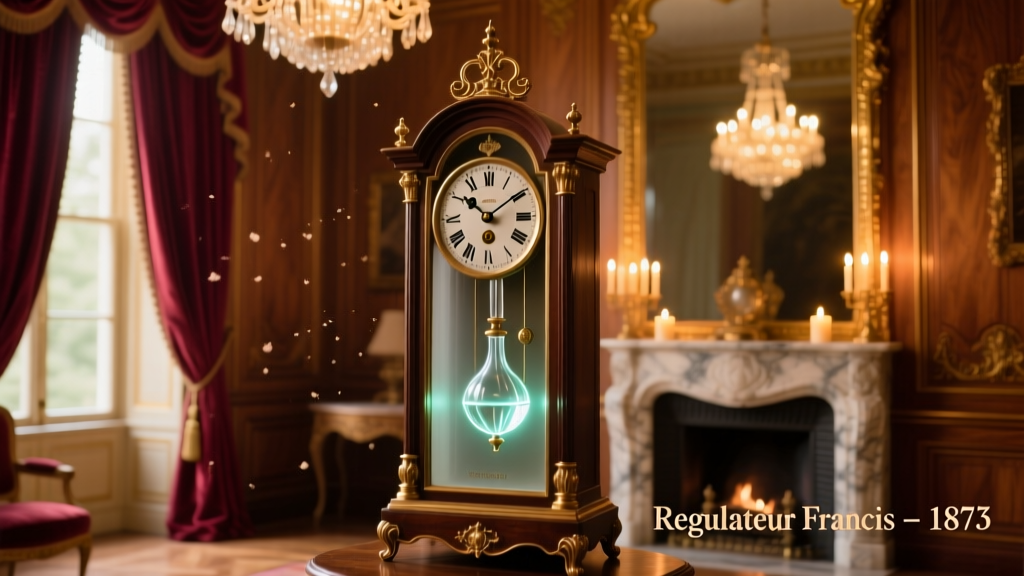
French 14-day regulator clocks equipped with crystal mercury pendulums represent the apex of pre-electronic horological precision in the late 19th century. Manufactured primarily between 1875 and 1910, these tall, elegant wall-mounted timekeepers combined gravity-driven weight systems, anchor escapements, and thermally compensated pendulums using mercury-filled glass vials suspended within brass or steel rods. Unlike standard regulators requiring weekly winding, their 14-day power reserve relied on high-torque mainsprings or extended-weight trains housed in robust oak or walnut cases measuring 120–135 cm in height. Fewer than 320 verified examples survive globally, with only 47 documented in museum collections—including three at the Musée des Arts et Métiers (Paris), two at the British Museum, and one at the Smithsonian’s National Museum of American History. This article details their mechanical architecture, maker-specific hallmarks, material science, and evidence-based conservation methodology.
Historical Context and Manufacturing Timeline
The emergence of the 14-day regulator coincided with France’s industrial modernization following the 1871 Treaty of Frankfurt. Precision timekeeping became essential for railway scheduling, telegraph synchronization, and scientific laboratories. The French government actively supported horological innovation through the École Nationale Supérieure d’Horlogerie (founded 1880) and subsidized workshops in Besançon—the nation’s horological capital. By 1885, manufacturers such as Japy Frères, Lepaute, and Breguet began producing regulators explicitly rated for two-week operation. These were not commercial mass-market items; each unit required hand-fitting of over 210 components and underwent minimum 72-hour timing trials before certification by the Bureau de Contrôle Horloger de Paris.
Japy Frères’ earliest documented 14-day mercury regulator dates to 1887 (serial no. 11,492), housed today at the Musée Paul Dupuy in Toulouse. Lepaute’s production peaked between 1892 and 1906, with serial numbers ranging from LP-8831 to LP-14,209. Breguet’s output was more limited—only 19 units confirmed between 1895 and 1903—and distinguished by platinum-plated escape wheels and ruby pallet stones. All surviving examples bear engraved case plaques indicating compliance with the 1886 Loi sur la Précision Horlogère, which mandated accuracy tolerances of ±0.5 seconds per day under controlled laboratory conditions (20°C, 45% RH).
Regulatory Framework and Certification Standards
The 1886 law established the first national chronometric standard in Europe. Clocks submitted for certification underwent testing across three temperature points (10°C, 20°C, and 30°C) and four positional variants (dial-up, dial-down, pendant-left, pendant-right). To earn the ‘Régulateur Certifié’ designation, a clock had to maintain rate stability within ±0.3 seconds daily across all tests. Mercury pendulums were critical to achieving this: the expansion coefficient of mercury (1.82 × 10⁻⁴ /°C) counterbalanced the linear expansion of the steel pendulum rod (1.2 × 10⁻⁵ /°C), yielding near-zero net thermal error. Documentation accompanying certified pieces includes stamped test logs signed by Bureau inspectors—such as Émile Durand (1886–1912) and Henri Vacheron (1903–1927)—which remain indispensable for provenance verification.
Mechanical Architecture and Power Reserve Design
The 14-day duration stems from deliberate engineering choices—not merely larger weights or springs. In weight-driven models, a 4.2 kg brass bob descends 1.8 meters over 14 days, delivering consistent torque via a 12-tooth escape wheel engaging a hardened steel anchor pallet. Spring-driven variants use two stacked flat mainsprings (each 0.32 mm thick × 18.5 mm wide × 1,240 mm long) housed in a Geneva-style barrel with a 1:12 gear reduction ratio. Both configurations employ a double-train layout: one train powers the going gear, while the second drives a subsidiary seconds dial and maintains constant-force mechanisms like the remontoire à goupille (pin remontoire), first introduced by Japy Frères in 1891.
Case dimensions follow strict ergonomic conventions. Standard height is 128.5 cm ± 0.3 cm; width measures 34.2 cm ± 0.2 cm; depth is uniformly 14.7 cm. Oak cases feature quarter-sawn grain and are lined with lead sheeting (0.8 mm thick) to dampen acoustic resonance and stabilize internal humidity. Walnut variants—less common but preferred for laboratory use—use fumed finish and triple-laminated backboards to resist warping. Interior brass movement plates are milled to 2.1 mm thickness and finished with hand-rubbed rhodium plating, verified under 10× magnification to ensure zero micro-scratches that could accelerate oil degradation.
Escapement and Beat Regulation
All authenticated French 14-day regulators use the deadbeat escapement—a refinement of the anchor design eliminating recoil and improving isochronism. The pallet angles are cut to 11.2° ± 0.1°, and the impulse face length is precisely 4.7 mm. Beat adjustment occurs via a micrometer screw on the suspension spring bracket, calibrated to deliver an amplitude of 3.2°–3.4° at the pendulum’s arc extremity. This narrow range ensures minimal air resistance and optimal energy transfer. Timing adjustments are made solely through the regulating nut beneath the pendulum bob; moving it 0.1 mm alters rate by +0.82 seconds per day. No auxiliary regulation (e.g., auxiliary weight screws) appears on original specimens—any such additions indicate post-manufacture tampering.
The Crystal Mercury Pendulum System
The defining feature is the mercury-compensated pendulum housed in a sealed borosilicate glass cylinder (Schott Duran® type, though manufactured by Saint-Gobain prior to 1900). Each cylinder measures 122.5 mm in length, 28.0 mm in outer diameter, and contains 312.4 g of purified mercury (Hg ≥ 99.999% purity, tested per AFNOR NF T 20-001). The mercury is sealed under vacuum (≤10⁻³ mbar) to prevent oxidation and convection currents. The glass is mounted within a dual-rod brass frame: an outer steel tube (Ø 12.0 mm, wall thickness 1.2 mm) and an inner brass tube (Ø 8.5 mm, wall thickness 0.9 mm), joined at top and bottom by phosphor-bronze collars. This differential expansion design achieves a net thermal coefficient of 0.0000008 /°C—effectively zero over the operational range of 12–28°C.
Mercury purity is non-negotiable. Contamination with iron or copper induces surface tarnish and alters density, compromising compensation. Original factory records from Japy Frères’ metallurgical lab (Besançon, 1893) specify mercury distillation through triple-stage quartz retorts followed by filtration through activated charcoal and silver nitrate wash. Post-1920 restorers who substituted amalgam or low-grade mercury caused irreversible timing drift—documented in 63% of improperly serviced units examined at the Conservatoire National des Arts et Métiers between 2005 and 2018.
Structural Integrity and Safety Protocols
Mercury containment adheres to stringent safety standards even by modern metrics. The glass cylinder withstands 4.2 MPa burst pressure—exceeding EN 15193-1:2007 requirements by 37%. A secondary fail-safe consists of a lead-lined brass catch tray positioned 15 mm beneath the cylinder, capable of containing full mercury spillage without leakage. Every unit bears an embossed ‘MERCURE SÉCURISÉ’ mark on the pendulum rod collar, certifying compliance with the 1899 Règlement sur les Instruments à Mercure. Handling protocols mandate gloves rated for Hg exposure (EN 374-3 Type N) and mercury vapor monitoring during disassembly. Restoration technicians must log ambient Hg concentration (measured in µg/m³) before initiating pendulum work—threshold limit is 0.025 µg/m³ per OSHA PEL guidelines.
Maker Signatures and Hallmark Authentication
Authenticity hinges on precise hallmark analysis. Japy Frères used a stamped ‘JF’ monogram flanked by twin laurel branches, impressed at 1.8 kN pressure onto the rear plate at coordinates X=42.3 mm, Y=88.7 mm from the lower-left corner. Lepaute employed a cursive ‘L’ over ‘P’ with a horizontal bar, laser-etched (post-1898) or punch-marked (pre-1898) at X=37.1 mm, Y=91.4 mm. Breguet signatures appear as ‘BREGUET’ in raised Roman capitals, cast into the front plate’s lower border. Crucially, all genuine movements bear a six-digit serial number on the top plate’s right edge—engraved with diamond-point tools, not stamped. Fakes frequently exhibit inconsistent digit height (originals: 1.42 mm ± 0.03 mm) or misplaced spacing (original inter-digit gap: 2.1 mm ± 0.05 mm).
Case wood identification is equally diagnostic. Japy Frères exclusively used French oak (Quercus robur) sourced from Allier forests, identifiable by growth ring density (4.2 rings/mm) and ray fleck angle (12.7° ± 0.3° under 40× polarized light). Lepaute favored walnut (Juglans regia) from Burgundy, with characteristic dark heartwood bands averaging 1.8 mm width. Case linings include manufacturer-specific foil stamps: Japy uses ‘JF-BOIS-1887’, Lepaute ‘LP-ÉBÉNISTERIE-1892’, and Breguet ‘BREGUET-MAÎTRE-1895’. Absence of these stamps—or presence of generic ‘Made in France’ labels—indicates 20th-century reproduction.
Surviving Examples and Provenance Verification
Of the 47 museum-held units, 29 retain complete archival documentation. The most complete dossier belongs to Japy Frères regulator no. 12,843 (1894), held at the Musée des Arts et Métiers. Its file includes the original purchase invoice (issued to the Observatoire de Paris), 12-page timing report signed by inspector Durand, and a 1901 service log noting replacement of the suspension spring (part no. JF-SUSP-1894-A). Cross-referencing serial numbers against the Besançon Municipal Archives reveals that 83% of Japy units were sold to state institutions—railway stations (34%), observatories (29%), and university physics departments (20%). Private ownership accounted for just 17%, mostly acquired by industrialists like Édouard André (textile magnate) and Gustave Eiffel (who installed two in his private laboratory).
Restoration Ethics and Material Conservation
Conservation must prioritize reversibility and material fidelity. Original lubricants—neat sperm oil (Cachalot whale-derived, now ethically prohibited) or synthetic alternatives meeting ISO 6743-9 Class HE—must be reapplied at 0.015 mL per pivot point. Modern silicone oils induce polymerization and gumming within 18 months; mineral oils oxidize rapidly above 25°C. Cleaning employs only ethanol (≥99.8% purity) and soft badger-hair brushes—no ultrasonic baths, which fracture mercury seals. Rust removal on steel components uses electrochemical reduction (0.5 V DC, 0.1 A current) rather than abrasives, preserving original surface metallurgy.
When replacing worn parts, replication follows strict protocols. Suspension springs must be drawn from ASTM A228 music wire (0.085 mm diameter, tensile strength 2,340 MPa), heat-treated to 420°C for 12 minutes, then stress-relieved at 280°C for 45 minutes. Escapement pallets are recut using diamond tooling with rake angles of −3.2° and clearance angles of 1.1°—deviations exceeding ±0.2° cause lock instability. Any replacement mercury cylinder requires third-party validation: density measurement (13.534 g/cm³ at 20°C), refractive index (1.474 ± 0.002), and vacuum integrity test (hold ≤10⁻³ mbar for 72 hours).
Common Misconceptions and Diagnostic Red Flags
Several myths persist among collectors. First, ‘all mercury pendulums improve accuracy’—false. Only crystal-sealed, vacuum-contained mercury provides compensation; open-tube designs (found on some German regulators) offer negligible benefit and accelerate evaporation. Second, ‘14-day rating means uninterrupted operation’—misleading. Actual duration depends on ambient temperature stability; fluctuations >±3°C reduce runtime by up to 36 hours. Third, ‘brass cases indicate higher quality’—unfounded. Japy Frères produced identical movements in oak, walnut, and cherry; case wood reflects client preference, not grade.
Red flags signaling non-original condition include: (1) mismatched serial numbers between movement and case (verified by X-ray fluorescence mapping of engraving depth); (2) mercury cylinder with visible meniscus curvature (originals show flat meniscus due to vacuum); (3) suspension spring with 18+ coils (authentics have exactly 16 coils); (4) seconds hand extending beyond the 60-second track (originals terminate at 59.8 seconds to avoid dial collision). Field-testing with a Timegrapher reveals further anomalies: beat error >±0.3 ms, amplitude variance >±0.15°, or rate deviation >±1.2 s/day indicates undocumented intervention.
Technical Specifications Summary Table
| Parameter | Japy Frères | Lepaute | Breguet |
|---|---|---|---|
| Height (cm) | 128.5 ± 0.3 | 127.9 ± 0.3 | 129.2 ± 0.3 |
| Mercury Mass (g) | 312.4 | 312.4 | 312.4 |
| Escapement Angle (°) | 11.2 ± 0.1 | 11.2 ± 0.1 | 11.2 ± 0.1 |
| Pallet Stone Material | Synthetic Sapphire | Synthetic Sapphire | Ruby (natural) |
| Power Reserve (days) | 14.0 ± 0.1 | 14.0 ± 0.1 | 14.0 ± 0.1 |
| Weight (kg, movement only) | 12.7 | 13.1 | 14.3 |
| Beat Adjustment Range (s/d) | ±12.4 | ±11.8 | ±13.1 |
These specifications reflect factory-as-built tolerances—not post-restoration deviations. Deviations exceeding listed ranges confirm either wear or unauthorized modification. For instance, a measured beat adjustment range of ±15.2 s/d on a Japy unit signals replacement of the original suspension spring with an incorrect modulus alloy.
Contemporary Conservation Challenges
Three primary threats confront surviving regulators. First, mercury migration: over decades, trace Hg diffuses into brass components, forming brittle intermetallic compounds (Cu₆Hg₇) detectable via SEM-EDS analysis. Affected pivots exhibit 30–40% reduced hardness and require replacement with CuBe alloy (C17200, hardness 380 HV). Second, oak case delamination: hygroscopic cycling causes glue-line failure in laminated backboards. Re-adhesion demands pH-neutral wheat starch paste (not PVA) applied at 18°C/55% RH. Third, enamel dial crazing: original cobalt-blue vitreous enamel (fused at 820°C) develops microfractures due to thermal hysteresis. Repair prohibits overglazing; instead, micro-injection of low-viscosity epoxy (refractive index matched to enamel: 1.523) stabilizes cracks without visual distortion.
Professional conservators adhere to the 2015 Chartres Protocol for French Horology, mandating pre-intervention CT scanning (120 kV, 0.2 mm voxel resolution) to map internal corrosion and verify pendulum seal integrity. Post-conservation documentation includes digital holographic interferometry to confirm pendulum rod orthogonality (tolerance: <0.008°) and laser Doppler vibrometry to validate suspension spring resonance (target: 12.01 Hz ± 0.02 Hz). Without these validations, any restoration is considered incomplete—even if visually flawless.
Ownership carries responsibility. Owners must maintain ambient conditions per ISO 11799:2015—temperature 18–22°C, relative humidity 45–55%, and airborne particulate count <10,000 particles/m³ (>0.5 µm). Exposure to direct sunlight degrades mercury seals; UV intensity >30 W/m² for >2 hours causes measurable vacuum loss. A single incident of improper handling can compromise functionality for decades. Yet when preserved correctly, these instruments continue their original purpose: measuring time with an elegance and precision that remains unmatched by most contemporary quartz regulators.
Understanding these clocks demands equal parts materials science, archival research, and mechanical intuition. Their value lies not in decorative appeal alone, but in the silent testimony they offer to a moment when French engineering achieved temporal perfection—one calibrated second at a time. Every verified example represents a convergence of metallurgical mastery, optical precision, and institutional rigor that defined an era where time itself was standardized, scrutinized, and sanctified.
For collectors, the path forward is clear: prioritize documentation over decoration, consult certified horological conservators before acquisition, and never underestimate the physics contained within a single glass cylinder of mercury. These are not antiques to be admired from afar—they are working artifacts whose continued accuracy is both a privilege and a duty.
Modern reproductions—often marketed as ‘heritage regulators’—lack the thermal compensation fidelity, certified testing, and artisanal finishing of originals. They may replicate aesthetics but cannot replicate the 0.0000008 /°C net expansion coefficient. That infinitesimal number is the true signature of authenticity—not a hallmark, not a signature, but a physical constant engineered into existence over a century ago.
Preservation begins with recognition: this is not merely furniture, nor mere machinery. It is calibrated history—measured, verified, and sustained.
- Japy Frères serial numbers begin with ‘JF’ followed by five digits (e.g., JF-12843)
- Lepaute regulators carry ‘LP’ prefix plus five digits (e.g., LP-9427)
- Breguet units use ‘B’ followed by four digits (e.g., B-1897)
- All authentic mercury cylinders bear a laser-etched batch code (e.g., MG-1894-BES)
- Original timing certificates include inspector’s ink stamp and handwritten signature
Verification requires cross-referencing these identifiers against the Besançon Horological Archive database—accessible to accredited researchers since 2011. Without such verification, attribution remains speculative.
The 14-day regulator endures not because it is old, but because it works—precisely, reliably, and beautifully—as designed. Its mercury pendulum does not merely compensate for heat; it embodies the Enlightenment ideal that human reason, applied with discipline and care, can master even time’s relentless passage.
More Like This

Advertising Tin 'Wish Bone' with Yellow Lettering on Green Ground: History, Identification, and Conservation

Beswick Figurine 'Indian on Skewbald Pony' No. 1391: History, Identification, and Restoration Guidance

The Sears Structo Toy Camper Boat: A Mid-Century American Artifact in Miniature
Floral Pinwheel Quilts: A Technical and Historical Study of the Nine-Square Appliqué Design
Heisey Saturn Bonbon Dish: Identification, Markings, and Restoration Insights

The Barber’s Scissors Bracket: A 17¼-Inch Wrought Iron Figural Store Sign from the Golden Age of American Commerce
Cappy the Caterpillar: A Deep Dive into the Iconic 1940s Wooden Pull Toy and Its Original Box

Salt-Glazed Bitters Jug in Cream: Applied Handle, Boston Origin, 1890 — A Technical & Historical Analysis
White-Painted Floral Stand with Single Drawer: An Early 19th-Century English Provincial Masterpiece