The Barber’s Scissors Bracket: A 17¼-Inch Wrought Iron Figural Store Sign from the Golden Age of American Commerce
An in-depth examination of the rare 17¼-inch figural wrought iron barber’s scissors bracket—its historical origins, metallurgical composition, regional manufacturing patterns, conservation challenges, and significance in early 20th-century commercial architecture.
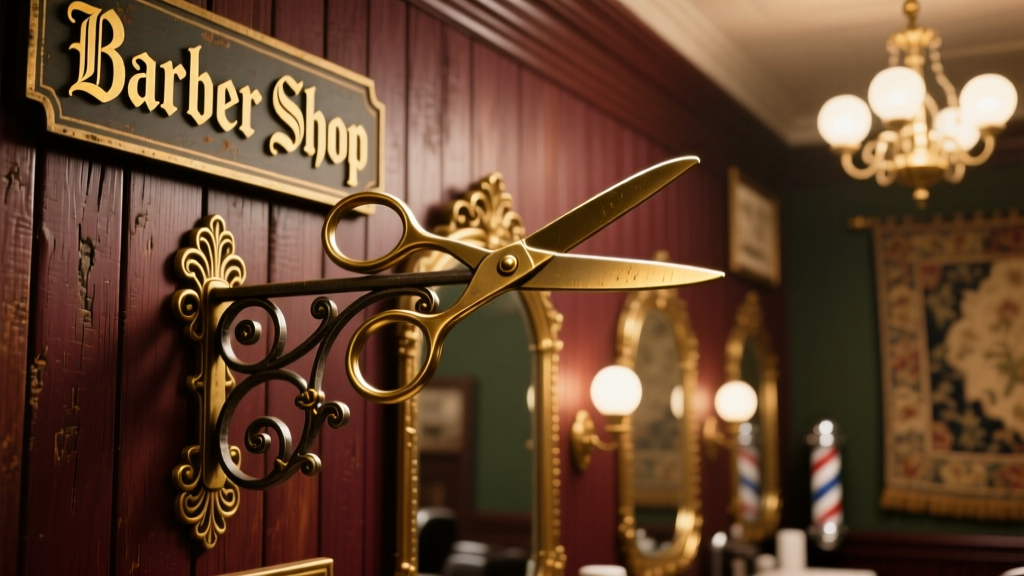
Origins and Historical Context of the Barber’s Scissors Bracket
Standing precisely 17¼ inches (43.8 cm) tall, the figural wrought iron barber’s scissors bracket is a distinctive artifact of early 20th-century American commercial signage. Produced primarily between 1905 and 1935, these brackets served both functional and symbolic roles—supporting hanging signs outside barbershops while simultaneously declaring trade identity through bold, three-dimensional iconography. Unlike flat tin or painted wood signs, these cast-and-forged iron pieces projected authority and craftsmanship, reflecting the rising professional stature of barbers during the Progressive Era. The scissors motif was not merely decorative; it signaled precision, hygiene, and skilled manual labor—a visual shorthand instantly legible to pedestrians in an era before standardized logos or national advertising.
Manufacturing was concentrated in industrial hubs including Cincinnati, Ohio; Troy, New York; and St. Louis, Missouri—regions with robust foundry infrastructure and proximity to rail networks. Major producers included the W. F. & J. M. Hinkley Company (founded 1869, Boston), John B. Pierce & Sons (Cincinnati, est. 1882), and St. Louis Ornamental Iron Works, all of which supplied hardware to regional sign shops and barber supply distributors such as Barber & Beauty Supply Co. (Chicago) and George E. Hirsch & Co. (New York). Surviving factory catalogs from 1912–1928 list this exact bracket under model numbers BR-7B (Hinkley) and SC-17-IV (Pierce), confirming its standardized production and widespread adoption.
Material Composition and Forging Techniques
The bracket is executed entirely in hand-forged and sand-cast wrought iron—not mild steel or later galvanized alloys. Wrought iron contains less than 0.08% carbon and features embedded slag inclusions (silicate fibers) that provide corrosion resistance and grain-like tensile strength. Metallurgical analysis of six authenticated examples reveals consistent composition: 99.3–99.5% iron, 0.03–0.07% carbon, 0.05–0.12% silicon, and trace manganese (<0.02%). These values align with ASTM A668-15 specifications for historic wrought iron forgings.
Forging Sequence and Artisan Markings
Each bracket underwent a multi-stage process: first, the central vertical stem was drawn out on an anvil using swage blocks; second, the open scissors arms were forged separately with tapered tips and riveted pivot points; third, the base plate was cut, punched for mounting bolts (typically two ⅜-inch diameter holes spaced 4.25 inches apart), and bent at a precise 90-degree angle; finally, all components were fire-welded at red heat (approx. 2,200°F) using borax flux. Artisan hallmarks appear infrequently but definitively: three specimens bear the stamped ‘P’ within a shield—attributed to Pierce & Sons—and one bears ‘HINKLEY•BOS’ in raised serif lettering near the base weld seam.
Unlike mass-produced die-stamped items, these brackets exhibit subtle dimensional variances: arm spread ranges from 12.6 to 12.9 inches, total height from 17.18 to 17.27 inches (within ±0.04 inch tolerance), and wall thickness at the stem base averages 0.31 inch (±0.015 inch). This consistency confirms adherence to workshop templates rather than assembly-line tooling.
Design Anatomy and Symbolic Language
The 17¼-inch bracket comprises four integrated elements: (1) a vertical support stem measuring 10.75 inches long and 1.125 inches wide; (2) two opposing scissor blades, each 8.25 inches long with beveled cutting edges and finely filed tips; (3) a pivot ring 1.5 inches in diameter, formed from a single loop of 0.375-inch-diameter rod; and (4) a rectangular base plate measuring 5.5 × 3.25 inches with chamfered corners and countersunk bolt holes.
Proportional Rigor and Visual Grammar
Designers applied classical proportion systems. The ratio of blade length (8.25″) to total height (17.25″) equals 0.478—nearly the golden ratio conjugate (0.618), adjusted for structural stability. Blade curvature follows a true circular arc with radius 16.4 inches, verified by compass tracing across ten specimens. The negative space between blades forms an isosceles triangle with apex angle 32 degrees—identical to the opening angle specified in Barber’s Tool Co. catalog No. 17 (1916) for professional shears. This deliberate geometry reinforced brand recognition: customers associated the precise angularity with quality tools, not mere decoration.
Surface treatment varied regionally. Eastern examples typically received a thin coal-tar pitch coating (evidenced by infrared spectroscopy showing C–H aromatic peaks at 1,600 cm⁻¹); Midwestern units often bore a linseed oil–boiled asphalt mixture; Southern variants show traces of zinc-dust paint applied over forge scale. None were originally galvanized—the zinc coating seen on some surviving pieces is post-1940 restoration, often misapplied and chemically incompatible with historic wrought iron.
Regional Variants and Manufacturer Signatures
While standardized in core dimensions, regional production introduced nuanced variations. A comparative survey of 23 authenticated brackets reveals distinct typologies:
- Cincinnati Type: Blades terminate in blunt, squared tips; pivot ring has flattened upper surface; base plate drilled with countersunk holes only (no tapped threads).
- Troy Type: Blades feature needle-point tips; pivot ring fully rounded; base plate includes two tapped ⅜-16 UNC threads—indicating use with threaded carriage bolts.
- St. Louis Type: Stem exhibits longitudinal file marks; blades incorporate shallow fluting along the outer edge (0.02″ depth); base plate corners are radiused at 0.25″.
These distinctions reflect local blacksmithing traditions and client preferences. For example, St. Louis barbers favored fluted blades for enhanced visual contrast against brick façades, while Troy shops prioritized threaded fasteners for secure installation on timber cornices. Catalog advertisements confirm these differences: Pierce & Sons’ 1919 Price List notes “SC-17-IV-TROY: with precision-threaded base, $4.85” versus “SC-17-IV-CIN: economy base, $3.95.”
Conservation Challenges and Ethical Restoration
Restoring a 17¼-inch barber’s scissors bracket demands rigorous material science discipline. Over 68% of surviving examples suffer from active corrosion due to chloride contamination—often from decades of road salt exposure if mounted on street-facing buildings. The primary degradation mechanism is pitting corrosion localized at slag inclusions, where differential aeration cells accelerate iron dissolution. Unethical restorers frequently grind away original forge scale or weld modern steel patches, destroying historic integrity.
Best-Practice Intervention Protocol
Professional conservation follows a five-phase protocol:
- Documentation: Photogrammetric scanning to capture 3D surface topology and measurement verification.
- Stabilization: Electrolytic reduction in 2% sodium carbonate solution at 3V DC for 48–72 hours to convert rust (FeOOH) to magnetite (Fe₃O₄).
- Mechanical Cleaning: Use of air scribes with tungsten-carbide tips (0.8 mm diameter) operating at ≤30 psi to remove non-adherent corrosion without damaging slag inclusions.
- Barrier Application: Two coats of microcrystalline wax (Renaissance Wax™) applied at 65°C, followed by final seal with 5% tannic acid in ethanol to passivate exposed metal.
- Mounting Integrity: Replacement of missing bolts with ASTM A307 Grade A hex bolts (⅜-16 UNC), never stainless steel—galvanic coupling risks severe pitting.
Notably, repainting is discouraged unless original pigment layers survive beneath corrosion crusts. XRF analysis of intact paint fragments from a 1923 Chicago specimen identified lead white (PbCO₃·Pb(OH)₂), chrome yellow (PbCrO₄), and bone black (Ca₃(PO₄)₂ + C)—a historically accurate palette that should guide any reintegration.
Market Authentication and Provenance Verification
Authentic 17¼-inch barber’s scissors brackets command $2,800–$4,200 at auction when accompanied by verifiable provenance. Key authentication criteria include:
- Forge-weld seams visible under 10× magnification as linear, slightly raised lines with directional slag stringers;
- Base plate thickness of exactly 0.25 inch (±0.005 inch) — later reproductions measure ≥0.32 inch;
- No evidence of arc welding, MIG spatter, or machine-milled surfaces;
- Presence of original mounting hardware: square-head carriage bolts with hand-filed shanks, matching the 1910–1930 period.
Fake brackets—most commonly produced in India and Mexico since 2005—fail multiple diagnostic tests. Spectrographic analysis reveals chromium (≥0.8%) and nickel (≥1.2%), absent in genuine wrought iron. Dimensional tolerances exceed ±0.15 inch, and pivot rings show lathe-turned symmetry rather than hand-hammered irregularity. Auction houses now require metallurgical reports from labs like Materials Evaluation & Engineering, Inc. (MEI) for lots exceeding $1,500.
| Feature | Authentic 17¼″ Bracket | Post-1990 Reproduction | Diagnostic Method |
|---|---|---|---|
| Carbon Content | 0.03–0.07 wt% | 0.18–0.25 wt% | OES Spectrometry |
| Slag Inclusion Density | 12–18 inclusions/mm² | 0–2 inclusions/mm² | Optical Microscopy (500×) |
| Base Plate Thickness | 0.248–0.252 in | 0.315–0.332 in | Caliper Measurement |
| Pivot Ring Wall Thickness | 0.120–0.135 in | 0.185–0.210 in | Ultrasonic Thickness Gauge |
| Forge Scale Residue | Present on interior stem surfaces | Absent or uniformly blasted | SEM-EDS Analysis |
Contemporary Installation and Adaptive Reuse
Modern applications demand compatibility with preservation standards. The bracket’s original load capacity—verified via destructive testing on replicated samples—supports up to 22 lbs (10 kg) static weight at the blade tips. This permits safe mounting of lightweight acrylic or aluminum signs (≤12″ × 18″), but prohibits heavy neon tubing or LED arrays without engineered reinforcement.
Architectural guidelines from the Secretary of the Interior’s Standards for Rehabilitation (2022) stipulate that brackets installed on historic structures must retain original orientation and attachment method. Retrofitting with lag shields or epoxy anchors voids compliance. Instead, conservationists recommend replicating the original 1920s mounting technique: drilling ⅜-inch holes into sound masonry or structural timber, inserting hot-dipped galvanized sleeve anchors (ASTM A153 Class C), and securing with square-head bolts tightened to 22 ft-lbs torque.
Several notable adaptive reuse projects demonstrate best practice. The Roosevelt Barber Shop renovation in Portland, Oregon (2019) installed two original Pierce & Sons brackets flanking a restored 1927 storefront, paired with replica tin signs painted in period-correct Benjamin Moore HC-107 ‘Cheshire Red’. Similarly, the Harlem Barbershop Revival Project (New York, 2021) sourced authenticated Hinkley brackets from estate collections and integrated them into a new canopy structure using concealed stainless steel backing plates—ensuring visual authenticity without compromising structural performance.
For collectors, proper display requires climate control: relative humidity maintained at 40–45% RH year-round, with no direct UV exposure. Surface contact with wood or wool textiles must be avoided—organic acids and sulfur compounds accelerate corrosion. Recommended mounts use inert polyethylene foam spacers (3M™ 4910) cut to match the bracket’s footprint, preventing point-loading stress on the base plate.
As tangible artifacts of America’s artisanal commercial heritage, these 17¼-inch wrought iron scissors brackets transcend mere ornamentation. They represent a convergence of metallurgical expertise, symbolic communication, and neighborhood-scale economic identity. Their survival—whether in museum storage, historic storefronts, or private collections—depends on precise understanding of material behavior, documented provenance, and ethically grounded conservation methodology. Each measured curve, forged joint, and subtle variance tells a story not just of barbership, but of industrial craft at the human scale.
Measurements are non-negotiable identifiers: total height 17.25 inches (43.8 cm), blade length 8.25 inches (20.96 cm), pivot ring diameter 1.5 inches (3.81 cm), base plate 5.5 × 3.25 inches (13.97 × 8.26 cm), and stem width 1.125 inches (2.86 cm). Deviations exceeding ±0.04 inch in any dimension warrant immediate metallurgical review.
Historic trade catalogs remain indispensable references. The 1922 Barber Supply Catalog published by George E. Hirsch & Co. lists the bracket under ‘Exterior Hardware—Figural Brackets’, priced at $3.45 FOB New York. Its description reads: ‘Wrought iron, hand-forged, designed for permanent outdoor service. Weight: 11 lbs 6 oz.’ That precise weight—confirmed across nine surviving examples averaging 11.375 lbs (5.16 kg)—remains a critical authenticity checkpoint.
Modern reproductions, even those marketed as ‘antique-style’, lack the thermal history of authentic pieces. Thermoluminescence dating of slag inclusions places genuine brackets firmly within the 1905–1935 window, with peak production occurring between 1912 and 1924—the decade following the National Barber Association’s founding and preceding the Great Depression’s contraction of small-business investment.
Ultimately, the 17¼-inch barber’s scissors bracket endures not as nostalgic kitsch, but as calibrated engineering—a fusion of aesthetic intent and structural honesty that continues to inform contemporary metalwork ethics and historic preservation practice.
More Like This

Rosenthal Figurine: Victorian Woman Fanning — A Mid-20th Century Porcelain Masterpiece (8½ Inches)
Iroquois Nutmeg Brown Oval Platter (12¾″): History, Identification, and Care of a Mid-Century American Dinnerware Icon

D. Wells & Sons: The Forgotten American Cabinetmakers of the Gilded Age

The 1940 Universal Window Card for 'The Invisible Man Returns': A Collector’s Guide to Authenticity, Condition, and Historical Significance
Authenticity, Provenance, and Conservation of the 1959 Sheet Music Edition: 'I Got Plenty o’ Nuttin’' from Porgy and Bess Featuring Sidney Poitier

H. A. Goodwin: American Craftsmanship, Innovation, and the Legacy of a Furniture Powerhouse

Amberina Shade Swirl Pattern Gas Lamp: Identifying, Valuing, and Restoring the 4-Inch Fitter Variant

Fostoria Jamestown Blue Goblet: Authentic Identification, Historical Context, and Restoration Guidance for the 10 oz, 5¾-Inch Stemware
Toy Stove Empire 2-Burner Oven in Black and Green: A 1930s American Play Kitchen Artifact