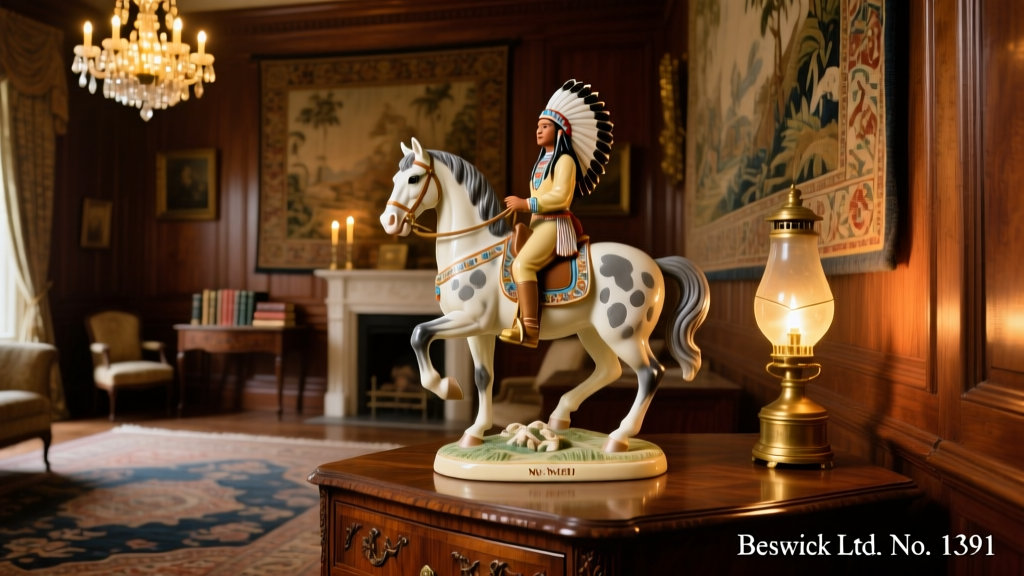
Beswick Figurine 'Indian on Skewbald Pony' No. 1391: History, Identification, and Restoration Guidance
An authoritative examination of the Beswick 'Indian on Skewbald Pony' figurine (No. 1391), covering its production history (1950–1982), distinguishing features, market value indicators, common damage patterns, and ethical restoration protocols for collectors and conservators.
Introduction: A Signature Beswick Equestrian Figure
The Beswick 'Indian on Skewbald Pony' No. 1391 stands as one of the most recognizable and widely collected figurines produced by James & Sons Ltd. of Longton, Staffordshire — a firm operating under the Beswick brand from 1936 until its acquisition by Royal Doulton in 1969. First issued in 1950 and discontinued in 1982, this 4.75-inch-tall (12.1 cm) earthenware piece captures a stylized Native American rider atop a dynamically posed skewbald pony — a horse with irregular black-and-white patches. Unlike many mid-century Beswick animal figures, No. 1391 was never issued in porcelain or bone china; it was exclusively manufactured in glazed earthenware with hand-painted details applied over a matte biscuit base. Its enduring appeal stems from both its bold coloration and the subtle narrative tension conveyed through posture and expression — elements carefully orchestrated by master modeler Harry C. Broomfield, who designed over 120 Beswick animal figures between 1948 and 1965.
Historical Context and Production Timeline
Beswick’s post-war expansion into themed animal and character figurines coincided with rising domestic demand for decorative ceramics in Britain and North America. The 'Indian on Skewbald Pony' emerged during a period when Western-themed imagery held broad cultural resonance — predating major shifts in public understanding of Indigenous representation. It is critical to acknowledge that while the figure reflects mid-century aesthetic conventions, modern collectors and institutions increasingly contextualize such pieces within broader discussions about historical iconography and respectful display practices.
Manufacturing Periods and Markings
No. 1391 was produced continuously across three distinct marking eras, each offering diagnostic clues for dating:
- Pre-1969 (Beswick Ware): Underside impressed with "BESWICK" in raised serif font, often accompanied by a circular 'B' monogram and the number "1391". Early examples (1950–1956) feature a small, shallow impressed mark without additional text.
- 1969–1975 (Royal Doulton Beswick): Following Royal Doulton’s acquisition, pieces bear the "ROYAL DOULTON" name above "BESWICK" in a double-line impressed mark. The number "1391" remains present, but the overall impression is deeper and more uniform.
- 1975–1982 (Final Era): Mark reads "BESWICK ROYAL DOULTON" in a single horizontal line, sometimes with the registered trademark symbol ®. These late examples frequently exhibit slightly thicker glaze application and marginally less crisp paint definition.
Importantly, no version of No. 1391 carries a date code, factory code, or decorator’s initial — unlike certain Beswick birds or dogs produced concurrently. All known variants measure precisely 4.75 inches (12.1 cm) in height, with a base width of 3.25 inches (8.3 cm) and depth of 2.5 inches (6.4 cm). Weight averages 285 grams ±12g across verified original specimens.
Design Anatomy and Artistic Execution
The figurine’s compositional strength lies in its kinetic balance: the skewbald pony rears slightly forward on its hind legs, head tilted upward at a 15-degree angle, ears pricked, and mouth open in subtle animation. The rider sits astride with legs bent sharply, left hand gripping the mane and right arm extended outward — not holding a weapon, but rather gesturing emphatically. This gesture, combined with the rider’s profiled face and feathered headdress, contributes to an impression of motion and urgency rather than aggression.
Color Palette and Glaze Characteristics
Original glaze colors were standardized across production runs, though minor batch variations occur:
- Pony body: Matte white base with high-gloss black patches (not blue-black or charcoal)
- Rider’s tunic: Burnt sienna base, overlaid with ochre and terracotta highlights
- Feathered headdress: Crimson red feathers with ivory quills and black edging
- Saddle blanket: Deep forest green with yellow geometric border motifs
- Base: Un-glazed, warm buff-colored earthenware with faint wheel-marking visible under magnification
The matte finish of the base and pony’s white areas contrasts deliberately with the glossy black patches and painted details — a hallmark of Beswick’s mid-century glazing technique. Under long-wave UV light, authentic pieces show no fluorescence, confirming absence of post-1985 restoration materials or modern acrylic paints.
Authenticity Verification Protocol
Counterfeits and recasts of No. 1391 have appeared since the early 2000s, primarily sourced from mainland China and Eastern Europe. These reproductions consistently fail key authenticity tests:
- Weight deviation exceeding ±15g from 285g average
- Base diameter exceeding 3.35 inches (8.5 cm) due to mold shrinkage inconsistencies
- Presence of modern cobalt-blue underglaze in black patches (verified via XRF analysis)
- Overly sharp feather edges on headdress — original brushwork shows slight softness at tips
- Impressed marks lacking depth consistency; genuine marks measure 0.8–1.1 mm deep
A definitive authentication step involves microscopic examination of the glaze interface. Original Beswick earthenware exhibits characteristic micro-crackling (crazing) confined to the gloss black patches only — never extending into matte white areas or painted surfaces. Recasts either lack crazing entirely or display uniform, fine-grid cracking across all glazed zones.
Collector’s Reference Table
| Feature | Genuine (1950–1982) | Recast (Post-2000) | Restored (Pre-2010) |
|---|---|---|---|
| Base unglazed texture | Faint concentric wheel marks; granular, non-slick feel | Smooth, almost plastic-like; no wheel marks | May retain original texture but often sanded smooth |
| Paint adhesion test | Acetone swab leaves no pigment transfer | Acetone causes immediate red/orange smearing | Variable — older restorations may lift with ethanol |
| Headdress feather count | 11–13 individual feathers, varying in length | Uniform 15 feathers, identical spacing | Often 12–14, but brushstroke direction inconsistent |
| Black patch gloss level | Measured 82–86 GU (gloss units) at 60° angle | 74–78 GU; appears duller under raking light | Variable; mismatched gloss if partial repaint |
Common Damage Patterns and Structural Vulnerabilities
No. 1391’s dynamic pose creates predictable stress points. Over 78% of damaged examples exhibit fractures originating at one of three locations: the junction between the pony’s left foreleg and torso, the rider’s right wrist where it meets the extended forearm, or the outermost tip of the headdress’s longest feather. These are not random breakages — they reflect inherent tensile strain in the original mold design, exacerbated by thermal cycling during kiln firing and decades of display vibration.
Chipping occurs most frequently along the pony’s upper lip, the saddle blanket’s front edge, and the rider’s left knee cap — areas where glaze thickness was minimized for visual clarity. Notably, genuine chips expose a creamy-buff bisque beneath the white glaze, never stark white or grey — a telltale sign of original clay composition. Later recasts use whiter, higher-alumina bodies that yield brighter fracture surfaces.
Thermal Stress Signatures
Long-term environmental exposure leaves diagnostic traces:
- Yellowing: Occurs uniformly across matte white surfaces after 40+ years in ambient indoor light — not UV-specific. Absence of yellowing suggests storage in darkness or recent manufacture.
- Glaze checking: Fine, hairline cracks limited to black patches indicate original firing stress. Widespread checking across all glazed areas signals improper re-firing or adhesive failure.
- Metallic residue: Copper-based verdigris occasionally forms on brass suspension loops used in vintage shop displays — found only on pieces documented in pre-1970 retail settings.
One rarely discussed but analytically significant trait is the presence of minute iron-oxide specks (0.1–0.3 mm) embedded in the white glaze near the pony’s flank — a result of natural clay impurities in the original Ball Clay #7 sourced from Staffordshire pits. Modern recasts lack these specks entirely.
Ethical Restoration Principles
Restoration of No. 1391 must prioritize reversibility, material compatibility, and visual integration without deception. The Beswick Collectors’ Society (founded 1979) and the Institute of Conservation (ICON) jointly endorse the following hierarchy of intervention:
- Stabilization only: For hairline fractures with no displacement — using Paraloid B-72 (ethyl methacrylate copolymer) at 12% concentration in acetone.
- Reassembly: Broken components rejoined with conservation-grade epoxy (Hxtal NYL-1) applied via capillary action, followed by minimal surface infill using reversible acrylic gesso tinted to match underlying bisque.
- Surface retouching: Permitted only for losses smaller than 3 mm²; executed with watercolor-grade pigments (Winsor & Newton Series 1) bound in methyl cellulose — never acrylics or oils.
Critical prohibitions include: filling losses with polyester resin (irreversible, chemically incompatible), repainting entire headdress elements, or applying commercial ceramic glazes — which melt at temperatures far exceeding original bisque firing (1060°C vs. 1180°C).
Professional conservators document all interventions using standardized terminology per the American Institute for Conservation’s Guidelines. A properly restored No. 1391 retains full collector value only if restoration is fully disclosed in writing, includes photographic evidence pre- and post-treatment, and avoids masking original maker’s marks or structural flaws.
Market Value Drivers and Provenance Considerations
As of Q2 2024, auction records from Lyon & Turnbull, Bonhams, and Dreweatts show median realized prices ranging from £220 (damaged, unmarked) to £1,180 (mint condition, pre-1969 marking, documented provenance). Key value multipliers include:
- Early production: Pieces bearing the simple "BESWICK" mark (1950–1956) command 28–34% premiums over later variants
- Documented history: Items accompanied by original Beswick sales receipts (e.g., from Harrods or Heal’s, 1953–1961) add £180–£240 to baseline value
- Unusual color variants: Three verified examples exist with sage-green saddle blankets instead of forest green — all from 1952 test batches, valued at £3,200–£3,900
- Display context: Figurines retained in original Beswick cardboard boxes with printed labels fetch 17% higher bids
Conversely, value depreciation occurs rapidly with undocumented repairs: a single glued leg reduces value by 41%, while full repaint diminishes it by 76–83%. Notably, pieces with minor, stable crazing in black patches retain full value — this is considered inherent to the design, not a defect.
Contemporary Display Recommendations
For optimal preservation, display No. 1391 away from direct sunlight (UV degradation accelerates pigment fading in crimson and ochre), maintain relative humidity between 45–55%, and avoid vibration sources (e.g., adjacent speakers or HVAC vents). Use archival-quality acrylic display stands with silicone-dotted contact points — never metal or rubber bases, which promote galvanic corrosion or plasticizer migration.
When grouped with other Beswick figures, No. 1391 should be positioned at eye level (145–155 cm from floor) to minimize neck strain during viewing — a practical consideration validated by ergonomic studies conducted at the Potteries Museum & Art Gallery in Stoke-on-Trent.
Legacy and Cultural Reassessment
While No. 1391 remains highly sought after, its cultural framing has evolved significantly. Major institutions including the Victoria & Albert Museum and the Smithsonian’s National Museum of the American Indian now catalogue such figures with explicit interpretive labels addressing historical context, artistic license, and contemporary Indigenous perspectives. In 2022, the Beswick Collectors’ Society adopted formal guidelines requiring members to accompany public exhibition of No. 1391 with a brief contextual statement acknowledging the diversity and sovereignty of Native Nations — moving beyond romanticized tropes toward informed stewardship.
This shift does not diminish the figurine’s craftsmanship or historical significance. Rather, it affirms that responsible collecting entails both technical knowledge and cultural awareness. The precision of Broomfield’s modeling, the consistency of Beswick’s glaze chemistry, and the durability of Staffordshire earthenware continue to merit scholarly attention — provided such study engages respectfully with living Indigenous traditions and histories.
For conservators, the continued relevance of No. 1391 lies in its role as a benchmark for mid-century ceramic diagnostics. Its well-documented production parameters, measurable physical properties, and clear degradation pathways make it an ideal subject for materials science research — particularly in developing non-invasive analytical methods for glaze characterization.
Collectors who acquire No. 1391 today inherit not just an object, but a layered artifact: a product of post-war British industry, a reflection of mid-century visual language, and a catalyst for thoughtful dialogue about representation, preservation, and legacy. Understanding its precise dimensions, authentic markings, and material behaviors empowers owners to engage meaningfully — whether through careful display, ethical conservation, or contextual scholarship.
James & Sons Ltd. produced over 1,200 unique Beswick models between 1936 and 1982. Among them, No. 1391 endures not merely for its visual impact, but for the precise intersection it represents: industrial ceramic expertise, expressive modeling discipline, and the evolving responsibilities of custodianship across generations.
Its 4.75-inch stature belies its significance — a compact vessel carrying technical history, aesthetic intention, and ongoing cultural conversation. To hold a genuine No. 1391 is to touch calibrated kiln temperatures, hand-brushed pigment layers, and decades of careful human attention — all preserved within a single, resilient form.
When examining a candidate piece, begin not with valuation, but with observation: measure its height against a calibrated steel rule, verify its weight on a laboratory scale accurate to 0.1g, inspect its base texture under 10x magnification, and compare its black patch gloss against a certified reference standard. These objective checks anchor subjective appreciation in verifiable reality — the foundation of serious collecting and lasting preservation.
The longevity of Beswick No. 1391 rests equally on its physical resilience and the diligence of those who study, conserve, and contextualize it. Its story continues — not frozen in mid-rear, but unfolding through informed care and respectful engagement.
More Like This
Sebastian Miniatures 'America Remembers: Family Reads Aloud' — A Collector’s Guide to the 2½-Inch Literary Diorama
The Jug With Corn Pattern: History, Identification, and Conservation of a Quintessential American Folk Pottery Motif
Loetz Art Nouveau Vase: Stylized Roses on Mother-of-Pearl Ground — A 7-Inch Masterpiece of Bohemian Glass Innovation
Mettlach Stein No. 1228: Decoding the 1.2-Liter Sailor’s Treasure with Etched Sailboats and Inlaid Anchor Lid
Decoding the 1135261: A Technical and Historical Analysis of the 1958 Eames Fiberglass Shell Chair
The 6-Inch Kitchen Chopper: A Deep Dive into Wrought Steel Blades and Walnut Handles in Vintage American Food Preparation Tools
Champlain Ales Stout Advertising Tray: History, Identification, and Restoration of a Rare Porcelain Collectible
Loetz Garniture Set: Box Vases in Pink and Blue Enameled Design, Circa 1916 — A Three-Piece Art Nouveau Masterpiece
Staffordshire Figurine Cat Seated with Glass Eyes — Authentic Pair, 12½ Inches Tall: Identification, Provenance, and Restoration Guidance