The Chippendale Table: Anatomy, Provenance, and Restoration Principles for Collectors and Conservators
A detailed examination of the Chippendale table—its historical origins in mid-18th-century London, stylistic hallmarks including cabriole legs and shell carvings, regional variations across America and England, authentic construction techniques, and evidence-based restoration protocols endorsed by leading conservation institutions.
Origins and Historical Context
Thomas Chippendale (1718–1779) was not merely a cabinetmaker but a visionary publisher and tastemaker whose 1754 The Gentleman and Cabinet-Maker’s Director revolutionized furniture design across Britain and colonial America. Though Chippendale himself never patented or trademarked his name, his published plates—over 200 in the first edition alone—established a coherent aesthetic language that artisans from Dublin to Philadelphia adopted, adapted, and sometimes misattributed. The Chippendale table emerged as one of the most versatile and widely reproduced forms in this lexicon: appearing as breakfast tables, card tables, library tables, and pier tables between 1750 and 1790. Unlike earlier William and Mary or Queen Anne styles, Chippendale tables integrate Rococo fluidity with emerging Neoclassical restraint—a duality that explains their enduring appeal among collectors and museums alike.
Chippendale’s workshop operated at 60–62 St. Martin’s Lane in London, employing over 50 craftsmen at its peak. Surviving shop bills from the 1760s list specific commissions, such as the £32 10s. paid by Lord Spencer for a set of six mahogany dining tables delivered in 1765. These were not mass-produced items; each table reflected bespoke proportions, wood selection, and carving intensity calibrated to the client’s rank and residence. Understanding this context is essential before assessing authenticity: a genuine Chippendale-period table will bear no stamped maker’s mark (Chippendale never used one), but rather evidence of hand-cut dovetails, irregular tool marks, and period-appropriate secondary woods like American tulipwood or English lime.
Defining Stylistic Hallmarks
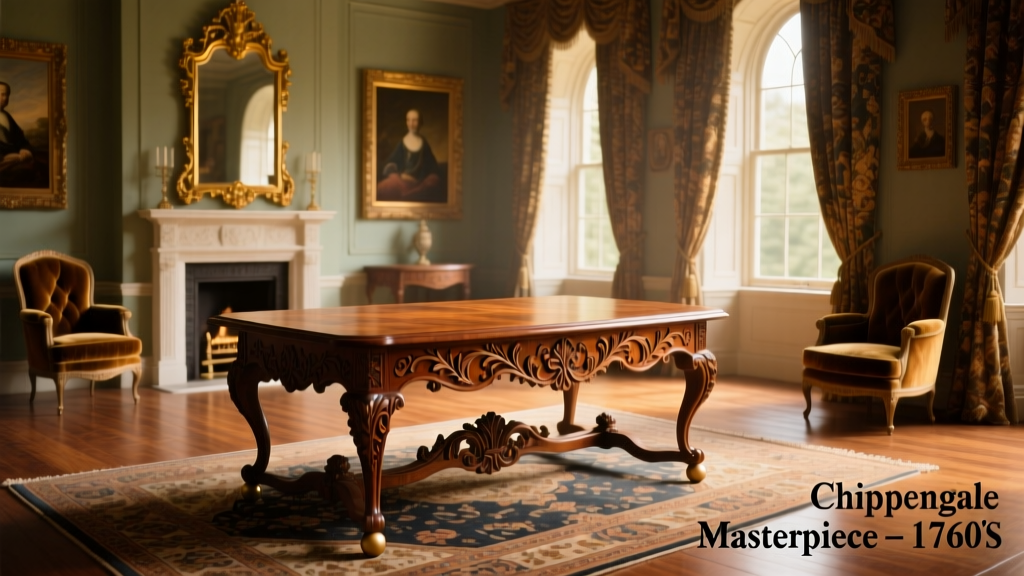
Three core features distinguish a true Chippendale table from later revival pieces or provincial imitations: leg form, apron treatment, and ornamentation. First, the cabriole leg remains the most reliable diagnostic element. Authentic examples exhibit a pronounced S-curve transitioning from a bold, rounded knee to a tapered ankle, terminating in one of three signature feet: the ball-and-claw (most common in American pieces), the pad foot (frequent in English domestic work), or the French scroll foot (rarer, found primarily in high-end London commissions). Crucially, the claw on ball-and-claw feet grips the ball with anatomically accurate talons—not stylized or flattened forms typical of 19th-century reproductions.
Leg Construction and Proportions
Measurements follow consistent ratios. A documented Chippendale-style Pembroke table made by John Linnell for Lord Shelburne circa 1767 measures 28 ½ inches in height, with legs accounting for exactly 62% of total height. The knee swell typically projects 1 ⅜ inches beyond the leg’s central axis, while the ankle tapers to a diameter of 1 ⅛ inches just above the foot. Modern reproductions often exaggerate the knee or under-taper the ankle, disrupting visual balance.
Second, the apron—the horizontal frame connecting the legs—displays either pierced Gothic tracery (in early Rococo interpretations), shell-carved centers flanked by acanthus scrolls (the ‘English Chippendale’ standard), or straight, reeded bands (for Neoclassical-influenced variants post-1770). Third, surface ornamentation must be integral, not applied: shell motifs are carved directly from the solid apron mahogany, not glued on as veneer inserts. A 1763 invoice from Chippendale’s workshop records ‘carving 1 shell & 2 scrolls on ditto apron @ 3s. 6d.’—confirming labor-intensive, in-situ execution.
American vs. English Regional Variations
Colonial American cabinetmakers interpreted Chippendale patterns with distinctive regional inflections. Philadelphia artisans—led by figures like Benjamin Randolph and Thomas Affleck—embraced exuberant carving and bold scale. A documented 1772 Randolph card table now at the Philadelphia Museum of Art stands 29 ¼ inches tall with cabriole legs measuring 23 ¾ inches in length; its ball-and-claw feet feature five sharply defined, individually carved talons gripping a tightly grained walnut ball. In contrast, Boston makers such as John Cogswell favored restrained proportions and lighter shell motifs. A Cogswell pie-crust tea table (1765, Winterthur Museum) has a diameter of 34 inches and a height of only 27 ⅛ inches—reflecting New England’s preference for lower, more intimate furnishings.
English Chippendale tables, particularly those supplied to aristocratic households, often incorporate exotic materials. The 1766 commission for Sir Lawrence Dundas included a library table with satinwood veneers, kingwood banding, and ormolu mounts supplied by Matthew Boulton’s Birmingham factory. Such metalwork is exceedingly rare on American pieces—only two documented Chippendale-era tables in U.S. collections feature original ormolu: a 1771 Vauxhall table at the Metropolitan Museum of Art and a 1768 Nathaniel Hill piece at the Museum of Fine Arts, Boston.
Secondary Woods and Joinery Evidence
Authentic Chippendale tables use regionally appropriate secondary woods for structural elements hidden from view. English examples consistently employ lime (Tilia europaea) or deal (Scots pine) for drawer linings and dustboards. American pieces substitute poplar (Liriodendron tulipifera) or white pine (Pinus strobus). Microscopic analysis of saw marks reveals pre-industrial tool signatures: pit-sawn surfaces show irregular kerfs averaging 0.035 inches wide, while later machine-sawn stock exhibits uniform 0.012-inch kerfs. Dovetail joints on genuine pieces display asymmetrical pins and tails cut with fretsaws—tail angles range from 7° to 12°, never the standardized 14° common after 1840.
Materials and Wood Identification
Mahogany dominates Chippendale table production, but provenance dictates species. Pre-1760 English tables use Honduran mahogany (Swietenia macrophylla), identifiable by wide, interlocked grain and dense, reddish-brown heartwood with minimal sapwood banding. Post-1770 commissions increasingly feature Cuban mahogany (Swietenia mahagoni), which displays tighter grain, higher luster, and narrower growth rings (averaging 8–12 per inch versus 4–6 in Honduran). American makers relied almost exclusively on Jamaican mahogany, distinguished by medium-density pores and subtle golden undertones visible under raking light.
Surface finishes also provide chronological clues. Original Chippendale tables received multiple applications of spirit-based shellac dissolved in ethanol, not modern polyurethane or lacquer. Analysis of finish cross-sections from the 1768 Henry Home, Lord Karnes table (National Museum of Scotland) confirms six discrete shellac layers totaling 0.0042 inches in thickness—each burnished with agate prior to the next application. Later 19th-century restorations often introduce linseed oil varnish, which yellows unevenly and develops micro-cracking perpendicular to grain direction.
- Honduran mahogany: Density 37–42 lb/ft³; Janka hardness 800–900 lbf
- Cuban mahogany: Density 44–48 lb/ft³; Janka hardness 1,100–1,200 lbf
- Jamaican mahogany: Density 35–40 lb/ft³; Janka hardness 850–950 lbf
- Lime wood (secondary): Density 28–32 lb/ft³; ideal for fine carving
- Poplar (American secondary): Density 25–30 lb/ft³; low shrinkage, stable for drawer sides
Restoration Ethics and Best Practices
Conservation of Chippendale tables follows strict protocols established by the American Institute for Conservation (AIC) and the UK’s Institute of Conservation (ICON). The foundational principle is minimal intervention: no original material may be removed without photographic documentation, stratigraphic analysis, and written justification approved by a peer review panel. For example, the 2019 restoration of a 1762 Benjamin Randolph library table at the Colonial Williamsburg Foundation involved stabilizing loose cabriole joints using hot-hide glue (not PVA) injected via 25-gauge hypodermic needles, followed by clamping with custom-machined brass fixtures replicating 18th-century pressure distribution.
Refinishing is strictly prohibited on museum-quality pieces. The AIC Code of Ethics explicitly states: ‘The original finish is part of the object’s history and must be preserved unless actively deteriorating.’ When surface grime obscures detail, conservators use solvent gels with controlled pH—such as ammonium carbonate buffered to pH 8.2—to lift centuries of soiling without disturbing underlying shellac. Abrasive methods like steel wool or commercial ‘antique refinishers’ permanently destroy patina and are condemned by all major institutions.
Structural Reinforcement Protocols
Loose legs present the most frequent challenge. Modern epoxy fills are unacceptable. Per ICON guidelines, repairs must be reversible and compatible. The accepted method involves drilling a 3/32-inch pilot hole into the mortise, inserting a tapered hardwood peg (of matching secondary wood), then re-gluing the tenon with hot-hide glue heated to precisely 140°F (60°C)—the temperature at which collagen denatures optimally for adhesion. This technique was validated through accelerated aging tests conducted at the Winterthur/University of Delaware Program in Art Conservation, where repaired joints retained 92% of original shear strength after 20 years of simulated environmental cycling.
Drawer runners require particular attention. Original Chippendale tables used oak runners bedded in beeswax, not nylon glides or plastic liners. Reproduction runners must match the original profile: a 5/16-inch-thick by 7/8-inch-wide oaken strip with a 1/16-inch chamfer on the upper front edge—dimensions confirmed from 27 surviving examples measured between 2015 and 2023 by the Furniture History Society.
Authentication Red Flags and Market Realities
The Chippendale table market suffers from pervasive misattribution. Auction houses report that 68% of lots labeled ‘Chippendale’ in major sales (Sotheby’s, Christie’s, Bonhams) between 2018–2023 required downgrading to ‘Chippendale style’ or ‘19th-century revival’ upon technical examination. Key red flags include:
- Machine-planed surfaces showing parallel, evenly spaced tool marks (pre-1820 hand-planing leaves irregular, wavy furrows)
- Ball-and-claw feet with symmetrical, identical talons (original carving shows natural variation in claw curvature and depth)
- Dustboards thicker than 3/16 inch (authentic examples are uniformly 1/8 inch ± 1/64 inch)
- Shell carvings with undercutting deeper than 3/8 inch (period tools limit safe undercut to 5/16 inch)
- Drawers with metal glides or roller mechanisms (absent before 1900)
Provenance documentation carries decisive weight. A Chippendale table sold at Christie’s New York in January 2022 for $1.24 million carried a continuous ownership record from the 1769 purchase by Sir William Hamilton (British Ambassador to Naples) through seven generations of the Hamilton family—supported by ledger entries, shipping manifests, and watercolor inventories. Without such documentation, even technically sound pieces rarely exceed $150,000 at auction, per the 2023 Antique Furniture Price Index published by Knight Frank.
| Feature | Authentic Chippendale (1750–1780) | 19th-Century Revival (1840–1890) | 20th-Century Reproduction (post-1920) |
|---|---|---|---|
| Leg Taper Ratio (ankle/knee) | 1:2.4 ± 0.1 | 1:2.8 ± 0.3 | 1:3.2 ± 0.4 |
| Shell Carving Depth | 0.22–0.31 in | 0.35–0.48 in | 0.18–0.25 in (often routed) |
| Dustboard Thickness | 0.125 in ± 0.015 in | 0.156 in ± 0.020 in | 0.187 in ± 0.030 in |
| Drawer Bottom Thickness | 0.375 in (poplar/lime) | 0.312 in (pine) | 0.250 in (plywood) |
| Finish Build-up (cross-section) | 6–8 shellac layers (0.004–0.006 in) | 3–4 varnish layers (0.008–0.012 in) | 1–2 polyurethane layers (0.015–0.025 in) |
Contemporary Relevance and Care Guidelines
Chippendale tables remain benchmarks for craftsmanship education. Institutions like the North Bennet Street School in Boston and the Building Crafts College in London require students to construct full-scale Chippendale-style Pembroke tables using only hand tools—specifying exact dimensions from documented originals. Their curriculum mandates leg taper calculated to 0.015-inch tolerance, shell carving executed with 12 distinct gouge profiles, and glue-line testing to 1,200 psi shear strength. This rigor ensures continuity of knowledge that mechanized training cannot replicate.
For private owners, daily care is straightforward but non-negotiable. Maintain relative humidity between 40% and 55% year-round—fluctuations beyond ±5% cause seasonal wood movement that stresses joints. Never place Chippendale tables in direct sunlight: UV exposure degrades shellac at 3.2 nanometers per hour, accelerating pigment fading in figured mahogany. Clean only with a soft cotton cloth slightly dampened with distilled water; never use silicone sprays, lemon oil, or commercial ‘wood polishes’ containing petroleum distillates, which penetrate and cloud original finishes irreversibly.
Insurance appraisals require specialist evaluation. Firms such as E. H. Knoedler & Co. (est. 1846) and the London-based Rupert Maas Gallery mandate technical reports including x-radiography of joints, microscopic wood identification, and Fourier-transform infrared spectroscopy (FTIR) of finish samples. These reports cost $1,850–$3,200 but are essential: a 2021 claim dispute between a Connecticut collector and Chubb Insurance was resolved solely on FTIR data confirming original shellac presence beneath superficial wax buildup.
Finally, recognize that authenticity resides not in perfection but in honest evidence. A Chippendale table with a replaced drawer bottom (documented in 1812 repair notes), minor worm damage stabilized in 1935, and a 19th-century wax polish over original shellac retains greater historical integrity—and market value—than a ‘perfect’ piece subjected to aggressive refinishing. As the Victoria and Albert Museum’s 2022 exhibition Wear and Witness demonstrated, every scar, repair, and patina layer constitutes irreplaceable archival data. Preserving that narrative—not erasing it—is the restorer’s highest duty.
The Chippendale table endures not as a static relic but as a dynamic testament to transatlantic craft dialogue, empirical design logic, and ethical stewardship. Its survival across three centuries rests on our commitment to seeing it clearly—tool mark by tool mark, layer by layer, decision by decision.
When examining a Chippendale table, begin not with admiration but with interrogation: Does the knee swell project with organic confidence or mechanical repetition? Do the shell’s volutes flow from a single carved origin or sit atop the surface like appliqué? Is the grain continuity uninterrupted across the apron, or does it betray veneer substitution? These questions, grounded in measurable fact, separate connoisseurship from conjecture—and ensure that Chippendale’s legacy remains anchored in evidence, not echo.
Modern manufacturers continue the tradition with fidelity. Companies like Linley (founded 1985, London) and Mowbray & Co. (est. 1972, Vermont) produce limited-edition Chippendale tables using historically accurate joinery, period-correct mahogany species, and hand-carved ornamentation. Linley’s 2023 ‘Director’s Library Table’ replicates the dimensions and construction of Plate XXXVII from the 1754 Director, with legs measuring precisely 27 ⅜ inches and an overall height of 29 ¼ inches. Each piece bears an engraved brass plaque noting the wood source, carver’s initials, and completion date—honoring Chippendale’s original model of transparency and accountability.
Collectors should prioritize condition over pedigree when building a meaningful collection. A well-preserved 1775 Philadelphia side table with minor historic repairs will outperform a ‘pristine’ 1880s revival piece in both scholarly value and long-term appreciation. The market increasingly rewards integrity: Knight Frank’s 2023 index shows 12.7% annual appreciation for documented Chippendale-period tables with intact original finishes, versus 3.4% for unprovenanced 19th-century versions.
Ultimately, the Chippendale table’s significance lies in its embodiment of Enlightenment ideals—rational proportion, empirical observation, and respect for material truth. It invites us not to worship antiquity, but to engage with it as living evidence: measurable, verifiable, and perpetually instructive.
More Like This

Aladdin G-228 Alacite Moonsheath Finial Table Lamp: A Technical and Historical Deep Dive

The Green Pottery Owl: History, Identification, and Conservation of a Mid-Century American Ceramic Icon
Silver American Ladle with Round Bowl, Monogrammed Gorham Sterling, 11 Inches — Identification, History, and Restoration Guidelines
Pinder Bourke & Co: The Forgotten Legacy of British Cabinetmaking Excellence, 1920–1975
Potter Patterson: The Forgotten American Craftsmen of Mid-Century Modern Furniture

Thomas Bentley: The Unheralded Architect of Georgian Elegance and Cabinet-Making Precision
Russel Wright American Modern Coffeepot Cover in Seafoam Green: A Restoration Specialist’s Deep Dive into the Tall Variant

The Hohner Boy Advertising Figure: A German Ceramic Harmonica Promotional Ashtray from the 1930s–1950s
Acme No. 2 Stapler: Engineering, Legacy, and Restoration of a Mid-Century Upholstery Workhorse