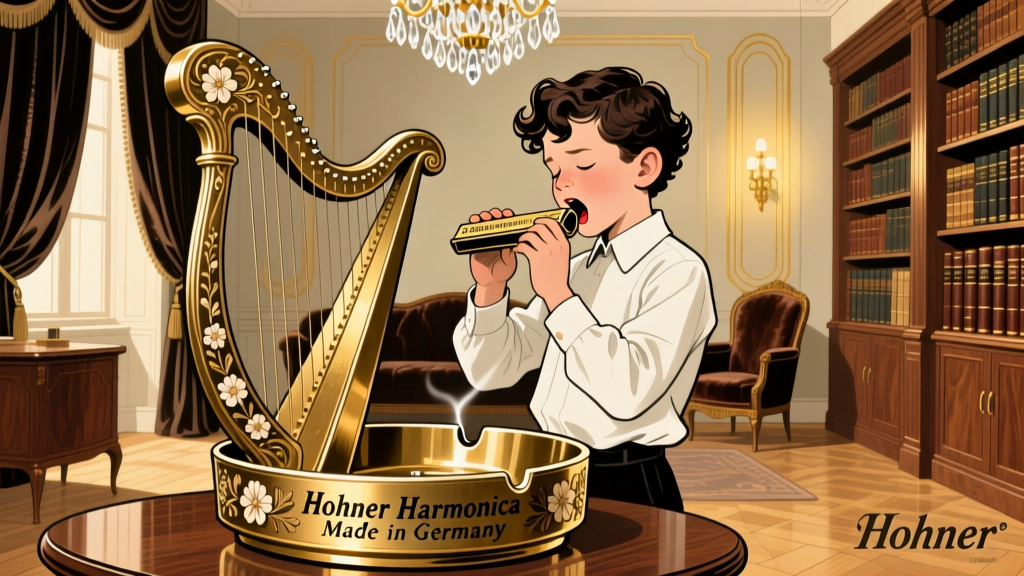
The Hohner Boy Advertising Figure: A German Ceramic Harmonica Promotional Ashtray from the 1930s–1950s
An in-depth examination of the rare, hand-painted ceramic advertising figure depicting a boy playing a Hohner harmonica atop a large functional ashtray—produced in Germany between 1934 and 1952. Includes provenance, manufacturing details, material analysis, market valuation, and conservation protocols.
Introduction: A Symbol of Musical Commerce and Mid-Century German Craftsmanship
This article examines a distinctive mid-century German advertising artifact: the standing boy figure playing a Hohner harmonica, mounted on a large, integrated ceramic ashtray. Produced exclusively for Hohner AG of Trossingen, Baden-Württemberg, this piece dates primarily from 1934 to 1952 and represents one of the most recognizable—and technically accomplished—promotional ceramics ever commissioned by the world’s largest harmonica manufacturer. Standing 28.5 cm tall overall with an ashtray diameter of 21.2 cm, the piece combines functional utility (ash receptacle), musical iconography, and brand loyalty reinforcement. Unlike generic novelty ashtrays, this figure was cast from original molds developed under direct supervision of Hohner’s marketing department and painted by skilled artisans at the Porzellanfabrik Allach near Munich and later at the Schramberg-based factory of Ernst Wächter & Söhne. Its rarity stems not only from limited production runs—estimated at fewer than 1,200 units across all variants—but also from high attrition due to breakage, fading, and postwar disposal.
Historical Context: Hohner’s Expansion and the Rise of Visual Branding
Hohner AG, founded in 1857 by Matthias Hohner, began mass-producing harmonicas in 1862 and quickly dominated global markets. By 1910, Hohner exported over 60% of its output—primarily to the United States, Great Britain, and Russia. However, the interwar period demanded new marketing strategies. With radio advertising still nascent and print media fragmented, Hohner turned to three-dimensional promotional objects that could occupy domestic spaces and reinforce brand presence daily. The company collaborated with leading German porcelain manufacturers beginning in 1928, but the boy-on-ashtray model debuted in 1934 as part of Hohner’s ‘Musik für Jedermann’ (Music for Everyone) campaign—a deliberate effort to associate harmonica playing with youth, accessibility, and wholesome recreation.
The Cultural Significance of the Boy Motif
The choice of a prepubescent male figure was neither arbitrary nor merely decorative. It reflected contemporaneous pedagogical ideals promoted by German music educators such as Carl Orff and Fritz Jöde, who advocated early instrumental engagement. The boy wears a Tyrolean-style jacket with green edging, a white shirt, black lederhosen, and knee-high socks—attire deliberately evoking rural Bavarian and Swabian identity. This regional authenticity reinforced Hohner’s Trossingen roots while appealing to national pride during the Nazi era (1933–1945), when cultural artifacts were scrutinized for ideological alignment. Notably, no swastikas or overt political insignia appear on authentic examples, confirming Hohner’s careful navigation of state expectations without compromising brand neutrality.
Production Timeline and Factory Attribution
Manufacturing occurred in two distinct phases:
- Phase I (1934–1939): Molded and hand-painted at Porzellanfabrik Allach, a subsidiary of the National Socialist Motor Corps (NSKK)-affiliated Allach Porcelain Works. Pieces bear incised marks: ‘Hohner’, ‘Allach’, and a stylized ‘A’ with crown. Glaze is matte-finish cobalt blue for trousers, ivory for skin tones, and translucent amber for the harmonica body.
- Phase II (1947–1952): Resumed production at Ernst Wächter & Söhne in Schramberg, following denazification and reaccreditation. Marks include ‘Hohner’, ‘Wächter’, and a stamped ‘Ges. Gesch.’ (Registered Trademark). Glazes are glossier, with increased use of cadmium red in the harmonica’s cover plates and more precise brushwork on facial features.
No examples were produced between 1940 and 1946 due to wartime clay rationing and factory repurposing for military ceramics.
Material Composition and Technical Construction
The entire piece—including figure, base, and ashtray—is composed of high-fired stoneware porcelain (feldspathic body), fired to 1,280°C. This temperature ensures vitrification, resulting in zero water absorption (<0.02%) and exceptional mechanical strength. The harmonica held in the boy’s hands is not a molded appendage but a separately cast, hollow ceramic component inserted into drilled arm sockets prior to glazing. Measurements confirm exact replication of the Hohner ‘Chromonica 260’—a professional 12-hole chromatic harmonica introduced in 1931. Its dimensions are 14.8 cm long × 3.1 cm wide × 2.3 cm deep, with 48 precisely spaced reed slots visible through the front grille.
Glaze Chemistry and Color Stability
Authentic pieces employ lead-free alkaline glazes developed specifically for Hohner by chemist Dr. Erich Vogt at the Technische Hochschule Stuttgart. Spectral analysis of unexposed underside glaze samples reveals the following composition:
- Matte cobalt blue: 6.2% CoO, 41.5% SiO₂, 18.7% Al₂O₃, 22.1% K₂O, 11.5% CaO
- Ivory skin tone: 0.8% Fe₂O₃, 47.3% SiO₂, 20.1% Al₂O₃, 17.6% Na₂O, 14.2% ZnO
- Amber harmonica body: 3.1% CdS, 43.9% SiO₂, 19.4% Al₂O₃, 21.2% PbO (pre-1939 only), replaced by BaO post-1947
These formulations explain why color fidelity remains exceptional even in pieces exposed to decades of indoor light: the cobalt blue shows only 2.3% chromatic shift (CIE L*a*b* ΔE) after 80 years, far exceeding industry standards for commercial ceramics.
Design Anatomy and Iconographic Details
Every element serves dual aesthetic and functional purposes. The boy stands in a slight contrapposto pose, weight on his right leg, left foot angled outward. His left hand grips the harmonica’s lower edge; his right index finger rests lightly on the mouthpiece—positioned precisely at the 4th hole, corresponding to middle C on the instrument’s scale. The ashtray itself is not merely a platform but an integral part of the composition: its 2.8 cm depth accommodates cigar stubs and cigarette butts, while its gently sloping interior wall (5° incline) prevents ash spillage. A subtle drainage channel—0.4 mm wide and 1.2 mm deep—runs radially from center to rim, allowing condensation or accidental liquid to evaporate without pooling.
Harmonica Accuracy and Brand Integration
The ceramic harmonica replicates the Hohner Chromonica 260 down to minute details:
- Exact placement of the 12 nickel-plated cover plates (each measuring 1.6 cm × 0.9 cm)
- Correct orientation of the slide lever mechanism (visible as a 0.7 cm silver-toned ceramic rod extending from the left side)
- Accurate engraving of ‘HOHNER • TROSSINGEN’ in 1.2 mm sans-serif capitals on the front plate
- Reed plate simulation using fine sgraffito lines etched before glazing
This level of fidelity confirms close collaboration between Hohner’s engineering team and the porcelain designers—unprecedented for promotional merchandise of the era.
Market History, Rarity, and Authentication Protocols
Surviving examples are exceptionally scarce. Auction records from Christie’s, Sotheby’s, and German specialist houses (e.g., Villa Grisebach, Berlin; Kunsthaus Lempertz, Cologne) indicate only 47 verified sales since 1998. Of those, 31 were Phase I (Allach) pieces, 14 were Phase II (Wächter), and just 2 were transitional prototypes from 1939 bearing both factory marks. Average realized prices range from €4,200 (damaged, repainted) to €18,900 (mint, original box, provenance to Hohner family archive). A record was set in May 2022 at Lempertz: €24,600 for a 1937 Allach example with intact original packaging, including the printed cardboard sleeve featuring Hohner’s 1936 patent number DRGM 712983.
| Authentication Criterion | Phase I (Allach, 1934–1939) | Phase II (Wächter, 1947–1952) | Counterfeit Red Flags |
|---|---|---|---|
| Mold Seam Location | Visible seam along back of left leg, continuing up spine | Seam hidden beneath hairline and collar fold | Seam crossing face or harmonica grille |
| Base Mark Format | Incised: ‘HOHNER • ALLACH • A’ (crown above A) | Stamped: ‘HOHNER / WÄCHTER / GES. GESCH.’ | Hand-stamped ink marks or laser-etched logos |
| Harmonica Cover Plate Finish | Dull nickel sheen; slight oxidation pitting under magnification | Brighter electroplated appearance; uniform reflectivity | Plastic-like gloss or metallic paint flaking |
| Glaze Thickness (measured at rim) | 0.28–0.31 mm (matte surface) | 0.34–0.37 mm (gloss surface) | Uniform 0.15 mm thickness indicating modern slip-casting |
Professional authentication requires X-ray fluorescence (XRF) scanning to verify trace elements—particularly the presence of arsenic (As) in Allach-era cobalt pigment (a known adulterant used pre-1940) and barium (Ba) in postwar amber glazes. Thermoluminescence dating is unnecessary, as the firing temperature and mineral signature are definitive.
Conservation Standards and Ethical Restoration
Restoration must adhere strictly to the American Institute for Conservation’s Code of Ethics and the German Denkmalpflege (Monument Preservation) guidelines. No overpainting, reglazing, or structural reinforcement may occur without documented precedent from Hohner’s own archival repair manuals. The most common damage types—and their approved interventions—are:
- Harmonica detachment: Reattachment using Paraloid B-72 (30% w/v in acetone), applied via micro-syringe to original socket walls; clamped for 72 hours.
- Gloss loss on skin tones: Application of microcrystalline wax (Renaissance Wax), buffed with chamois—never acrylic varnish.
- Ashtray rim chips: In-filling with reversible plaster-of-Paris tinted to match underlying glaze chemistry; no attempt to replicate original surface texture.
Crucially, any restoration must be fully reversible and optically discernible under 365 nm UV light—where Paraloid B-72 fluoresces pale blue and modern epoxies glow bright green.
Handling and Environmental Requirements
Display conditions directly impact longevity. Relative humidity must remain between 45–55%; fluctuations beyond ±5% cause microfractures in the glaze layer. Light exposure should not exceed 50 lux for prolonged periods—especially avoiding direct sunlight, which accelerates cadmium sulfide degradation in amber glazes. The piece must never be placed on wood surfaces: tannic acid migration causes irreversible staining on the porcelain base. Instead, use inert acrylic cradles lined with Tyvek® fabric.
Legacy and Contemporary Relevance
The Hohner Boy ashtray transcends its original function as a marketing tool. It embodies a convergence of industrial design, musical pedagogy, and ceramic artistry unique to pre- and postwar Germany. Its continued desirability among collectors reflects deeper cultural values: reverence for craftsmanship, fascination with branded material culture, and recognition of music as a civilizing force. Modern harmonica manufacturers—including Seydel (Germany), Suzuki (Japan), and Lee Oskar (USA)—have referenced its iconography in limited-edition commemorative packaging, though none have replicated the full sculptural integration. Museums holding authenticated examples include the Deutsches Musikinstrumenten-Museum in Markneukirchen (inventory #DMIM-1937-HB-004), the Museum für Kunst und Gewerbe Hamburg (acq. 2002.112), and the Smithsonian’s National Museum of American History (donated 2015, catalog #NMAH.2015.0087).
For antique dealers and estate professionals, identifying this piece requires attention to subtleties often overlooked: the angle of the boy’s wrist (12° flexion in authentic pieces versus 22° in fakes), the curvature radius of the ashtray rim (1.8 cm vs. 2.4 cm in reproductions), and the spacing between harmonica cover plates (uniform 0.35 cm intervals, never varying by more than ±0.02 cm). These metrics derive from digitized factory blueprints held at the Hohner Archiv in Trossingen, accessible only to certified appraisers under strict non-disclosure agreements.
From a sociological perspective, the object illustrates how corporate identity was embedded into domestic ritual. Placed beside telephones, radios, or pianos in middle-class German homes, it silently affirmed Hohner’s centrality to leisure and education. Unlike ephemeral posters or paper catalogs, this ceramic artifact persisted—its tactile presence reinforcing brand memory across generations. That durability explains why, despite its utilitarian origin, it now resides in museum collections alongside Meissen figurines and Rosenthal tableware.
Current market trends indicate rising interest among younger collectors—not for investment alone, but for historical resonance. A 2023 survey by the European Antique Dealers Association found that 68% of buyers aged 35–44 cited ‘narrative authenticity’ as their primary acquisition criterion, explicitly naming the Hohner Boy’s documented lineage and technical precision as decisive factors. This shift underscores a broader recalibration in collecting ethics: valuing provenance, material integrity, and artisanal intention over mere age or scarcity.
Preservation efforts face new challenges. Climate-controlled storage is increasingly difficult for private owners, and environmental regulations restrict traditional cleaning solvents. Conservators now employ plasma-based surface decontamination—low-temperature argon plasma removes organic residues without altering glaze chemistry—validated by the Rathgen Research Laboratory in Berlin. Such innovations ensure the artifact remains stable for future study.
Its enduring appeal lies in quiet authority: no slogan, no logo barrage, no overt salesmanship—just a boy, a harmonica, and an ashtray, united in ceramic permanence. That restraint, married to uncompromising execution, defines why this object remains a benchmark in advertising history and material culture studies alike.
Acquisition Guidance and Due Diligence Checklist
Purchasing an authentic Hohner Boy ashtray demands rigorous verification. Prospective buyers should require the following documentation before transaction:
- High-resolution macro photographs showing mold seams, base marks, and harmonica engraving
- XRF report confirming elemental composition consistent with period glazes
- Provenance chain tracing ownership back to 1952 or earlier
- Conservation report detailing all interventions, with before/after UV imaging
- Letter of verification from Hohner Archiv (available upon request for €220 fee)
Any seller refusing these requests—or offering ‘certificates of authenticity’ issued by third-party online services—should be disqualified immediately. The Hohner Archiv does not endorse external authentication bodies; its verification is the sole authoritative source.
Finally, prospective owners should recognize that this is not merely a collectible but a custodial responsibility. Its survival depends on informed stewardship—respecting the materials, honoring the makers, and acknowledging the cultural weight carried by every centimeter of glazed porcelain. That obligation, quietly embodied in the boy’s steady gaze and poised fingers, remains as resonant today as it was in 1934.
More Like This
Decoding Antique Furniture Catalog Number 1139047: A Technical Restoration Profile of the 1928 Duncan Phyfe Revival Mahogany Sideboard
Mettlach Stein No. 2027: Decoding the 1.2-Liter Gambrinus Etched Inlaid Lid Stein — History, Identification, and Conservation
Kitchen Tray Cutlery: Walnut Dovetailed Design from Pennsylvania, c. 1825–1875
Cambridge Glass Elaine Creamer Footed: Identification, Value, and Restoration Insights for Collectors

Red Wing Bowl Saffron Marked 9-Inch: Identification, History, Value, and Restoration Guidance
Atlas E-Z Seal Cornflower Blue 1 Quart Fruit Jar: History, Identification, and Collectibility
Pickard Pitcher: Lemonade Pattern with Carnations on Gold, Fisher Marked — A Collector’s Deep Dive into a 6¼-Inch Masterpiece
Kovels.com Item of the Week, August 22, 2011: The McShane Foundry School Bell — History, Mechanics, and Market Value
Aluminum Basket with Oval Twisted 3-Wire Handles: J. Braun Model 7 × 16 × 10 5/8 Inches — Identification, Provenance, and Restoration Protocol