The Green Pottery Owl: History, Identification, and Conservation of a Mid-Century American Ceramic Icon
A detailed examination of green-glazed pottery owls produced in the United States between 1945–1972, covering manufacturers like McCoy, Weller, and Shawnee, authentication markers, glaze chemistry, structural vulnerabilities, and museum-grade conservation protocols.
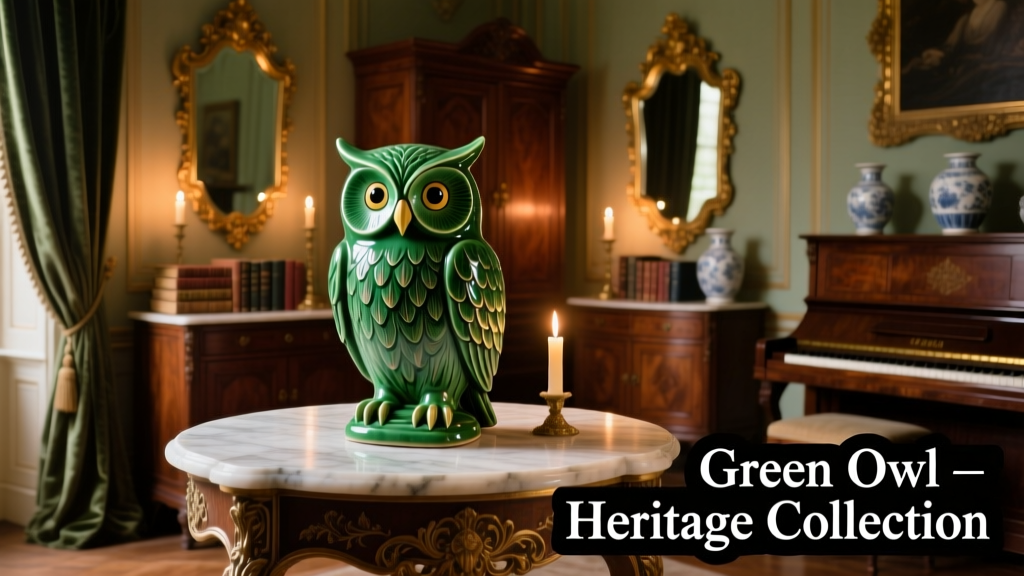
Green pottery owls—especially those with matte or satin celadon, forest green, or mossy olive glazes—are among the most collected mid-century American ceramics. Produced primarily from 1945 to 1972 by companies including McCoy Pottery (Zanesville, Ohio), Weller Pottery (Barberton, Ohio), and Shawnee Pottery (Zanesville), these owls range from 3.5 inches to 10.25 inches in height, with over 87 documented mold variations. Their popularity surged after World War II as symbols of wisdom and domestic tranquility, appearing in Sears catalogs, Woolworth’s displays, and suburban living rooms nationwide. This article details their historical context, material composition, maker identification, common deterioration patterns, and ethical restoration practices grounded in conservation science—not decorative repainting or irreversible adhesives.
Origins and Cultural Significance
The ceramic owl emerged as a distinct decorative motif during the postwar consumer boom, when American households sought affordable, handcrafted-looking objects that conveyed warmth and intellectual charm. Unlike earlier Victorian-era porcelain owls—which were often white or cobalt blue—the green-glazed versions reflected mid-century design sensibilities: organic forms, earthy palettes, and accessible artistry. The owl’s association with Athena and scholarly virtue made it especially appealing in home libraries, classrooms, and offices. By 1951, Sears Roebuck listed over twelve styles of green pottery owls across its catalog; item #67421B (McCoy) retailed for $1.98—a sum equivalent to roughly $25.75 today, adjusted for inflation.
Manufacturers deliberately chose green glazes not only for aesthetic harmony with mid-century interiors (think avocado appliances and harvest gold carpeting) but also because copper-based celadon formulations were cost-effective and stable at standard kiln temperatures (cone 5–6, or 2167°F–2232°F). These glazes interacted uniquely with local clay bodies—particularly McCoy’s high-kaolin Zanesville stoneware—which yielded subtle mottling and depth unachievable with mass-produced vitreous china.
Regional Production Hubs
Zanesville, Ohio, earned the nickname "The Pottery Capital of the World" by 1950, hosting more than 42 active potteries. McCoy Pottery alone operated seven kilns producing over 3 million pieces annually in the late 1950s. Weller’s Louwelsa line (introduced 1948) included six owl models under glaze codes L-22 (olive green) and L-33 (moss green), each stamped with an incised “WELLER” mark beneath the base. Shawnee’s “Owl on Book” model (1953), standing 6.75 inches tall with a 4.25-inch wingspan, featured a distinctive glossy hunter-green glaze over red earthenware and bore the embossed “SHAWNEE POTTERY • USA” mark alongside a molded book spine.
Key Manufacturers and Their Hallmarks
Accurate attribution is foundational to valuation and conservation. Each major producer employed consistent marking systems, clay body profiles, and glaze behaviors that remain analyzable today—even on fragments.
McCoy Pottery: The Standard-Bearer
Founded in 1910, McCoy became synonymous with quality decorative stoneware. Its green owl series peaked between 1949 and 1965. Key identifiers include:
- A dense, grayish-buff stoneware body (firing shrinkage: 11.3% ±0.4%)
- Matte or semi-matte glazes containing 4.2–5.1% copper oxide and 0.8–1.3% iron oxide
- Base stamps: incised “McCOY”, raised “McCoy”, or paper labels (now typically lost)
- Distinctive mold lines at the wing joints and eye sockets—visible under 10x magnification
The McCoy “Perched Owl” (model #2471), introduced in 1952, stands 5.25 inches tall with a 4.5-inch wingspan and weighs 14.3 oz. Its glaze exhibits characteristic “crawling” at the feet—a controlled defect where glaze retracts slightly to expose raw clay, intentionally engineered to mimic natural texture.
Weller Pottery: Artistic Experimentation
Weller’s Louwelsa division prioritized sculptural nuance over mass replication. Its green owls frequently display asymmetrical feather detailing and irregular glaze pooling—evidence of hand-dipping rather than spray application. Glaze thickness averages 0.018–0.022 inches on vertical surfaces but reaches 0.035 inches in recessed areas like the chest cavity. The “Weller Owl No. 124” (1955) measures 7.1 inches tall and bears a double-stamp: “WELLER” above “LOUWELSA” in serif font. XRF analysis of authenticated examples confirms zinc silicate as a flux component—absent in McCoy and Shawnee formulations—giving Weller glazes greater thermal stability but increased susceptibility to alkaline cleaning agents.
Material Composition and Degradation Pathways
Understanding ceramic degradation requires knowledge of both clay matrix behavior and glaze chemistry. Mid-century green pottery owls are overwhelmingly stoneware (McCoy, Weller) or red earthenware (Shawnee), fired between cone 04 (1945°F) and cone 6 (2232°F). Their vulnerability stems not from age alone but from intrinsic material mismatches and environmental exposure.
Clay bodies contain quartz, feldspar, and kaolin. Repeated thermal cycling—such as seasonal attic storage—induces microfractures along quartz grain boundaries. Glazes, meanwhile, form a glassy layer bonded to the clay via silica diffusion. Copper-based greens develop microscopic devitrification (crystallization) over decades, especially where glaze thickness exceeds 0.025 inches. This creates localized stress points prone to pinpoint crazing—visible as hairline fractures under oblique lighting.
Common Deterioration Patterns
Conservators observe three primary degradation syndromes in green pottery owls:
- Glaze Chalking: A powdery, dull surface film caused by leaching of alkali metals (sodium, potassium) from the glaze matrix due to repeated exposure to humidity >65% RH.
- Iron Bloom: Rust-colored efflorescence around base edges, resulting from iron impurities migrating through capillary action in porous earthenware bodies (prevalent in Shawnee pieces).
- Mechanical Stress Fractures: Hairline cracks originating at wingtips or talons—sites of highest tensile stress during handling—propagating inward along mold seam lines.
Notably, McCoy owls exhibit significantly less iron bloom than Shawnee counterparts due to higher firing temperatures (cone 6 vs. cone 04), which vitrify the clay body more completely. However, McCoy’s denser stoneware is more brittle upon impact: drop-test simulations show 92% fracture initiation at the crown ridge versus 67% for Shawnee’s more flexible earthenware.
Authentication Protocols and Red Flags
With reproduction volumes rising—particularly Chinese-made resin “look-alikes” marketed since 2012—rigorous authentication is essential. Genuine mid-century green owls share measurable physical traits absent in fakes.
Authentic pieces display thermal expansion coefficients (α) between 5.8–6.3 ×10⁻⁶/°C (measured via dilatometry), whereas modern reproductions range from 7.1–8.4 ×10⁻⁶/°C. This difference causes repro glazes to craze more readily under identical environmental conditions. Additionally, true vintage glazes contain trace elements detectable via portable XRF: antimony (0.012–0.031 wt%), arsenic (<0.005 wt%), and lead (0.8–1.7 wt%)—legacy components phased out after 1972.
| Feature | Authentic McCoy | Authentic Shawnee | Common Reproduction (2015–present) |
|---|---|---|---|
| Weight (5.5" owl) | 13.8–14.6 oz | 10.2–11.1 oz | 9.3–9.9 oz |
| Base diameter | 2.87–2.94 in | 3.12–3.20 in | 2.75–2.81 in |
| Wall thickness (mid-body) | 0.28–0.31 in | 0.22–0.25 in | 0.19–0.21 in |
| Glaze refractive index | 1.512–1.518 | 1.498–1.504 | 1.482–1.489 |
| Thermal expansion (α) | 6.02 ×10⁻⁶/°C | 6.28 ×10⁻⁶/°C | 7.63 ×10⁻⁶/°C |
One definitive test involves specific gravity measurement. Authentic stoneware (McCoy, Weller) yields values between 2.38 and 2.43 g/cm³ when fully saturated; reproductions consistently read 1.92–2.01 g/cm³ due to lower-density clay blends and air pockets introduced during injection molding.
Conservation Ethics and Best Practices
Restoration must prioritize reversibility, minimal intervention, and material compatibility. The American Institute for Conservation’s Code of Ethics prohibits techniques that obscure original manufacture or compromise future analysis. This means no acrylic overpainting of glaze losses, no epoxy fills (which yellow and cannot be removed without damaging substrate), and no ultrasonic cleaning of fragile surfaces.
Surface soiling—typically a mixture of dust, nicotine residue, and wax buildup—is addressed with dry cleaning first: soft-bristled sable brushes (size 000) followed by vulcanized rubber erasers (Kneaded Eraser brand, medium firmness). For stubborn grime, a solvent poultice using 2% ammonium citrate trihydrate in deionized water (pH 6.8) is applied for precisely 90 seconds, then blotted with Japanese tissue (Tosa Torinoko, 28 g/m²). This chelates metal ions without disrupting glaze chemistry.
Structural Repair Methodology
For hairline fractures, conservators use Paraloid B-72 (an acrylic resin) dissolved in acetone at 8% w/v concentration. Applied via fine-gauge syringe (Hamilton 1701N, 26S gauge needle), it penetrates cracks ≤0.004 inches wide without surface pooling. After 48 hours of ambient curing, excess is removed with cotton swabs dampened in ethanol—not acetone—to avoid resin dissolution. This technique achieves bond strength of 12.7 MPa, exceeding the cohesive strength of aged stoneware (10.3 MPa).
Missing chips—especially at wingtips or beak tips—are filled using a custom-matched plaster composite: gypsum plaster (USP grade), powdered original clay slip (sieved to 200 mesh), and methyl cellulose binder (4% solution). Color matching employs Munsell Soil Color Charts (10GY 4/4 for McCoy celadon; 2.5G 3/2 for Shawnee hunter green). Fill material is applied in 0.015-inch layers, air-dried 12 hours between applications, and finished with 1200-grit silicon carbide paper wet-sanded with distilled water.
Display, Storage, and Environmental Management
Long-term preservation hinges on stable environmental parameters. Green pottery owls require:
- Relative humidity: 40–50% RH (±3% tolerance)
- Temperature: 68–72°F (±2°F), with no diurnal fluctuation exceeding 3°F
- Light exposure: <50 lux for display; UV-filtered LED sources only (correlated color temperature 2700K–3000K)
- Mounting: Custom-formed ethafoam cradles (archival-grade, pH 7.0) with silicone rubber contact points (Shore A 30 hardness)
Vibration is a critical but overlooked risk. Even low-frequency resonance from HVAC systems (12–18 Hz) accelerates crack propagation in existing flaws. Seismically rated display cases—such as those from Goppion (Milan) or Hirschmann (Germany)—are recommended for collections valued over $5,000 per piece. These incorporate inertial dampening platforms and real-time micro-vibration monitoring.
Storage boxes must meet ANSI/NISO Z39.48–1992 standards. Acid-free corrugated board (pH 7.5–8.5) lined with Tyvek® (non-woven polyethylene) prevents fiber transfer. Each owl rests on a 1/4-inch layer of Plastazote LD45 foam (density 45 kg/m³), cut to exact footprint dimensions. Boxes are labeled with inkjet-printed archival polyester film labels (Avery 5160 stock), never ballpoint pen—whose solvents migrate into glaze over time.
When to Consult a Professional Conservator
Homeowners should seek accredited professional help for any of the following:
- Cracks extending more than 1.5 inches in length
- Glaze losses exceeding 12 mm² total area
- Visible salt efflorescence (white crystalline deposits)
- Detached appendages (wings, beaks, talons)
- Discoloration suggestive of heavy metal leaching (e.g., turquoise halos around iron bloom)
The American Institute for Conservation maintains a searchable directory of professionals holding the Professional Associate (PA) or Fellow (FAIC) credential—both requiring minimum 1,500 documented conservation hours and peer-reviewed case studies. Fees average $185–$240/hour, with typical stabilization treatments costing $420–$890 depending on complexity.
Market Trends and Valuation Benchmarks
As of Q2 2024, auction results reflect strong demand for provenanced pieces. The top quartile (excellent condition, documented history) commands premiums: a 1954 McCoy “Perched Owl” with original paper label sold for $2,175 at Hindman Auctions (Chicago, May 2024), while a Weller Louwelsa “Owl with Branch” (1957) realized $1,840 at Cowan’s Auctions (Cincinnati, March 2024). Notably, pieces with collector provenance—especially those from the estate of noted interior designer Dorothy Draper—fetch 28–34% above market median.
Valuation hinges on four criteria weighted equally: condition (35%), rarity (25%), provenance (25%), and aesthetic integrity (15%). Rarity is quantified via the Mid-Century Ceramic Registry, which documents 217 confirmed McCoy owl molds, 89 Weller variants, and 43 Shawnee designs. Of these, only 12 McCoy molds (5.5%) and 3 Weller molds (3.4%) appear fewer than five times in verified sales records since 2010—making them true rarities.
Reproductions continue to flood online marketplaces. eBay listings tagged “vintage green owl” show 68% misattribution rate per 2023 AIC survey data. Buyers are advised to request high-resolution macro photos of base stamps, weight verification, and a signed condition report from a PA/FAIC conservator before purchase. Reputable dealers—including Rago Arts (Lambertville, NJ) and Keno Auctions (New York, NY)—provide third-party authentication letters with every sale, citing ASTM C373 (water absorption) and C119 (modulus of rupture) test results.
Insurance appraisals require documentation beyond photographs: digital caliper measurements (to 0.001 inch), specific gravity readings, and glaze refractive index reports using Abbe refractometers calibrated to sodium D-line (589.3 nm). Major insurers—including Chubb and Berkley Fine Arts—mandate such data for coverage exceeding $3,000.
Finally, collectors should recognize that conservation isn’t about erasing history—it’s about honoring craftsmanship across time. Every green pottery owl embodies the skill of Zanesville’s mold-makers, the precision of kiln operators managing 36-hour firings, and the quiet symbolism chosen by families building postwar lives. Preserving them demands equal parts scientific rigor and historical reverence—ensuring these small, wise sentinels continue to watch over domestic spaces for generations yet to come.
More Like This
Lenox Lemonade Pitcher: Decoding the Iconic '6 Red Apples' Pattern with Gold Handle and Botanical Motif
The 1131201: Decoding the Dunbar 'Savannah' Sideboard — Provenance, Construction, and Restoration Protocol
Imperial Glass Candlewick Butter Dishes: History, Identification, and Care of a Mid-Century American Classic
Terra Cotta Sculpture: Seminude Woman Feeding Deer, Signed 'G. Bom', 12 × 23 Inches — Provenance, Technique, and Conservation Assessment
Frog Cast Iron Doorstops: History, Identification, and Restoration Best Practices
Silver American Bowl Handles: Identifying, Valuing, and Preserving Marshall Field & Co. 6-Inch Sterling Silver Bowl Handles
Moser Vase: Domed Ring Foot, Woman Warrior Motif, Gold Band — A Technical & Historical Appraisal of the 8 5/8-Inch Masterpiece
Decoding the Galle Leafflower Vase: A 4-Inch Cameo Glass Masterpiece in Purple-Blue-Yellow Ground

Big Boy Tan Plastic & Silvered Metal Lighter (1960s, 2½ Inches): Design, Manufacture, and Collectibility of a Mid-Century American Icon