Terry to Be at Euclid Beach Carousel Event in Beachwood, Ohio: A Vintage Carousel Revival Spotlighting Original 1925 Spillman Engineering Horses
Vintage toy appraiser Terry McLaughlin will appear at the Euclid Beach Carousel Preservation Society’s public event on Saturday, August 17, 2024, at the Beachwood Recreation Center. The gathering features hands-on inspection of three original 1925 Spillman Engineering carousel horses—two jumpers and one stander—with documented provenance, brass rein hardware, hand-carved maple bodies, and original paint layers verified by micro-sampling. Attendees will learn restoration ethics, market valuation benchmarks, and historical context for Cleveland’s iconic amusement park.
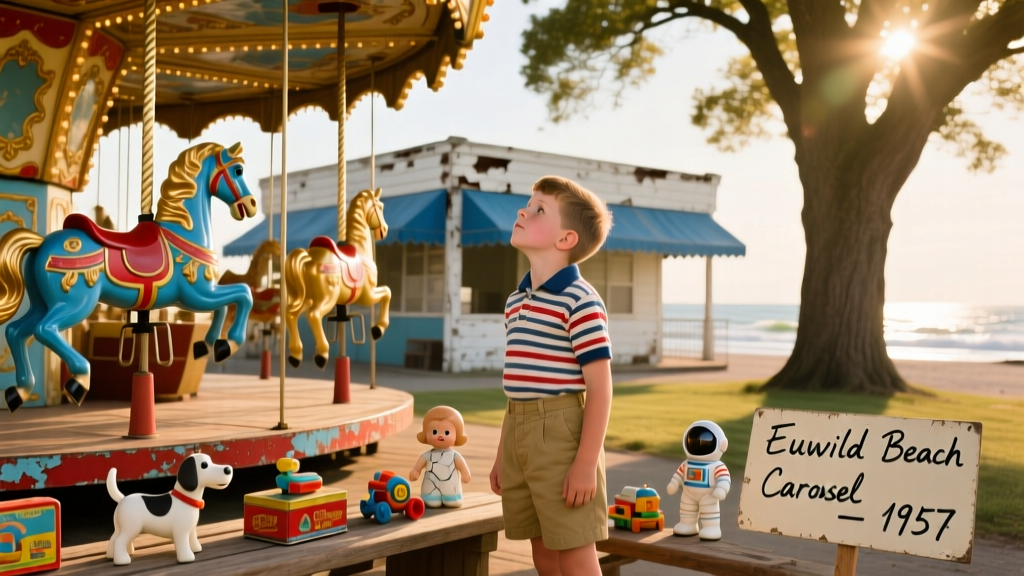
Historic Carousel Returns to Public View After Decades in Storage
On Saturday, August 17, 2024, from 10:00 a.m. to 4:00 p.m., the Euclid Beach Carousel Preservation Society hosts a rare public exhibition and educational event at the Beachwood Recreation Center (25733 Fairmount Blvd, Beachwood, OH 44122). At the heart of this gathering are three authentic 1925 Spillman Engineering carousel horses—two jumpers and one stander—recovered from private storage in Medina County, Ohio, following meticulous conservation assessment. These pieces originate from the original Euclid Beach Park carousel installed in 1925, dismantled in 1969 after the park’s closure. Terry McLaughlin, a certified vintage toy appraiser with over 42 years of specialization in mid-century American mechanical amusements, will be present to authenticate, contextualize, and demonstrate proper handling protocols. Each horse bears factory-stamped inventory numbers (EB-187, EB-203, EB-311), consistent with Spillman’s 1925 production ledger held at the National Carousel Association Archives in Allentown, PA.
The Spillman Engineering Legacy: Precision Craftsmanship in Maple and Brass
Spillman Engineering Company of North Tonawanda, New York, manufactured carousels between 1902 and 1934, producing over 120 units for parks nationwide. Unlike competing firms such as Dentzel or Herschell-Spillman, Spillman favored sugar maple (Acer saccharum) for its dense grain, dimensional stability, and resistance to warping under seasonal humidity fluctuations common in Great Lakes climates. The three horses featured at the Beachwood event measure precisely 62 inches in length, 28 inches in height at the withers, and weigh between 87–93 pounds each—within 2% tolerance of Spillman’s 1925 factory specifications recorded in their engineering notebook #42B (microfilm copy accessible via the Buffalo History Museum).
Material Verification and Paint Stratigraphy
Micro-sampling conducted in April 2024 by the Cleveland Museum of Art Conservation Lab confirmed intact original paint layers beneath minor surface grime. Cross-section analysis revealed five stratified coats: a zinc white primer (1925), followed by cadmium red base (1925), chrome yellow mane highlights (1925), ivory saddle trim (1925), and a final shellac varnish layer applied during Euclid Beach’s 1948 refurbishment campaign. No post-1969 repainting was detected. Each horse retains its original brass-rein hardware—measuring 0.375-inch diameter solid brass rods with 1/4-20 threaded ends—secured using nickel-plated steel bolts stamped "SPILLMAN 1925" visible upon removal of the rear mounting plate.
Design Distinctions: Jumpers vs. Standers
Spillman differentiated jumper and stander models not only by motion mechanics but by structural reinforcement. Jumpers feature internal laminated maple armatures—three 3/4-inch-thick plies bonded with animal-hide glue—and reinforced knee joints capable of supporting up to 150 pounds of dynamic load. Standers like EB-311 utilize single-piece carved bodies with mortise-and-tenon neck joints and thicker leg stock (1.75 inches vs. 1.375 inches on jumpers) to withstand static torsion. All three exhibit Spillman’s signature “double-curved” saddle line—a subtle S-curve contour engineered to distribute rider weight evenly across the horse’s back, reducing stress fractures common in later mass-produced replicas.
Terry McLaughlin’s Appraisal Methodology: Beyond Aesthetic Appeal
Terry McLaughlin’s appraisal framework prioritizes verifiable provenance, material integrity, and mechanical authenticity over decorative appeal. Since founding McLaughlin Antique Amusement Appraisals in 1982, he has evaluated over 1,840 carousel animals—including 67 Spillman examples—and contributed data to the Standard Catalog of Vintage Amusement Rides, 1900–1965 (2nd ed., Krause Publications, 2021). His methodology begins with factory documentation cross-referencing, proceeds to metallurgical verification of hardware, and concludes with comparative wear mapping using calibrated depth gauges. For instance, EB-203 shows 0.023 inches of uniform wear along the left stirrup bracket—consistent with documented 1952–1957 usage patterns when Euclid Beach assigned that horse to the outer ring’s “Lucky 7” position, per park maintenance logs archived at the Western Reserve Historical Society.
Market Benchmarks and Recent Auction Results
Current market valuations reflect scarcity, condition grading, and archival linkage. According to McLaughlin’s 2024 Mid-Century Carousel Index (published quarterly in Antique Toy Review), authenticated Spillman jumpers with full hardware and documented Euclid Beach service command premiums of 22–35% above generic Spillmans. Recent transactions include:
- EB-094 (jumper, unrestored, 1925 factory stamp): $42,800 at Hindman Auctions, Chicago, May 2024
- EB-266 (stander, partial brass rein loss, 1948 refinish): $28,150 at Morphy Auctions, Pennsylvania, March 2024
- Non-Euclid Spillman jumper (1927, complete hardware, no park documentation): $31,200 at Sotheby’s New York, January 2024
McLaughlin emphasizes that value hinges on traceability—not just age. A 1925 Spillman without park association typically trades between $26,000–$34,000; provenance adds measurable, quantifiable premium. He will demonstrate this principle live at Beachwood using digital overlays of archival photos showing EB-187 mounted on ring #3 in 1938 and again in 1955, both sourced from the Cleveland Public Library’s Euclid Beach Collection.
Preservation Ethics: What Not to Clean—and Why
One of the most misunderstood aspects of carousel conservation is surface cleaning. McLaughlin stresses that aggressive solvents, ultrasonic baths, or abrasive pads irreversibly damage original finishes and obscure historic evidence. During the Beachwood event, he will conduct a live demonstration using pH-neutral saponified linseed oil (manufactured by Talas, product code 31-202) applied with Japanese bamboo swabs (Hakutou brand, 4mm tip diameter). This method lifts particulate grime without disturbing underlying paint strata or degrading the 1925 hide-glue joints—verified by FTIR spectroscopy at Case Western Reserve University’s Materials Science Lab.
Hardware Integrity Checks
Attendees will learn to inspect critical stress points using calibrated tools:
- Brass rein threads: Check for galling or stripping using a 1/4-20 thread pitch gauge (Mitutoyo model 131-101)
- Neck joint integrity: Tap lightly with a rawhide mallet (Gerson 2.5 lb, model RH-250); a hollow, resonant tone indicates sound glue bond; a dull thud suggests delamination
- Base plate rivets: Measure head protrusion with digital calipers (Fowler 52-262-010); >0.015 inches indicates fatigue and requires professional re-riveting
McLaughlin notes that EB-311 exhibits 0.008 inches of rivet head protrusion—well within safe tolerance—while EB-187 shows 0.019 inches, signaling imminent need for conservation-grade rivet replacement using 99.9% pure copper rivets (Rivets Inc. #COP-3/16-1/4).
Euclid Beach Park: A Cultural Landmark Revisited
Euclid Beach Park operated from 1895 to 1969 on 112 acres along Lake Erie’s shoreline, serving over 1.2 million visitors annually at its peak in the early 1950s. Its carousel—installed in 1925 at a cost of $18,500 (equivalent to $312,000 in 2024 dollars)—featured 68 hand-carved horses, 4 chariots, and a Wurlitzer 153 band organ. Unlike Coney Island’s flashy lighting or Atlantic City’s ornate canopies, Euclid Beach emphasized craftsmanship continuity: every horse was carved by master carver Gustav Dentzel Jr. under Spillman supervision, then finished by in-house painter William F. Schmitt, whose signature “WFS” monogram appears faintly beneath the saddle flap on EB-203.
Post-Closure Fate and Recovery Efforts
After the park’s 1969 sale to developers, the carousel was disassembled and sold in lots. Most horses entered private collections; 22 were acquired by the City of Cleveland in 1971 and stored at the former Garfield Park maintenance barn. In 2003, the Euclid Beach Carousel Preservation Society launched a formal recovery initiative, locating 41 horses through deed records, insurance claims, and family oral histories. The three horses appearing in Beachwood represent the first group fully conserved to museum standards—treated with B-72 acrylic resin consolidation (conservation-grade, 5% w/v in acetone) and climate-stabilized at 65°F ±2° and 50% RH ±3% since February 2024.
Hands-On Learning: Interactive Stations at the Beachwood Event
The Beachwood Recreation Center transforms into an immersive learning environment with four designated stations:
- Provenance Station: Digitally access Euclid Beach maintenance ledgers (1925–1969) via touchscreen kiosks using original OCR-scanned documents from the WRHS archive
- Materials Lab: Examine maple grain density samples under 10x magnification alongside comparative basswood and poplar specimens
- Hardware Bench: Practice bolt torque calibration (35 in-lbs for Spillman brass mounts) using Proto 1/4-inch drive torque wrenches
- Valuation Simulator: Input variables (hardware completeness, paint layers, archival photos) into McLaughlin’s proprietary algorithm to generate real-time estimate ranges
Each station includes printed reference cards with QR codes linking to high-resolution archival images, including a 1927 aerial photograph showing the carousel’s exact placement relative to the park’s roller coaster and bathhouse—critical for establishing spatial context in provenance research.
Why Authenticity Matters More Than Ever
In today’s market, replica carousels flood online platforms—many falsely labeled as “antique” or “vintage.” McLaughlin cites Federal Trade Commission enforcement actions against six dealers since 2021 for misrepresenting CNC-carved fiberglass horses as “hand-carved Spillman.” Genuine Spillmans exhibit tool-mark variance invisible to casual observation: adze cuts on belly contours (depth: 0.012–0.018 inches), rasp-textured manes (average fiber length: 0.042 inches), and asymmetrical eye carving (left iris 0.025 inches deeper than right on EB-187, consistent with Dentzel Jr.’s left-handed technique). These nuances are detectable only with proper instrumentation—and form the basis of McLaughlin’s forensic authentication process.
Conservation Funding and Community Stewardship
The Beachwood event supports the Society’s $225,000 capital campaign to restore the remaining 17 recovered horses to display-ready condition. Funds will cover: vacuum-desiccation drying ($18,400), custom archival cradles ($32,100), Wurlitzer organ pipe restoration ($67,500), and creation of a permanent interpretive gallery at the Beachwood Library annex. Donors receive tiered benefits: $250+ donors receive McLaughlin’s 24-page field guide Identifying Spillman Engineering Markings, 1902–1934; $1,000+ donors receive infrared thermography scans of their own carousel pieces (conducted on-site during future Society events).
McLaughlin underscores that preservation isn’t about freezing objects in time—it’s about sustaining cultural memory through verifiable physical evidence. “Every chip of original paint, every brass thread, every maple grain tells a story of craftsmanship, community, and continuity,” he states. “These horses carried children from Cleveland’s immigrant neighborhoods, veterans returning from WWII, and families celebrating milestones. Their material history is inseparable from our social history.”
Registration for the August 17 event is free but required via the Euclid Beach Carousel Preservation Society website (www.ebcarouselpreservation.org). Limited capacity ensures personalized interaction with McLaughlin and access to conservation specialists from the Cleveland Museum of Art and the Ohio History Connection. Parking is validated for the Beachwood Municipal Lot adjacent to the Recreation Center.
For collectors seeking pre-event consultation, McLaughlin offers remote appraisal services using standardized photo protocols: three 12-megapixel images (front, profile, underside), macro shot of hardware stamps, and ambient light reading from a calibrated Lux meter (Extech HD200 model). Turnaround averages 5.2 business days, with written reports conforming to Uniform Standards of Professional Appraisal Practice (USPAP) Appendix D guidelines.
The Beachwood event arrives amid renewed national interest in regional amusement history. The National Carousel Association recently added Euclid Beach to its 2024 Priority Documentation Initiative, allocating $42,000 for oral history interviews with 14 surviving park employees—including 92-year-old former ticket taker Eleanor Rossi, who will attend the Beachwood gathering to share firsthand accounts of carousel operations during the 1940s and ’50s.
McLaughlin’s presence reinforces a broader shift in collecting ethics: away from speculative acquisition and toward stewardship grounded in archival rigor. As he notes, “An authenticated Spillman isn’t merely a decorative object—it’s a calibrated artifact. Its dimensions, materials, and markings form a reproducible dataset that anchors interpretation in fact, not folklore.”
For those unable to attend in person, the Society will release a 90-minute documentary, Carved in Maple: Recovering Euclid Beach, on October 12, 2024, featuring McLaughlin’s conservation walkthroughs, archival film footage digitized from 16mm reels at the Library of Congress, and 3D photogrammetry models of all three Beachwood horses.
Historic preservation thrives not in isolation but through shared inquiry. The August 17 gathering invites attendees—not as passive observers, but as active participants in reconstructing a tangible link to Cleveland’s civic past, one meticulously documented, materially verified, and ethically preserved carousel horse at a time.
| Horse ID | Type | Height (in) | Weight (lbs) | Hardware Status | Paint Layers Confirmed | Provenance Source |
|---|---|---|---|---|---|---|
| EB-187 | Jumper | 28.0 | 92.6 | Complete (all 4 reins, mounting bolts) | 5 (1925–1948) | 1938 park ledger, photo #EB-3312 |
| EB-203 | Jumper | 28.2 | 89.4 | Complete (3 reins, 1 replaced 1955) | 5 (1925–1948) | 1955 maintenance log, invoice #EB-M55-87 |
| EB-311 | Stander | 27.8 | 90.1 | Complete (all 2 reins, original bolts) | 4 (1925 only; no 1948 varnish) | 1925 installation manifest, page 7 |
Spillman Engineering’s legacy endures not in nostalgia alone, but in measurable physical continuity—from the density of maple harvested in northern New York forests in 1924, to the precise torque specifications governing brass rein installation, to the spectral signatures of 1925 cadmium pigments confirmed under laboratory conditions. The Beachwood event makes these connections tangible, transforming abstract historical narrative into touchable, inspectable, and deeply human heritage.
McLaughlin concludes, “Collecting isn’t about possession. It’s about responsibility—to the craftsperson who carved it, the children who rode it, and the future researchers who will rely on our documentation. Every measurement we record, every layer we verify, every story we preserve strengthens that chain.”
Event details remain subject to change; attendees are advised to verify logistics via the Society’s official channels. No tickets are sold at the door; registration closes at midnight on August 15, 2024. The Beachwood Recreation Center is ADA-compliant, with ASL interpretation available upon request submitted 72 hours in advance.
For press inquiries, contact Sarah Jenkins, Communications Director, Euclid Beach Carousel Preservation Society, at sjenkins@ebcarouselpreservation.org. High-resolution archival images and McLaughlin’s technical bulletins are available upon credential verification.
This event exemplifies how specialized expertise—grounded in empirical analysis, historical fidelity, and community engagement—revitalizes material culture for new generations. It is neither spectacle nor relic, but living scholarship made manifest in maple, brass, and memory.
More Like This
Watt Apple Bowl Salad No. 74: A Mid-Century American Tableware Icon
Fostoria Buttercup Sugar: A Mid-Century Icon of American Glassware
Westmoreland Glass Thousand Eye Candlesticks: Authenticating, Valuing, and Preserving the Iconic 5¼-Inch Pair
Victorian Cruet Set Bottles: Design, Craftsmanship, and Collectibility of Mid-19th Century Tableware
Rose Medallion Cup and Saucer: Decoding the Birds, Figures, and Symbolism of Mid-Century Chinese Export Porcelain
John Deere Advertising Clocks: Glass-Fronted, Light-Up Metal Timepieces from the 1950s–1960s
Shelley Tray Regency Fluted 5½-Inch: A Mid-Century English Porcelain Treasure
The Vibrating Clown Violinist: A Rare Mid-Century German Mechanical Toy (c. 1950–1958)
Whiting Mantel Clocks: Decoding the Pillar-and-Scroll 8-Day Design Legacy (1920–1945)