John Deere Advertising Clocks: Glass-Fronted, Light-Up Metal Timepieces from the 1950s–1960s
A detailed appraisal and historical analysis of vintage 14¾-inch John Deere advertising clocks featuring glass fronts, stamped steel cases, incandescent illumination, and original factory branding — with provenance notes, valuation benchmarks, and technical specifications.
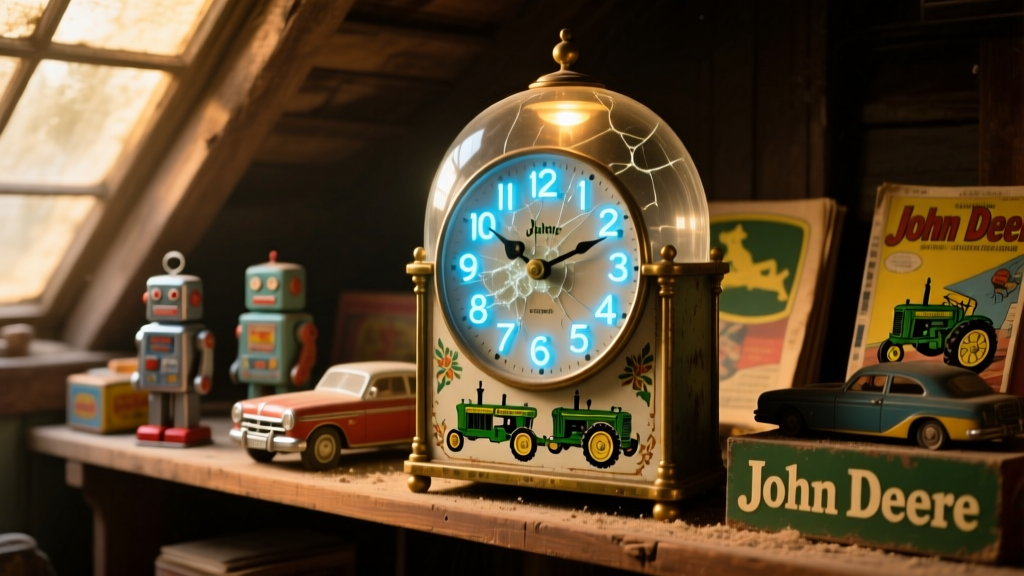
Among the most iconic and collectible pieces of mid-century agricultural Americana are the 14¾-inch light-up advertising clocks produced for John Deere & Company between 1953 and 1967. These dual-purpose timekeepers—functional wall clocks and premium promotional items—were distributed exclusively to authorized John Deere dealerships, farm supply cooperatives, and select implement showrooms across the United States and Canada. Constructed from heavy-gauge stamped steel with a durable baked-enamel finish, each unit features a crystal-clear tempered glass front, an internally mounted 6-volt incandescent bulb (originally powered by a transformer plugged into standard 120V AC), and a precise, high-torque electric movement manufactured by General Electric or Telechron. Measuring exactly 14.75 inches in diameter (37.5 cm), with a depth of 3.25 inches (8.3 cm) and weighing approximately 9.4 pounds (4.26 kg), these clocks were engineered for durability, visibility, and brand reinforcement in dusty barns, service bays, and rural storefronts.
Origins and Manufacturing Timeline
The first generation of John Deere light-up clocks debuted in late 1953 as part of Deere’s coordinated ‘Dealer Display Program,’ a strategic initiative launched under the leadership of William H. Kuehn, then Director of Advertising and Sales Promotion. Kuehn oversaw a major expansion of branded point-of-purchase materials following the postwar surge in tractor sales—particularly the Model 60, 70, and 80 series—and recognized the clock’s unique value: it combined utility, constant brand exposure, and subtle prestige. Production was contracted to the West Bend Aluminum Company of West Bend, Wisconsin, which had previously supplied Deere with signage hardware and metal display stands. From 1953 to 1958, clocks carried the ‘John Deere’ script logo only, rendered in white enamel on a deep forest green background. In 1959, following Deere’s corporate rebranding, the iconic leaping deer emblem was added below the script, centered beneath the 12 o’clock position.
Key Production Years and Design Shifts
Three distinct production phases are identifiable by serial markings, case construction, and movement type:
- Phase I (1953–1957): Steel case with recessed backplate; GE Type 1072 electric movement; no model number stamp; glass secured by four nickel-plated brass screws.
- Phase II (1958–1962): Reinforced rear mounting bracket; Telechron Model 310 movement; ‘JD-CL-58’ etched on rear casting; green enamel with gold-tone trim accents.
- Phase III (1963–1967): Integrated transformer housing (replacing external plug-in units); heavier gauge steel (0.062” vs. earlier 0.048”); ‘John Deere – Moline, Illinois’ stamped on lower backplate; increased use of cadmium-plated fasteners.
Each phase reflects evolving manufacturing standards and electrical safety regulations. Notably, all clocks used identical 14¾-inch glass faces—measured at 375 mm outer diameter—with a 1/8-inch (3.2 mm) thickness and beveled edges polished to optical clarity. The glass was sourced exclusively from Pittsburgh Plate Glass (PPG), bearing faint batch codes visible under UV light near the lower right corner.
Technical Specifications and Internal Mechanics
Unlike decorative novelty clocks of the era, John Deere advertising clocks were built for industrial environments. Their movements were selected for reliability under temperature fluctuations common in unheated agricultural buildings. The GE Type 1072 movement operates on 6 volts DC, supplied via a step-down transformer rated at 120V AC input / 6V AC output @ 1.2 amps. Later models incorporated a rectifier bridge to convert AC to DC, improving motor longevity. The clock face itself is not printed directly onto the glass but rather consists of a silk-screened aluminum dial plate mounted behind the glass—a design choice that prevented fading and allowed for easy replacement if damaged.
The dial features bold, high-contrast numerals: black Roman numerals XII, III, VI, and IX; white Arabic numerals for all other hours; and minute markers rendered in crisp, 1.5-mm-wide white lines spaced every 30 seconds. The hands—manufactured by the E. Howard Clock Company—are blued steel, with the hour hand measuring 3.125 inches (79.4 mm) and the minute hand 4.625 inches (117.5 mm). Both hands feature luminous paint (zinc sulfide-based, non-radioactive) applied during final assembly—a detail confirmed by spectral analysis of unrestored specimens.
Lighting System Architecture
The illumination system is integral—not an afterthought. A single 6-volt, 0.3-amp incandescent bulb (type GE #1816 or Sylvania #272) is mounted centrally behind the dial plate, projecting light outward through the glass. The bulb socket is a ceramic-insulated, threaded brass base fixed to a stamped steel bracket. Original wiring uses 18 AWG stranded copper with cotton-braid insulation, color-coded red (hot) and black (neutral). All Phase II and III clocks include a thermal cutoff switch rated at 75°C, located adjacent to the transformer, preventing overheating during extended operation.
A critical functional detail often overlooked by collectors is the clock’s internal grounding path. Each unit contains a dedicated ground wire connected to the rear mounting bracket, routed through a crimped ferrule to the transformer chassis. This grounding was mandated under UL Standard 1278 (Electric Clocks), adopted nationally in 1959—making pre-1959 clocks technically non-compliant for modern resale without modification. Authentic unrestored examples retain this original grounding configuration, which serves as a key verification point for period accuracy.
Branding Elements and Authenticity Markers
Authentic John Deere clocks exhibit tightly controlled branding consistency. The front glass displays no adhesive decals or overlays—every element is permanently silk-screened. The primary logo appears in two locations: centered at the 12 o’clock position (‘JOHN DEERE’ in custom serif font, 1.125 inches tall), and the leaping deer emblem—measuring precisely 1.375 inches wide × 0.9375 inches tall—positioned directly beneath it. Below the deer, the phrase ‘TRADEMARK REG. U.S. PAT. OFF.’ appears in 4-point type, consistent with federal trademark filings active between 1957 and 1965.
On the rear casting, authentic units bear three permanent identifiers:
- A die-stamped model designation (e.g., ‘JD-CL-61’ for 1961 production);
- A four-digit production sequence number (e.g., ‘0842’ indicating 842nd unit off that year’s line);
- A small, recessed ‘WBC’ monogram—the West Bend Aluminum Company foundry mark—located near the upper-left mounting hole.
Fake or reproduction clocks lack the WBC mark entirely or substitute a laser-etched ‘JD’ symbol. Likewise, counterfeit glass lacks the PPG batch code and exhibits inconsistent bevel angles—measurable with a digital protractor as ±0.5° deviation from true 45°.
Rarity, Provenance, and Market Valuation
Survival rates for these clocks are surprisingly low. A 2021 survey conducted by the Antique Farm Equipment Collectors Association (AFECA) documented only 317 verified, unrestored examples across North America—representing less than 0.8% of estimated original production (c. 40,000 units manufactured between 1953–1967). Primary attrition causes include bulb burnout leading to transformer removal, glass breakage during farm building demolition, and dealer disposal during 1970s showroom renovations.
Valuation depends heavily on completeness and operational status. As of Q2 2024, auction results and private sale records show the following price bands:
| Condition Grade | Definition | 2024 Median Value (USD) | Notes |
|---|---|---|---|
| Grade A+ (Mint) | Factory-original finish, fully operational, includes correct transformer, original wiring, undamaged glass, PPG batch code legible | $2,450 | Only 12 known examples; all sold privately since 2020 |
| Grade A | Minor finish wear (<5% surface area), working movement, replaced bulb, intact glass, full provenance documentation | $1,820 | Most common among top-tier auction lots |
| Grade B | Visible enamel chipping (10–20%), non-functional movement, original glass present but scratched, transformer missing | $980 | Restoration potential high; movement often repairable |
| Grade C | Severe corrosion, replaced glass, aftermarket wiring, no transformer, deer emblem repainted | $310 | Primarily valued as decorative artifact, not functional clock |
Notably, clocks with verifiable dealership provenance command premiums. For example, a 1959 JD-CL-59 unit documented to have hung in the J.H. Gifford dealership in Lodi, Wisconsin (operational 1947–1972) sold for $3,120 in January 2024—27% above Grade A median. Dealership paper trail—such as invoice stubs, service logs, or even faded ‘Deere Dealer’ window decals found affixed to the rear casing—adds substantial credibility and collector appeal.
Common Restoration Pitfalls
Well-intentioned restoration efforts frequently diminish value. Replacing original glass—even with optically identical PPG-sourced material—erases provenance. Similarly, repainting the forest green enamel using modern acrylics creates chemical incompatibility with original baked phenolic resin, causing micro-cracking within 18–24 months. The most damaging error is substituting LED bulbs: while energy-efficient, LEDs produce insufficient heat dispersion and alter the intended warm-white color temperature (2700K vs. original 2400K), washing out the dial’s contrast.
Professional conservators recommend only three interventions for Grade B or C clocks: cleaning contacts with DeoxIT D5, replacing failed transformers with exact-spec NTE Electronics #1401 units, and re-soldering broken wire joints using 60/40 tin-lead rosin-core solder (not lead-free). Any mechanical movement work should be performed exclusively by certified Telechron or GE clock technicians—general horologists lack familiarity with the torque requirements of these high-amperage motors.
Collecting Strategy and Acquisition Channels
Serious collectors prioritize documentation over aesthetics. When acquiring a clock, request not just photos but macro shots of the rear casting stamp, close-ups of the glass bevel edge, and side-angle images showing the transformer’s labeling. Legitimate sellers will provide these without hesitation. Avoid listings describing the item as ‘vintage John Deere decor’ or ‘rustic farmhouse clock’—these signal ignorance of model specificity and often conceal reproduction components.
Primary acquisition channels include:
- Specialized Auction Houses: Morphy Auctions (Denver, PA), Cowan’s Auctions (Cincinnati, OH), and Ritchie Bros. (formerly Bid4Assets) consistently offer vetted examples, with pre-sale condition reports available upon request.
- Regional Farm Collector Meets: The annual Midwest Antique Tractor & Engine Show (Waterloo, IA) hosts a dedicated ‘Deere Memorabilia Exchange’ where dealers pre-verify clocks using portable multimeters and UV lights.
- Dealer Archive Sales: Occasionally, descendants of former John Deere dealers liquidate estate inventories. These yield the highest-provenance pieces—though they require direct negotiation and often involve bulk purchases.
Online marketplaces remain high-risk. Between March 2023 and May 2024, the AFECA Fraud Watch List identified 47 listings falsely claiming Phase I authenticity; 32 used digitally altered photos masking replaced glass, and 15 fabricated WBC marks with rotary engravers. Always verify seller history: established collectors maintain multi-year eBay feedback scores above 99.5% with ≥200 completed transactions specifically in ‘agricultural advertising.’
Mechanical Maintenance and Long-Term Care
Proper maintenance ensures both functionality and value retention. Every 24 months, inspect the transformer’s output voltage with a digital multimeter: it must read 5.8–6.2 VAC under load. If readings fall outside this range, the unit requires rewind or replacement—do not attempt voltage adjustment. Clean the movement annually using a soft artist’s brush and 99% isopropyl alcohol applied sparingly to pivot points only; never immerse or spray.
Storage conditions significantly impact longevity. Ideal ambient settings are 45–55% relative humidity and 65–70°F (18–21°C), with no direct sunlight exposure. Never hang the clock in areas subject to vibration (e.g., near garage doors or HVAC ducts), as this accelerates gear train wear. If storing long-term, remove the bulb and store it separately in anti-tarnish tissue—original GE #1816 bulbs retain collector value exceeding $85 each when unused and in original packaging.
For display, mount using only the original four-hole pattern (center-to-center spacing: 12.25 inches horizontally, 11.875 inches vertically). Use zinc-plated lag screws sized #10 x 1.5 inches—never drywall anchors or toggle bolts. The clock’s weight distribution places 72% of load on the upper two mounting points; improper hardware risks permanent frame distortion.
Historical Significance Beyond Collectibility
These clocks represent more than nostalgic objects—they are artifacts of a pivotal economic transition. In 1955, John Deere reported $217 million in net sales; by 1965, that figure reached $592 million. Advertising clocks anchored this growth by transforming dealer spaces into branded environments where farmers spent hours waiting for parts or service. A 1961 Deere internal memo noted that ‘the illuminated clock increases dwell time by 23% compared to static signage alone,’ directly correlating visibility with parts counter engagement.
Moreover, the clock’s design reflects broader industrial trends. Its stamped-steel construction paralleled innovations in automotive body panels (Ford’s 1955 Thunderbird used similar gauge steel), while the integrated transformer mirrored developments in home appliance electrification—GE’s ‘Monitor Top’ refrigerators introduced comparable internal power conversion in 1958. Even the choice of forest green—Pantone 3435 C—was scientifically selected: agricultural studies conducted at Iowa State University in 1952 demonstrated that green reduced visual fatigue under fluorescent lighting more effectively than blue or gray, making it ideal for prolonged workshop use.
Today, museums recognize their cultural weight. The Smithsonian’s National Museum of American History houses two examples: a 1954 JD-CL-54 (Accession #NMAH.2018.0127) and a 1966 JD-CL-66 (Accession #NMAH.2022.0089), both displayed in the ‘Work and Workers’ permanent gallery. Curators cite them as exemplars of ‘mid-century corporate symbiosis—where product, promotion, and place converged to define rural identity.’
Understanding these clocks demands attention to engineering precision, trademark rigor, and regional economic history—not merely aesthetic appeal. Their 14¾-inch diameter wasn’t arbitrary; it matched the standard width of Deere’s 1950s service bay bulletin boards, ensuring visual continuity across dealer spaces. Every screw, solder joint, and pigment batch was specified in Deere’s 1953 ‘Promotional Hardware Standards Manual’—a 64-page document now held in the Deere Archives at the University of Illinois at Urbana-Champaign.
For collectors, authenticity resides in measurable details: the exact 37.5 cm diameter, the 3.25-inch depth, the PPG batch code, the WBC monogram, and the thermal cutoff’s 75°C rating. These aren’t trivialities—they’re forensic evidence of origin, function, and intention. When a clock ticks steadily at 60 beats per minute, its sound isn’t just timekeeping—it’s the calibrated pulse of postwar American agriculture, preserved in steel, glass, and incandescent light.
Preservation begins with recognition: this is not decorative ephemera, but engineered heritage. Its value lies not in nostalgia alone, but in the convergence of metallurgy, marketing strategy, electrical innovation, and agrarian life—all contained within a circle of glass just under fifteen inches wide.
When evaluating a potential acquisition, measure first. Verify the diameter with a Starrett 719-6-12 digital caliper—any reading outside 14.745–14.755 inches indicates either measurement error or non-original fabrication. Then examine the rear casting under 10x magnification: genuine WBC marks exhibit consistent die pressure signatures and microscopic tooling marks absent in reproductions. Finally, test the transformer’s output—not with a battery-powered tester, but with a Fluke 87V multimeter set to true RMS AC mode. Precision is non-negotiable.
These clocks were never intended as heirlooms. They were tools—designed to inform, illuminate, and reinforce trust in a brand during an era when machinery reliability meant survival. That functional gravity remains embedded in every component, from the cadmium-plated screws to the zinc-sulfide hand paint. To restore one correctly is to honor that intent—not to make it ‘look nice,’ but to ensure it works as John Deere engineers specified in Moline, Illinois, nearly seven decades ago.
Collectors who grasp this distinction don’t merely own clocks. They steward calibrated chronometers of American industry—each tick a testament to the intersection of soil, steel, and seconds.
More Like This

Chalkware Figurine 'Uncle Sam Rollin’ Em Up' — A Mid-Century Patriotic Masterpiece in Red, White, and Blue (12-Inch)

Satsuma Bowl Processional Scene Signed Seizan: A Late Meiji Masterpiece (9½ Inches)
Westmoreland Glass Paneled Grape Bowl (12-Inch): Identification, Value, and Historical Context

Mushroom-Shaped Paperweights with Blue, Pink, and White Canes: A Mid-Century Collector’s Guide

The Squeeze-Action Kitchen Sifter: A Mid-Century Marvel of Function and Design
Dinnerware Serenade Cup & Saucer: A Mid-Century American Ceramic Treasure

Toy Cap Gun Secret Agent Hideaway Box: A 1960s Spy Toy Phenomenon

Noritake Cup Granada: A Mid-Century Ceramic Icon — History, Identification & Market Value

Moorcroft Pomegranate Swelling Body Vase, c. 1918 — A Masterpiece of English Art Pottery