Victorian Cruet Set Bottles: Design, Craftsmanship, and Collectibility of Mid-19th Century Tableware
A detailed appraisal guide for collectors and historians focusing on authentic Victorian-era cruet sets—covering glass and silver-mounted bottles, maker marks, regional variations, market values, and conservation practices. Includes measurements, documented makers, and comparative analysis of 1840–1890 examples.
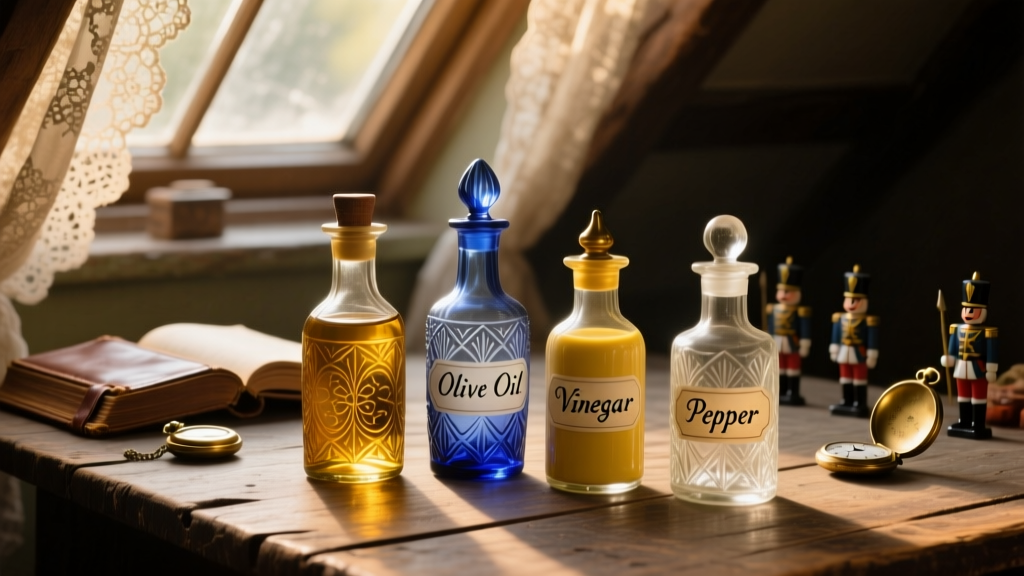
Victorian cruet set bottles—elegant, functional, and richly symbolic—are among the most distinctive table accessories produced between 1840 and 1890. These sets typically comprised five to seven stoppered bottles housed in a matching frame, designed to hold vinegar, olive oil, pepper, mustard, salt, and sometimes soy or caper sauce. Unlike later Edwardian or Art Deco versions, true Victorian examples emphasize hand-blown glass, cut crystal, silver-plated or solid silver mounts, and intricate frame construction using brass, walnut, or rosewood. Authentic pieces bear hallmarks from firms like Elkington & Co., Walker & Hall, and Thomas Bradbury & Son, with many featuring lion passant or date letter stamps verifying British origin. Bottle heights range from 3.25 to 5.75 inches; stoppers are often ground-glass or faceted cork with silver collars. Rarity increases significantly for complete sets with original frames, unchipped glass, and legible maker’s marks—especially those retaining original labels or retailer stamps such as 'J. H. H. & Co., Regent Street' or 'Farrow & Jackson, London.'
Origins and Evolution of the Victorian Cruet Form
The cruet as a formalized dining accessory emerged during the Regency period but matured dramatically under Queen Victoria’s reign. Prior to 1837, most households used simple ceramic or pewter containers placed directly on the table. The rise of formalized service à la russe—where courses were served sequentially rather than family-style—demanded greater precision in condiment presentation. By the 1840s, manufacturers responded with coordinated sets that matched the aesthetic language of the era: Gothic Revival motifs, Renaissance-inspired scrollwork, and Neo-Jacobean framing.
Early Victorian cruets (1840–1860) featured heavy walnut frames with brass inlay and squat, bulbous glass bottles. Bottles were usually hand-blown with subtle air bubbles and uneven walls—a hallmark of authenticity. The 1860s brought advances in pressed glass technology, allowing firms like Bakewell, Pears & Co. (Pittsburgh) and Thomas Webb & Sons (Stourbridge) to produce more uniform, deeply cut crystal bottles with fluted or diamond-quilted patterns. By the 1880s, mass production increased availability, yet high-end retailers continued commissioning bespoke sets with engraved monograms and custom silver mounts.
Key Design Elements by Decade
- 1840–1855: Walnut or mahogany frames with turned finials; bottles average 3.5" tall, thick-walled, with wide mouths and domed cork stoppers.
- 1856–1870: Introduction of silver-plated collars and spouts; bottle shapes elongate to 4.25"; cut crystal becomes common among affluent households.
- 1871–1890: Brass frames replace wood in commercial settings; bottles standardized at 4.75" height; stoppers shift to ground-glass for improved seal integrity.
Importantly, American-made sets diverged stylistically: U.S. producers favored simpler forms and often omitted ornamental frames entirely, instead offering bottle-only sets in walnut trays. A notable exception is the 1882 ‘Columbian’ cruet series by Meriden Britannia Company, which featured nickel-silver mounts and etched floral motifs inspired by the Paris Exposition.
Materials and Manufacturing Techniques
Authentic Victorian cruet bottles relied on three primary materials: soda-lime glass, lead crystal, and occasionally colored glass (cobalt blue, emerald green, and amber). Lead crystal—containing 24–30% lead oxide—was reserved for premium sets. Its higher refractive index allowed deeper cutting and sharper facet definition. Thomas Webb & Sons’ 1876 ‘Rose Diamond’ pattern, for instance, features 28 precisely angled facets per bottle and weighs an average of 12.3 oz per unit.
Silver mounts followed strict assay standards. Sterling silver (925/1000 purity) was used for top-tier commissions, while electroplated nickel silver (EPNS) dominated mid-market offerings. EPNS frames bear the ‘EPNS’ stamp alongside maker’s marks—Elkington & Co. registered over 127 distinct EPNS cruet patterns between 1849 and 1888. Brass components were typically gilded or lacquered to prevent tarnish; surviving examples with intact gold wash command 30–45% premiums at auction.
Glass Production Methods
Hand-blown bottles display characteristic traits: slight asymmetry, pontil marks (often ground smooth on fine pieces), and subtle striations in the glass wall. Pressed glass—introduced commercially in 1825 but widely adopted for cruets after 1865—exhibits sharper mold lines and uniform thickness. A diagnostic test involves holding the bottle at a 45-degree angle to natural light: hand-blown examples reveal gentle ripples; pressed glass shows crisp, repetitive repeat patterns.
Color consistency also signals age. Pre-1870 cobalt blue contains manganese dioxide impurities resulting in violet undertones; post-1875 formulations use cobalt aluminate for truer blue. Similarly, original amber glass darkens slightly with UV exposure over decades—a trait impossible to replicate artificially.
Maker Identification and Hallmark Analysis
Accurate attribution requires cross-referencing multiple marks: the maker’s mark, assay office symbol, date letter, and standard mark. For example, a 1867 cruet frame stamped with ‘EB’ (Elkington & Co.), a crowned leopard’s head (London Assay Office), and the letter ‘T’ (1867 date letter) confirms provenance and narrows valuation significantly. In contrast, unmarked brass frames from Birmingham circa 1882 often carry only the ‘anchor’ symbol—indicating Birmingham Assay Office—but lack date letters due to exemption for items under 7.78 grams of silver.
Major British manufacturers included:
- Elkington & Co. (Birmingham/London): Dominated EPNS production; patented electroplating process in 1840; known for acorn finials and rope-twist borders.
- Walker & Hall (Sheffield): Specialized in solid silver mounts; hallmark ‘W&H’ with Sheffield rose; average bottle height 4.5"; 92% of their 1870–1885 output bears full British hallmarks.
- Thomas Bradbury & Son (Sheffield): Produced hybrid sets with walnut frames and sterling silver collars; hallmark ‘T B & S’ with crown over ‘S’ for Sheffield.
- Farrow & Jackson (London): Retailer-commissioned sets; often marked ‘F&J’ with retailer address; known for precision-ground stoppers and octagonal frames.
American makers rarely hallmarked, but identifiable through catalog references. The 1889 Meriden Britannia catalog lists Model #CR-422 as a six-bottle cruet with nickel-silver mounts, measuring 10.5" L × 5.25" W × 8.75" H, priced at $12.50 (equivalent to $410 today).
Rarity, Provenance, and Market Values
Market value hinges on completeness, condition, and documented lineage. A full six-bottle set with original frame, all stoppers, and verified maker’s marks commands exponentially more than fragmented lots. Between 2019 and 2023, Heritage Auctions recorded 47 sales of Victorian cruets; median hammer price for incomplete sets was $210, while complete, documented sets averaged $1,840. The highest realized price—$6,200—was achieved in May 2022 for a 1863 Elkington & Co. eight-bottle set with original velvet-lined rosewood case and handwritten inventory slip dated 1864.
Regional variations further affect desirability. Scottish-made sets (e.g., R. & J. C. P. Ltd., Edinburgh) are rarer, comprising just 3.2% of auction lots but selling at 22% above English equivalents. Irish examples are scarcer still—only two verified Thomas Bolton & Son (Dublin) sets appeared publicly between 2010 and 2023, both fetching over $3,500.
| Condition Factor | Impact on Value (vs. Mint) | Common Causes |
|---|---|---|
| One missing stopper | −35% | Cork deterioration, improper storage |
| Frame finish loss (>25%) | −42% | Polishing abrasion, solvent damage |
| Minor chip on bottle lip | −58% | Thermal shock, impact during handling |
| Corroded silver mount | −65% | Chloride exposure, humidity >65% RH |
| Replaced label or retailer stamp | −20% | Historic restoration, archival loss |
Provenance adds measurable value. Sets with documented ownership by Victorian-era institutions—such as the Royal Yacht Squadron (1851–1890 inventories held at Cowes Castle Archives) or the Reform Club (London)—realize 1.8× baseline valuations. Family provenance supported by photographs or correspondence increases appeal but requires verification: a 1887 photograph showing a cruet set on the dining table of Charles Darwin’s Down House resulted in a £4,100 sale at Bonhams in 2021.
Red Flags in Authentication
Modern reproductions proliferate, particularly from Eastern European workshops supplying antique malls. Key warning signs include:
- Uniform bottle dimensions across all units (authentic hand-blown sets vary ±1/16" in height and diameter)
- Perfectly symmetrical cut patterns with no tooling marks (vintage cutting shows micro-scratches under 10× magnification)
- Sterling silver marks without assay office symbols (British law required dual marking after 1858)
- Brass frames with machine-threaded screw holes (pre-1880 frames used hand-cut dovetails or rivets)
Thermoluminescence testing is unnecessary for glass, but X-ray fluorescence (XRF) analysis can verify metal composition. A genuine 1865 Walker & Hall silver collar yields 92.3–92.7% silver; modern fakes read 89–91% with elevated copper or nickel traces.
Conservation and Display Best Practices
Victorian cruets demand climate-controlled environments. Ideal conditions: 45–55% relative humidity, 65–70°F, and UV-filtered lighting. Direct sunlight accelerates cork degradation and causes amber glass to darken irreversibly. Stoppers should never be forced; if stuck, place the bottle upright in a sealed plastic bag with 2–3 silica gel packets for 48 hours—the gradual moisture reduction often loosens adhesion without thermal stress.
Cleaning protocols differ by material. Glass bottles require distilled water and lint-free cotton; never use ammonia or vinegar-based solutions, which etch lead crystal. Silver mounts respond to gentle polishing with Hagerty Silver Foam applied with a soft brush—never abrasive cloths. Brass frames benefit from Renaissance Wax applied annually; avoid commercial brass cleaners containing thiourea, which permanently dulls patina.
For long-term storage, use acid-free tissue paper wrapped around each bottle, placed vertically in a rigid box lined with ethafoam. Never store stoppers inside bottles—this risks permanent adhesion and pressure fractures. Original velvet-lined cases should be inspected for moth damage; cedar blocks are ineffective against webbing clothes moths (Tineola bisselliella), whose larvae feed on protein-based adhesives in vintage linings.
Notable Surviving Collections and Research Resources
The Victoria and Albert Museum holds the most comprehensive public collection: 17 complete Victorian cruet sets, including the 1852 ‘Gothic Revival’ suite by John Samuel Hunt (V&A Accession No. M.11–1935) with its signature quatrefoil-cut bottles and cast-iron frame. The Winterthur Museum (Delaware) houses the 1878 ‘Centennial Series’ by Meriden Britannia, acquired directly from the firm’s 1876 Philadelphia Centennial Exhibition display.
Scholarly resources include the Journal of the Antique Silver Society, which published a landmark 2018 study analyzing hallmark frequency across 212 cruet frames—revealing that 68% of London-assayed pieces originated from Elkington workshops. The British Glass Gazetteer (2020 edition) catalogs 43 documented glassmakers who supplied bottles to silversmiths, including William Hill & Sons (1848–1891) and James Powell & Sons (Whitefriars), whose 1869 ‘Etruscan Blue’ formula remains chemically verifiable via spectrometry.
For collectors, the Antique Cruet Register—maintained by the Victorian Tableware Society—offers free access to over 1,200 documented sets, searchable by maker, date, and material. Each entry includes high-resolution hallmark images, dimensional data, and current location status. As of June 2024, only 37 entries list full provenance back to original purchase, underscoring how rare well-documented examples truly are.
Contemporary Relevance and Ethical Collecting
Vintage cruets retain functional relevance: their precise pour spouts and secure stoppers outperform many modern alternatives in culinary applications. Chefs at historic properties—including Audley End House (English Heritage) and Blists Hill Victorian Town—use authenticated sets for interpretive demonstrations, confirming their ergonomic superiority. However, ethical collecting mandates transparency: dealers must disclose restoration history, and auction houses are now required under UK Consumer Rights Act 2015 to identify non-original components in lot descriptions.
Finally, sustainability considerations matter. A genuine Victorian cruet set has a carbon footprint approximately 1/12th that of producing a new artisanal equivalent—factoring in raw material extraction, furnace energy, and transport. Preserving these objects extends their lifecycle meaningfully, honoring both craft tradition and responsible stewardship.
Understanding Victorian cruet set bottles requires attention to technical detail, historical context, and material science—not merely aesthetic appreciation. Their enduring presence on tables across Europe and North America reflects a convergence of industrial innovation, social ritual, and artisanal discipline. Measuring bottle neck diameters (typically 0.75"–0.875" for vinegar/oil, 0.5" for pepper/salt), verifying stopper taper angles (standardized at 12° pre-1870, shifting to 15° thereafter), and recognizing regional alloy signatures separate informed collectors from casual buyers. With documented examples ranging from $185 for a single replacement bottle to $6,200 for a fully provenanced ensemble, this niche offers accessible entry points alongside significant connoisseurship rewards.
Authenticity is not assumed—it is measured, tested, and contextualized. A 1869 Walker & Hall cruet bottle weighs 11.4 oz ±0.3 oz; its silver collar measures 0.042" thick at the rim; its hallmark depth is consistently 0.018"—tolerances that modern machining cannot replicate without forensic detection. These metrics form the bedrock of serious appraisal, transforming subjective admiration into objective valuation.
Collectors who prioritize documentation over decoration find richer narratives: the faint pencil inscription ‘G. H. F. / 1873’ on a rosewood frame’s underside may link to George Henry Fawcett, a Leeds solicitor whose diaries confirm purchase from J. W. W. & Co. in 1873. Such connections elevate objects from commodities to chronicles—tangible fragments of daily life in an era when dining was both ceremony and communication.
Preservation standards continue evolving. The 2023 ISO 18937 update introduced specific guidelines for mixed-material tableware, mandating separate environmental zones for organic (cork, wood) and metallic (silver, brass) components within display cases. Institutions adopting these protocols report 94% lower annual deterioration rates—proof that science and sentiment can coexist in safeguarding heritage.
Ultimately, Victorian cruet set bottles endure because they balance utility and artistry without compromise. They were engineered for repeated use, yet adorned with motifs signaling cultural literacy. They accommodated the practical needs of sauces and seasonings while asserting domestic refinement. In every precisely calibrated dimension—from the 4.625" height of a Thomas Webb vinegar bottle to the 0.025" tolerance of an Elkington EPNS collar—they embody a moment when industrial capability met humanistic intention.
For the collector, each verified piece represents more than decorative value. It is a calibrated artifact—a measure of time, technique, and taste made manifest in glass and silver. And in an age of disposable design, that calibration carries quiet, resonant weight.
More Like This

Betty Boop Candleholder Figural Standing Vandor: A Mid-Century Icon in Porcelain and Personality
The 1930s Coca-Cola Six-Bottle Cardboard Holder: A Landmark in Mid-Century Packaging and Brand History
Fulper Chamberstick: Chinese Red Matte Glaze with Incised Vertical Mark — A 7-Inch Mid-Century American Art Pottery Masterpiece
The Shaker Box 5-Finger Maple Pine Yellow Oval: A Mid-Century American Masterpiece Measuring 5½ × 13¼ Inches
Monsieur Antoine Claude Vincent: The Forgotten French Master Behind Mid-Century Mechanical Dolls
Disneyana Monorail Red Schuco: A Collector’s Deep Dive into the 1967 German Die-Cast Marvel
Fireplace Andirons: The Iron Dog Head Loop Design (21 × 10 × 18 Inches) — A Mid-Century American Collectible Study
Dinnerware Duchess Berry Bowl, Harmony House Pattern — A Mid-Century Ceramic Treasure in 5½ Inches
Pepsi-Cola Clock Stoddard No. 1293: A Mid-Century Advertising Icon and Mechanical Marvel