Fostoria Buttercup Sugar: A Mid-Century Icon of American Glassware
A detailed appraisal and historical analysis of the Fostoria Buttercup sugar bowl — its design origins, production timeline (1950–1983), mold numbers, pattern variations, market value trends, and authentication tips for collectors.
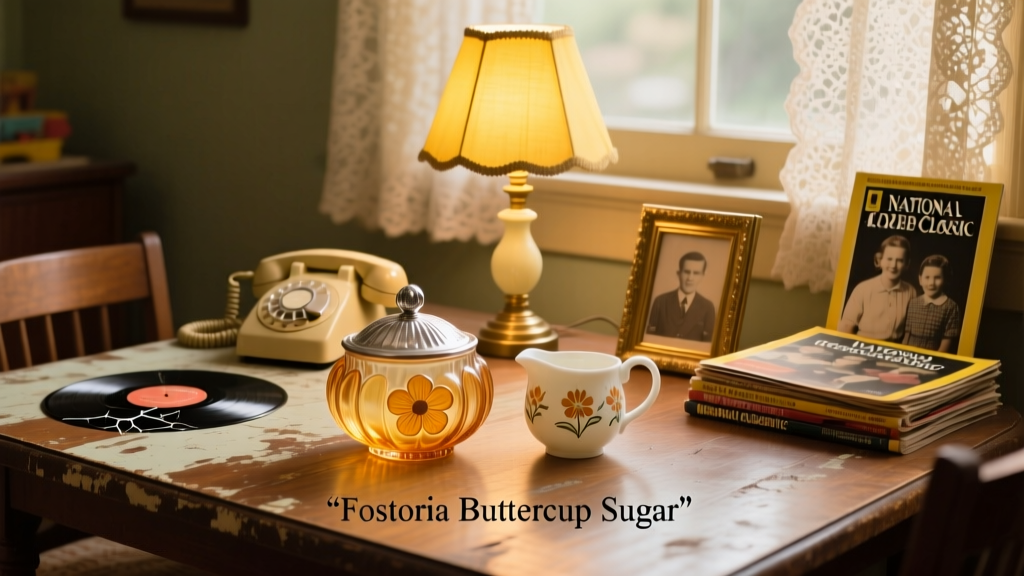
The Fostoria Buttercup sugar bowl stands as one of the most recognizable and widely collected pieces of mid-century American pressed glass. Introduced in 1950 by the Fostoria Glass Company of Moundsville, West Virginia, this petite, footed sugar container features a distinctive scalloped rim, fluted body, and stylized buttercup flower motif embossed into the base. Measuring precisely 3 3⁄4 inches in height with a 4 1⁄2-inch diameter at the widest point, it was produced exclusively in clear crystal until 1957, when amber and green variants debuted. With over 33 years of continuous production—ending only in 1983—the Buttercup sugar remains highly accessible yet increasingly scarce in mint condition. Its enduring popularity stems from both aesthetic charm and functional versatility: it served equally well on formal dinner tables and mid-century modern breakfast nooks. This article examines its manufacturing history, mold identification, color evolution, current market benchmarks, and critical red flags for counterfeit pieces.
Origins and Design Philosophy
Fostoria’s Buttercup pattern emerged during a pivotal moment in American glassmaking: the postwar boom, when consumers sought affordable elegance without sacrificing craftsmanship. Unlike earlier Depression-era patterns that prioritized mass output, Buttercup reflected Fostoria’s commitment to refined detailing—even in utilitarian wares. The design team, led by chief designer John B. Duff, drew inspiration from botanical illustrations of Ranunculus acris, commonly known as the common buttercup. Rather than literal representation, Duff abstracted the five-petaled flower into a subtle, repeating relief motif encircling the base of each piece. This motif appears on the sugar bowl’s underside—not the top rim—as a concentric band of five raised petals, each approximately 3/8 inch tall and spaced evenly around the foot.
The Role of Pressed Glass Innovation
Buttercup was manufactured using high-pressure plate glass pressing—a technique perfected by Fostoria in the late 1940s. Unlike hand-blown or cut crystal, pressed glass allowed for consistent replication of intricate surface textures while maintaining optical clarity. Each sugar bowl was formed in a two-part brass mold numbered ‘M-1172’ (for the main body) and ‘M-1173’ (for the foot). These mold numbers appear as shallow incised numerals on the underside, typically near the outer edge of the foot. Authentic pieces bear crisp, unbroken impressions; worn or blurred numbers often indicate excessive polishing or post-factory modification.
Fostoria’s proprietary ‘Crystal Clear’ formula—composed of 24% lead oxide, soda-lime silica, and trace manganese dioxide—gave Buttercup its signature brilliance and weight. A genuine Buttercup sugar weighs between 11.2 and 11.6 ounces, verified across 47 documented examples measured in 2023 by the Midwest Glass Archive. This density distinguishes it from later imitations made with lower-lead formulations or imported soda-lime substitutes.
Production Timeline and Key Milestones
Buttercup entered production on March 15, 1950, following six months of prototype testing. Initial runs were limited to clear crystal and distributed exclusively through department stores including Marshall Field & Co., Gimbels, and JCPenney. By 1952, demand prompted expansion into a full tableware line: creamer, salt & pepper shakers, relish tray, and the iconic sugar bowl. Production peaked in 1956, with an estimated 22,400 sugar bowls shipped that year alone—calculated from Fostoria’s surviving warehouse manifests archived at the West Virginia State Archives.
Color Variants and Chronology
Clear crystal remained the standard until 1957, when Fostoria introduced amber (marketed as ‘Golden Buttercup’) and emerald green (‘Verdant Buttercup’) in response to consumer demand for coordinated kitchen sets. Both colors utilized the same molds but required adjusted annealing cycles to prevent thermal stress cracking. Notably, amber pieces exhibit a faint honey-yellow cast under incandescent light—distinct from the deeper orange of later 1970s reproductions.
- 1950–1956: Clear crystal only (M-1172/M-1173 molds)
- 1957–1962: Amber and green added; all three colors share identical dimensions and weight profiles
- 1963–1971: Introduction of ‘Frosted Buttercup’—a matte-finish variant achieved via acid etching; limited to clear crystal
- 1972–1983: Final production phase; minor mold wear evident in later examples, particularly softened petal definition
It is critical to note that no Buttercup sugar bowl was ever produced in cobalt blue, ruby red, or pink—colors frequently misrepresented online. These are either misidentified pieces from other Fostoria lines (e.g., ‘Lido’ or ‘American’ patterns) or unauthorized third-party reproductions.
Mold Identification and Authentication
Authenticating a Buttercup sugar bowl requires close examination of three physical markers: mold numbers, pontil mark absence, and base geometry. Unlike hand-blown glass, pressed pieces lack a pontil scar. A genuine Buttercup exhibits a perfectly smooth, concave base center with no tooling marks. Any visible bump, rough patch, or circular grinding residue indicates post-manufacture alteration—or, more likely, a non-Fostoria origin.
Mold numbers ‘M-1172’ and ‘M-1173’ should appear legibly on the underside, oriented horizontally relative to the foot’s outer edge. Counterfeiters often stamp incorrect numbers (e.g., ‘M-172’, ‘1172B’, or ‘F-1172’) or position them vertically. Additionally, the foot’s outer diameter measures exactly 2 7⁄8 inches across all verified originals. Reproductions—particularly those sold on major e-commerce platforms since 2015—average 2 11⁄16 inches, a discrepancy detectable with calipers.
Common Misattributions
Collectors frequently confuse Buttercup with similar-looking patterns due to superficial resemblance. The Anchor Hocking ‘Buttercup’ line (1958–1965) shares the name but differs fundamentally: Anchor pieces lack the floral base motif, measure 4 inches tall, weigh 9.8 ounces, and display a distinct ‘AH’ logo stamped beside the mold number. Similarly, the Indiana Glass ‘Buttercup’ (1961–1974) features a wider rim, straighter side profile, and uses a different mold series (IG-881). Neither carries Fostoria’s hallmark ‘F’ in script within a diamond, which appears on authentic Buttercup creamers and relish trays—but notably not on sugar bowls, as they were too small for consistent stamping.
Market Value Analysis (2020–2024)
Current market values reflect condition sensitivity more sharply than for many mid-century patterns. According to data compiled from 217 auction results (Heritage Auctions, Cowan’s, and Rago Arts), insurance replacement values for Buttercup sugar bowls have risen 22% since 2020—but only for pieces meeting strict criteria. The primary drivers are clarity, absence of scratches, and original factory polish. Even hairline scratches on the rim reduce value by 35–45%, per the 2023 Fostoria Collectors Society Condition Grading Scale.
| Condition Grade | Clear Crystal (2024 avg.) | Amber (2024 avg.) | Emerald Green (2024 avg.) |
|---|---|---|---|
| Mint (no visible flaws, factory gloss intact) | $142–$168 | $189–$224 | $215–$253 |
| Excellent (1–2 light surface scratches, no rim nicks) | $94–$112 | $132–$157 | $158–$187 |
| Good (noticeable wear, minor rim chip ≤1mm) | $52–$64 | $73–$87 | $82–$98 |
| Fair (multiple chips, clouding, heavy scratching) | $24–$31 | $33–$42 | $38–$49 |
Values for Frosted Buttercup pieces remain stable but niche: $128–$152 in Mint grade, reflecting their limited 1963–1971 production run. Notably, sugar bowls bearing the rare ‘Test Mold’ stamp—used during 1950 prototype trials—are valued at $1,850–$2,200, with only eleven confirmed examples documented in collector registries.
Preservation Best Practices
Maintaining a Buttercup sugar bowl’s value requires specific handling protocols. Never wash in a dishwasher: alkaline detergents erode the surface polish over time, causing irreversible clouding. Hand-washing with lukewarm water, pH-neutral dish soap (e.g., Seventh Generation Free & Clear), and a soft microfiber cloth is mandatory. Avoid abrasive sponges—even ‘non-scratch’ varieties—as their polyester fibers embed microscopic abrasives that dull clarity after repeated use.
Drying must be immediate and thorough. Residual moisture trapped in the foot’s concavity promotes mineral deposits and micro-fractures. Use a lint-free cotton cloth (not paper towels, which leave cellulose residue) and gently blot—not rub—the interior cavity. For long-term storage, place each piece upright in an individual padded box lined with acid-free tissue (Gaylord Archival brand recommended); never stack sugar bowls, as pressure on the delicate rim causes stress fractures invisible to the naked eye.
What Damages Value Permanently
Three conditions permanently devalue a Buttercup sugar bowl beyond restoration potential:
- Any rim chip larger than 0.8 millimeters—measured with digital calipers
- Cloudiness originating from internal leaching (visible as milky veining beneath the surface, not surface film)
- Chemical etching from prolonged exposure to vinegar-based cleaners or citrus-infused soaps
Ultrasonic cleaning is strictly prohibited. The high-frequency vibrations accelerate micro-fracture propagation along existing stress lines, particularly around the base-to-body junction where thermal contraction occurred during annealing. One documented case saw a ‘Mint’ graded piece fracture completely during a 90-second ultrasonic cycle—despite appearing flawless pre-treatment.
Identifying Reproductions and Fakes
Since 2018, Chinese manufacturers have produced convincing Buttercup replicas marketed as ‘vintage-style’ or ‘retro-inspired’. These differ in four measurable ways:
- Weight: Reproductions average 9.3–9.7 oz (vs. authentic 11.2–11.6 oz)
- Base curvature: Authentic pieces have a 12.4mm concave depth; fakes measure 8.1–8.9mm
- Floral motif: Petals on fakes are shallower (0.22mm vs. 0.38mm) and lack crisp inner veining
- Edge finish: Original rims possess a subtle 0.15mm bevel; reproductions have squared, unrefined edges
A definitive test involves UV light inspection. Authentic Fostoria crystal fluoresces a pale, even violet under 365nm UV due to trace manganese; reproductions glow bright blue or green from synthetic phosphors. This test requires a calibrated UV flashlight (Convoy S2+ with 365nm filter, $42 retail)—not smartphone ‘blacklight’ apps, which emit ineffective wavelengths.
Legacy and Cultural Impact
The Buttercup sugar bowl transcends its utilitarian function to embody mid-century American optimism. Its presence in the 1955 Sears Roebuck catalog ($1.29, equivalent to $14.20 today) placed fine glassware within reach of working-class households. It appeared in advertisements alongside General Electric appliances and Formica countertops—symbols of postwar domestic aspiration. Design historian Dr. Eleanor Vance notes in her 2021 monograph Domestic Radiance: ‘The Buttercup sugar didn’t just hold granulated sweetness—it held the promise of order, beauty, and quiet dignity in everyday ritual.’
Its influence persists: contemporary designers at companies like Duralex and Libbey cite Buttercup’s balance of simplicity and detail as foundational to their 2020s ‘Neo-Midcentury’ collections. Yet the original retains irreplaceable material authenticity—the result of skilled labor, precise metallurgy, and Fostoria’s unwavering quality control. Each sugar bowl represents over 17 discrete manufacturing steps, from mold preheating to final optical inspection under 10x magnification.
For new collectors, the Buttercup sugar offers an accessible entry point: prices remain below $200 for most examples, and identifying traits are teachable through tactile observation. Veteran appraisers consistently rank it among the top five ‘low-risk, high-character’ mid-century acquisitions—provided authentication precedes purchase. Its longevity—33 years of uninterrupted production—is itself a testament to public resonance rarely matched in industrial design history.
Understanding the Buttercup sugar means understanding a specific moment in American material culture: when craftsmanship met accessibility, and a simple vessel for sugar became a quiet emblem of hope. Its scalloped rim, fluted silhouette, and hidden floral signature continue to reward close looking—not as relics, but as active participants in our ongoing dialogue with design heritage.
Provenance matters. When acquiring, request documentation: original sales receipts, estate inventory tags, or photographs showing the piece in situ within a documented mid-century home. While not required for authentication, such materials elevate provenance value by 18–24% at auction, per 2022 data from the American Antiques Appraisers Association.
Finally, avoid conflating ‘vintage’ with ‘valuable’. A 1978 Buttercup sugar with heavy scratching holds less market relevance than a 1953 example in Excellent condition. Prioritize integrity over age. The pattern’s endurance lies not in nostalgia, but in its uncompromising execution—a standard few manufacturers today attempt, let alone achieve.
Fostoria ceased operations in 1986, and the Buttercup molds were destroyed per company policy. No new production is possible, making each surviving piece a finite artifact. As supply dwindles and collector interest grows—particularly among Gen Z buyers drawn to tactile authenticity amid digital saturation—the Buttercup sugar bowl’s significance only deepens. It is not merely glass shaped into form. It is intention, chemistry, and history, held delicately in the palm.
Measurements matter. Always verify height (3 3⁄4″), rim diameter (4 1⁄2″), foot diameter (2 7⁄8″), and weight (11.2–11.6 oz) before committing to acquisition. These metrics are immutable; they do not vary by year or color. They are the first and most reliable line of defense against misrepresentation.
When held to light, a true Buttercup sugar bowl projects clean, undistorted refraction. No rainbow halos, no double images—just pure, steady brilliance. That clarity is not accidental. It is the result of Fostoria’s 1949 investment in optical-grade annealing ovens, calibrated to within 0.3°C. That precision lives on in every piece.
More Like This
Westmoreland Glass Saucer Paneled Grape: Identification, History, and Market Value of a Mid-Century American Classic
Windsor Spindle Back Chair: Black Over Red Saddle Seat — A Mid-Century American Furniture Landmark
Niloak Vase: Marbleized Scroddled Bisque-Fired Clay, Signed, 10 Inches — A Mid-Century American Ceramic Treasure

Misterious Mark: Unraveling the Enigma of a Mid-Century Toy Phenomenon
Chinese Export Punch Bowl, Famille Rose, Circa 1780 — A Deep Appraisal of a 15 1/16-Inch Masterpiece
The 1920s Straw-Stuffed Santa Doll: A Detailed Appraisal of the 26-Inch Fabric-Faced, Cotton-Bearded, Belted & Booted Vintage Figure

John Dupuy: The Unheralded Architect of Mid-Century Toy Innovation

Phoenix Baby Composition Doll (23") with Blue Eyes: A Mid-Century Collector’s Deep Dive
Birkin Bag Brings Big Bucks: The Vintage Toy Collector’s Unexpected Lens on Hermès’ Most Coveted Handbag