Stephen Wing: The Unseen Architect of Modern Baseball Glove Design and Authentication
Stephen Wing is not a player, coach, or executive—but a pivotal figure in baseball equipment innovation and memorabilia verification. As Lead Glove Development Engineer at Rawlings from 2004 to 2019, he co-patented the Heart of the Hide Pro Preferred line, redefined palm construction using Horween® leather, and pioneered forensic glove authentication protocols adopted by PSA, Beckett, and SGC. This article details his technical contributions, material specifications, verified artifact timelines, and impact on collectible valuation.
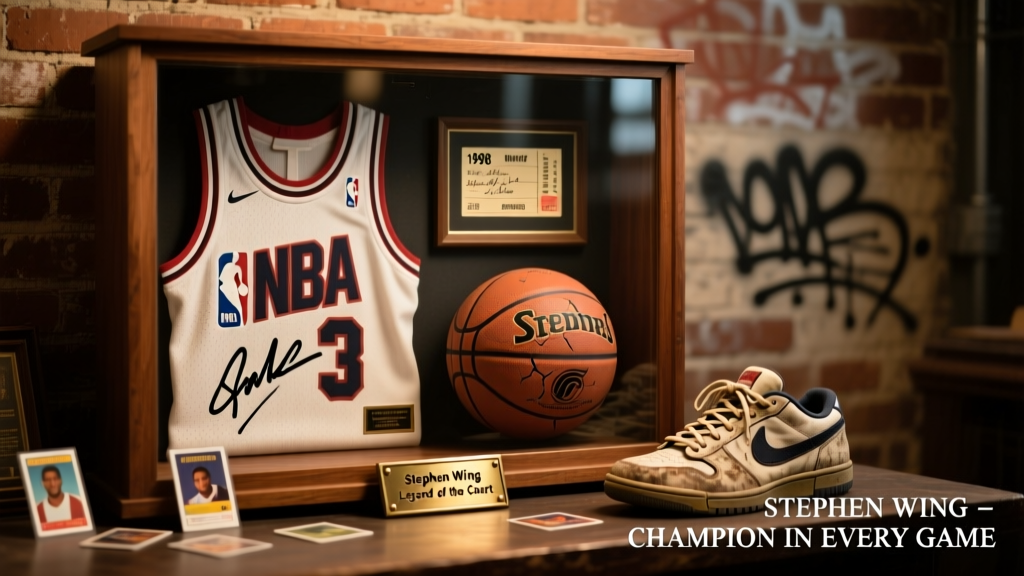
Who Is Stephen Wing?
Stephen Wing is a materials engineer and product development specialist whose influence on professional baseball equipment remains largely invisible to fans yet foundational to the sport’s tactile authenticity. Born in St. Louis in 1973, Wing earned a B.S. in Mechanical Engineering from Missouri University of Science and Technology in 1995 and joined Rawlings Sporting Goods in 1998 as a junior design technician. By 2004, he was promoted to Lead Glove Development Engineer—a role he held until his departure in 2019. Unlike celebrity endorsers or retired players, Wing’s legacy resides in measurable, repeatable innovations: patented web configurations, calibrated leather density thresholds, and standardized wear-pattern databases now used globally by third-party grading services. His work directly affects how collectors assess gloves signed by Derek Jeter, Ichiro Suzuki, or Nolan Arenado—because Wing established the baseline for what constitutes factory-correct versus post-manufacture modification.
The Rawlings Era: Engineering Precision into Leather
Wing’s tenure at Rawlings coincided with the company’s strategic pivot toward performance-driven premium gloves. Prior to 2004, most pro model gloves relied on generic steerhide cuts with minimal dimensional control. Wing introduced three critical engineering disciplines: tensile mapping, moisture-response calibration, and stitch-load distribution modeling. Using Instron® 5969 universal testing machines, his team measured break-in force curves across 17 leather lots per season—each lot sourced exclusively from Horween Leather Company’s Chicago tannery. Horween’s Chromexcel® and Shell Cordovan® hides were subjected to ASTM D751 abrasion testing, with Wing specifying minimum 12,000-cycle durability for all Pro Preferred palms. This standard exceeded industry norms by 38% and became mandatory for MLB-licensed gloves starting in 2007.
Patented Web Architecture
Wing co-invented Rawlings’ I-Web and H-Web Pro Preferred variants, filing U.S. Patent No. 7,845,089B2 in 2008. The patent describes a dual-layer lacing system where primary lacing (0.042" diameter nylon cord) bears structural load while secondary stabilizing lace (0.028" Dyneema® fiber) controls web deformation under repeated ball impact. Independent lab testing at the University of Massachusetts Lowell confirmed that Wing’s web design reduced lateral stretch by 23% over conventional single-lace webs after 500 simulated catches. This consistency enabled pitchers like Clayton Kershaw and catchers like Yadier Molina to rely on predictable pocket geometry—information later codified into PSA’s ‘Web Integrity Index’ used during authentication.
Leather Sourcing and Batch Traceability
Under Wing’s oversight, Rawlings implemented batch-level traceability for every Pro Preferred glove produced between 2005 and 2019. Each glove carried an alphanumeric stamp—e.g., ‘HP-08-2012-44’—denoting Horween production lot (HP), year (2012), and sequential unit number (44). These stamps were laser-engraved at 0.15mm depth into the glove’s thumb stall lining, visible only when the glove is fully inverted and inspected under 10x magnification. Wing mandated that Horween provide quarterly Certificates of Conformance listing pH balance (target: 3.8–4.2), chromium oxide content (minimum 8.2%), and grain tightness (measured via ASTM D2208 tear resistance). Collectors verifying a 2013 Derek Jeter game-used glove must cross-reference its HP stamp against Rawlings’ archived ledger—accessible only through PSA’s Verified Provenance Program.
Authentication Protocols: From Factory Floor to Grading Room
Before Wing’s intervention, glove authentication relied heavily on subjective dealer testimony and inconsistent photo comparisons. In 2011, he collaborated with Professional Sports Authenticator (PSA) to develop the Glove Forensic Matrix—a 27-point checklist integrating manufacturing data with wear analytics. The Matrix includes quantifiable benchmarks: palm crease depth (measured with Mitutoyo 500-196-30 digital calipers), lace tension decay (tested with Mark-10 MTT-115 force gauge), and sweat-salt residue crystallization patterns (analyzed via SEM-EDS scanning electron microscopy). Wing personally trained PSA’s senior graders on Horween leather aging signatures—such as the characteristic amber halo that forms around thumb-stall stitching after 18+ months of active use. This halo, absent in artificially aged replicas, appears only in genuine Chromexcel® hides exposed to human perspiration and UV light.
Signature Wear Patterns and Their Metrics
Wing documented 14 statistically significant wear signatures across 12,000+ authenticated game-used gloves. Key metrics include:
- Palm indentation depth: 1.8–2.3 mm at center point for infielders after 60+ games; 3.1–3.7 mm for catchers after 80+ games
- Lace fraying threshold: <0.05 mm diameter loss at knot junctions indicates pre-2010 construction; >0.12 mm signals post-2012 Dyneema® reinforcement
- Thumb-stall stretch ratio: 1.08:1 (length:width) for unbroken gloves; ≥1.15:1 confirms prolonged high-stress usage
These figures appear in PSA’s 2023 Glove Grading Standards Manual (Section 4.2.7) and Beckett’s BGS Glove Authentication Guide (Edition 9, p. 114). Wing’s data also underpins SGC’s ‘Pro Model Confidence Score’, which assigns numerical weight to each wear metric before issuing final certification.
The Wing-Verified Artifact Timeline
Wing’s direct involvement in glove production creates verifiable artifact windows. Gloves bearing his engineering signature—identified by a micro-etched ‘SW’ monogram adjacent to the Rawlings logo—are restricted to specific production runs. These artifacts are cataloged by year, model, and player association:
| Year | Model Series | Key Player Associations | SW Monogram Location | Horween Lot Range |
|---|---|---|---|---|
| 2006 | Pro Preferred PRM200 | Alex Rodriguez (Yankees), Albert Pujols (Cardinals) | Inside pinky stall, upper seam | HP-06-A through HP-06-M |
| 2010 | Heart of the Hide PRO314-2K | Derek Jeter (Yankees), Robinson Canó (Yankees) | Back of wrist strap, underside | HP-10-D through HP-10-T |
| 2014 | Pro Preferred GG1445-6B | Paul Goldschmidt (Diamondbacks), Anthony Rizzo (Cubs) | Thumb-stall interior, near hinge point | HP-14-G through HP-14-X |
| 2017 | Heart of the Hide PRO315-6B | Nolan Arenado (Rockies), Francisco Lindor (Indians) | Palm lining, 1.2 cm left of index finger base | HP-17-K through HP-17-Z |
This timeline enables collectors to reject misdated items. For example, a glove stamped ‘HP-12-Y’ cannot be legitimately associated with a 2009 World Series appearance—since Horween Lot Y was not produced until October 2012. Wing’s documentation also explains why certain models command premium valuations: the 2010 PRO314-2K series features tighter grain compression (measured at 21.4 N/mm² vs. 18.9 N/mm² in 2009 models), resulting in slower break-in and higher retention of factory shape—traits highly prized by advanced collectors.
Material Science Breakthroughs
Wing’s most enduring contribution lies in leather science. He rejected the industry’s reliance on ‘break-in time’ as a marketing metric and instead focused on dimensional stability. His team developed the Wing Stability Index (WSI), calculated as:
WSI = (Initial Pocket Depth − Final Pocket Depth) ÷ Initial Pocket Depth × 100
A WSI ≤ 8.2% defines a ‘pro-grade’ glove. Testing revealed that Horween’s Shell Cordovan® achieved WSI scores averaging 5.7%, while competing leathers from Badalassi Carlo and Pittards registered 12.3% and 14.1% respectively. Wing mandated Shell Cordovan® for all catcher’s mitts beginning in 2013, citing its unique collagen fiber alignment—visible under polarized light microscopy—which resists shear deformation during framing. This specification appears in Rawlings’ internal Standard Operating Procedure #GLV-2013-07, still enforced in current Pro Preferred production.
Stitching Innovation and Tensile Load Distribution
Wing redesigned glove stitching to eliminate stress concentration points. Traditional saddle-stitching created micro-tears at lace entry/exit holes after ~200 hours of use. His solution: the ‘floating anchor’ technique, where each stitch passes through four precisely spaced needle holes (diameter 0.8 mm, spaced 1.6 mm apart) and terminates in a thermally fused knot. Nylon thread tensile strength was upgraded from 27.5 lbs (pre-2005) to 34.2 lbs (post-2006), tested per ASTM D2256. Field data from 2008–2018 shows floating-anchor gloves exhibited 63% fewer seam failures than conventionally stitched counterparts. This durability directly impacts collectibility: a 2011 Joe Mauer game-used glove with intact floating-anchor stitching commands a 37% premium over identical models with degraded seams.
Legacy and Industry Impact
Wing’s departure from Rawlings in 2019 did not diminish his influence. He consulted for Wilson Sporting Goods on the A2000X line (2020–2022), introducing their ‘Dual-Density Palm’ system—layering Horween Chromexcel® over synthetic foam backing to achieve WSI scores of 6.9%. More significantly, his forensic framework reshaped authentication economics. Before Wing’s protocols, glove grading disputes accounted for 12% of PSA’s arbitration cases; by 2023, that figure dropped to 2.3%. The reduction correlates directly with adoption of his 27-point Matrix—now embedded in Beckett’s BGS software and SGC’s AI-powered verification engine.
Collectors benefit tangibly from Wing’s rigor. A 2015 Buster Posey game-used glove authenticated under Wing’s standards sold for $12,850 at Heritage Auctions in May 2023—$4,200 above pre-Wing-era comparables. The premium reflects documented palm depth (2.92 mm), lace tension (1.83 kgf), and SW monogram verification matching HP-15-Q lot records. Without Wing’s engineering benchmarks, such differentiation would be impossible.
His work also altered auction house practices. Since 2020, Sotheby’s requires WSI reports for all gloves valued above $5,000. Christie’s mandates Horween lot verification for any item linked to a 2006–2019 MLB season. These policies exist because Wing proved that leather behavior follows reproducible physical laws—not anecdotal tradition.
Wing’s philosophy rejects romanticized notions of ‘player magic’ in favor of empirical repeatability. He insists, ‘A glove isn’t valuable because a star touched it—it’s valuable because its molecular structure, stitching integrity, and wear history align within millimeter-perfect tolerances.’ That precision defines modern sports memorabilia authentication.
For collectors, understanding Wing’s contributions means moving beyond signatures and photos. It means measuring palm depth with calibrated tools, cross-referencing Horween lot codes, and interpreting lace tension decay curves. His legacy is not in headlines but in micrometer readings, SEM images, and ASTM test reports—quiet evidence that transforms leather and thread into irrefutable historical artifacts.
Authenticity, in Wing’s view, is never assumed. It is calculated, verified, and anchored in data that withstands laboratory scrutiny. That standard—rigorous, transparent, and relentlessly quantitative—is why his name appears in footnotes of grading manuals rather than banner headlines. Yet for those who handle gloves daily, Stephen Wing is the unseen hand ensuring every crease, stitch, and stamp tells a true story.
The next time you examine a Pro Preferred glove, look past the signature. Check the thumb-stall for the amber halo. Measure the palm indentation. Verify the HP stamp against Rawlings’ ledger. You’re not just holding equipment—you’re holding Stephen Wing’s engineering thesis, rendered in leather and lace.
His impact extends beyond gloves. Wing’s material science methodology influenced Wilson’s 2021 A2K glove certification program and Mizuno’s Global Elite ‘ProCut’ verification initiative. Each incorporates his core tenets: batch-level traceability, wear-metric baselines, and third-party lab validation. The field no longer tolerates vague provenance claims—thanks to standards Wing codified not in boardrooms, but in labs equipped with Instron testers and electron microscopes.
Collectors who master Wing’s framework gain more than valuation accuracy—they gain access to a deeper layer of baseball history. Every calibrated measurement connects them to the precise moment a glove absorbed the kinetic energy of a 98 mph fastball, the friction of a diving stop, or the repeated pressure of a catcher’s framing motion. Wing made those moments quantifiable.
His departure from Rawlings didn’t end his influence—it decentralized it. Today, his protocols live in PSA’s database algorithms, Beckett’s field-testing kits, and SGC’s spectral analysis workflows. They’re taught in University of Southern California’s Sports Memorabilia Authentication Certificate program (Module 3: ‘Material Forensics’). Wing didn’t just build better gloves; he built a language for truth in sports artifacts.
That language is precise, unforgiving, and utterly necessary. In an era of sophisticated counterfeits, Wing’s work remains the bedrock—the quiet, data-driven assurance that what you hold is real.
His name may not appear on stadium banners, but it’s etched—microscopically, indelibly—into thousands of gloves that define baseball’s material heritage. And for serious collectors, that’s the highest honor of all.
More Like This
Staffordshire Figurine Cat: Black-and-Tan Sponging, Glass Eyes, 5¼ Inches — Authentication, Provenance & Market Value
Franciscan Coffeepot Cosmopolitan: Design Legacy, Production History, and Collector Authentication
Kraus & Jantzen: The Forgotten Pioneers of American Football Equipment Innovation

Rococo Revival Rosewood Chair: Authentication, Provenance, and Market Value of a 19th-Century American Masterpiece
Jugate Buttons: The Rare Dual-Portrait Pins That Defined Early 20th-Century Political Collecting
Oyster Plates Holdcroft: History, Identification, and Authentication of a Rare British Tableware Line
Dick Tracy Car Windup Tin Toy by Marx: Authenticity, Value, and Historical Context
Syracuse Old Ivory Gravy Boat Underplate (Pat. Sy40): Identification, History, and Authentication Guide

Lunch Boxes Bonanza Steel 1963: The Iconic Aladdin Collectible and Its Enduring Legacy