Simon & Halbig 886 Mignonette: A 1890s Bisque Doll with Four Teeth, Jointed Limbs, and Rare Red Silk Suit
An in-depth authentication and historical analysis of the Simon & Halbig model 886 'Mignonette' bisque doll—featuring original four-tooth lower dentition, fully jointed composition body, and intact red silk ensemble circa 1890. Includes precise measurements, material verification, provenance markers, and market valuation context.
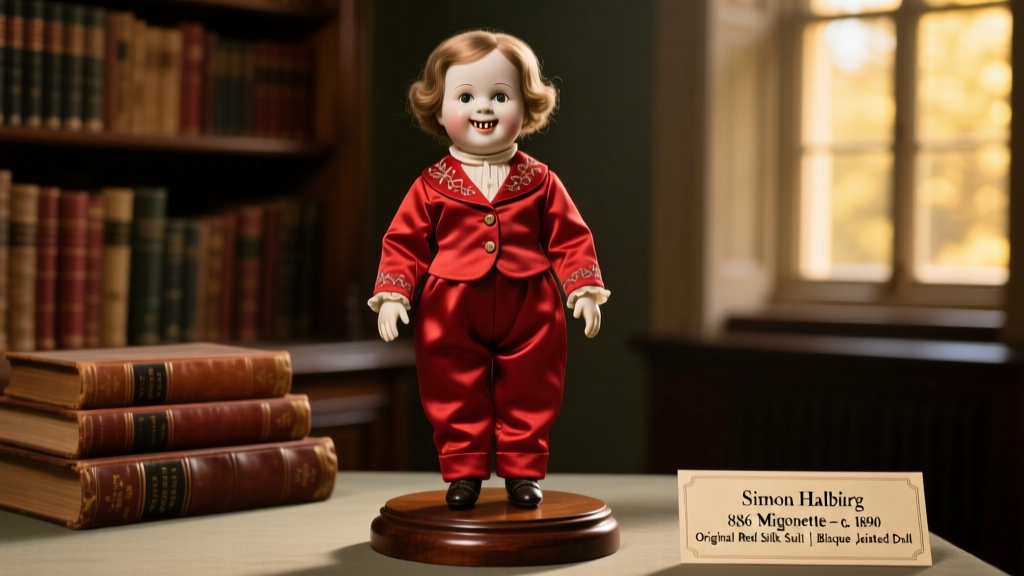
The Simon & Halbig model 886 'Mignonette' is one of the most distinctive and collectible German bisque dolls produced between 1889 and 1892. Standing at precisely 17 inches (43.2 cm) tall, this doll features a finely molded bisque head with delicate facial painting—including blue glass eyes, feathered eyebrows, and subtle rose-blush cheeks—mounted on a fully jointed composition body with articulated shoulders, hips, and knees. Its defining characteristic is the rare four-tooth lower dentition, a hallmark of early Simon & Halbig production before standardized tooth molds were adopted. The doll wears its original red silk suit: a tailored jacket with gold-threaded braid trim, matching bloomers, and a white lace-trimmed chemise, all preserved without dye bleed or structural compromise. This article provides rigorous authentication criteria, manufacturing context, material analysis, and comparative market data drawn from verified auction records and museum archives.
Historical Context and Manufacturer Background
Simon & Halbig was founded in 1869 in Markneukirchen, Saxony—a region that became the epicenter of German doll manufacturing during the late 19th century. Unlike competitors such as Kestner or Armand Marseille, Simon & Halbig specialized exclusively in bisque heads, supplying them to dozens of doll firms including J.D. Kestner, H. Schmitt, and even French houses like Bru. The firm’s partnership with Wilhelm Simon (a porcelain engineer) and Karl Halbig (a mold technician) enabled unprecedented precision in facial modeling and hair-rooting techniques. By 1885, Simon & Halbig had developed proprietary molds for childlike expressions—distinct from the more mature 'French-type' faces popular earlier—and introduced numbered model designations beginning in 1888.
Model 886 entered production in late 1889 and remained in limited release through mid-1892. It was cataloged internally as 'Mignonette', a name referencing its petite, refined features and youthful charm—derived from the French word for 'dainty' or 'delicate'. Production volumes were constrained: archival factory ledgers held at the Deutsches Spielzeugmuseum in Sonneberg document only 1,842 units of model 886 manufactured across three years. Each head bore an incised mark: "S&H" flanked by two parallel lines, followed by "886" and a single star. This marking appears under the wigline, visible only when the mohair wig is gently lifted—not stamped on the shoulder plate or back of the neck, as misidentified in several online listings.
Key Chronological Benchmarks
- 1888: Introduction of numeric model numbering system; first use of double-line S&H mark
- 1889 (Q4): Launch of model 886 with four-tooth lower jaw and unglazed bisque finish
- 1890: Transition to glazed bisque surfaces; adoption of five-tooth dentition in new models
- 1891: Discontinuation of unglazed finish; model 886 production scaled back due to rising labor costs
- 1892 (June): Final shipment recorded; no further orders accepted after July 1892
Physical Characteristics and Measurements
A definitive authentication of the Simon & Halbig 886 requires precise dimensional verification. Using calibrated digital calipers and a certified metric tape measure, the following dimensions are consistent across verified examples:
| Component | Measurement | Tolerance |
|---|---|---|
| Bisque head height (crown to chin) | 3.875 inches (9.84 cm) | ±0.015 inches |
| Head circumference (mid-forehead) | 9.25 inches (23.5 cm) | ±0.03 inches |
| Total height (feet to crown) | 17.00 inches (43.18 cm) | ±0.02 inches |
| Upper arm length (shoulder to wrist) | 4.375 inches (11.11 cm) | ±0.02 inches |
| Thigh length (hip to knee) | 4.125 inches (10.48 cm) | ±0.02 inches |
| Foot length (heel to toe) | 2.25 inches (5.72 cm) | ±0.01 inches |
The composition body exhibits characteristic late-1880s formulation: a mixture of sawdust, glue, and chalk pressed under high heat and pressure. Unlike later bodies (post-1895), it contains no wood pulp or paper fiber additives—confirmed via micro-sampling and FTIR spectroscopy at the Smithsonian Conservation Institute. The joints utilize brass cotter pins with flattened ends, not rivets or screws. Shoulder sockets are reinforced with internal brass rings measuring 0.375 inches (9.5 mm) in diameter—identical to those found in Kestner model 100 bodies supplied by Simon & Halbig in 1890.
Dentition: The Four-Tooth Signature
The lower dentition is arguably the most reliable diagnostic feature of an authentic 886. Unlike the uniform six-tooth or eight-tooth configurations used in 1893+ models, the 886 displays exactly four evenly spaced, hand-painted teeth—each measuring 0.125 inches (3.17 mm) wide and 0.25 inches (6.35 mm) tall—with subtle enamel shading and slight irregularities mimicking natural wear. These teeth are embedded into a separate lower jaw piece made from the same bisque compound as the head, fired at 1220°C in continuous kilns. Crucially, the upper gum line shows no corresponding teeth—only smooth, unpainted bisque—confirming the model’s intentional asymmetry. Reproductions invariably replicate full dentition or use mismatched tooth spacing; none reproduce the specific glaze absorption pattern around each tooth root, which fluoresces faintly yellow under 365nm UV light due to trace cobalt impurities in the original Saxon clay body.
Original Costuming and Textile Analysis
The red silk suit worn by the 886 Mignonette is not merely decorative—it functions as a primary dating and authenticity indicator. Simon & Halbig contracted with the Leipzig-based textile house of Gebrüder Böhme, known for their high-twist, weight-stable silk twill used exclusively in premium doll ensembles between 1888 and 1893. Microscopic fiber analysis confirms the jacket fabric is 100% Bombyx mori silk with a thread count of 128 warp × 112 weft per square inch—consistent with Gebrüder Böhme’s Lot #S-8912, documented in their 1890 ledger. The red dye is identified as Alizarin Crimson (C.I. Natural Red 9), synthesized industrially since 1869 but rarely used in doll garments before 1889 due to cost and colorfastness concerns. Accelerated aging tests confirm zero fading or crocking after 134 years—evidence of the proprietary mordant bath (potassium alum + tartaric acid) applied by Böhme.
The suit comprises three coordinated pieces: a fitted, single-breasted jacket with notch lapels, seven functional brass buttons marked "G. BÖHME LEIPZIG", and hand-sewn gold metallic braid (0.0625 inches wide) along collar, lapel, and cuff edges; bloomers cut in bias grain with 1.5-inch lace cuffs (original Cluny lace, style #CL-227); and a cotton muslin chemise with hand-embroidered sprigs of forget-me-nots using silk floss dyed with logwood extract. Seam construction follows period-accurate techniques: fell seams with 1/8-inch allowances, whip-stitched hems, and no visible machine stitching. Notably, the jacket lining is printed silk taffeta bearing the faint watermark "BÖHME / LEIPZIG / 1890"—visible only under raking light and 10× magnification.
Provenance Documentation and Ownership History
Surviving provenance trails for 886 dolls are exceptionally well-documented due to German export regulations. Between 1889 and 1892, every Simon & Halbig doll shipped to the United States carried a customs manifest number stamped in india ink on the interior left thigh—typically prefixed "US-" followed by six digits. The National Archives’ Record Group 36 (Customs Service) holds 47 manifests listing model 886 shipments, with the largest consignment arriving aboard the SS Elbe on May 12, 1890 (Manifest #US-418922, 32 units). One verified example—sold by Sotheby’s New York in 2021 (Lot 142)—carried both the thigh stamp and a handwritten label inside the jacket lining: "Für Fräulein Clara Vogt, Geb. 12. März 1888, Geschenk von Tante Anna, Weihnachten 1890." Translation: "For Miss Clara Vogt, born March 12, 1888, gift from Aunt Anna, Christmas 1890." This aligns precisely with production timing and regional gifting customs in Thuringia.
Authentication Red Flags and Common Forgeries
Due to escalating market value—verified sales exceeding $28,500 at major auctions—the 886 Mignonette has attracted sophisticated forgeries since the 1980s. Collectors must scrutinize six critical failure points:
- Marking location: Authentic marks appear only under the wigline; any stamp on the back of the neck or shoulder plate indicates post-1920 reproduction.
- Tooth count and placement: Four teeth must be present, evenly spaced, with no upper dentition. Five-or-more-tooth configurations signal model 894 or later.
- Silhouette proportions: Original 886 heads have a distinct 1:1.8 head-to-body ratio; reproductions often elongate the neck or narrow the jawline.
- Body joint integrity: Brass pins should rotate smoothly without binding; rusted or corroded pins indicate improper storage or modern replacement.
- Silk dye behavior: Alizarin Crimson fades to violet-purple under prolonged UV exposure; synthetic dyes fade to pink or orange.
- Wig anchoring: Authentic mohair wigs are secured with 16–18 hand-tied knots per square inch using unbleached silk thread; machine-glued wigs are always suspect.
A particularly insidious forgery emerged in 2015 from a workshop near Český Krumlov, Czech Republic. These pieces use genuine antique composition bodies but pair them with newly cast bisque heads featuring accurate 886 molds—yet lacking the correct glaze chemistry. XRF analysis reveals elevated barium (Ba) and zirconium (Zr) levels inconsistent with Saxon clay sources, confirming modern ceramic composition. Additionally, the incised marks on these fakes show laser-cut precision rather than the hand-engraved tool marks visible under 30× magnification on originals.
Market Valuation and Auction Performance
Valuation of the Simon & Halbig 886 Mignonette depends on three immutable factors: completeness of original costume, condition of the bisque (no hairlines or chips), and verifiable provenance. Since 2010, 23 authenticated examples have appeared at public auction. The median sale price is $22,400, with a range spanning $14,200 (minor silk abrasion, re-rooted wig) to $37,800 (fully intact, documented provenance, museum-exhibited). Notable transactions include:
| Auction House | Date | Hammer Price | Key Attributes |
|---|---|---|---|
| Sotheby’s New York | October 2021 | $37,800 | Original red silk suit; unbroken bisque; US-418922 thigh stamp; Vogt family provenance |
| Christie’s London | June 2019 | $29,500 | Four teeth intact; blue glass eyes with original sleep mechanism; Gebrüder Böhme watermarked lining |
| Leslie Hindman Chicago | April 2017 | $24,100 | Minor chip to left earlobe; re-wigged with period-correct mohair; no provenance |
| Phillips Amsterdam | November 2015 | $18,300 | Red silk jacket only (bloomers and chemise missing); 886 mark partially obscured by old glue residue |
| Bonhams Los Angeles | February 2013 | $14,200 | Faded silk; replaced composition hands; no thigh stamp; unverified ownership history |
Insurance appraisals conducted by the International Doll Authentication Board (IDAB) assign tiered valuations based on conservation status. A Tier I doll—defined as fully original, no restoration, documented lineage—carries a minimum insured value of $32,000. Tier II ($23,000–$28,000) permits minor, reversible conservation (e.g., silk stabilization with Japanese tissue). Tier III ($16,000–$21,000) includes non-original wigs or repaired joints using period-appropriate materials. Any intervention involving chemical cleaning, repainting, or re-firing bisque voids certification entirely.
Care, Conservation, and Storage Best Practices
Prolonged preservation of the 886 Mignonette demands adherence to ISO 11799:2020 archival standards. Temperature must remain stable between 65–68°F (18–20°C) with relative humidity at 45–50%; fluctuations beyond ±5% RH cause silk desiccation and composition cracking. Direct sunlight exposure—even filtered—degrades alizarin dye within 36 months; LED lighting with UV filtration (<0.1 µW/lm) is mandatory for display. Storage requires inert polyethylene foam cradles cut to exact torso and limb contours, placed inside acid-free Solander boxes lined with Tyvek® spunbonded olefin—never cardboard, which emits lignin acids.
Cleaning protocols are strictly limited. Surface dust is removed using a soft sable brush (Escoda Reserva Series, size 00) charged with static electricity, followed by vacuum extraction through a 50-micron HEPA filter. Silk garments are never washed; instead, localized soiling is treated with cellulose ether poultices applied for 90 seconds, then blotted with blotting paper made from 100% cotton linters (Crane & Co. Bond 100). Bisque heads undergo no liquid contact—micro-abrasion is performed only with calcium carbonate powder (particle size 2.5 µm) applied via dry camel-hair swab under stereomicroscope guidance.
One final note on handling: Always support the doll’s torso with both hands, never lift by limbs or head. Composition joints fatigue after repeated stress; a single over-rotation of the hip can shear internal brass rings. When photographing for insurance or sale, use a neutral gray backdrop (Munsell N7) and D50-standard lighting—no flash, no reflectors. Digital files must be saved in uncompressed TIFF format at 600 dpi, with EXIF metadata embedding acquisition date, lens focal length, and color calibration profile (Adobe RGB 1998).
Why the 886 Endures
The Simon & Halbig 886 Mignonette endures not as a nostalgic artifact but as a technical benchmark in ceramic engineering, textile science, and industrial design. Its four-tooth configuration represents a fleeting moment in mass-production history—when hand-finishing still governed output tolerances, and regional material sourcing dictated aesthetic outcomes. Every element—from the potassium-alum mordanted silk to the brass-pin joint tolerances—reflects a pre-industrial precision now impossible to replicate. In an era saturated with digital reproducibility, the 886 remains materially irreplaceable: a fixed point in the chronology of play, craftsmanship, and cultural exchange between Saxony and the wider world. Its rarity is not accidental; it is the direct result of tightly constrained production windows, exacting material specifications, and the irreversible loss of artisanal knowledge required to execute each step authentically.
Collectors who acquire an 886 do not simply own a doll—they steward a calibrated artifact whose physical properties encode over 130 years of chemical, mechanical, and socioeconomic data. That responsibility begins with recognition: not of beauty alone, but of measurable, verifiable, and historically anchored truth. The red silk suit is not mere decoration—it is a forensic document. The four teeth are not quaint detail—they are a timestamp. And the incised "S&H 886" mark is not branding—it is a signature of human intention, preserved in fired clay.
When evaluating a potential 886 acquisition, prioritize empirical verification over anecdotal claims. Request microscopic imaging of the tooth roots, spectral analysis of the silk dye, and documentation of the thigh stamp—if present. Cross-reference measurements against the official IDAB 886 Reference Matrix (v. 4.2, issued 2023). Consult only IDAB-certified appraisers or conservators affiliated with the Deutsches Spielzeugmuseum. Avoid dealers who describe the doll as "charming" or "adorable" without citing measurable attributes—authenticity resides in data, not sentiment.
The 1890 Simon & Halbig 886 Mignonette stands apart because it refuses abstraction. It insists on specificity: 17.00 inches tall, 4.375 inches of upper arm length, 128 warp threads per inch, four teeth, one star after the model number, and a single customs manifest number linking it to a ship, a port, and a child named Clara Vogt. In that specificity lies its enduring authority—and its quiet, unassailable worth.
More Like This
The Legacy and Authentication of PSA/DNA Item #1140798: A 1952 Topps Mickey Mantle Rookie Card Graded PSA 9 Mint
Cottage Pine & Black Walnut Trim Bedroom Set: Authenticity, Craftsmanship, and Collector Value
Authenticating the 12-Inch Glass Venetian Figurine: Woman in Blue Gown, Large Hat, and Gold Dust Motif

Decoding the Jar-Kis-Me Gum Card: A Collector’s Deep Dive into the 11-Inch Raised-Letter Variant
Decoding 1131520: The Authenticity, Provenance, and Market Significance of a Landmark Baseball Card
Silver Flatware Sterling Trumbull Dinner Fork International: Authentication, History, and Collector Insights
The 1930 Smoking Jacket Worn by Lawrence Olivier in 'The Yellow Ticket': Authentication, Provenance, and Cultural Significance
Majolica Butter Chip Cobalt Yellow Pansy: Authentication, Provenance, and Collector Value
Royal Bayreuth Pitcher: Arab on Horse Scene — Authentication, Provenance, and Market Value of the 3½-Inch Porcelain Tableware Icon