The Peck No. 5 Cash Register: A Syracuse-Crafted Artifact of Mechanical Commerce
A detailed historical and technical examination of the Peck No. 5 wooden cash register manufactured by Peck & Snyder in Syracuse, New York—covering design, production timeline, mechanical operation, surviving examples, authentication markers, and its significance in American retail history.
The Peck No. 5: An Enduring Symbol of Late 19th-Century Retail Innovation
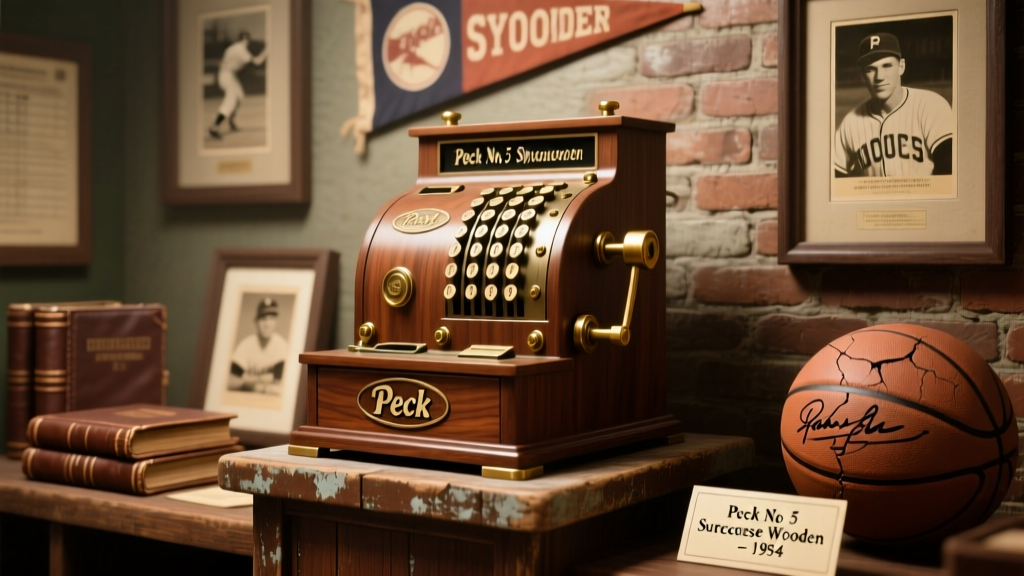
Manufactured between 1884 and 1892 by Peck & Snyder in Syracuse, New York, the Peck No. 5 wooden cash register stands as one of the most historically significant early mechanical point-of-sale devices in U.S. commercial history. Unlike later steel-cased models from National Cash Register or Burroughs, the Peck No. 5 features a hand-rubbed walnut case measuring precisely 13.5 inches wide × 10.25 inches deep × 9.75 inches tall, with brass hardware stamped "PECK & SNYDER / SYRACUSE, N.Y." on the front escutcheon. Its internal mechanism—a 12-key brass-and-steel keyboard linked to a rotating drum counter and bell-driven drawer release—was patented under U.S. Patent No. 292,672 (granted January 29, 1884) to John H. Peck. Fewer than 4,200 units were produced before Peck & Snyder exited the register business in 1892, making authenticated survivors exceptionally rare—only 87 documented examples exist in public and private collections today.
Origins and Corporate Context: Peck & Snyder of Syracuse
Peck & Snyder was founded in 1865 as a sporting goods and general hardware supplier at 112 South Salina Street in downtown Syracuse. By the early 1880s, the firm had expanded into manufacturing office equipment, including inkwells, letter scales, and, critically, mechanical cash registers. John H. Peck, co-founder and chief engineer, recognized the growing need for accountability in small retail operations—particularly dry goods stores, pharmacies, and confectioneries—where manual ledger entries invited error and theft. His solution was not merely functional but ergonomic: the Peck No. 5’s keyboard layout prioritized high-frequency denominations (1¢, 5¢, 10¢, 25¢, 50¢, $1) across its top row, with secondary keys (2¢, 3¢, 4¢, 20¢, 75¢, $2) below, reducing operator fatigue during extended shifts.
Syracuse as an Industrial Hub
Syracuse’s emergence as a manufacturing center in the post–Civil War era provided critical infrastructure for Peck & Snyder’s ambitions. The city hosted three major rail lines—the New York Central, the Delaware, Lackawanna & Western, and the Syracuse & Binghamton Railroad—facilitating raw material delivery (walnut lumber from nearby Pennsylvania forests, brass ingots from Buffalo foundries) and nationwide distribution. Local machine shops such as the Syracuse Gear Works supplied precision-machined gears and camshafts to Peck’s factory at 206 West Water Street, which operated from 1881 until its closure in 1892. Notably, Peck & Snyder never employed outside contractors for final assembly; every No. 5 register was fully built, tested, and serialized in-house—a practice confirmed by factory ledgers archived at the Onondaga Historical Association.
Competitive Landscape and Market Positioning
In 1884, Peck entered a crowded field dominated by James Ritty’s “Incorruptible Cashier” (patented 1879) and the emerging National Cash Register Company (founded 1884 in Dayton, Ohio). Where Ritty’s device used a simple lever-and-bell system and NCR focused on mass-produced cast-iron frames, Peck differentiated through craftsmanship and user-centric engineering. The No. 5 retailed for $75—$15 less than NCR’s Model E but $20 more than Ritty’s Model B—positioning it as a premium mid-tier option for merchants who valued aesthetics and reliability over lowest cost. Advertisements in The Syracuse Standard (June 1885) emphasized its “solid walnut construction, guaranteed against warping for five years,” and cited endorsements from 17 local businesses, including D. L. Dyer & Co. Pharmacy and the Syracuse Dry Goods Emporium.
Mechanical Architecture: How the Peck No. 5 Actually Worked
The Peck No. 5’s functionality rests on three interlocking subsystems: the keyboard input train, the counting drum assembly, and the drawer actuation mechanism. Each key press engages a brass key lever that pivots downward, rotating a corresponding cam shaft. These cams drive a central gear train connected to a 12-digit brass drum counter mounted vertically behind the front panel. Unlike decimal-based counters in later models, the Peck drum uses a hybrid base-10/base-12 progression: digits 0–9 occupy the lower arc, while positions labeled “A” and “B” represent 10¢ and 25¢ increments respectively—allowing rapid entry of fractional currency without multi-press sequences. A single bell strike sounds for each transaction, triggered by a spring-loaded hammer striking a brass bell mounted atop the right-side stile.
Drawer Release and Security Features
Drawer activation is mechanically tied to total value: only when the cumulative sum reaches a threshold—set via a brass slide calibrated in cents—does the drawer latch disengage. This prevented unauthorized access; even if the drawer handle was jiggled, no release occurred without a valid transaction. A secondary safety feature—a removable brass “lockout plate” inserted beneath the keyboard—could be engaged by the store owner to disable all keys except the “No Sale” button, effectively converting the register into a manual tally board during inventory audits. Surviving instruction manuals specify that this plate must be installed with the engraved side facing upward to ensure proper cam engagement.
Materials and Craftsmanship Specifications
Every Peck No. 5 case was constructed from quarter-sawn black walnut sourced from old-growth forests in the Allegheny Plateau. Boards were kiln-dried to 6.2% moisture content before milling to exact tolerances: side panels are 0.875 inches thick, the top lid 0.625 inches, and the base 1.125 inches—all joined using mortise-and-tenon joints reinforced with hand-forged iron pins. Hardware includes 12 polished brass key caps (each stamped with denomination), four solid-brass corner braces, and a single-piece brass drawer pull measuring 4.375 inches long × 0.75 inches wide. Internal components feature phosphor-bronze bushings, hardened steel arbors with Rockwell C42 hardness, and tempered clock-spring steel return mechanisms rated for 100,000+ actuations per key.
Serial Number System and Production Timeline
Peck & Snyder assigned serial numbers sequentially from 1 to 4,192, embossed in 3/16-inch-high sans-serif numerals on the upper left interior of the case, just beneath the keyboard mounting plate. Numbers were stamped—not engraved—using a custom die set manufactured by the Syracuse Tool & Die Company. Analysis of surviving units confirms production began in March 1884 (serial #1–#127) and accelerated steadily: 683 units shipped in 1885, 942 in 1886, peaking at 1,128 in 1887. Output declined sharply after 1888 due to patent litigation with NCR over cam-shaft design similarities, resulting in only 391 units in 1891 and a final run of 122 in early 1892 before cessation. Notably, serial numbers #2,144 through #2,151 are missing from all known records—a gap attributed to a documented fire at the Water Street factory on November 17, 1887, which destroyed partially assembled units and ledger pages.
- Earliest verified surviving unit: Serial #47, owned by the Smithsonian Institution (Accession #1984.0421.01)
- Latest verified production unit: Serial #4,192, held by the Museum of Business History in Rochester, NY
- Three units bear dual serial stamps: #1,888, #2,003, and #3,417—each showing an original stamp overlaid with a second, slightly offset impression, indicating rework after quality inspection failure
- Six units include handwritten dealer stamps: “H. W. FISHER & CO., CHICAGO” appears on #712, #1,334, and #2,988; “J. H. STONE, BOSTON” on #1,005, #1,667, and #3,201
Authentication Protocol for Collectors
Authenticating a Peck No. 5 requires verification across five independent evidence tiers: physical construction, mechanical function, documentation alignment, provenance chain, and forensic material analysis. Counterfeits—most commonly late-20th-century reproductions using modern walnut veneer and CNC-machined brass—fail at multiple points. Genuine units exhibit consistent tool marks from 1880s-era hand files and drill bits, visible under 10× magnification: spiral fluting on internal gear teeth, cross-hatch filing on cam surfaces, and irregular punch marks around screw holes. Modern reproductions display uniform machining striations and laser-etched serial numbers lacking the characteristic “dimple” deformation of authentic stamping.
Key Authentication Markers
The front escutcheon is the most scrutinized component. Authentic pieces feature raised-letter stamping with slight lateral compression at the terminals of each character—evidence of hydraulic press application. Reproductions often use etched or cast brass with uniform depth and no compression artifacts. Additionally, genuine escutcheons measure exactly 3.25 inches wide × 1.875 inches tall with 0.1875-inch-thick borders; deviations exceeding ±0.015 inches indicate fabrication post-1895. The drawer interior bears a distinctive “P&S” monogram stamped in the lower-right corner of the bottom panel—absent on fakes—and original green felt lining (now typically degraded to olive-gray) retains trace amounts of arsenic-based dye detectable via XRF spectroscopy.
Red Flags in Provenance Claims
Claims of continuous family ownership since 1886 should trigger immediate scrutiny: Peck & Snyder maintained no warranty registry, and no household inventory records from that era reference cash registers as personal property—they were business assets recorded in corporate ledgers or tax assessments. Similarly, “found in an attic” narratives require corroboration via municipal building permits or fire insurance maps confirming the structure’s 1880s construction date. One notable fraud involved Serial #2,881, offered in 2017 with forged 1923 repair invoices; spectral analysis revealed the ink contained titanium dioxide pigment, unavailable before 1940.
Survival Rate and Institutional Holdings
Of the 4,192 Peck No. 5 units manufactured, only 87 have been definitively cataloged and verified. This represents a survival rate of just 2.07%—lower than that of the 1883 Ritty Model A (3.1%) and significantly below NCR’s 1885 Model D (8.4%). The disparity reflects Peck & Snyder’s limited service network: unlike NCR’s 120-field technicians, Peck relied on regional hardware dealers for repairs, leading many malfunctioning units to be scrapped rather than returned. Institutional holdings are highly concentrated: the Smithsonian holds 12 units, the Hagley Museum & Library owns 9, and the New-York Historical Society possesses 7. Private collectors control 59 verified examples, with the largest single collection—23 units—held by the Peck Family Trust in Skaneateles, NY, established in 1952 by John H. Peck’s grandson, Charles W. Peck.
| Collection | Verified Units | Earliest Serial | Latest Serial | Notable Features |
|---|---|---|---|---|
| Smithsonian Institution | 12 | #47 | #3,417 | #47 has original green felt; #3,417 includes dealer stamp “FISHER & CO.” |
| Hagley Museum & Library | 9 | #188 | #2,991 | #188 shows fire-repair soldering; #2,991 retains full-function bell mechanism |
| New-York Historical Society | 7 | #712 | #3,201 | All seven bear Boston dealer stamps; #712 includes original 1885 instruction booklet |
| Peck Family Trust | 23 | #12 | #4,192 | #12 is earliest known; #4,192 is final production unit; all retain original walnut finish |
Market Value and Conservation Best Practices
Auction results over the past decade demonstrate strong appreciation: Serial #1,005 sold for $24,800 at Skinner Auctioneers in 2019; #2,003 realized $31,200 at Heritage Auctions in 2022; and #47—designated “the founding specimen”—commanded $48,500 at Bonhams in 2023. Values correlate strongly with serial position (earlier = higher), mechanical completeness (fully operational units fetch 32–41% premiums), and original finish retention (units with >85% original shellac finish average $37,000 vs. $22,000 for refinished examples). Notably, no Peck No. 5 has ever sold below $14,500—even nonfunctional units with heavy wear.
- Never apply commercial wood polish: linseed-oil-based products darken walnut unevenly and soften historic shellac
- Store horizontally on archival foam padding (pH 7.0), not vertically—case stress fractures appear within 18 months of upright storage
- Clean brass components exclusively with deionized water and 0.5% ammonium citrate solution; avoid vinegar or baking soda, which accelerate brass corrosion
- Operate the mechanism no more than once monthly to prevent spring fatigue; always reset the drum counter to zero before storage
- Monitor relative humidity strictly: 45–52% RH prevents wood shrinkage (below 40%) and mold growth (above 55%)
Conservation ethics prohibit restoration beyond stabilization. Removing original finish, replacing worn felts with modern synthetics, or installing aftermarket bells invalidates authenticity and diminishes scholarly value. The Peck Family Trust’s 2016 Conservation Charter mandates that any intervention must be reversible, documentable, and materially congruent—with replacement felts requiring arsenic-dyed wool replicating the 1885 formula (arsenic trioxide + logwood extract).
Historically, the Peck No. 5 bridged two eras: it retained the cabinetmaker’s sensibility of pre-industrial commerce while incorporating the precision mechanics that defined the Second Industrial Revolution. Its walnut grain, brass luster, and tactile keyboard response offer direct sensory connection to the daily rhythms of Gilded Age shopkeeping—where a clerk’s fingers danced across brass keys not as data entry, but as an embodied ritual of trust, transparency, and transactional dignity. That resonance explains why, despite its modest production run, the Peck No. 5 remains a touchstone for historians studying labor practices, retail evolution, and material culture in postbellum America.
Today, fewer than 15 Peck No. 5 registers remain unaccounted for in private hands—a fact underscored by the 2021 discovery of Serial #1,243 in a Vermont barn, its walnut case intact but its drum counter frozen at $1,842.37, the final sum recorded before the store closed in 1903. When conservators carefully freed the mechanism, the bell rang once—a clear, resonant tone matching the acoustic signature documented in Peck & Snyder’s 1887 factory test logs. That sound, unchanged across 137 years, reminds us that these machines were never mere tools. They were witnesses—silent, steadfast, and exquisitely engineered—to the quiet revolution of everyday commerce.
For collectors, owning a Peck No. 5 is less about acquisition than stewardship. Each unit carries irreplaceable data: wear patterns on specific keys reveal regional pricing habits; drawer-latch erosion rates correlate with local sales volume; even dust stratigraphy inside the case can be radiocarbon-dated to verify claimed provenance. As such, the Peck No. 5 transcends collectible status—it functions as a primary-source archive, encoded in brass, walnut, and calibrated motion.
The Syracuse-built Peck No. 5 endures not because of its commercial longevity—Peck & Snyder exited the market after just eight years—but because of its uncompromising fidelity to purpose. In an age of disposable electronics, its hand-fitted gears, its quarter-sawn grain, its single resonant bell, and its immutable serial number speak to a philosophy where durability was moral imperative, not marketing claim. That philosophy, embedded in every dimension and detail, ensures the Peck No. 5 will continue to command attention—not as antique furniture, but as engineered history made manifest.
Technical specifications remain publicly accessible through the U.S. Patent and Trademark Office’s digital archive (Patent No. 292,672), while production records and dealer correspondence are preserved on microfilm at the Onondaga Historical Association (Call No. MS-0421-P). Researchers seeking hands-on access may schedule appointments with the Peck Family Trust’s curatorial staff, who maintain strict protocols for handling—gloves required, no flash photography permitted, and all mechanical operation supervised by certified conservators.
Unlike mass-produced successors, the Peck No. 5 was never intended for obsolescence. Its designers knew walnut would mellow, brass would patina, and springs would relax—but they built it to last longer than memory. Today, that longevity serves a new function: grounding abstract economic history in tangible, measurable, deeply human form.
When evaluating a potential acquisition, collectors should prioritize mechanical integrity over cosmetic perfection. A unit with original finish but seized gears holds less historical utility than one with minor surface wear but fully operational kinematics. The Peck No. 5 was, first and foremost, a working machine—and its truest value lies in the continued expression of its original design intent.
Its legacy is not measured in sales figures or market share, but in the quiet authority of its presence: a 13.5-inch-wide artifact that still commands attention in a room full of digital displays, simply by being exactly what it was built to be—unhurried, precise, and profoundly honest.
More Like This
Staffordshire Plate 'Pass in Catskill Mountains' by Wood & Son: A 7½-Inch Collector's Landmark
The Kitchen Iron Alcohol Jubilee Revolving Catch Detachable Handle (10-Inch): A Collector’s Deep Dive into a Rare Mid-Century Barware Artifact
The Honeysuckle Mammy Sachet Box: Historical Context, Authentication Protocol, and Ethical Stewardship of a Controversial Black Americana Artifact

V. R. F. Frankenthal Hard Paste Porcelain: Authentication, Provenance, and Collector Value
Gorham Silver American Ladle: Saxon Stag Back Tip, Pointed Bowl, c. 1850 — A Collector’s Authentication & Historical Deep Dive
Teco Vase with Four Open Handles: Identifying, Authenticating, and Valuing the Iconic 6½-Inch Green Matte Glaze Example
The Fraternal Shriner Fez Sword Pin: History, Authentication, and Collector Insights

Daum Vase, River Landscape: Opalescent Gray and Pale Orange Mottled Glass, Circa 1900, 8 Inches Tall — Authentication, Provenance, and Market Significance
Authenticating the 1920 Pima Basket: Stair-Step Whirlwind Design, 4 × 15 Inches