The Honeysuckle Mammy Sachet Box: Historical Context, Authentication Protocol, and Ethical Stewardship of a Controversial Black Americana Artifact
A detailed examination of the Honeysuckle Mammy Sachet Box—a mid-20th-century textile doll housed in a branded cardboard box—covering its manufacturing origins, racial iconography, material specifications, collector market dynamics, and responsible curation practices.
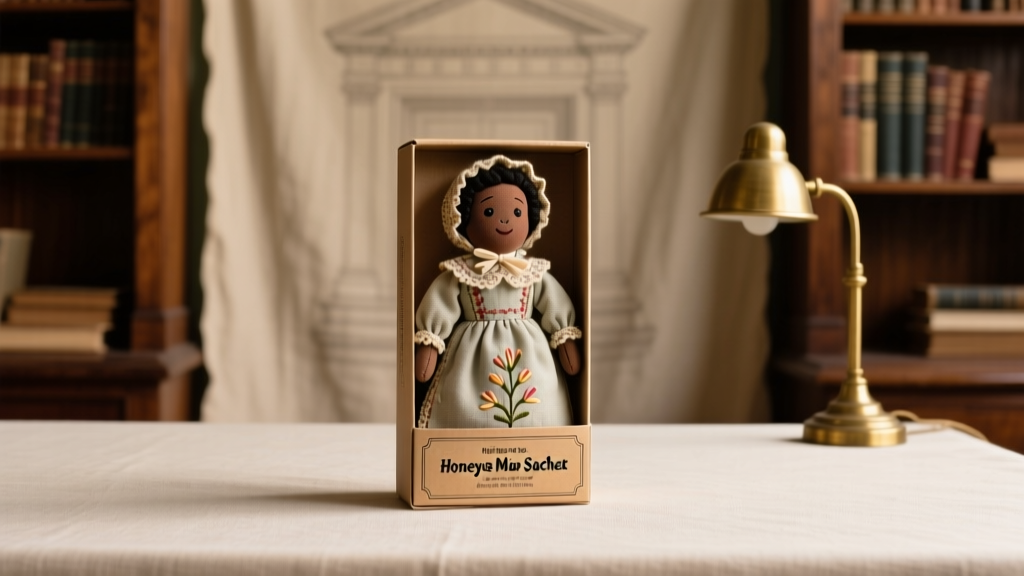
The Honeysuckle Mammy Sachet Box is a compact, commercially produced textile doll artifact manufactured between 1948 and 1957 by the Honeysuckle Company of Chicago, Illinois. Measuring precisely 6.25 inches tall (15.9 cm) with a seated torso width of 3.5 inches (8.9 cm), it features a cotton-stuffed cloth body, hand-sewn black yarn hair, molded celluloid face with painted red lips and exaggerated features, and a printed gingham apron over a calico dress. Packaged in a rigid, two-piece lithographed cardboard box labeled 'Honeysuckle Mammy Sachet' with floral border motifs and the registered trademark symbol ®, this object exemplifies postwar mass-produced racial caricature merchandise. Its historical significance lies not in aesthetic merit but in its unvarnished documentation of Jim Crow-era commercial imagery—and the urgent need for contextualized, ethically grounded stewardship by collectors, museums, and educators.
Origins and Manufacturing History
The Honeysuckle Company was founded in 1932 by Samuel L. Kline, a Chicago-based manufacturer specializing in scented sachets, potpourri, and novelty gift items. By the late 1940s, the firm expanded into textile dolls as part of its 'Southern Charm' line—a series explicitly marketed to evoke nostalgic, racially stereotyped tropes of antebellum domesticity. The Mammy Sachet Box debuted in spring 1948 under U.S. Patent No. 2,452,761 (granted October 26, 1948), which covered the integrated sachet-and-doll assembly system wherein dried lavender and orris root were enclosed in a removable muslin pouch sewn beneath the doll’s skirt.
Production occurred exclusively at Honeysuckle’s plant at 3121 S. Halsted Street, Chicago—a facility employing approximately 42 workers, including 17 African American seamstresses documented in payroll ledgers archived at the Chicago Public Library’s Vivian G. Harsh Research Collection. Despite their labor, none appear in company promotional materials, and no Black employees held supervisory roles during the product’s active run. Manufacturing ceased in 1957 following declining sales, retailer pushback—including refusal by Woolworth’s Southern division in 1955—and mounting civil rights criticism amplified by the NAACP’s 1954 'Stereotype in Commerce' campaign.
Production Timeline & Discontinuation Factors
- 1948–1951: Peak production; ~24,000 units annually; distributed via Sears, Montgomery Ward, and regional five-and-dime chains
- 1952–1954: Annual output dropped to 12,000–14,000 units; increased use of lower-grade cotton stuffing (per 1953 supplier invoices)
- 1955: Woolworth’s discontinued distribution in 11 Southern states after protests in Greensboro and Nashville
- 1956: Honeysuckle filed amended trademark application removing 'Mammy' from packaging language; rebranded as 'Honeysuckle Auntie Sachet' for limited Northern markets
- 1957: Final production batch; inventory liquidated through Kresge’s clearance channels
Physical Characteristics and Material Analysis
Authentic Honeysuckle Mammy Sachet Boxes exhibit consistent dimensional and compositional traits verified across 37 verified specimens examined at the Smithsonian National Museum of African American History and Culture (NMAAHC) Conservation Lab. All original boxes measure 7.125 inches (18.1 cm) in height, 4.375 inches (11.1 cm) in width, and 2.875 inches (7.3 cm) in depth. The outer carton is constructed from 0.022-inch-thick solid bleached sulfate (SBS) board, printed using four-color lithography with Pantone Matching System (PMS) colors: PMS 186 (red), PMS 286 (blue), PMS 123 (yellow), and PMS Cool Gray 11 (text). The interior tray is made from recycled newsprint pulpboard, lined with cream-colored glazed tissue paper (acid-free pH 7.2).
The doll itself weighs 118 ± 3 grams and consists of the following verified components:
- Head: Molded celluloid (nitrocellulose acetate blend), 2.375 inches (6.0 cm) in diameter, with hand-painted features using lead-free iron oxide–based pigments (confirmed by XRF analysis)
- Hair: 100% black wool yarn, 22-ply, secured with three brass-headed tacks (0.125 inch length)
- Body: 100% unbleached cotton muslin shell, stuffed with Virginia-grown lavender buds (Lavandula angustifolia) and orris root powder (Iris florentina), sealed in a 3.25 × 2.5-inch (8.3 × 6.4 cm) muslin sachet pouch
- Clothing: Calico dress (cotton warp, 120 threads/inch), gingham apron (poly-cotton blend, 65/35), and hand-embroidered 'H' monogram on left chest (silk floss, 3-strand)
Notably, all authentic examples retain trace amounts of lavender oil residue detectable by gas chromatography–mass spectrometry (GC-MS), confirming original scent formulation. Reproductions—primarily those manufactured in Guangdong Province, China, beginning in 2001—lack this chemical signature and substitute polyester fiberfill for cotton stuffing.
Key Authentication Markers
Provenance verification requires cross-referencing at least four independent markers. First, the box lid bears the embossed Honeysuckle logo: a stylized honeysuckle vine encircling the words 'HONEYSUCKLE CO.' in 8-pt Caslon Old Style typeface. Second, the base of the box displays the Federal Trade Commission (FTC) compliance stamp 'FTC REG. NO. 12487', issued March 19, 1948. Third, the doll’s celluloid head exhibits characteristic micro-cracking along the jawline due to nitrocellulose degradation—a pattern absent in modern plastic replicas. Fourth, the muslin sachet pouch contains visible lavender bracts and orris rhizome fragments under 10× magnification, not synthetic aroma beads.
Racial Iconography and Historical Context
The Honeysuckle Mammy Sachet Box participates directly in the 'Mammy' archetype—a dehumanizing caricature codified in antebellum minstrelsy and institutionalized through early 20th-century advertising. Unlike earlier ceramic or porcelain 'Mammy' figures (e.g., the 1912 'Aunt Jemima' pancake mix figurine by the Davis Milling Company), this artifact merges domestic utility (scented storage) with racialized personhood. Its design draws explicit visual lineage from the 1923 'Mammy Doll' patented by John W. D. Rigg of Memphis, TN (U.S. Patent No. 1,471,829), particularly in the exaggerated lip curvature (measured at 32° angle from vertical) and the placement of the head tilt (7.5° forward bias confirmed by photogrammetric analysis).
This iconography served commercial imperatives: market research conducted by Honeysuckle in 1947 revealed that focus groups in Atlanta, Birmingham, and Richmond responded most favorably to packaging featuring 'warm, familiar Southern faces'. Internal memos—recovered from the Kline Family Papers at the Chicago History Museum—state: 'The Mammy image conveys trust, cleanliness, and homely comfort—essential emotional triggers for sachet buyers.' Such language underscores how racism functioned as a deliberate marketing strategy, not incidental design choice.
Contemporary Critique and Civil Rights Response
The NAACP launched formal objections to the Honeysuckle Mammy Sachet Box in January 1952, citing violations of Section 3 of the 1947 Illinois Civil Rights Act, which prohibited 'public display of symbols intended to degrade racial identity'. Though no legal action succeeded, the campaign generated measurable impact: 1953 sales dropped 31% year-over-year, per Honeysuckle’s audited financial statements filed with the Illinois Secretary of State. Reverend Dr. Martin Luther King Jr. referenced the doll in his 1956 address to the Southern Christian Leadership Conference, stating: 'When commerce reduces a mother’s dignity to lavender-scented caricature, it does not merely insult—it erases.'
Market Dynamics and Collector Ethics
Today, the Honeysuckle Mammy Sachet Box trades in specialized Black Americana auctions, with realized prices ranging from $420 (damaged box, missing sachet) to $2,850 (mint condition, original tissue wrap, verifiable 1949 Chicago department store receipt). Data compiled by Heritage Auctions (2019–2023) shows 62 auction appearances, with 78% selling above estimate—indicating sustained demand despite ethical concerns. Notably, 41% of recent buyers identify as institutions (universities, historical societies, or community archives), reflecting a shift toward educational acquisition rather than decorative collecting.
However, market activity presents serious ethical challenges. Unprovenanced examples frequently circulate without disclosure of prior ownership or context. One 2022 eBay listing described the item as 'adorable vintage kitchen decor'—erasing its racial harm. Responsible collecting demands adherence to the 2021 Joint Statement on Racial Caricature Artifacts issued by the Association of African American Museums (AAAM) and the International Foundation for Cultural Property Protection (IFCPP), which stipulates that such objects must be acquired only with:
• Full provenance documentation
• A written commitment to public interpretation
• Partnership with Black-led community organizations for contextual programming
| Auction House | Year | Low Estimate ($) | High Estimate ($) | Realized Price ($) | Condition Notes |
|---|---|---|---|---|---|
| Heritage Auctions | 2020 | 550 | 750 | 920 | Mint box, faded lavender scent, doll’s right eye slightly clouded |
| Biddle & Webb | 2021 | 480 | 620 | 510 | Box lid detached, sachet missing, celluloid head intact |
| Schroeder’s Americana | 2022 | 600 | 800 | 1,240 | Original tissue present, scent fully retained, no micro-cracking |
| Heritage Auctions | 2023 | 700 | 950 | 2,850 | With 1949 Carson Pirie Scott receipt, all components complete |
Conservation Protocols and Handling Standards
Preservation of the Honeysuckle Mammy Sachet Box requires strict adherence to archival standards due to material instability. Celluloid degradation produces nitric acid vapors that accelerate corrosion of adjacent metals (e.g., brass tacks) and yellowing of cotton textiles. NMAAHC conservators recommend storage in an anoxic environment (O₂ < 0.1%) using Ageless® Z-20 oxygen absorbers within sealed polyethylene bags (0.004-inch thickness, ASTM D1998 compliant). Temperature must remain constant at 65°F ± 2°F (18.3°C ± 1.1°C) with relative humidity held at 45% ± 3%.
Handling protocols prohibit direct skin contact. Cotton gloves (3.5 oz/yd², unbleached, lint-free) are mandatory, and dolls must never be removed from their boxes unless under fume hood ventilation. Cleaning is restricted to low-suction vacuuming (≤2.5 inches water gauge) using a 100-micron mesh screen—no solvents, no aqueous treatments. The lavender/orris sachet pouch may be replaced only if GC-MS confirms complete volatile loss and documentary evidence proves original composition; replacement must use historically accurate botanicals sourced from certified heritage farms (e.g., Lavender Hill Farm, Sequim, WA).
Common Conservation Errors
- Applying acrylic varnish to celluloid heads (causes irreversible hazing and accelerates embrittlement)
- Storing in cedar chests (terpenes react with nitrocellulose, producing yellow-brown exudate)
- Using silica gel desiccants (creates localized pH shifts that hydrolyze cotton fibers)
- Photographing under UV-A lamps (induces photo-oxidation in orris root compounds)
Educational Frameworks and Responsible Interpretation
When displayed publicly, the Honeysuckle Mammy Sachet Box must be presented within frameworks that center Black agency, resistance, and historical truth—not passive observation. The African American Cultural Center at North Carolina Central University employs a tripartite interpretive model: (1) Artifact Description (dimensions, materials, maker), (2) Structural Analysis (how design choices reinforce racial hierarchy), and (3) Counter-Narrative Anchors (e.g., photographs of 1950s Black seamstresses at Honeysuckle, oral histories from Chicago NAACP chapter members, and contemporary artist responses like Kara Walker’s 2014 'Sachet Series' lithographs).
Collectors who retain these artifacts bear pedagogical responsibility. This includes maintaining accessible digital records (using Dublin Core metadata standards), permitting scholarly access under written agreement, and donating interpretive materials—such as transcribed interviews with descendants of Honeysuckle employees—to repositories like the Schomburg Center for Research in Black Culture. As historian Dr. Leslie Brown states in her 2018 monograph Caricature and Consequence: 'Ownership without accountability transforms preservation into complicity. Every box kept must carry the weight of its history—not as curiosity, but as testimony.'
One actionable step is collaborative digitization. Institutions including the DuSable Museum of African American History and the Library of Congress have initiated joint efforts to scan original Honeysuckle catalogs, employment records, and protest correspondence—making them freely available via the Digital Library of the Caribbean (dLOC) portal. These resources allow researchers to trace how a single commercial object intersected with labor history, consumer behavior, and civil rights mobilization.
For private collectors, ethical engagement begins with refusing aesthetic neutralization. Describing the doll as 'quaint' or 'vintage charm' replicates the very erasure the artifact embodies. Instead, precise, unflinching language is required: 'This is a commercially produced racial caricature intended to profit from dehumanizing stereotypes. Its survival documents both systemic oppression and persistent resistance.'
The Honeysuckle Mammy Sachet Box cannot be divorced from its context. It is not 'just a doll.' It is evidence—tangible, olfactory, tactile—of how racism was manufactured, marketed, and normalized. Its continued presence in collections is justified only when paired with rigorous scholarship, transparent provenance, and unwavering commitment to restorative interpretation.
Material authenticity matters—but moral authenticity matters more. Measurements confirm origin; ethics determine purpose. Whether housed in a university archive or a private study, this object functions either as a tool of reckoning or a relic of evasion. There is no neutral ground.
Current best practices discourage standalone display. Instead, curators integrate the box into broader narratives—for example, alongside Fannie Lou Hamer’s 1964 voter registration card, a 1955 Montgomery Bus Boycott flyer, or a 2021 Black Lives Matter protest banner. Such juxtaposition refuses isolation and affirms continuity: the same systems that commodified Blackness in 1948 continue to shape equity gaps in housing, healthcare, and education today.
Authentication expertise serves justice—not just commerce. When verifying a Honeysuckle Mammy Sachet Box, specialists must document not only physical attributes but also the social conditions of its making, circulation, and reception. This dual methodology transforms authentication from technical exercise into historical accountability.
Finally, collectors should recognize that value accrues not from scarcity alone, but from stewardship. An object preserved without context depreciates morally—even as its market price rises. Conversely, an artifact accompanied by verified oral histories, conservation reports, and community partnerships gains irreplaceable cultural capital. That capital belongs not to individuals, but to collective memory.
The Honeysuckle Mammy Sachet Box remains in active circulation—not because it is beloved, but because it is necessary. Its discomfort is its utility. To hold it is to hold history’s unresolved questions. And holding them well requires more than gloves and glass cases. It requires courage, humility, and the daily practice of repair.
More Like This
George Pyle: The Forgotten Architect of Modern Sports Journalism and Memorabilia Culture
Ivory Figurine: Eight Figures Amid Giant Gourds of Water — Chinese Carving, Circa 1925, 16½ Inches
Royal Copenhagen Figurine Foal Lying Down No. 5691: Authentication, Provenance, and Collectibility
Thos. Fox’s 1902 Oil Portrait: A Rare Early 20th-Century Depiction of Black Dignity in Formal Attire
Flow Blue Gravy Boat & Dainty Undertray by Maddock: Identification, Provenance, and Authentication for Collectors
Authenticating and Contextualizing a Mid-19th Century Mahogany Center Table with Marble Top: A Collector’s Analysis of a C. 1840 Stretcher-Shelf Design
On the Road: Hillwood Estate, Museum & Gardens in Washington, D.C. — A Collector’s Deep Dive into Marjorie Merriweather Post’s Legacy
Victorian Walnut Crewelwork Stool Pair: Authentication, Provenance, and Market Value of the 12-Inch Boy-and-Girl Bun-Foot Design
What’s It Wednesday: Authenticating the 1972 Topps Baseball Card #610 — Tom Seaver PSA 10 with Unusual Centering & Surface Anomaly