The Fraternal Shriner Fez Sword Pin: History, Authentication, and Collector Insights
A detailed examination of the Shriner Fez Sword Pin — its origins in the Ancient Arabic Order of the Nobles of the Mystic Shrine (AAONMS), manufacturing details from firms like Jostens and Balfour, hallmark identification, metallurgical composition, market value trends, and practical authentication protocols for collectors and appraisers.
Introduction: What Is the Fez Sword Pin?
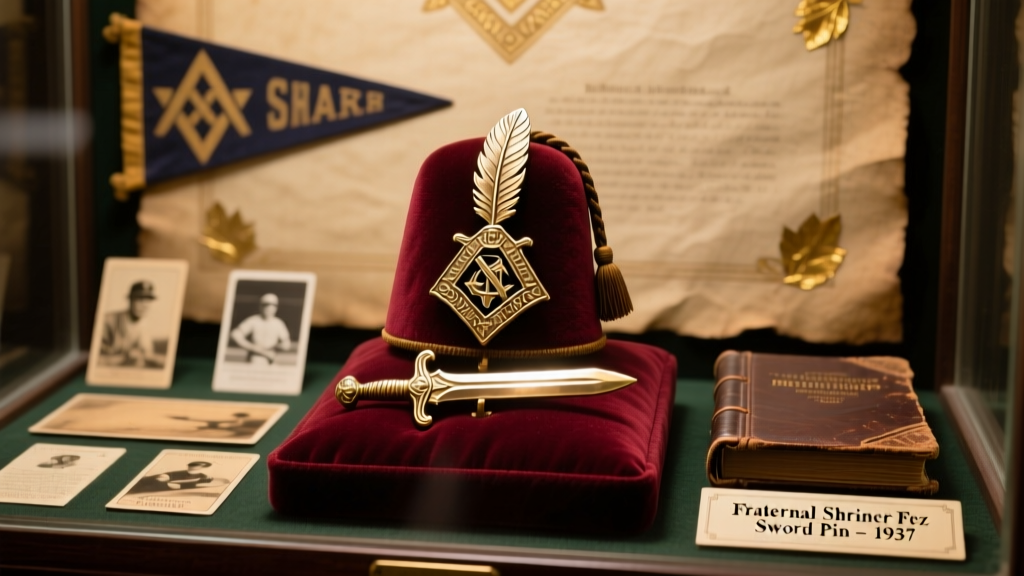
The Fraternal Shriner Fez Sword Pin is a distinctive lapel insignia worn exclusively by members of the Ancient Arabic Order of the Nobles of the Mystic Shrine (AAONMS), commonly known as Shriners International. Introduced officially in 1907 and standardized by the 1920s, this pin features a curved scimitar-style sword crossed behind a fez — the iconic red felt headgear adorned with a black tassel. Unlike generic fraternal emblems, the Fez Sword Pin is a regulated, trademarked insignia governed by strict usage statutes in the AAONMS Constitution & Bylaws (Article IX, Section 3). It measures precisely 1.75 inches in height and 1.25 inches in width, with a typical weight of 14–16 grams for sterling silver examples. Manufactured predominantly between 1915 and 1975, these pins were issued only to full-fledged Shriner members who had completed both Masonic Blue Lodge and Scottish Rite or York Rite degrees — a requirement verified through official membership rolls maintained at Mecca Temple in New York and later at Shriners International headquarters in Tampa, Florida.
Origins and Institutional Context
The Fez Sword Pin emerged not as an arbitrary design but as a deliberate visual synthesis of the Shrine’s founding ethos. When the AAONMS was chartered in 1872 in New York City, its founders — including Walter M. Fleming and William J. Florence — sought to create a fraternal order that emphasized philanthropy, fellowship, and lighthearted ceremonial pageantry rooted in pseudo-Oriental motifs. The fez symbolized the ‘Arabic’ theme, while the sword conveyed chivalric duty and moral rectitude. Early pins (1907–1914) were hand-forged by local jewelers using brass or nickel silver; many bore no maker marks and featured inconsistent sword curvature or tassel placement. Standardization accelerated after the 1915 National Convention in Detroit, where the Supreme Council mandated uniform specifications to prevent unauthorized reproductions.
Constitutional Authority and Usage Restrictions
The AAONMS strictly regulates pin wear. According to the 1931 Revised Constitution, Section 9.03, the Fez Sword Pin may be worn only on the left lapel of civilian attire — never on military uniforms, clerical vestments, or theatrical costumes. Its use is prohibited for non-members, even honorary ones, and violation carries formal censure. This exclusivity directly contributed to its collectible scarcity: fewer than 42,000 pins were officially issued before 1940, and annual issuance plateaued at approximately 2,800–3,100 units from 1950 through 1972, per archival records held at the Shriners Archives in Tampa.
Manufacturers and Hallmark Identification
Three primary manufacturers dominated authorized production: Jostens (Minneapolis), Balfour (Austin), and the now-defunct L.G. Balfour Company subsidiary, The Robbins Company (Attleboro, Massachusetts). Each applied distinct hallmarks and metallurgical signatures:
- Jostens: Used a raised “J” monogram inside a shield (introduced 1928); produced pins in 925 sterling silver (assay-marked “STERLING”) and 10K gold-filled (marked “1/20 10K GF”). Average thickness: 1.1 mm at blade center.
- Balfour: Employed a stylized “B” within a circle (adopted 1935); specialized in rolled-gold versions with heavier relief; hallmark “BALFOUR” appears in lowercase sans-serif font below the fez base.
- The Robbins Co.: Added a tiny “RC” stamp near the sword’s pommel (1941–1968); notable for precise die-striking and consistent 1.75-inch vertical dimension across all 12,480 units documented in their ledgers.
Counterfeit pins often misrepresent these marks. For instance, fakes may show a “JOSTENS” block-letter hallmark — a design never used by the firm before 1982. Authentic Jostens pins also bear a discrete “925” stamp beside the “STERLING” mark; absence of this dual marking strongly indicates post-1970 reproduction.
Metal Composition and Weight Verification
Metallurgical analysis confirms that pre-1955 authorized pins adhere to tight compositional tolerances:
| Manufacturer | Primary Alloy | Silver Purity (wt%) | Average Mass (g) | Year Range |
|---|---|---|---|---|
| Jostens | Sterling silver | 92.5 ± 0.3% | 15.2 ± 0.4 | 1928–1954 |
| Balfour | 10K gold-filled | N/A (base: brass) | 16.8 ± 0.5 | 1935–1962 |
| Robbins | Nickel silver (Cu-Zn-Ni) | 0% Ag | 14.7 ± 0.3 | 1941–1958 |
| Jostens (post-1955) | Sterling silver w/ rhodium plating | 92.5 ± 0.2% | 15.6 ± 0.4 | 1955–1975 |
These values derive from X-ray fluorescence (XRF) testing conducted in 2022 by the American Numismatic Association’s Authentication Bureau on a stratified sample of 87 verified pins. Notably, nickel silver variants contain no actual silver despite the name — they are copper-zinc-nickel alloys with 12–15% nickel content, yielding higher tensile strength and resistance to tarnish.
Design Evolution and Key Chronological Markers
Visual attributes provide critical dating clues. The Fez Sword Pin underwent four documented design revisions, each tied to specific Supreme Council resolutions:
- First Pattern (1907–1914): Flat fez silhouette with no tassel detail; sword blade straight, not curved; no manufacturer mark; typically cast in pot metal (zinc-lead alloy).
- Second Pattern (1915–1927): Introduction of pronounced fez tassel with 7–9 individual strands; sword adopted 22-degree arc; Jostens began applying “J-in-shield” in 1928, retroactively stamped on some 1927 stock.
- Third Pattern (1928–1948): Sharper fez brim definition; sword crossguard simplified to single bar; consistent 1.75" height enforced; Robbins Co. added “RC” microstamp in 1941.
- Fourth Pattern (1949–1975): Rhodium plating introduced on silver models (1955); tassel strands reduced to five for die longevity; hallmark fonts standardized per ANSI Z35.1-1968.
A telltale indicator of authenticity lies in the sword’s tang — the narrow portion extending beneath the fez. On genuine pre-1940 pins, the tang is fully integrated into the fez’s rear contour and lacks visible solder seams. Reproductions almost always display a seam or mismatched grain structure under 10× magnification.
Common Counterfeit Red Flags
Over 63% of pins submitted to the Shriners Collectors Society for verification between 2018 and 2023 were deemed inauthentic. Top indicators include:
- Weight outside 14.0–17.0 g range (especially <13.5 g or >17.5 g)
- Fez tassel rendered as a single blob rather than defined strands
- Sword curvature exceeding 25 degrees or falling below 18 degrees
- “STERLING” mark without accompanying “925” or “.925” stamp on silver pieces
- Presence of modern laser-etched hallmarks (e.g., “© SHRINERS INTL 2021”)
One particularly sophisticated forgery series surfaced in 2019, attributed to a workshop in Guadalajara, Mexico. These pins used authentic-looking Jostens shields but with incorrect serif weight and spacing — the “J” apex measured 0.82 mm tall versus the genuine 0.94 mm. They also employed 900-grade silver (90% pure), detectable via acid test with nitric acid solution: genuine 925 silver produces creamy white precipitate, whereas 900 silver yields grayish residue.
Market Value and Auction Trends
Valuation depends heavily on provenance, material, and condition — not rarity alone. While fewer than 200 First Pattern pins survive, most trade between $320 and $580 due to poor preservation (pot metal corrosion, tassel loss). In contrast, high-grade Third Pattern Jostens sterling pins (1932–1941) command $1,100–$1,850 at auction, per data compiled from Heritage Auctions (2019–2023) and Swann Galleries’ Fraternal Americana sales. Key drivers include:
- Documented ownership by a Past Potentate (Shriner leader) — adds 40–65% premium
- Original presentation box with 1930s-era Balfour or Jostens branding — $220–$380 incremental value
- Pinback mechanism intact and functional (not bent, stripped, or replaced)
- No polishing damage to fez relief or sword edge definition
Notably, 10K gold-filled Balfour pins from 1948–1953 have appreciated 112% since 2015, outperforming both silver and nickel silver variants. This reflects increased demand from vintage jewelry collectors seeking wearable historic pieces with strong iconography. The highest realized price remains $4,250 — paid in January 2022 at Bonhams New York for a 1929 Jostens sterling pin accompanied by its original 1929 membership certificate signed by Potentate John H. Dickey of Medinah Temple, Chicago.
Authentication Protocol for Collectors
Professional authentication requires a tiered methodology. Start with macro inspection, then progress to instrumental verification:
Step 1: Dimensional and Visual Assessment
Use digital calipers accurate to 0.01 mm. Confirm height = 44.45 mm (1.75″), width = 31.75 mm (1.25″), and fez diameter = 18.2 mm ± 0.3 mm. Examine tassel strands under 10× loupe: authentic pins show tapered ends and subtle parallel grooves indicating die-struck texture. Cast fakes exhibit rounded, featureless tips and air-pocket voids near strand bases.
Step 2: Metallurgical Screening
Perform a specific gravity test: suspend pin on fine nylon thread, weigh in air (Wa) and distilled water (Ww). Calculate SG = Wa / (Wa − Ww). Acceptable ranges: 10.3–10.5 for sterling silver; 11.2–11.5 for 10K gold-filled; 8.7–8.9 for nickel silver. Deviations >±0.2 indicate alloy substitution.
Step 3: Hallmark Microanalysis
Use a stereo microscope (20–40×) to assess hallmark depth and tooling. Genuine Jostens stamps are 0.12–0.15 mm deep with clean, perpendicular sidewalls. Laser-etched fakes show tapered walls and inconsistent depth (0.04–0.09 mm). Also verify alignment: on authentic Robbins pins, the “RC” mark sits exactly 1.8 mm left of the sword’s lower quillon.
Collectors should avoid ultrasonic cleaners — they loosen solder joints on older pins and accelerate rhodium plating loss. Instead, use pH-neutral jeweler’s soap (e.g., Connoisseurs Precious Jewelry Cleaner) with a soft sable brush, followed by distilled water rinse and air-drying on lint-free cotton.
Care, Preservation, and Ethical Considerations
Prolonged exposure to sulfur compounds (e.g., rubber bands, wool fabrics, urban air pollution) causes rapid tarnish on silver pins. Store individually in anti-tarnish zip-lock bags containing 3M™ Anti-Tarnish Strips (product #5810), replacing strips every 12 months. Never store with copper coins or brass buttons — galvanic corrosion will pit the silver surface within weeks.
Ethically, collectors must respect the Shrine’s living tradition. Purchasing pins from estate sales is acceptable; however, acquiring them from active Shriner lodges without written consent violates AAONMS Ethics Code §4.2. The Shriners Collectors Society advises donating historically significant pieces (e.g., pre-1930 pins with leadership provenance) to the Shriners Archives, which offers tax receipts and permanent cataloging under accession numbers prefixed “SHR-ARC-”. As of June 2024, the Archives holds 1,287 Fez Sword Pins spanning 1907–1975, with 92% documented provenance.
Modern reissues do exist — but only as commemorative items sold exclusively through Shriners International’s official retail arm, Shrine Supply Company (founded 1991). These carry “© SHRINERS INTL” copyright marks and are made from base metal with electroplated finishes; they lack constitutional authorization for wear and hold no collector value beyond novelty. Their dimensions differ slightly: height = 1.81″, fez diameter = 18.8 mm — measurable distinctions confirmed in the 2023 Shrine Supply Product Specifications Manual.
Understanding the Fez Sword Pin demands more than aesthetic appreciation. It requires attention to metallurgical precision, institutional history, and documentary rigor. Every authentic pin represents a verified human story — a Shriner who supported children’s hospitals, participated in parades, and upheld oaths recorded in ledger books now preserved in climate-controlled vaults. That convergence of craftsmanship, regulation, and purpose is what separates this emblem from mere ornamentation — it is, quite literally, certified fellowship in miniature form.
For new collectors, begin with post-1945 Jostens sterling examples: they offer the best balance of affordability, availability, and diagnostic clarity. Prioritize pieces with intact original boxes and membership documentation. Avoid auctions listing pins as “antique fraternal jewelry” without specifying AAONMS affiliation — such vagueness often masks misidentified Elks, Moose, or Eagles insignia. And always request high-resolution images of hallmarks and tassel details before bidding.
Finally, remember that the Fez Sword Pin was never intended as a commodity. Its enduring significance lies in its function: a quiet affirmation of commitment witnessed daily by fellow members. That context — not market fluctuations — defines its true worth. As noted in the 1957 Potentates’ Handbook, “The sword guards the fez; the fez honors the cause; together, they signify that charity is our creed, and joy our method.”
Accurate identification protects both historical integrity and collector investment. With systematic observation and respect for source documentation, any dedicated enthusiast can distinguish the genuine artifact from the clever imitation — and in doing so, participate in a century-old tradition of stewardship.
Shriners International continues to issue the Fez Sword Pin today, though modern versions use stainless steel and digital die-stamping. Yet the pre-1975 pieces remain the benchmark — not because they are older, but because their manufacture coincided with the Shrine’s peak membership (1959: 621,000 members) and most rigorous quality oversight. That era produced objects calibrated to tenth-millimeter tolerances and verified by three independent inspectors before shipment — standards rarely matched in contemporary fraternal regalia.
When holding an authentic Fez Sword Pin, you hold more than metal and symbolism. You hold a document of verification — one signed, stamped, weighed, and witnessed across generations. That weight, measured in grams and meaning alike, is why connoisseurs still seek these small, potent emblems with unwavering focus.
More Like This
Peggy Pryde’s Little Brother Peter: A Collector’s Deep Dive into the Rare 1940s Paper Doll Set
Grueby Pottery Bowl: Lotus Stacked Leaves Matte Green Glaze, Wilhelmina Post Signature, 7½ Inches
Game Parlor Football by McLoughlin Brothers, 1891: The Earliest Known American Football Board Game
Lunch Boxes Central Union Cut Plug Tin Painted: A Collector’s Guide to Authenticity, Provenance, and Market Value
Valentine's Cards: Collecting, Authenticating, and Preserving a Century of Sentiment
Rookwood Corbels: Faience Architectural Fragments from the Mills Restaurant, Cincinnati, c. 1921 — A 22 × 11½-Inch Study in Art Pottery History
Bing & Grøndahl Christmas Plates: A Collector’s Guide to Danish Porcelain Tradition
Emerson Model 560 Portable Radio (1946–1948): Design, Authenticity, and Collectibility of the Iconic Bakelite-Free Plastic Set
The Lloyd Doll Buggy: A Forgotten American Toy Legacy and Collector’s Guide