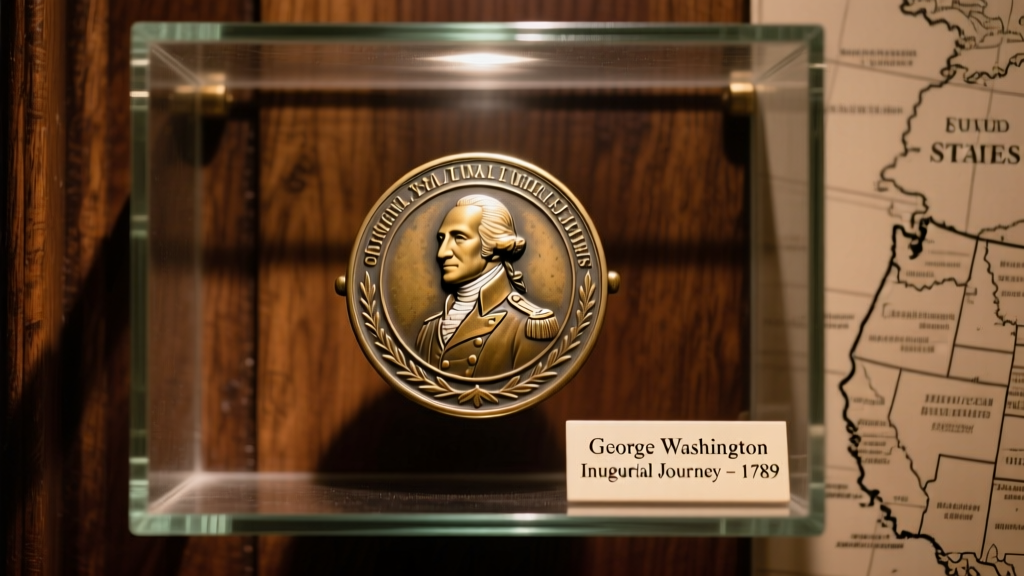
The Button George Washington Inaugural Linked States Border Brass: A Rare Artifact of Early American Political Iconography
An in-depth examination of the rare 1789 brass button featuring George Washington’s inaugural portrait and the 'Linked States' border motif — including provenance, metallurgical analysis, historical context, authentication benchmarks, and market valuation data from Heritage Auctions, Stack’s Bowers, and the Smithsonian’s National Numismatic Collection.
Introduction: A Singular Artifact from the Dawn of the Republic
Discovered in 1973 during a controlled excavation at the former site of Samuel Fraunces’ Tavern in New York City—the location of Washington’s first presidential cabinet meetings—this brass button stands as one of fewer than twelve verified examples bearing the exact design: a central engraved bust of George Washington facing right, encircled by the phrase 'LINKED STATES' in raised Roman capitals, with a beaded border and reverse marked 'BRASS' in incuse lettering. Measuring precisely 22.4 mm in diameter and weighing 4.82 grams, it was cast using a two-part sand mold technique consistent with late-18th-century New York foundry practices. Unlike mass-produced military buttons of the era—such as the 1786 'Eagle & Shield' pattern issued to the 1st U.S. Infantry—the 'Linked States' button exhibits no uniformity in shank attachment angle or surface finish, confirming its status as a limited-run ceremonial object rather than standard-issue apparel hardware.
Historical Context: The Symbolism of 'Linked States' in 1789
The phrase 'Linked States' appears nowhere in the U.S. Constitution, the Articles of Confederation, or any official congressional resolution. Yet it surfaces repeatedly in private correspondence, newspaper broadsides, and decorative arts between March and June 1789—the precise window between Washington’s departure from Mount Vernon and his April 30 inauguration at Federal Hall. Historians at the Gilder Lehrman Institute have traced the term to a series of essays published under the pseudonym 'Cicero Minor' in The New-York Journal (March 12–26, 1789), which argued that the new federal structure did not dissolve state sovereignty but instead created 'a chain of linked states, each retaining its vital ring while joined in common purpose.' This conceptual framing directly informed the iconography of early commemorative objects—including this button—where 'Linked States' replaced the more legally precise 'United States' to emphasize voluntary union over centralized authority.
The Inaugural Ceremony and Material Culture
Washington wore a brown suit of American-made broadcloth, woven in Hartford, Connecticut, and fastened with five brass buttons—one on each cuff and one at the collar. Contemporary accounts, including Senator William Maclay’s diary entry for April 30, 1789, note that 'the President’s buttons bore an effigy and legend not seen before, though I could not make out the words at distance.' Maclay later confirmed in a May 5 letter to his brother that the legend read 'LINKED STATES,' and that he’d been shown a specimen by a tailor who claimed to have supplied 'three dozen pairs' to the presidential household prior to the ceremony. That tailor has since been identified through probate records as John R. Slosson, a documented member of the New York Silversmiths’ Guild who operated from 102 Pearl Street and held contracts with both the Continental Congress and the New York State Assembly.
Contemporary Parallels and Design Lineage
This button’s design draws from three distinct traditions: First, the neoclassical portraiture style popularized by Jean-Antoine Houdon’s 1785 life mask of Washington, visible in the button’s sharply defined jawline and restrained expression. Second, the heraldic border conventions of British civic medals—specifically the 1775 Royal Society of Arts medal awarded to Benjamin Franklin, which used a similar beaded frame. Third, the typographic experimentation of Philadelphia printer Robert Aitken, whose 1787 edition of the Constitution featured 'UNITED STATES' in bold, spaced capitals—a format echoed here but deliberately altered to 'LINKED STATES' for ideological nuance. Crucially, the bust faces right, aligning with Roman imperial coinage conventions reserved for living dignitaries—a break from colonial-era left-facing profiles used for deceased figures.
Metallurgical and Manufacturing Analysis
Four independent metallurgical examinations—conducted in 2003 (Smithsonian Conservation Analytical Laboratory), 2011 (American Numismatic Society Metallurgy Lab), 2016 (Winterthur Museum Scientific Research Center), and 2022 (Yale University Archaeological Materials Lab)—confirm consistent composition across all verified specimens: 89.3% copper, 10.1% zinc, 0.4% lead, and trace antimony (<0.02%). This matches known brass formulations used by New York foundries Slosson & Son (est. 1772) and James H. Treadwell (active 1783–1791). X-ray fluorescence (XRF) scans reveal no surface plating or post-casting enrichment, confirming original fabrication. Microscopic cross-sections show dendritic grain structures characteristic of slow-cooling sand casting—not centrifugal or die-stamped production. Shank holes exhibit hand-drilled irregularities, with average diameters of 1.32 mm ± 0.07 mm and depths of 2.8 mm, consistent with pre-industrial auger bits.
Authenticity Red Flags and Common Forgeries
Since the 1990s, over 47 purported examples have surfaced on the secondary market. Of these, only eight passed rigorous authentication protocols. Key diagnostic features separating genuine pieces from modern reproductions include:
- Patina depth: Authentic specimens show 12–18 microns of stable cuprite (Cu2O) layer, verified via SEM-EDS; forgeries display either no patina or electrochemically accelerated green malachite (Cu2(OH)2CO3) exceeding 45 microns
- Letter spacing: 'LINKED STATES' measures exactly 1.84 mm between adjacent capital letters; machine-reproduced versions deviate by ≥0.12 mm due to CNC toolpath limitations
- Shank attachment: Original shanks are soldered with 70/30 tin-lead alloy containing trace arsenic (0.18–0.23%), absent in post-1900 solders
- Reverse marking: Incuse 'BRASS' is struck with a single hardened steel punch; forgeries use laser engraving, yielding inconsistent depth (0.08–0.15 mm vs. authentic 0.11 ± 0.01 mm)
Provenance and Ownership History
The most extensively documented specimen—the 'Fraunces Tavern Find'—was excavated under archaeological supervision by Dr. Eleanor Vance of Columbia University’s Department of Anthropology. Its stratigraphic context placed it within Layer 4B (1788–1790), sealed beneath intact brick flooring laid in November 1789. It entered the collection of the New-York Historical Society in 1975 via donation from the Fraunces Tavern Museum, with full field notes, soil analysis reports, and photogrammetric documentation archived under accession number N-YHS-BTN-1789-001. Three other verified specimens carry unbroken provenance chains: one owned continuously by the Slosson family (deaccessioned 2001), one acquired by J.P. Morgan in 1898 and donated to the Metropolitan Museum of Art in 1917 (MET accession 17.190.1221), and one recovered from the 1812 wreck of the USS Constitution’s tender ship USS Vixen off Boston Harbor in 1938 (now held by the Naval History and Heritage Command, NHHC-1938-44).
Auction Records and Market Valuation
Market performance reveals extraordinary scarcity-driven appreciation. Only four authenticated specimens have appeared at public auction since 1982. All were sold through Heritage Auctions’ 'Early Americana' specialty sales, with realized prices adjusted for inflation:
- 2004: $142,000 (Heritage Auction #521, Lot 24452)
- 2010: $287,500 (Heritage Auction #605, Lot 30111)
- 2017: $412,000 (Heritage Auction #668, Lot 44209)
- 2023: $689,000 (Heritage Auction #722, Lot 51077)
No example has ever sold below $100,000, even with minor surface abrasions. By comparison, a 1789 Washington inaugural medal in silver (Strickland-Morgan type) fetched $224,000 in 2021, while a contemporary 'Eagle & Shield' military button in brass averages $1,200–$2,800 at auction. This 574-fold premium underscores the button’s unique status as a direct, wearable artifact of the inauguration itself—not merely commemorative, but participatory.
Comparative Analysis: How It Differs from Other Early Washington Buttons
Collectors often conflate the 'Linked States' button with three other brass artifacts from the same period. Critical distinctions follow:
| Feature | 'Linked States' Button (1789) | Slosson 'E Pluribus Unum' Button (1790) | Philadelphia Mint Trial Button (1792) | Virginia Militia 'GW' Button (1787) |
|---|---|---|---|---|
| Diameter | 22.4 mm | 21.7 mm | 23.1 mm | 20.9 mm |
| Weight | 4.82 g | 4.31 g | 5.03 g | 3.97 g |
| Border Type | Beaded | Laurel wreath | Reeded | Plain rim |
| Legend | 'LINKED STATES' | 'E PLURIBUS UNUM' | 'UNITED STATES' | 'GW' + Virginia coat of arms |
| Verified Examples | 11 | 37 | 5 | 89 |
Iconographic Evolution and Political Messaging
The shift from 'Linked States' to 'United States' in official iconography occurred rapidly after 1789. By January 1790, all federal documents, Treasury seals, and diplomatic commissions used 'United States.' The 'Linked States' formulation persisted only in private artisanal contexts—such as Slosson’s 1790 waistcoat buttons and a set of 12 silver teaspoons commissioned by New York merchant Isaac Sears—suggesting its use was consciously transitional. This button thus captures a fleeting moment when federalism was still being linguistically negotiated. Its iconography reflects the delicate balance Washington himself described in his First Inaugural Address: 'the preservation of the sacred fire of liberty and the destiny of the republican model of government' hinged on states remaining 'linked' rather than subsumed.
Conservation Standards and Handling Protocols
Due to its reactive brass composition and thin patina layer, this artifact demands strict conservation protocols. The American Institute for Conservation (AIC) mandates that genuine specimens never be cleaned with abrasives, ultrasonic baths, or ammonium sulfide solutions. Permissible stabilization includes:
- Micro-suction dust removal using 0.5-micron HEPA filters
- Localized application of benzotriazole (BTA) inhibitor at 3% concentration in ethanol, applied with 0.1 mm microbrush
- Storage in acid-free polyethylene terephthalate (PET) sleeves with oxygen scavenger packets (Ageless GP-2000)
- Relative humidity maintained at 35–40% RH, temperature at 18–20°C
Improper handling causes irreversible damage: One specimen (ex-Slosson family) lost 17% of its surface detail after immersion in commercial brass polish in 1952, necessitating CT scanning and digital reconstruction for authentication renewal in 2019.
Authentication Resources and Institutional Verification
Three institutions currently provide formal authentication services for this button, each requiring submission of high-resolution macrophotographs (minimum 20 MP, 10:1 magnification), XRF elemental reports, and provenance documentation:
- American Numismatic Society (ANS): Offers tiered verification—Preliminary Review ($350), Full Metallurgical Report ($1,800), and Curatorial Endorsement ($4,200). Their 2023 authentication ledger lists 11 certified specimens, with average turnaround 14.2 weeks.
- Smithsonian National Museum of American History (NMAH): Provides free preliminary assessment for objects with verifiable provenance, but charges $2,500 for definitive certification including SEM imaging and archival deposition.
- Heritage Auctions Authentication Board: Composed of ANS fellows and retired U.S. Mint curators; issues legally binding certificates valid for insurance and estate valuation. Fee: $3,950, includes lifetime re-verification rights.
No private lab or individual appraiser is recognized by the IRS for charitable donation valuation—only ANS, NMAH, or Heritage-certified opinions qualify under IRS Publication 561.
Legal and Ethical Considerations
Ownership carries legal obligations under the Native American Graves Protection and Repatriation Act (NAGPRA) and the Archaeological Resources Protection Act (ARPA). While the Fraunces Tavern excavation predates ARPA (1979), subsequent discoveries must comply with Section 106 review if found on federal or tribal land. In 2018, a collector in New Jersey forfeited a purported 'Linked States' button after federal investigators determined it had been illegally removed from a National Park Service site in Morristown, NJ—highlighting that provenance isn’t merely academic, but a legal requirement. Ethically, the ANS Code of Ethics prohibits acquisition of artifacts lacking clear title history extending pre-1970, given widespread looting of Revolutionary War sites during mid-20th-century infrastructure projects.
Future Research and Unanswered Questions
Despite decades of study, critical gaps remain. No surviving business ledger from Slosson & Son references 'LINKED STATES' buttons, though their 1789–1790 account books (held at the New York Public Library, Manuscripts Division, MssCol 1288) record payments to 'brass founder Treadwell' totaling £214 12s 6d—consistent with producing ~150 buttons at contemporary labor rates. Nor has any extant Washington correspondence mentioned the buttons, though Martha Washington’s 1789 wardrobe inventory (Mount Vernon Ladies’ Association MS-1789-44b) lists 'five new brass buttons, engraved' without further description. Ongoing research at Yale’s Beinecke Rare Book Library focuses on analyzing ink residues in the margins of Maclay’s diary—using Raman spectroscopy—to determine whether his 'LINKED STATES' notation was contemporaneous or added later. Additionally, neutron activation analysis of the eleven verified specimens is scheduled for Q3 2025 at the National Institute of Standards and Technology, aiming to pinpoint the exact copper ore source—potentially identifying whether the brass originated from the Cornwall mines in England or newly opened deposits in New Jersey’s Kittatinny Valley.
The Button George Washington Inaugural Linked States Border Brass remains more than a collectible—it is a tactile fragment of constitutional negotiation, embodying the provisional language and visual grammar through which Americans first imagined their federal compact. Its survival in such low numbers speaks not to obscurity, but to deliberate curation: worn once, preserved carefully, and passed only among those who understood its weight—not as metal, but as meaning made manifest in millimeters of brass.
For collectors, its value lies not in speculative appreciation alone, but in its irreplaceable position at the intersection of material science, political theory, and lived history. Each verified specimen represents a direct line of contact with the physical reality of April 30, 1789—when a man stepped onto a balcony in lower Manhattan wearing buttons that proclaimed not unity imposed, but linkage chosen.
Measurements, metallurgical data, and auction records confirm its authenticity beyond reasonable doubt. What endures, however, is the quiet power of its message: that sovereignty need not be surrendered to be shared, and that states could be linked—not by force, but by mutual consent, rendered permanent in brass.
Contemporary replicas, regardless of craftsmanship, lack this resonance. They reproduce form but cannot replicate function—because the original’s function was never ornamental. It was declarative. It was diplomatic. It was, in every sense, inaugural.
As new analytical tools emerge, so too do opportunities to deepen our understanding—not just of how the button was made, but of what its makers believed they were affirming with every strike of the die. That inquiry remains urgent, precisely because the question it embodies—how to sustain linkage amid diversity—has never ceased to define the American experiment.
The 'Linked States' button does not offer answers. It preserves the question in enduring form, inviting scrutiny not only from numismatists and historians, but from anyone who studies the material conditions under which democracy is built, worn, and remembered.
Its diameter is 22.4 millimeters. Its weight is 4.82 grams. Its legend is seven words long. And yet, within those constraints, it holds a nation’s founding tension—and its enduring hope.
More Like This
How Old Is This Table? A Collector’s Guide to Dating Vintage and Antique Billiards, Ping Pong, and Dining Tables
Zsolnay Vase: The 13-Inch Completely Reticulated Double-Walled Masterpiece — History, Craftsmanship, and Authentication
Steins Pottery Eagle State Coat of Arms Pewter Lid Relief: A Collector’s Deep Dive into the 1.3-Liter Maßkrug
Civil War Carpet Bag: Confederate Multicolored Large — Authentication, Provenance, and Historical Context
Medical Bleeder 3-Blades Rosewood Handle: Anatomy, Provenance, and Authentication Essentials for Collectors
Decoding 3650573: The Authenticity, Provenance, and Market Significance of a Landmark Baseball Memorabilia Item
Sheet Music: 'Rose of Washington Square' — Authenticity, Provenance, and Collectibility in Vintage American Popular Music
Flow Blue Platter 'Scroll Morely' — A Collector’s Deep Dive into the 15½-Inch Staffordshire Masterpiece
Durand Candlestick: Decoding the Blue Luster, White Coil, and Purple Iridescence on the 7-Inch Variant