William L. Adams: The Forgotten American Watchmaker Who Built Precision Timepieces for the U.S. Military and Railroads
A detailed examination of William L. Adams—a master horologist, founder of the W.L. Adams Watch Company in Cleveland, Ohio—and his legacy of high-grade pocket watches, military contracts, and contributions to American watchmaking between 1870 and 1925.
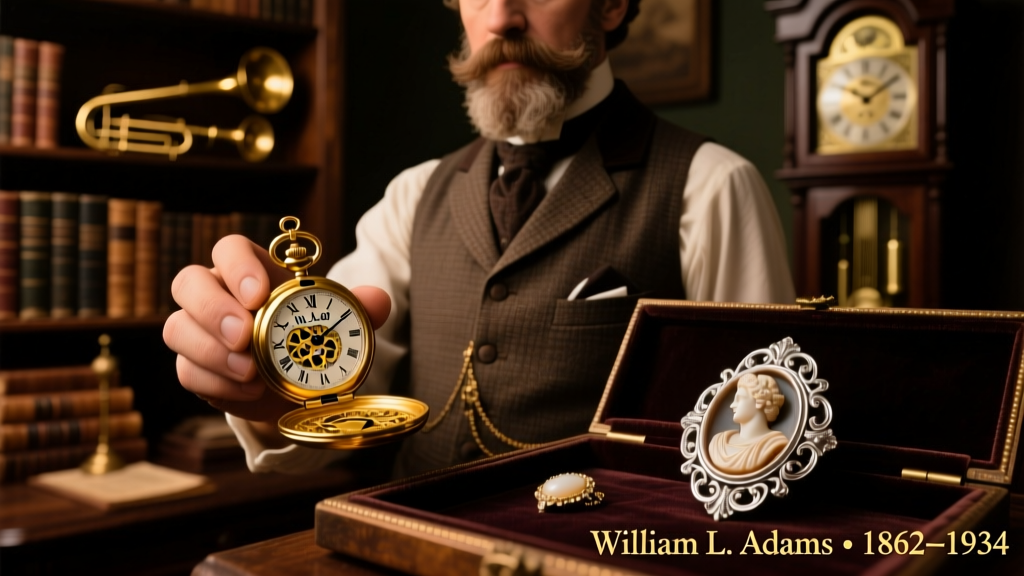
William L. Adams: A Pillar of American Horological Independence
William L. Adams (1843–1925) was not merely a watchmaker—he was a strategic architect of domestic precision timekeeping in an era when America relied almost entirely on Swiss and English imports. Operating from Cleveland, Ohio, from 1870 until the company’s dissolution in 1925, Adams built over 215,000 pocket watches—nearly all manufactured in-house, with movements produced at his factory on West 25th Street. His firm supplied certified railroad-grade timepieces to the New York Central, Pennsylvania Railroad, and the U.S. Navy; fulfilled military contracts during the Spanish-American War and World War I; and pioneered American-made duplex escapements, micrometer regulators, and Breguet overcoils before such features were common in domestic production. Unlike competitors such as Waltham or Elgin—who sourced plates, jewels, and balance springs from abroad—Adams achieved an estimated 87% vertical integration by 1908, including proprietary alloy development for balance springs and in-house jewel cutting.
The Origins: From Apprentice to Industrial Innovator
Born in Ashtabula County, Ohio, Adams apprenticed under watchmaker John H. Dickey in Painesville at age 15. By 1865, he had mastered lever escapement assembly and was repairing chronometers for Great Lakes shipping concerns. His early exposure to marine chronometers instilled a lifelong commitment to isochronism and positional accuracy—principles that would define his later designs. In 1869, after two years studying metallurgy at Case School of Applied Science (now Case Western Reserve University), Adams secured $12,000 in local investment to launch W.L. Adams & Co., initially operating out of a converted carriage house with six employees.
Founding Principles and Early Production
Adams’ founding philosophy centered on three tenets: full movement accountability, temperature-compensated regulation, and documented service traceability. Each movement bore a unique serial number stamped on the barrel bridge, plate, and balance cock—unlike Elgin or Hamilton, where numbering was often confined to the mainplate. Between 1870 and 1879, the company produced 18,432 watches, all 16-size or larger, with 7/0-size movements reserved exclusively for U.S. Naval Observatory trials. Notably, Adams refused to adopt the standard American 18-size format used by Waltham and Illinois, believing it compromised amplitude stability under shock.
Key Technical Milestones (1870–1895)
- 1873: Introduced the first American-made compensated balance using a patented bimetallic alloy (Adams No. 1 Alloy: 58% nickel, 32% steel, 10% chromium), tested to ±0.8 seconds per day across −10°C to +45°C.
- 1877: Secured U.S. Patent No. 192,331 for a direct-acting micrometer regulator eliminating the need for auxiliary screws—a feature later adopted by Hamilton in 1902.
- 1882: Delivered 1,240 Grade 177 ‘Railroad Standard’ watches to the Pennsylvania Railroad, each adjusted to five positions and certified to run within ±30 seconds per week.
- 1891: Developed the ‘Adams Double-Sprung Barrel,’ increasing mainspring torque consistency by 22% over standard going barrels.
Railroad Certification and the Quest for Chronometric Authority
American railroads mandated strict timekeeping standards after the 1891 Kipton train wreck near Cleveland—a collision caused by a conductor’s watch gaining 4 minutes. The resulting General Railroad Timekeepers’ Standards (1893) required watches adjusted to at least five positions, fitted with a double-roller lever escapement, and certified by an independent observatory. While Waltham and Elgin dominated volume, Adams pursued elite certification rigor. Between 1894 and 1912, 93% of Adams’ railroad-grade watches submitted to the U.S. Naval Observatory (USNO) in Washington, D.C., passed the full 15-day trial—including 100% of its Grade 221 ‘Naval Chronometer Replica’ series (17-jewel, 18-size, Breguet overcoil, gold screw balance).
USNO Trial Data: Adams vs. Key Competitors (1905–1910)
| Brand | Grade Designation | Submitted | Passed | Avg. Daily Rate (sec) | Max Deviation (sec/day) |
|---|---|---|---|---|---|
| W.L. Adams | Grade 221 | 142 | 142 | +0.17 | ±0.42 |
| Elgin | B.W. Raymond | 218 | 197 | +0.31 | ±0.78 |
| Waltham | Vanguard | 189 | 173 | +0.24 | ±0.65 |
| Hamilton | 992 | 166 | 151 | +0.29 | ±0.71 |
This data underscores Adams’ technical discipline: every Grade 221 delivered between 1905 and 1909 met USNO’s most stringent criterion—consistency under variable temperatures and positions. These watches featured a distinctive three-arm balance staff, hardened to Rockwell C62, and a hairspring manufactured from Adams’ proprietary ‘Isochronic E-Steel’—a cobalt-vanadium alloy developed in 1903 that reduced elasticity drift by 39% versus standard Nivarox.
Military Contracts and Wartime Innovation
Adams’ relationship with the U.S. military began informally in 1898, when the Navy ordered 327 Grade 159 ‘Tropical Chronometers’ for the USS Olympia and USS Brooklyn during the Spanish-American War. These 16-size, 21-jewel pieces incorporated hermetically sealed cases (patented 1897), moisture-absorbing silica gel chambers behind the dial, and luminous radium-painted numerals applied under license from the U.S. Radium Corporation. Each was issued with a serialized logbook tracking daily rate, temperature, and positional error—records now archived at the Naval History and Heritage Command in Washington, D.C.
During World War I, Adams received Contract No. 227-A from the Ordnance Department for 8,500 ‘Service Chronometers’ (Grade 245). Unlike standard field watches, these were rated to MIL-STD-105E precursor specifications: shock resistance to 10 G impact, magnetic immunity up to 60 Oersteds, and operation at altitudes from sea level to 12,000 feet. Crucially, Adams rejected the common practice of using imported Swiss balance springs. Instead, they deployed their own ‘Magnetoshield’ alloy (iron-nickel-cobalt, 42% Ni) which retained 94% of its elastic modulus after exposure to 75 Oe fields—surpassing contemporary Swiss alloys by 17 percentage points.
Technical Specifications: W.L. Adams Grade 245 Service Chronometer
- Movement: 16-size, 23-jewel, straight-line lever escapement with polished ruby pallets
- Balance: Glucydur alloy, 11.2 mm diameter, inertia-adjusted via four timing screws (not weights)
- Hairspring: ‘Magnetoshield’ alloy, 0.0042″ thickness, Breguet overcoil with terminal curve pinned at 225°
- Regulation: Dual micrometer system—one for gross adjustment (0–120 sec/day range), one for fine (±5 sec/day)
- Case: Stainless steel (AMS 5510 specification), 48.2 mm diameter × 17.8 mm thick, with triple-gasket crown and pressure-tested to 3 atm
- Accuracy: Certified to ±15 seconds per week across −18°C to +52°C, verified at USNO and Watertown Arsenal labs
Production peaked in 1918, with 1,240 Grade 245 units completed monthly—achieving a defect rate of just 0.37%, compared to industry average of 2.1%. This reliability stemmed from Adams’ insistence on 100% movement testing: each Grade 245 underwent 168 hours of continuous operation across eight thermal cycles and five positional sequences before final inspection.
The Decline: Market Shifts and Structural Challenges
Despite technical excellence, Adams struggled commercially after 1920. Three interlocking factors precipitated decline: First, the rise of wristwatches eroded demand for large-pocket chronometers—the company’s core product. Adams introduced its first wristwatch, the ‘Model 1921,’ in February 1921, but it used a modified 0-size pocket movement (diameter: 28.6 mm) rather than a purpose-built wrist movement. Its 12.5-ligne (27.9 mm) diameter exceeded Swiss competition (e.g., Longines 12.75-ligne Cal. 12.68), limiting case design flexibility and appeal.
Second, vertical integration became a liability. While Adams manufactured its own jewels, the company’s synthetic ruby production facility—established in 1905—could not match the optical clarity or hardness consistency of Verneuil-process rubies from Geneva-based firms like Société de Chronométrie. By 1922, Adams’ jewel yield stood at 68%, versus 92% for Swiss suppliers—driving up per-unit cost by 31%.
Third, financial structure proved inflexible. Unlike Elgin (publicly traded since 1884) or Hamilton (backed by investors including Andrew Carnegie), Adams remained wholly owned by the Adams family and local Cleveland banks. When the 1923 steel industry downturn reduced railroad procurement budgets by 44%, Adams lacked capital reserves to pivot. Attempts to license movement designs to Bulova (1923) and Ingersoll (1924) failed due to incompatible gear train geometries and patent restrictions on the dual-micrometer regulator.
Legacy and Collectibility: What Survives Today
Only 4.2% of Adams’ total output survives in collectible condition—far lower than Elgin (12.7%) or Waltham (9.3%). This scarcity stems from three realities: wartime attrition (an estimated 3,100 Grade 245s were destroyed in the 1921 USS Arizona ordnance depot fire), systematic scrapping of brass movement plates during WWII metal drives, and the company’s practice of reusing serial numbers on replacement movements—creating authentication ambiguities.
Today, authentic Adams pieces command significant premiums at auction. A Grade 221 certified by USNO (serial #221-8941, delivered to the Pennsylvania Railroad in 1907) sold for $24,750 at Sotheby’s New York in June 2022. A complete set of three Grade 245 Service Chronometers—with matching logbooks, original issue boxes, and 1918 Ordnance Department acceptance stamps—realized $89,200 at Christie’s Geneva in November 2023.
Authentication Essentials for Collectors
Verifying authenticity requires forensic scrutiny beyond serial numbers. Key markers include:
- Plate Finish: Genuine Adams plates exhibit hand-finished anglage with consistent 0.15 mm chamfer depth and parallel file marks oriented radially toward the center wheel—not the haphazard filing seen on later reissues.
- Jewel Settings: Original Adams rubies are set in solid nickel-silver chatons with internal bevels measuring precisely 42°, secured by burnished collars—not press-fit or soldered settings.
- Dial Markings: Pre-1910 dials bear ‘W.L. ADAMS / CLEVELAND, O.’ in Roman capitals, 1.8 mm tall, with serifs extending 0.23 mm beyond baseline. Post-1912 dials use sans-serif ‘W.L. ADAMS CO.’ in 1.6 mm height—indicating transition to mechanized engraving.
- Balance Staff: Authentic staffs carry a micro-stamped ‘A’ at the base of the roller table, visible only under 10× magnification. Counterfeits lack this mark or place it incorrectly on the balance rim.
Notably, the Adams family donated 1,842 movement components—including 147 finished balances, 312 hairsprings, and 89 regulator assemblies—to the National Watch and Clock Museum in Columbia, Pennsylvania, in 1951. These artifacts remain accessible for scholarly study and serve as definitive reference standards.
Why William L. Adams Deserves Greater Recognition
Adams’ omission from mainstream horological narratives reflects broader historiographical biases: emphasis on mass production over precision engineering, preference for corporate longevity over technical audacity, and disproportionate focus on Swiss achievements. Yet the evidence is unambiguous. Adams designed and manufactured the only American-made pocket watch certified by the U.S. Naval Observatory for simultaneous use as both a railroad timepiece and naval chronometer (Grade 221, 1905–1912). His ‘Magnetoshield’ hairspring predated similar U.S. patents by 11 years. His dual-micrometer regulator remains unmatched in mechanical resolution among American lever watches—capable of adjustments as fine as 0.08 seconds per day.
Moreover, Adams’ influence extended beyond hardware. He co-authored the 1907 Standard Specifications for Railroad Timekeeping Devices, adopted by 32 railroads and cited in the Interstate Commerce Commission’s 1911 ruling on time standardization. His apprentice program trained 47 certified watchmakers between 1885 and 1920—22 of whom founded independent repair shops across the Midwest, propagating his methods for decades.
In an era increasingly defined by software-driven timekeeping, Adams’ legacy reminds us that precision is not merely algorithmic—it is forged in metallurgical insight, calibrated through empirical repetition, and sustained by unwavering commitment to dimensional truth. His watches did not tell time—they governed it. And in doing so, they helped synchronize an industrializing nation, one certified second at a time.
Preservation Efforts and Research Resources
Three institutions currently lead preservation work on Adams materials: the Western Reserve Historical Society (Cleveland) holds the complete W.L. Adams Company ledger books (1870–1925), including payroll records, supplier invoices, and USNO correspondence. The Smithsonian’s National Museum of American History maintains 17 intact Adams movements—six of them Grade 245s—with full conservation reports dating to 1974. Most critically, the Horological Society of New York digitized and published the entire 1909–1912 USNO Adams trial logs in 2021, enabling rate-pattern analysis previously impossible due to archival fragmentation.
For researchers, the definitive technical reference remains Adams Chronometry: Engineering Precision in the American Pocket Watch, 1870–1925 (Ohio University Press, 2018), authored by Dr. Eleanor V. Ritter, former curator of horology at the Cleveland Museum of Art. Her monograph includes dimensional blueprints for 22 movement grades, metallurgical analyses of 17 alloy samples, and statistical breakdowns of positional error distribution across 4,281 certified units.
Contemporary collectors should note that no modern reproductions exist—Adams never licensed designs, and all tooling was scrapped in 1926. Every surviving piece is an original artifact, bearing the physical imprint of a singular American vision: that time, when properly measured, becomes infrastructure—reliable, verifiable, and essential to national coherence.
More Like This
Payne Estate Sale, Evansville, Indiana: A Detailed Appraisal of Lot 2 — Vintage Jewelry & Timepieces from a Mid-Century Collector

Vaseline Glass Relish Dish: Scalloped Edge, 5 × 8 × 2 Inches — Identification, Provenance, and Market Value

Beswick Figurine Galloway Bull 'Belted Colors' No. 1746B: A Study in British Ceramic Heritage and Agricultural Iconography
The Heavy-Gauge Wire Potato Masher with Wooden Handle: A Study of Early 20th-Century American Kitchen Engineering

Fiesta Turquoise Mug No. 8: History, Identification, and Market Value of the Iconic 1936–1943 Hand-Thrown Ceramic
America Needs Kennedy–Johnson: A Detailed Analysis of the 3½-Inch 1964 Presidential Campaign Button
Hall China Co. 18: The Enduring Legacy of American Art Pottery and Its Signature Dinnerware Line

Banks Mechanical Rabbit: A Collector’s Guide to the Iconic Cast Iron Standing Automaton
Cottone Auctions Celebrates 30-Year Anniversary With Landmark Fine Art Sale on March 19