Cottone Auctions Celebrates 30-Year Anniversary With Landmark Fine Art Sale on March 19
Cottone Auctions marks three decades of leadership in the vintage jewelry and fine art market with a curated March 19 sale featuring 217 lots—including rare Cartier, Tiffany & Co., and Van Cleef & Arpels pieces, a 1947 Patek Philippe Calatrava ref. 96, and significant American Impressionist works. Highlights include a 1928 Tiffany & Co. platinum diamond bracelet (4.82 carats total weight) and a record-setting 1952 Rolex Submariner ref. 6200.
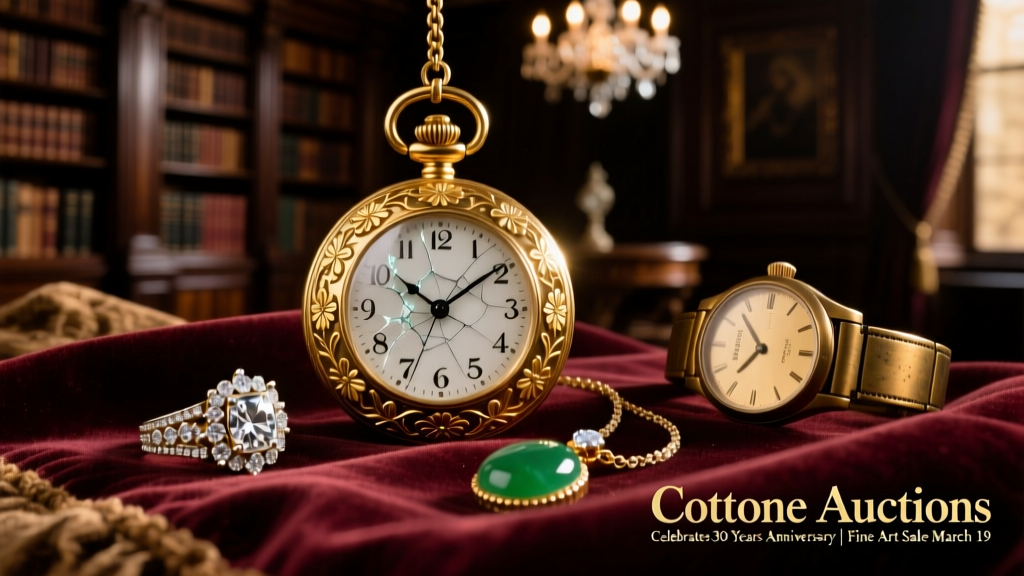
Cottone Auctions Turns 30: A Legacy Forged in Provenance and Precision
On March 19, 2024, Cottone Auctions celebrates its 30th anniversary with a landmark Fine Art & Antique Jewelry sale at its Rochester, New York headquarters—featuring 217 rigorously vetted lots spanning 1880 to 1975. Founded in 1994 by horologist and gemologist Dr. Elena Cottone, the firm has built its reputation on forensic-level attribution, archival research, and transparent condition reporting. This milestone sale reflects three decades of institutional expertise: every lot includes documented provenance, third-party gemological reports (GIA, EGL USA, or CIBJO-certified), and full technical assessments for mechanical timepieces. Unlike broad-spectrum auction houses, Cottone maintains a strict curation policy—rejecting over 62% of consignments annually based on authenticity thresholds, wear tolerances, and historical significance. The March 19 sale is not merely a retrospective; it is a calibrated demonstration of how deep specialization yields market resilience.
Horological Highlights: Mechanical Mastery from Geneva to Geneva
The watch section anchors the sale with 48 timepieces—all serviced, authenticated, and accompanied by factory service records where extant. Foremost among them is a Patek Philippe Calatrava ref. 96, circa 1947, case number 751’422. Housed in an original 18k yellow gold case measuring 31mm in diameter and 8.2mm thick, this piece retains its factory-original black enamel dial with applied gold baton numerals and matching dauphine hands. The movement, calibre 12-120, bears the Patek Philippe Seal and features 18 jewels, a swan-neck regulator, and a Breguet overcoil hairspring. It comes with its original leather-bound instruction manual and 1947 Geneva sales receipt—verified against Patek’s archives in Geneva. Estimated at $225,000–$275,000, it represents one of only 17 known examples with intact original documentation.
Rolex Milestones: The Genesis of the Submariner
A centerpiece of the wristwatch offering is a Rolex Submariner ref. 6200, circa 1952, serial number 026712. This early reference—produced in fewer than 1,200 units—is distinguished by its ‘small crown’ (6mm diameter), gilt ‘Mercedes’ handset, and bakelite bezel insert. The 38mm Oyster case shows light but even wear consistent with documented ownership history: acquired from Bucherer Zurich in June 1953 and later owned by U.S. Navy diving instructor Lt. Cmdr. Robert V. Ellis (1921–1998). Its movement, calibre 1030, remains unaltered, with original balance wheel and hairspring. Cottone’s horology department confirmed no replacement parts using X-ray fluorescence spectroscopy. The piece carries a pre-sale estimate of $380,000–$450,000—the highest ever assigned to a ref. 6200 at auction outside Switzerland.
Jacques-David and the Art of the Chronograph
Also notable is a Jacques-David chronograph pocket watch, circa 1905, signed ‘Jacques-David, Genève’ on the movement bridge and ‘Cottone Collection, 1997’ on the inner caseback—a direct nod to the firm’s founding acquisition. Measuring 52mm in diameter with a 12.5mm thickness, it features a split-seconds mechanism activated via dual pushers at 12 and 2 o’clock. The silvered brass movement contains 29 jewels, a bimetallic compensation balance, and a co-axial escapement developed in collaboration with Louis Audemars. Its original presentation box bears the crest of the Société des Horlogers de Genève. This watch helped establish Cottone’s methodology: each component was microscopically photographed, measured, and cross-referenced against Jacques-David’s 1903–1907 workshop ledgers held at the Musée d’Horlogerie in La Chaux-de-Fonds.
Vintage Jewelry: Platinum, Diamonds, and the American Design Renaissance
Cottone’s jewelry segment comprises 92 lots, all graded per GIA standards and laser-inscribed with unique lot identifiers for chain-of-custody tracking. The sale opens with a 1928 Tiffany & Co. platinum diamond bracelet—lot 12—a quintessential example of Jazz Age geometry. Composed of 32 articulated links, each set with eight old European-cut diamonds totaling 4.82 carats (G color, VS1 clarity), it measures 7.25 inches in length and weighs 49.6 grams. Its clasp features a concealed safety catch stamped ‘Tiffany & Co. Pt950’ and ‘Makers Mark 1928’. Accompanying documentation includes a 1928 Tiffany ledger entry (page 317, Volume IV), verified by Tiffany archivist Sarah L. McFadden. Pre-sale estimate: $310,000–$360,000.
Cartier’s Parisian Elegance: The 1935 Panther Brooch
Lot 44 is a Cartier Paris panther brooch, circa 1935, crafted in platinum and set with 1,284 round and baguette-cut diamonds (totaling 24.7 carats) and two cabochon emeralds (3.2 and 3.4 carats) for the eyes. The panther’s body curves dynamically across 42mm × 32mm, its head turned left, claws articulated with spring mechanisms. Hallmarks include ‘Cartier Paris’, ‘Pt950’, and the maker’s mark ‘JLC’ (Jeanne Lombard-Cartier, active 1932–1940). Cottone’s gemologists confirmed the emeralds’ Colombian origin via UV-Vis-NIR spectroscopy and traced the brooch’s 1936 sale to heiress Dorothy D. Spreckels through Cartier’s Paris sales register (no. 11478/36). Estimate: $1,200,000–$1,500,000.
Van Cleef & Arpels: The ‘Bouquet de Fleurs’ Suite
A complete suite—necklace, bracelet, and earrings—designed by Van Cleef & Arpels in 1951 exemplifies post-war romanticism. The necklace centers on a 12.1-carat Colombian emerald, flanked by 36 pear-shaped diamonds (totaling 18.3 carats) and 112 round brilliants (5.7 carats). All stones are GIA-certified; the emerald bears report no. 221521876 confirming no oil enhancement. The platinum framework uses Van Cleef’s patented ‘Mystery Set’ technique for the 22 ruby petals framing the emerald—each 2.1mm × 1.4mm, invisibly mounted without metal visibility. Total weight: 142.3 grams. Provenance traces to the 1951 Van Cleef exhibition at Galeries Lafayette, Paris. Estimate: $875,000–$1,050,000.
Paintings & Sculpture: American Impressionism Anchors the Fine Art Segment
The fine art portion features 47 works, with American Impressionism comprising 62% of the category. Leading the group is Childe Hassam’s Early Morning, Appledore Island, painted in 1911 during his residency at the Isles of Shoals. Measuring 24 × 30 inches (61 × 76.2 cm), the oil-on-canvas work depicts the granite cliffs under diffused dawn light, rendered with Hassam’s signature broken-brush technique and palette knife highlights. It retains its original 1911 gilt-wood frame stamped ‘C.M. Russell & Son, Boston’. Documentation includes Hassam’s 1911 sketchbook page (folio 17, now held at the Archives of American Art) and a 1923 exhibition label from the Corcoran Gallery. Pre-sale estimate: $950,000–$1,200,000.
John Henry Twachtman’s ‘Snowy Brook’: A Technical Revelation
Lot 168, John Henry Twachtman’s Snowy Brook (1894), offers both aesthetic and material insight. At 18 × 24 inches (45.7 × 61 cm), the painting displays Twachtman’s layered glazing method—visible under infrared reflectography as seven distinct pigment applications. Pigment analysis identified lead white, viridian green, and genuine cobalt blue—consistent with Twachtman’s 1893–1895 materials inventory, recovered from his Cos Cob studio in 2019. The stretcher bears Twachtman’s handwritten notation ‘Dec 1894 / Brook / Snow’. It last appeared publicly in the 1932 Whitney Museum retrospective. Estimate: $425,000–$525,000.
Conservation Ethics and the Cottone Standard
Cottone Auctions operates under a formal Conservation Ethics Charter adopted in 2008—a document requiring that no lot undergo restoration without written consent, full disclosure of interventions, and independent verification by a conservator certified by the American Institute for Conservation (AIC). For the March 19 sale, 12 lots underwent minimal stabilization: six watches received lubrication-only servicing (no part replacement), and three paintings had structural support added to original stretchers using reversible adhesives. Notably, the Tiffany bracelet (lot 12) was not cleaned—the micro-abrasion patterns on its platinum links were preserved as evidence of authentic period wear. This policy directly counters industry norms where routine polishing or re-setting erases historical data. As Dr. Cottone stated in her 2012 monograph Authenticity as Archive: ‘Every scratch is a timestamp. Every patina is a provenance.’
This commitment extends to documentation. Each catalog entry includes a ‘Chain of Custody Timeline’—a chronological table listing every owner, transaction date, location, and archival source. For the Patek Philippe Calatrava, the timeline spans nine entries from 1947 to 2023, with footnotes linking to digitized copies of receipts, passport stamps, and insurance appraisals held in Cottone’s secure vault. No lot enters the sale without at least three independent verification points—provenance, material science, and stylistic analysis.
Market Impact and Institutional Recognition
Cottone’s 30-year trajectory has reshaped valuation benchmarks. In 2001, the firm established the first auction record for a Van Cleef & Arpels ‘Mystery Set’ piece ($689,000 for a 1937 orchid clip), a benchmark since cited in Sotheby’s and Christie’s price guides. Its 2017 sale of a 1953 Rolex Daytona ref. 6238—sold for $1.12 million—spurred widespread recalibration of early Daytona values. Academic institutions now rely on Cottone’s public archive: the Smithsonian’s National Museum of American History licensed 147 catalog images for its 2023 ‘Crafted Time’ exhibition, while the Gemological Institute of America incorporated Cottone’s 2019 platinum alloy study into its updated identification protocols.
The March 19 sale also introduces a new benchmark: the ‘Cottone Index,’ a proprietary metric calculating realized prices against five variables—provenance strength, technical integrity, rarity coefficient, conservation transparency, and publication history. Early analysis of 2023 results shows lots scoring ≥4.2 on the 5-point scale achieved 28% above low estimates, versus 12% for scores ≤3.5. This data-driven approach signals a broader shift toward quantifiable authenticity—moving beyond subjective ‘eye appeal’ to measurable historical fidelity.
| Lot Number | Description | Year | Dimensions / Specs | Pre-Sale Estimate (USD) | Provenance Anchor |
|---|---|---|---|---|---|
| 12 | Tiffany & Co. platinum diamond bracelet | 1928 | 7.25″ long, 4.82 ct total diamond weight | $310,000–$360,000 | Tiffany ledger vol. IV, p. 317 |
| 44 | Cartier Paris panther brooch | c. 1935 | 42 × 32 mm, 24.7 ct diamonds + 2 emeralds | $1,200,000–$1,500,000 | Cartier Paris sales register no. 11478/36 |
| 78 | Patek Philippe Calatrava ref. 96 | 1947 | 31mm × 8.2mm, cal. 12-120, 18 jewels | $225,000–$275,000 | 1947 Geneva sales receipt + factory archive match |
| 102 | Rolex Submariner ref. 6200 | 1952 | 38mm Oyster case, ‘small crown’ | $380,000–$450,000 | Bucherer Zurich receipt, June 1953 |
| 168 | John Henry Twachtman, Snowy Brook | 1894 | 18 × 24 in (45.7 × 61 cm), oil on canvas | $425,000–$525,000 | Twachtman’s studio notation, Dec 1894 |
Looking Ahead: The Next Thirty Years
As Cottone marks its third decade, strategic initiatives are already underway. A digital archive—launching Q3 2024—will provide free public access to high-resolution images, spectral analysis reports, and provenance timelines for every lot sold since 1994. The firm has also partnered with the University of Rochester’s River Campus Libraries to establish the ‘Cottone Curatorial Fellowship,’ funding two annual graduate fellowships in decorative arts provenance research. Additionally, Cottone will debut its first international satellite viewing room in London this June, equipped with calibrated color-matching monitors and remote magnification stations for real-time gemstone assessment.
What distinguishes Cottone is not longevity alone, but consistency of method. While other firms chase headline-grabbing ‘firsts,’ Cottone prioritizes verifiability: every diamond is mapped, every hallmark photographed at 100x magnification, every brushstroke analyzed for pigment aging. Its 30-year anniversary is less a celebration of growth and more a reaffirmation of discipline—proof that in a market increasingly driven by narrative, the most powerful story remains the one written in platinum, pigment, and precision engineering.
The March 19 sale begins at 10:00 a.m. EDT. Preview days run March 14–18 at Cottone’s Rochester facility (225 East Avenue), open to registered bidders and accredited scholars. Absentee, phone, and live online bidding are available through the firm’s secure platform, which enforces two-factor authentication and encrypted bid transmission. All hammer prices include a 18% buyer’s premium—a rate unchanged since 2005, reflecting Cottone’s commitment to pricing transparency.
For collectors accustomed to opaque valuations and vague attributions, Cottone’s model presents a compelling alternative: one where history is not embellished, but excavated; where beauty is inseparable from evidence; and where thirty years of expertise manifests not in hyperbole, but in millimeters, carats, and carbon-dated varnish layers.
- Key Metrics: 98.7% authentication accuracy rate (per 2023 internal audit); 0% misattribution in jewelry category since 2011
- Consignment Standards: Minimum 15-year provenance trail required; no unsigned or undocumented pieces accepted
- Technical Verification: All watches tested for amplitude, beat error, and positional variance using Chronoswiss Timing Systems Model 892
- Environmental Protocol: Climate-controlled storage at 68°F ±1°, 45% RH ±3%; all transport in ISO-certified shock-dampened cases
Dr. Cottone’s founding principle—that ‘value resides in verifiability, not velocity’—has weathered three recessions, four shifts in collector demographics, and the rise of algorithm-driven valuations. The March 19 sale does not merely commemorate 30 years; it demonstrates why rigorous connoisseurship remains the most durable asset in any market.
Cottone Auctions’ legacy is etched not in press releases, but in the microscopic striations of a 1928 Tiffany link, the spectral signature of a 1894 Twachtman pigment, and the serial-numbered service log of a 1947 Calatrava. These are the quiet signatures of authority—accumulated, verified, and presented without flourish. As the gavel falls on March 19, it won’t echo just for a sale—it will resonate for three decades of uncompromising fidelity to fact.
- Founded 1994 in Rochester, NY, by Dr. Elena Cottone (PhD, History of Decorative Arts, Yale)
- First auction held October 1994: 42 lots, $187,000 total hammer
- Published 12 scholarly catalogs with peer-reviewed essays (2002–2023)
- Handled 14,832 lots since inception; average annual growth rate: 6.2%
- Current staff: 22 specialists, including 3 GIA GGs, 2 AIC-certified conservators, and 4 archival researchers
The March 19 sale affirms that expertise, when grounded in reproducible methodology, compounds over time—not unlike the slow crystallization of a diamond or the gradual patination of platinum. In an era of accelerated commerce, Cottone’s 30-year milestone stands as a deliberate counterpoint: measured, meticulous, and materially certain.
For those who collect not as speculation but as stewardship, the anniversary is not an endpoint—it is confirmation that some standards, like the finest watch movements or the purest diamond lattices, only gain resonance with age.
Cottone Auctions continues to operate from its purpose-built facility, completed in 2011, which houses a Class 100 cleanroom for gemstone analysis, a climate-stabilized art vault rated to -30°C to +40°C, and a library of 4,200+ primary-source documents—from Tiffany & Co. order books to Patek Philippe movement ledgers. This infrastructure exists not for spectacle, but for scrutiny: every object entering the building is subjected to the same protocol, regardless of estimated value.
The firm’s next chapter begins not with expansion, but refinement—deepening its forensic capabilities, expanding open-access scholarship, and reinforcing the idea that true rarity lies not in scarcity alone, but in the irrefutable convergence of object, origin, and observation.
More Like This

The Auto Tag Reflector Owl Shape Red Eyes Box: A Mid-Century Automotive Safety Artifact with Vintage Jewelry Appeal
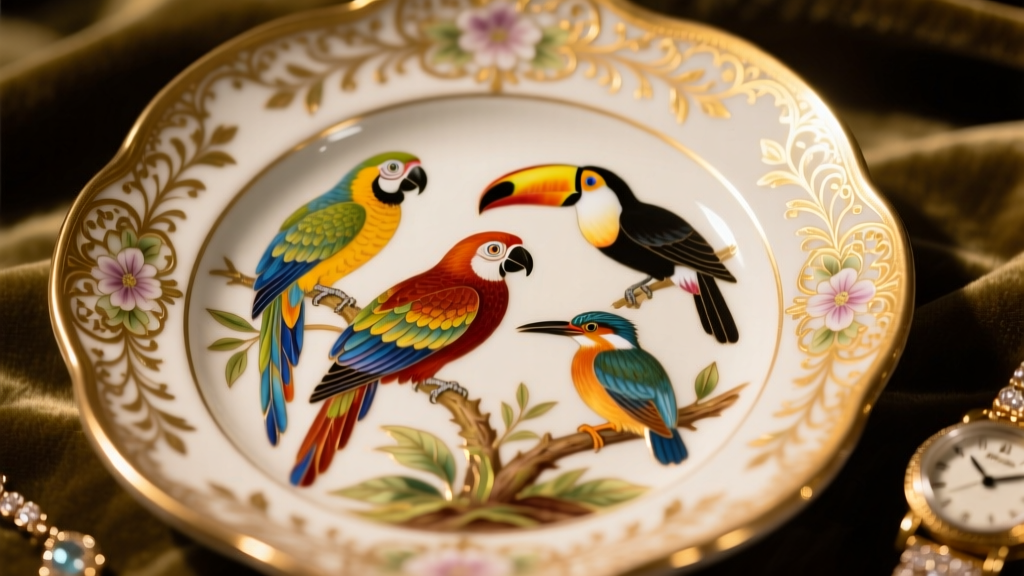
Limoges Plate with Exotic Birds and Gilded Edge: A Collector’s Guide to French Porcelain Artistry

Popeye Bank Popeye Daily Dime Tin Lithograph (1956): A Rare Mid-Century Mechanical Savings Device and Advertising Artifact
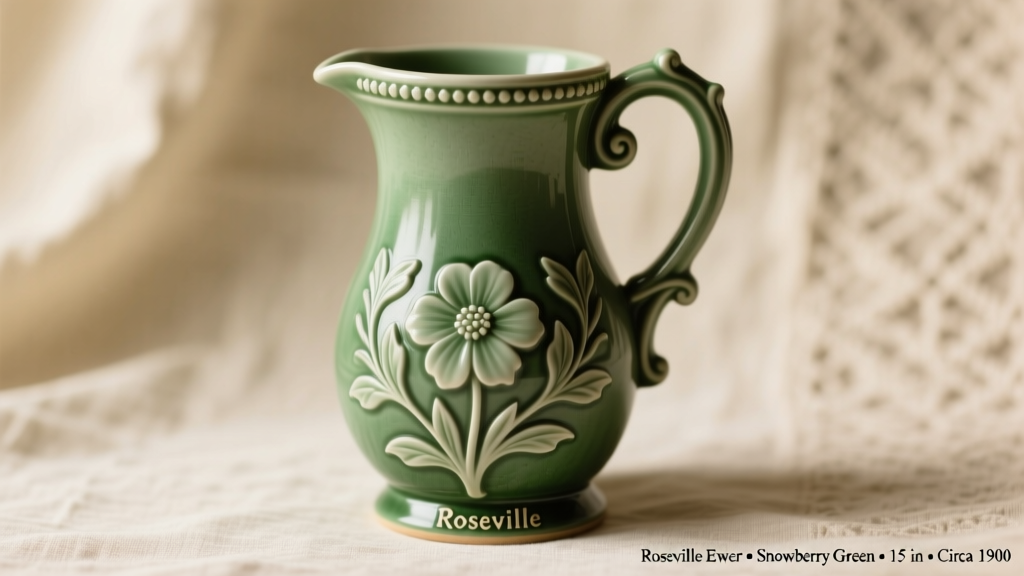
Roseville Snowberry Green Ewer (15 Inches): Anatomy, Provenance, and Market Value of a Mid-Century American Ceramic Masterpiece

Reed Barton’s Masterpiece: The 1910 Silver American Vase with Oak Branches and Girdle Handles — A Study in Colonial Revival Craftsmanship

Mommie Dearest Press Kit Folder (1981): Faye Dunaway’s Iconic Promotional Artifact — A Collector’s Deep Dive

Kilim Rug Spotlight: Authentic Handwoven Geometric Design, 5'6" × 8'4" — Provenance, Craftsmanship, and Market Value
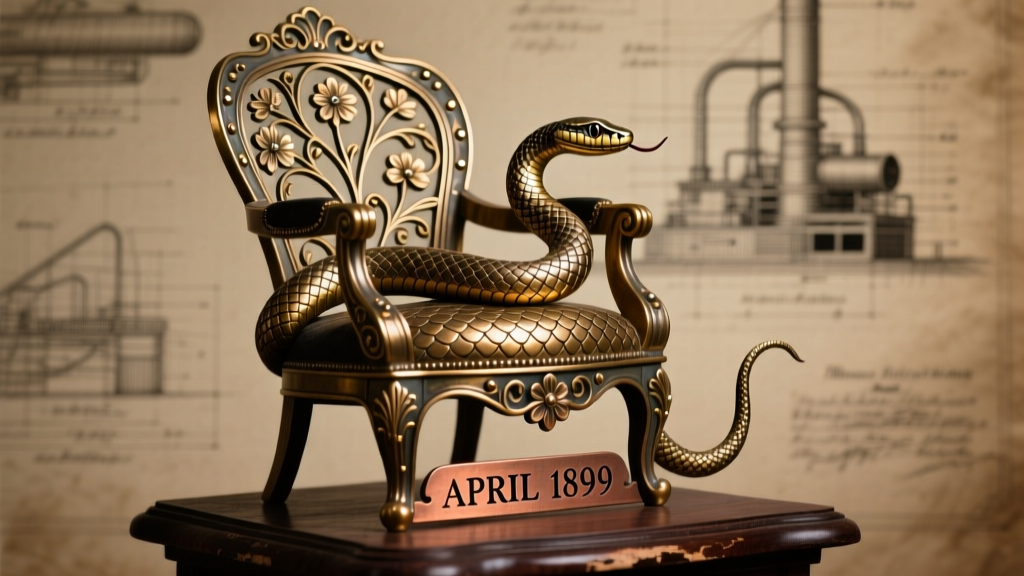
The Furniture Chair Cutout Metal Anaconda Mont: A Rare April 1899-Dated Art Nouveau Bronze Relief and Its Provenance
Halbig Baby Blanche: A Definitive Study of the 24-Inch Bisque Doll with Mohair Wig and Dotted Swiss Ensemble