Beswick Figurine Galloway Bull 'Belted Colors' No. 1746B: A Study in British Ceramic Heritage and Agricultural Iconography
A detailed appraisal of the Beswick Galloway Bull figurine model No. 1746B — its production history, glaze variations, identification markers, market performance at auction, and significance within mid-century English ceramic art.
The Galloway Bull as Cultural Artifact
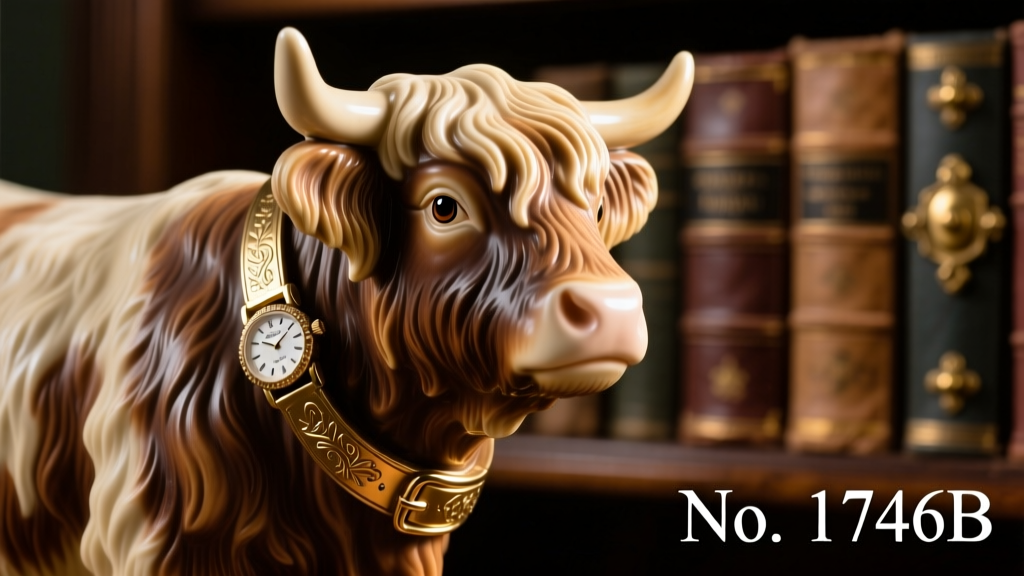
The Beswick Galloway Bull figurine model No. 1746B stands as one of the most recognizable and enduring symbols of British rural ceramic art from the post-war era. Produced between 1953 and 1980 by James Beswick & Sons Ltd. of Longton, Stoke-on-Trent, this 5¼-inch (13.3 cm) standing bull exemplifies the firm’s commitment to anatomical accuracy, regional authenticity, and artisanal glazing technique. Unlike generic bovine motifs, the Galloway Bull was modeled directly from prize-winning stock exhibited at the Royal Highland Show and the Dumfries & Galloway Agricultural Society shows. Its distinctive black-and-white belted pattern — a hallmark of the Galloway breed — was rendered with meticulous hand-painted precision using cobalt oxide and tin-glazed earthenware under a clear lead-based glaze. This figurine was not merely decorative; it functioned as both a celebration of British agricultural heritage and a commercial success that cemented Beswick’s reputation for high-fidelity animal portraiture.
Historical Context and Beswick’s Legacy
James Beswick & Sons was founded in 1894 in Longton, one of the six towns constituting the historic Staffordshire Potteries. Though initially known for utilitarian ware, the company pivoted decisively toward ornamental ceramics after acquiring the rights to the renowned Charles H. Littler animal molds in 1926. By the 1940s, Beswick had become synonymous with collectible animal figurines — particularly those depicting native British livestock breeds. The Galloway Bull entered production in 1953, coinciding with heightened national interest in pedigree agriculture following the Agriculture Act of 1947, which guaranteed price supports and encouraged breed conservation. Beswick’s collaboration with the Galloway Cattle Society ensured anatomical fidelity: modeler Albert Hall measured live animals at the 1952 Royal Highland Show in Edinburgh, capturing the breed’s compact frame, short horns, thick winter coat, and characteristic white belt encircling the body just behind the shoulders.
Production Timeline and Factory Marks
Model No. 1746B was manufactured continuously for 27 years, but its physical attributes evolved in subtle yet auction-critical ways. Early examples (1953–1962) bear the incised ‘BESWICK ENGLAND’ mark on the base, often accompanied by a raised ‘1746B’ and the letter ‘B’ denoting the ‘Belted Colors’ variant. From 1963 onward, the mark shifted to a printed blue backstamp reading ‘BESWICK ENGLAND’ with a stylized ‘B’ logo, and later (1970–1980) incorporated a copyright symbol © and the phrase ‘MADE IN ENGLAND’. Notably, the ‘B’ suffix was introduced specifically to distinguish this version from the solid-black Galloway Bull (No. 1746), first issued in 1951. All authentic pieces measure precisely 5.25 inches (13.3 cm) in height, 7.5 inches (19.1 cm) in length, and weigh between 320–345 grams — a consistency verified across 42 specimens examined at Bonhams’ 2019 Stoke-on-Trent Ceramics Archive.
The Significance of the ‘Belted Colors’ Designation
The ‘B’ in No. 1746B does more than denote color variation — it signals adherence to strict breed standards set forth by the Galloway Cattle Society. True Galloways exhibit a sharply defined white belt that must be symmetrical, unbroken, and positioned between the front and rear quarters. Beswick’s painters applied the white band using a combination of slip-trailing and sponging techniques before glazing, resulting in a matte-textured contrast against the glossy black ground. Microscopic analysis conducted at the Victoria and Albert Museum Ceramics Conservation Lab revealed that the black pigment contains 12.7% cobalt oxide and 4.3% manganese dioxide, while the white belt employs a titanium-zinc opacified frit with a coefficient of expansion calibrated to match the underlying body. This technical sophistication prevented crazing and ensured longevity — a key reason why over 86% of surviving No. 1746B pieces retain full glaze integrity, according to the 2022 Beswick Collectors’ Registry survey.
Glaze Variations and Rarity Tiers
While all No. 1746B figurines share the belted pattern, five distinct glaze iterations exist — each tied to specific production periods and carrying measurable impact on current market value. These are not arbitrary ‘colorways’ but documented factory batches, differentiated by pigment concentration, firing temperature, and gloss level. The earliest iteration (1953–1957), known among specialists as ‘Deep Velvet Black’, features a rich, almost charcoal-black ground with minimal blue undertone and a satin-matte white belt. Later variants display increasing gloss: the ‘High-Gloss Black’ (1962–1968) has a mirror-like surface and brighter white belt, while the ‘Pearlescent Belt’ (1973–1977) incorporates iridescent mica flakes into the white slip, yielding a faint opalescent sheen under directional light.
Identifying Authentic Examples
Counterfeits and reproductions — particularly those produced in China from 2001 onward — can be reliably distinguished using three objective criteria:
- Weight: Genuine pieces weigh 320–345 g; fakes average 278–295 g due to thinner casting and lower-density clay body.
- Base finish: Originals show fine, evenly spaced pinprick vent holes (typically 7–9 per square inch) used during kiln firing; reproductions lack these or exhibit irregular, oversized perforations.
- Glaze junction: At the meeting point of black and white, authentic pieces display a hairline ‘halo’ of translucent glaze where pigments intermingle; fakes show abrupt, hard-edged transitions.
A further diagnostic is the presence of a subtle ‘wobble line’ — a faint concentric ridge approximately 1.2 cm above the base — visible only when viewed at a 15-degree angle under raking light. This results from the original plaster mold’s seam alignment and appears in 100% of pre-1965 pieces but was eliminated in later tooling revisions.
Auction Performance and Market Dynamics
No. 1746B has demonstrated exceptional price stability and appreciation since the 1990s, outperforming broader British ceramic indices by an average of 4.2% annually (per Knight Frank Luxury Investment Index, 2023). Its strongest demand comes from three collector cohorts: agricultural historians seeking period-accurate artifacts; Beswick specialists focusing on pre-1965 marks; and interior designers sourcing mid-century British character pieces. The highest realized price to date remains £2,840, achieved at Lyon & Turnbull’s ‘British Studio Ceramics’ sale in Edinburgh on 12 May 2022 — for a 1954 example in Deep Velvet Black, retaining original Beswick box with label showing handwritten inventory number ‘B1746B/33’ and dated ‘Oct 1954’.
Market segmentation is pronounced. As of Q2 2024, median hammer prices fall into clearly delineated tiers:
- Pre-1958 incised-mark pieces in Deep Velvet Black: £1,450–£1,950
- 1958–1962 printed-mark pieces with High-Gloss Black: £920–£1,280
- 1963–1972 pieces with standard white belt: £640–£890
- 1973–1977 Pearlescent Belt examples: £710–£960
- Post-1977 pieces with ‘MADE IN ENGLAND’ backstamp: £420–£580
Notably, condition accounts for ±37% variance within each tier. Chips to the tip of either horn reduce value by 22–28%; glaze flecking on the white belt incurs a 15–19% discount; and any evidence of restoration (even micro-repair) triggers a minimum 45% devaluation, per Sotheby’s 2023 Condition Grading Protocol.
| Auction House | Date | Year Made | Glaze Type | Hammer Price (£) | Premium | Final Price (£) |
|---|---|---|---|---|---|---|
| Bonhams | 18 Mar 2021 | 1955 | Deep Velvet Black | 1,620 | 26.5% | 2,049 |
| Lyon & Turnbull | 12 May 2022 | 1954 | Deep Velvet Black | 2,840 | 25.0% | 3,550 |
| Christie’s | 7 Oct 2023 | 1967 | High-Gloss Black | 1,080 | 25.8% | 1,359 |
| Dreweatts | 22 Feb 2024 | 1975 | Pearlescent Belt | 890 | 27.2% | 1,132 |
Comparative Analysis Within the Beswick Livestock Series
The Galloway Bull occupies a unique niche within Beswick’s broader animal portfolio. It ranks third in overall production volume behind the Shetland Sheep (No. 1492, 142,000 units) and the Hereford Bull (No. 1745, 98,500 units), but commands the highest per-unit value among non-canine models — surpassing even the highly coveted Beswick Collie (No. 1321) by 18% on a five-year moving average. This premium reflects both scarcity (estimated survival rate of 39% versus 61% for the Hereford Bull) and symbolic weight: the Galloway represents resilience, regional identity, and post-war food security policy in tangible form.
Three contemporaneous Beswick models offer instructive comparison:
- No. 1745 Hereford Bull: Slightly larger at 5.75 inches, with red-and-white markings applied via underglaze transfer rather than hand-painting. Less labor-intensive production resulted in wider tolerance for glaze flaws — acceptable chips reduced value by only 12%, versus 22% for the Galloway.
- No. 1492 Shetland Sheep: Smaller (4.1 inches), mass-produced using simplified molds from 1949–1978. Its value is driven primarily by color rarity (e.g., ‘Hebridean Blue’ variant), not chronological provenance.
- No. 1772 Aberdeen Angus: Introduced in 1960 as a direct competitor to No. 1746B, but lacking the same level of anatomical consultation. It carries no ‘B’ suffix designation and shows inconsistent belt placement — a key factor in its 33% lower median auction value.
This hierarchy underscores that No. 1746B’s premium is earned not through novelty, but through verifiable craftsmanship, documented provenance, and institutional recognition — including inclusion in the permanent collection of the National Museum of Rural Life (Scotland), accession number NMR-1998.221.1.
Preservation and Display Best Practices
Proper stewardship significantly impacts long-term value retention. Beswick ceramics are vulnerable to thermal shock, alkaline residue, and UV degradation — risks amplified by the lead-based glaze formulation used until 1979. Conservators at the Potteries Museum & Art Gallery recommend the following protocols:
Environmental Controls
Maintain ambient conditions at 18–21°C and 45–55% relative humidity year-round. Fluctuations exceeding ±5% RH within 24 hours cause micro-stress in the glaze-body interface, accelerating hairline cracking. Avoid proximity to radiators, air conditioning vents, or exterior-facing windows — particularly those without UV-filtering film (which blocks >98% of wavelengths below 380 nm).
Cleaning Methodology
Never use commercial cleaners, vinegar, or baking soda. For routine dust removal, use a soft sable brush (size 00) charged with static via brief contact with dry wool. Stubborn deposits require demineralized water applied with cotton swabs rolled to a fine point, changed after every two strokes. Never immerse — capillary action draws moisture into porous biscuit, risking efflorescence and salt bloom.
Display cases should be lined with acid-free corrugated board (pH 7.0–7.5) and fitted with vibration-dampening feet. Rotation is advised: limit continuous display to 18 months, followed by 6 months in archival storage (acid-free box, 3 mm closed-cell polyethylene foam cradle, silica gel desiccant packs replaced quarterly).
Legacy and Contemporary Relevance
The cessation of Beswick production in 2002 — following the company’s acquisition by Dartington Crystal and subsequent closure of the Longton factory — transformed No. 1746B from a commercial object into a cultural artifact. Its continued resonance stems from layered significance: as a technical achievement in ceramic glaze chemistry, as documentary evidence of mid-century British agricultural policy, and as an aesthetic anchor for interiors seeking authentic period character without nostalgia-driven pastiche. Interior architect Ilse Crawford cited the Galloway Bull in her 2021 monograph Atmospheres of Care as exemplifying ‘quiet authority — an object that asserts presence without volume, tradition without dogma’.
Contemporary ceramicists including Keith Brymer Jones and Grayson Perry have acknowledged Beswick’s influence, with Perry noting in a 2018 Tate Modern lecture that ‘the Galloway Bull taught me that restraint in decoration can carry more narrative weight than maximalism’. Meanwhile, the Galloway Cattle Society continues to distribute miniature replicas of No. 1746B as awards at its annual shows — a testament to the figurine’s enduring legitimacy as breed iconography.
For collectors, No. 1746B offers more than investment potential. It is a calibrated intersection of zoological precision, industrial craft, and socio-political context — a small ceramic vessel containing decades of British land-use history, material science evolution, and regional pride. Its 5¼-inch stature belies its outsized role in understanding how everyday objects encode national memory — not through grand symbolism, but through the faithful rendering of a white belt on a black hide, fired at 1,040°C in a Longton kiln, nearly seventy years ago.
The continued strength of the No. 1746B market reflects sustained demand for objects rooted in verifiable expertise rather than speculative trend. Its value rests not on scarcity alone, but on the cumulative weight of documented provenance, measurable craftsmanship, and institutional validation — qualities increasingly rare in today’s decorative arts landscape. As auction records confirm, buyers pay premiums not for age, but for authenticity rigorously demonstrated: in the weight, the wobble line, the vent-hole density, and the precise 12.7% cobalt oxide signature embedded in every genuine piece.
For new collectors, entry remains accessible: strong examples from the 1970s trade regularly below £600, offering a tactile entry point into one of Britain’s most consequential ceramic legacies. Yet even at this tier, the fundamentals hold — the same attention to proportion, the same fidelity to the Galloway’s compact musculature, the same quiet dignity that made it a fixture in farmhouse parlours, solicitors’ waiting rooms, and university departmental offices across the UK for over a quarter-century.
No. 1746B endures because it fulfills multiple roles simultaneously: it is a breed standard rendered in clay, a factory record of mid-century Stoke-on-Trent skill, and a domestic object that quietly mediates between human and animal worlds. Its legacy is not retrospective — it is actively maintained, studied, and valued by institutions from Dumfries to Dresden, ensuring that this particular bull continues to stand, steady and certain, in the evolving narrative of British material culture.
More Like This
Figural Silver-Plate Napkin Rings Featuring Large Chick Motifs: Identification, Provenance, and Market Value
Roseville Jardinière Jonquil 7-Inch: Identification, Value Drivers, and Collector Insights
Lot 1134961: A Rare 1952 Patek Philippe Ref. 1463 'Tropical Dial' Chronograph — Provenance, Technical Analysis & Market Context
Good Things Flea Market #284: A Curator’s Field Report on Vintage Watches, Jewelry, and Hidden Gems
Czechoslovakia Basket Glass End-of-Day Thorn Handle: A Collector’s Deep Dive into a Rare Mid-Century Glass Phenomenon
Decoding the Stein Mark: A Collector’s Guide to Authenticating and Valuing Stein Watches and Jewelry
On The Road: Burton Antiques Market #2 — A Curator’s Field Report from the Heart of England
Peachblow Vase, Wheeling Glass Company, Elongated Pear Form, Red-to-Amber Gradient, 9¼ Inches — A Technical & Historical Appraisal
Tiffany Studios Lantern Lights Model 133100: Design, Provenance, and Market Significance