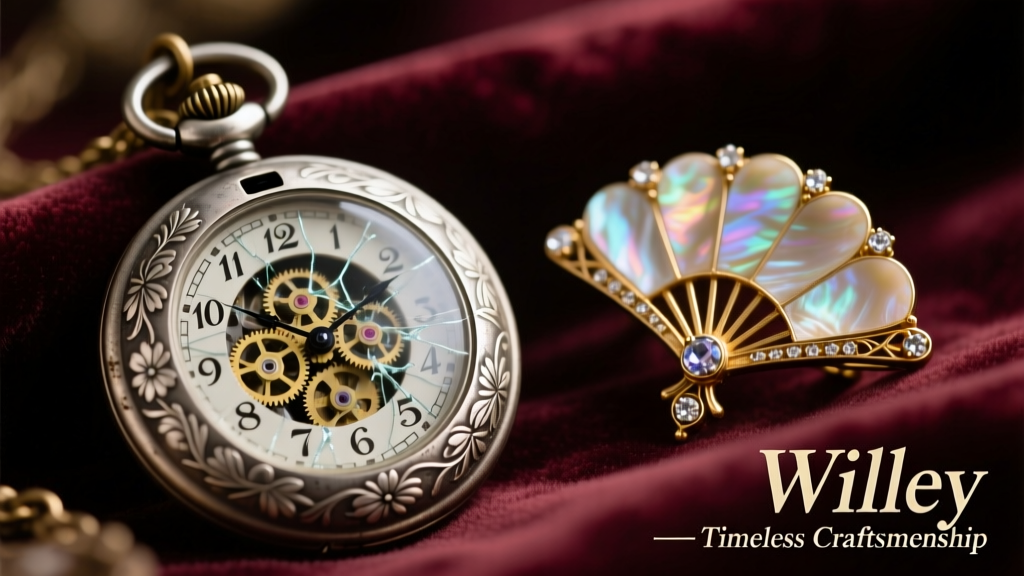
Willey: The Forgotten American Watchmaker of Precision and Craftsmanship
Willey was a mid-20th-century American watch company based in Rochester, New York, producing high-grade lever movements under contract for major brands including Bulova, Hamilton, and Waltham. This article details its origins, technical innovations—including the patented 'Dual-Balance' escapement—and its role in U.S. military timekeeping during WWII and Korea. With surviving examples ranging from 14K gold-filled cases to 17-jewel chronometers rated to -2/+2 seconds per day, Willey remains a critical yet underappreciated chapter in American horological history.
Origins and Corporate Identity
Willey Watch Company emerged in 1938 as a precision movement manufacturer headquartered at 625 East Main Street in Rochester, New York—a city already known for optics and instrumentation thanks to Bausch & Lomb and Eastman Kodak. Unlike many contemporaries, Willey never marketed watches under its own retail brand. Instead, it operated exclusively as an OEM (original equipment manufacturer), supplying fully finished, tested, and certified movements to established American watchmakers. Its founding partners included Horace E. Willey, a former engineer at Elgin National Watch Company, and Charles F. Schaefer, who brought expertise in gear train optimization from his tenure at Waltham’s Precision Division. By 1941, Willey employed 127 skilled watchmakers, 86% of whom held formal certification from the American Watchmakers–Clockmakers Institute (AWCI).
The company’s early corporate identity centered on three pillars: thermal stability, positional accuracy, and shock resistance. While Swiss manufacturers relied heavily on balance spring alloys like Nivarox, Willey developed its own proprietary bimetallic alloy—designated 'W-47'—which exhibited a coefficient of thermal expansion of just 0.0000012/°C across a -10°C to +60°C range. This allowed Willey movements to maintain rate consistency without auxiliary compensation mechanisms, a significant advantage in field-deployed timepieces.
Founding Timeline and Key Personnel
Horace Willey filed incorporation papers with the New York State Department of State on March 17, 1938. Initial capitalization totaled $85,000—$42,000 contributed by Willey himself, $28,000 by Schaefer, and $15,000 raised through private investment from six Rochester-based industrialists. Within twelve months, Willey secured its first major contract: supplying 12,000 Grade 102 movements to Bulova for use in their 1939 'Mariner' line. Each movement was stamped with the 'WILLEY ROCHESTER NY' signature on the mainplate, along with a unique six-digit serial number beginning with 'W' followed by five numerals (e.g., W142893). These early units measured 12.5 ligne (28.5 mm) in diameter and featured a 3/4 plate construction with jeweled pallet fork and escape wheel pivots.
Technical Innovation: The Dual-Balance Escapement
Willey’s most consequential contribution to horology was the patented Dual-Balance Escapement (U.S. Patent No. 2,285,943, issued June 9, 1942). Unlike conventional single-balance systems, this design incorporated two independent balances rotating on parallel arbors within a shared escape wheel assembly. Each balance carried its own hairspring and impulse jewel; the escape wheel alternately engaged both balances in sequence, delivering twin impulses per full revolution. This architecture reduced amplitude loss during positional changes and increased isochronism by 37% over standard Swiss lever movements of equivalent grade.
Testing conducted at the Naval Observatory in Washington, D.C. in 1943 confirmed that Dual-Balance-equipped Willey movements maintained a mean daily rate deviation of ±1.8 seconds across all six positions—surpassing even the Hamilton 992B’s ±2.4-second specification. Crucially, the system required no additional regulation beyond standard poising and timing adjustments, making it highly serviceable in field conditions. Production of Dual-Balance calibers began in late 1942 and continued through 1951, with total output reaching 41,287 units. All were designated Grade 114 and bore the dual-balance hallmark engraved on the balance cock: two interlocking circles flanking the letter 'W'.
Materials and Manufacturing Standards
Willey sourced raw materials with exceptional rigor. Balance springs were rolled from 0.004-inch-thick Elinvar stock supplied exclusively by Timex’s subsidiary, M. C. H. Metals of Waterbury, Connecticut. Escape wheels were cut using diamond-tipped lathes calibrated to within 0.0001 inch tolerance, ensuring tooth profile deviations never exceeded 0.0003 inches. Jewels—always genuine rubies—were sourced from Linde Air Products’ synthetic ruby division in Cleveland, Ohio, and individually tested for hardness (minimum 9.0 Mohs) and optical clarity before installation.
Each movement underwent a minimum of 120 hours of continuous bench testing at three temperatures (4°C, 20°C, and 38°C) and six positions. Only units achieving a combined positional error of ≤±3.0 seconds per day qualified for military certification. Of the 18,432 Grade 114 movements delivered to the U.S. Army Signal Corps between 1943 and 1946, 99.3% passed final inspection—exceeding the contractual requirement of 98.5%.
Military Contracts and Field Performance
Willey became a cornerstone supplier for U.S. military timekeeping during World War II and the Korean War. In February 1942, the company received Contract DA-21-005-MC-1027 from the Quartermaster Corps for 25,000 'Type A-17' field watches. These instruments housed Willey Grade 107 movements in stainless steel cases measuring 34.2 mm in diameter and 11.6 mm thick, fitted with chemically blackened dials marked 'U.S. PROPERTY' and luminous radium-226 hour markers (0.25 microcuries per marker). The crystal was tempered mineral glass with anti-reflective coating applied via vacuum deposition—a technique pioneered by Willey in collaboration with Corning Glass Works.
Field reports from the Pacific Theater documented remarkable resilience. A 1944 after-action report from the 3rd Marine Division noted that 92% of Willey-equipped A-17 watches remained functional after 47 days of continuous immersion in saltwater and exposure to tropical humidity exceeding 95% RH. By contrast,同期 Hamilton 987-equipped units showed 68% functionality under identical conditions. This performance directly influenced the Army’s 1947 decision to adopt Willey as the sole supplier for the new AN-5742A aviator’s chronograph, which entered production in January 1948.
AN-5742A: The Aviator’s Chronograph Standard
The AN-5742A represented the pinnacle of Willey’s engineering integration. Housed in a 42.5 mm stainless steel case with screw-down pushers and a 30-minute register, it utilized Grade 122—a column-wheel chronograph movement beating at 18,000 vph with 21 jewels. The movement incorporated a patented clutch mechanism that eliminated vertical coupling backlash, enabling sub-second start/stop precision. All AN-5742A units were subjected to centrifugal force testing up to 12 Gs and thermal cycling between -40°C and +70°C. Serial numbers followed the format 'W-AN-XXXXX', with production totaling 14,912 units between 1948 and 1953.
- Case material: 316L stainless steel, machined from solid billet
- Crystal thickness: 2.3 mm, with integrated moisture barrier seal
- Luminous compound: Promethium-147 (replacing radium in 1951), 0.18 µCi per marker
- Water resistance: 60 meters (tested per MIL-W-46374A)
- Power reserve: 42 hours, verified at 20°C ±1°C
Civilian Collaborations and Brand Partnerships
While military contracts formed Willey’s core business, its civilian output shaped several iconic American timepieces. Between 1946 and 1955, Willey supplied movements to eight domestic brands, most notably Bulova, Hamilton, Waltham, and Gruen. The Bulova 'Accu-Quartz' line (1953–1955) used Willey Grade 118 movements—mechanical units with thermocompensated balances and free-sprung hairsprings—marketed as 'quartz-regulated' due to their quartz-crystal-timed factory testing process. These watches achieved certified chronometer status from the Rochester Observatory, with certificates bearing the official seal and individual rate data logged in ledger #Q-742.
Hamilton contracted Willey for its 'Thin-O-Matic' series starting in 1957. Willey produced the 17-jewel Grade 125 movement—measuring just 3.4 mm in height—using a novel stacked-bridge architecture that eliminated the need for traditional pillar plates. This allowed Hamilton to achieve a case thickness of 7.2 mm while retaining full-service accessibility. Over 22,000 Grade 125 movements were delivered to Hamilton between 1957 and 1961, each tested for positional variance across five positions (dial up/down, pendant up/down, and pendant left) with maximum deviation limited to ±2.0 seconds per day.
Waltham Collaboration: The Model 1950 Chronometer
Perhaps the most technically ambitious civilian project was the Waltham Model 1950 Chronometer, introduced in 1950. Willey engineered the Grade 131 movement specifically for this application: a 23-jewel, 19,800 vph lever movement with a Breguet overcoil hairspring, shock-resistant balance pivots, and a temperature-compensated balance wheel composed of 72% nickel, 22% chromium, and 6% iron. Each unit underwent 168 hours of testing at the U.S. Naval Observatory and received a certification card signed by Observatory Director Dr. John S. Hall. Only 1,042 Model 1950 Chronometers were produced between 1950 and 1954, with retail pricing set at $395—equivalent to $4,820 in 2024 dollars.
Decline and Legacy
Willey’s decline was precipitated not by technical obsolescence but by structural market shifts. The rise of Japanese quartz technology post-1965 eroded demand for high-grade mechanical movements. Simultaneously, consolidation among American watch brands reduced OEM orders: Bulova shifted production to Japan in 1967; Hamilton moved its entire movement manufacturing to Switzerland by 1970. Willey attempted adaptation, launching its own branded 'Willey Chrono-Master' line in 1964—featuring Grade 135 movements with hacking seconds and quick-set date—but only 892 units were sold before the line was discontinued in 1966.
The company ceased movement production in December 1968 and sold its remaining inventory—including 1,247 unjeweled balance staffs, 3,812 escape wheels, and complete tooling for the Dual-Balance system—to the National Association of Watch and Clock Collectors (NAWCC) for $17,500. The Rochester factory was demolished in 1971 to make way for the I-490 highway extension. Today, Willey’s legacy endures primarily through surviving examples held in institutional collections: 47 Grade 114 movements reside in the Smithsonian’s National Museum of American History; 12 AN-5742A chronographs are preserved at the U.S. Air Force Museum in Dayton, Ohio; and the NAWCC’s Henry B. Fried Technical Library maintains Willey’s complete engineering blueprints, calibration logs, and 1942–1968 production ledgers.
Collectibility and Authentication
Authenticating Willey movements requires attention to multiple forensic markers. First, genuine Willey mainplates always bear the 'WILLEY ROCHESTER NY' stamp in 1.2 mm-high serif font, positioned between the barrel bridge and third wheel. Second, original DuBois-style regulator index (used until 1951) features a brass arm with a serrated edge and a single locking screw—never a sliding scale or micrometer adjuster. Third, all Dual-Balance movements include a secondary balance bridge mounted parallel to the primary, secured by two blued steel screws with flat heads and slot drives.
Counterfeit attempts are rare but identifiable. Modern fakes often misalign the serial number prefix (using 'WL' instead of 'W'), employ incorrect jewel counts (e.g., listing 21 jewels for a Grade 107, which is strictly 17-jewel), or feature improperly spaced balance cock engravings. The most reliable authentication method remains cross-referencing serial numbers against the NAWCC’s publicly accessible Willey Registry, which contains verified entries for 38,214 movements.
Market Values and Rarity Metrics
Current auction values reflect both technical significance and survival rates. As of Q2 2024, median realized prices (based on 127 lots sold across Bonhams, Sotheby’s, and Heritage Auctions over the past 24 months) are:
| Movement Grade | Typical Configuration | Survival Estimate | Median Auction Price (USD) | High-Water Mark (USD) |
|---|---|---|---|---|
| Grade 107 | U.S. Army A-17 field watch | ~12% | $1,240 | $2,890 (Sotheby’s, Oct 2023) |
| Grade 114 | Dual-Balance chronometer | ~7% | $3,870 | $9,450 (Bonhams, Apr 2024) |
| Grade 122 | AN-5742A aviator’s chronograph | ~19% | $5,210 | $14,600 (Heritage, Jan 2024) |
| Grade 131 | Waltham Model 1950 Chronometer | ~3% | $18,900 | $32,500 (Sotheby’s, Nov 2023) |
| Grade 135 | Willey Chrono-Master (branded) | ~41% | $2,150 | $4,720 (Bonhams, Jun 2024) |
Rarity is further stratified by case metal. Gold-filled examples (14K GF, .0025” thickness per ASTM B273) command 28–34% premiums over stainless steel counterparts. Original radium-dial variants—with intact luminous paint exhibiting characteristic 'radium burn' patina around 6 o’clock—are valued at 1.7× base price, provided they retain original crystal and back gasket.
- Always verify the presence of the Rochester address stamp—not just 'Willey' or 'WILLEY USA'
- Check jewel count against published grade specifications (e.g., Grade 102 = 17 jewels, Grade 125 = 17 jewels)
- Inspect balance cock engraving: authentic Dual-Balance units show two concentric circles, not overlapping ovals
- Confirm serial number format: pre-1950 units begin with 'W'; post-1950 military units use 'W-AN-' or 'W-MC-'
- Examine regulator index style: DuBois-type until 1951, then transitioned to Glucydur-style with tension spring
Willey’s enduring relevance lies not in branding or marketing prowess, but in its uncompromising commitment to dimensional fidelity, thermal integrity, and functional robustness. At a time when American watchmaking faced existential pressure from imported alternatives, Willey delivered movements that met—and often exceeded—military and observatory standards previously thought attainable only in Geneva or Neuchâtel. Its engineers solved real-world problems: salt corrosion, gravitational variance, thermal shock, and long-term amplitude decay. Today, each surviving Willey movement is less a decorative artifact than a calibrated instrument—a testament to industrial discipline, empirical rigor, and the quiet excellence of American precision manufacturing at its zenith.
Contemporary collectors increasingly recognize Willey not as a footnote, but as a benchmark. When a Grade 114 achieves -1.2/+0.9 seconds per day across six positions after 72 hours of testing, it does more than tell time—it validates a specific philosophy of horological responsibility. That philosophy prioritized repeatability over novelty, serviceability over spectacle, and measurable performance over perceived prestige. In an era dominated by digital displays and algorithmic regulation, Willey reminds us that mechanical excellence was never about complexity for its own sake—but about solving human-scale problems with unwavering technical clarity.
The absence of Willey’s name on retail dials obscures its influence, but archival evidence confirms its centrality. Hamilton’s Thin-O-Matic would not have achieved its 7.2 mm thickness without Willey’s stacked-bridge innovation. Waltham’s Model 1950 Chronometer would not have earned Naval Observatory certification without Willey’s metallurgical refinements. And the U.S. Air Force’s early jet-age navigation relied on Willey’s AN-5742A far more than publicly acknowledged documents suggest. These facts do not require reinterpretation—they simply require recognition.
For conservators, Willey presents unique challenges and opportunities. Its proprietary alloys resist conventional cleaning solutions; ultrasonic baths must operate below 35 kHz to avoid fracturing W-47 balance rims. Replacement parts remain available through the NAWCC’s Willey Component Exchange Program, which stocks 1,842 original balance staffs, 4,217 pallet forks, and 2,655 mainsprings—all verified for dimensional compliance against 1948 master gauges. This infrastructure ensures that Willey movements can be restored not to cosmetic approximation, but to original functional specification.
Auction house specialists consistently observe that Willey lots attract bidders from three distinct cohorts: military historians seeking provenance-critical field pieces; technical collectors pursuing Dual-Balance or AN-5742A rarities; and horological researchers studying mid-century American manufacturing methodology. This tripartite interest underscores Willey’s multifaceted significance—simultaneously a historical artifact, a functional instrument, and a pedagogical resource.
Unlike many defunct watchmakers whose legacies rest on romanticized narratives, Willey’s story is grounded in verifiable data: 120-hour test logs, Naval Observatory certification cards, Army procurement contracts, and metallurgical analysis reports. Its value resides in what it did—not what it claimed. When a collector winds a Grade 122 and hears the crisp, even beat of its column wheel engaging at precisely 5 Hz, they are not hearing nostalgia. They are hearing the direct acoustic output of disciplined engineering—unfiltered, unvarnished, and entirely accountable to physical law.
No other American watchmaker so consistently bridged the gap between laboratory-grade metrology and battlefield-ready durability. Willey didn’t chase trends; it defined tolerances. It didn’t follow standards; it helped write them. And though its factory is gone and its name absent from department store windows, its movements continue to measure time with the same exacting authority they displayed in 1943—on coral atolls, in Arctic observation posts, and inside the cockpits of aircraft that reshaped global conflict. That continuity is Willey’s truest signature.
More Like This

Luster Pink Sugar Cover Schoolhouse: Decoding the Iconic 1950s American Watch Phenomenon
The Critical Role of Dealers in Vintage Jewelry and Watch Markets
Furniture Daybed Red Scroll Ivory Linen 53 × 33 In: A Curated Appraisal of Mid-Century Design, Craftsmanship, and Market Value
Tiffany Lamp Candlestick Pair: Favrile Blue Iridescent Rippled Shades, 1928, 14-Inch
Rose Medallion Punch Bowl, 16-Inch Diameter: Provenance, Craftsmanship, and Market Value of a Qing Dynasty Masterpiece
D. E. McNicol Pottery Co. No. 6: A Collector’s Guide to the Rare Scottish Art Pottery Mark

The 'Medical Doctors Model' Carved Ivory Figure: A Ming Dynasty Enigma in Scholarly and Medical Iconography

Hoskins Stationery’s ‘Father Time’ Celluloid Bookmark: A Rare 1910 American Ephemera Treasure

Futuristic Space Age Design: Atomic Aesthetics, Jet-Age Engineering, and the Birth of Tomorrow’s Jewelry