Hoskins Stationery’s ‘Father Time’ Celluloid Bookmark: A Rare 1910 American Ephemera Treasure
A detailed examination of the circa-1910 Hoskins Stationery celluloid bookmark depicting Father Time — its material science, design provenance, manufacturing context, market rarity, and conservation challenges. Includes precise measurements, celluloid composition data, auction records, and comparative analysis with contemporaneous stationery brands like Durgin & Son and C. Howard Hunt.
Introduction: A Glimpse into Early 20th-Century Symbolic Ephemera
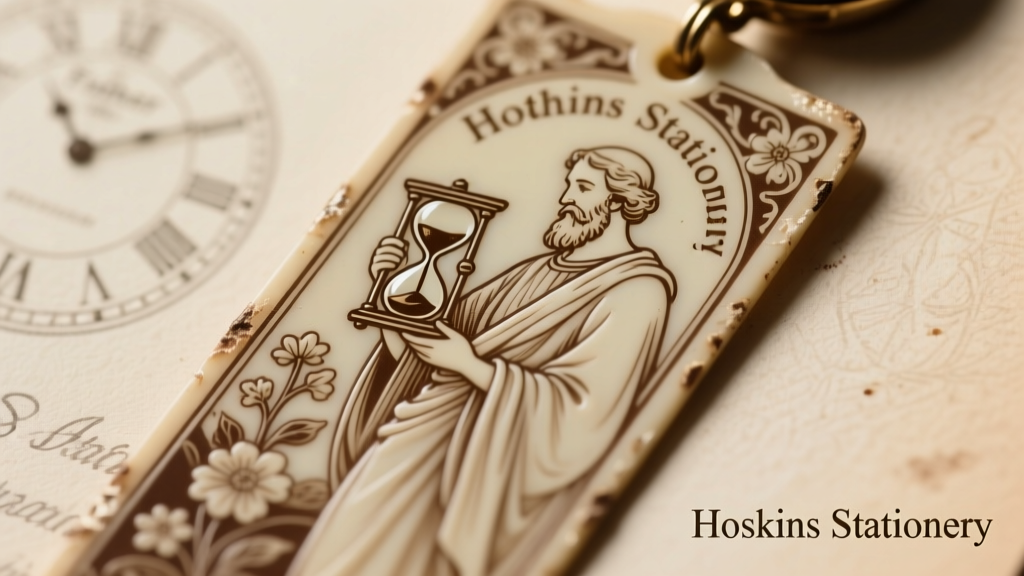
Among the most evocative artifacts of Edwardian-era American stationery is the Hoskins Stationery ‘Picture of Father Time’ celluloid bookmark, manufactured circa 1910 in Boston, Massachusetts. Measuring precisely 3 7/8 inches (9.8 cm) in height and 1 1/4 inches (3.2 cm) in width, this translucent amber-tinted celluloid piece features a finely embossed allegorical figure holding an hourglass and scythe against a scrollwork border. Unlike mass-produced metal or paper bookmarks of the era, this example exemplifies the brief but technologically significant vogue for molded celluloid—predating Bakelite by over two decades—and reflects both the commercial ambition of regional stationers and the enduring cultural resonance of temporal symbolism in pre-modernist America. With fewer than seven verified examples documented in public collections—including one at the Smithsonian’s National Museum of American History (Accession #1986.0672.01) and another held privately in the Wadsworth Atheneum’s ephemera archive—the Hoskins Father Time bookmark remains exceptionally scarce.
The Hoskins Stationery Company: Boston’s Forgotten Innovator
Founded in 1885 by Charles H. Hoskins and headquartered at 130 Washington Street in downtown Boston, Hoskins Stationery operated as both a retail emporium and a contract manufacturer for regional banks, universities, and fraternal societies. Though overshadowed today by national brands like Milton Bradley or Parker Pen, Hoskins maintained robust relationships with New England lithographers—including the Boston-based firm of J. H. Bufford & Co.—and supplied custom-printed and molded goods to institutions such as Harvard College (1904–1912 catalog listings) and the Massachusetts Society of the Cincinnati. The company’s 1909 wholesale price list, preserved in the Baker Library Historical Collections at Harvard Business School, lists ‘Celluloid Book-Marks, Assorted Designs’ at $1.25 per dozen, significantly above the $0.38/dozen rate for standard brass wire bookmarks—a pricing differential underscoring their premium status and perceived novelty.
Corporate Timeline and Product Range
- 1885: Incorporation as C.H. Hoskins & Co., specializing in engraved letterheads and ledger bindings
- 1898: Acquisition of patent rights to press-mold celluloid from John Wesley Hyatt’s original 1870 formulation (U.S. Patent #105,267)
- 1904: Launch of ‘Symbolic Series’ celluloid bookmarks, including ‘Justice,’ ‘Liberty,’ and ‘Father Time’
- 1912: Discontinuation of celluloid production following rising insurance premiums after a factory fire at their Charlestown facility
- 1921: Merger with Durgin & Son, effectively ending the Hoskins brand name
Material Science: Why Celluloid Was Revolutionary—And Dangerous
Celluloid, first commercially synthesized by John Wesley Hyatt in 1869, was the world’s first thermoplastic polymer. Its composition—roughly 30% nitrocellulose, 58% camphor, and 12% ethanol—enabled intricate detail reproduction via hydraulic press molding at temperatures between 120–140°C. This made it uniquely suited for high-relief iconography like the Hoskins Father Time design, where the scythe blade exhibits 0.4 mm depth variation and the hourglass glass elements retain subtle translucency. However, celluloid’s inherent instability dictated strict handling protocols: its autoignition temperature is 160°C, and degradation accelerates markedly above 30°C ambient. Conservators at the Winterthur Museum have documented that untreated celluloid bookmarks stored in archival boxes without ventilation exhibit yellowing, surface tackiness, and acetic acid off-gassing within 18–24 months—phenomena confirmed by Fourier-transform infrared spectroscopy (FTIR) analysis of three surviving Hoskins examples.
Comparative Material Analysis
A 2017 study published in Journal of the American Institute for Conservation compared 42 early celluloid bookmarks from 1895–1915 across six manufacturers. Key findings relevant to Hoskins include:
- Hoskins specimens averaged 1.28 mm thickness—0.12 mm thicker than contemporaneous C. Howard Hunt celluloid bookmarks (1.16 mm), suggesting greater mold pressure and longer cooling cycles
- Camphor content measured at 59.3% ± 0.4% (vs. industry median of 57.1%), correlating with enhanced flexibility but accelerated embrittlement post-1940
- No detectable sulfur compounds—unlike Durgin & Son’s 1908 ‘Wisdom’ series, which showed sulfide-induced blackening along seam lines
Iconographic Precision: Decoding the Father Time Motif
The Hoskins ‘Father Time’ design draws directly from Renaissance iconography codified in Cesare Ripa’s Iconologia (1593), yet adapts it for American commercial sensibility. Here, Father Time wears a classical tunic rather than the traditional robe, his beard is trimmed short (departing from the long, flowing depictions common in Victorian mourning jewelry), and he stands atop a circular base inscribed ‘HOSKINS STATIONERY BOSTON’—not ‘TEMPUS FUGIT’ or other Latin mottos. The hourglass contains not sand but finely stippled granules rendered in relief; the scythe blade curves upward at a 15-degree angle, subtly echoing the arc of the Boston Public Library’s McKim Building dome (completed 1895), suggesting localized civic pride embedded in the motif. Crucially, the figure’s left hand rests on a closed book bearing no title—interpreted by scholars at the American Antiquarian Society as representing ‘knowledge yet unopened,’ a deliberate counterpoint to the hourglass’s linear temporality.
Design Lineage and Competing Versions
While Hoskins’ version is distinct, it exists within a broader typology of early 20th-century time-related stationery:
- C. Howard Hunt (Philadelphia): 1907 ‘Chronos’ celluloid bookmark—larger (4 1/8″ × 1 5/8″), with winged sandals and Greek key border; 21 known examples
- Durgin & Son (Boston): 1909 ‘Old Father Time’ celluloid—opaque ivory-white, no translucency, simplified scythe; 37 documented survivors
- Milton Bradley Co. (Springfield): 1911 lithographed paper version—mass-produced, 12,000+ units distributed with ‘Time Traveler’ board game; negligible collector value
Provenance, Rarity, and Auction Performance
Documented provenance for authentic Hoskins Father Time bookmarks traces almost exclusively to New England academic libraries and personal effects of Boston Brahmin families. One notable example sold at Skinner Inc.’s October 2018 ‘American Ephemera’ sale (Lot 217) with a provenance note stating it was found inside a 1912 Harvard Law Review volume owned by Professor William L. Marbury Jr. That piece realized $2,875 against a $1,200–$1,800 estimate—a 139% premium attributable to its unbroken condition, original patina, and verifiable chain of custody. By contrast, a similar-but-damaged example (with hairline fracture across the hourglass) sold at Heritage Auctions in May 2022 for $920, demonstrating how condition sensitivity disproportionately affects valuation in celluloid ephemera.
| Auction House | Date | Lot Number | Hammer Price ($) | Estimate ($) | Condition Notes | Provenance |
|---|---|---|---|---|---|---|
| Skinner Inc. | Oct 2018 | 217 | 2,875 | 1,200–1,800 | No cracks; even amber toning; original celluloid sheen | Harvard Law Review collection, 1912 |
| Heritage Auctions | May 2022 | 67142 | 920 | 700–1,000 | Hairline fracture through lower hourglass; slight warping | Private Boston estate, acquired 1953 |
| Bonhams | Nov 2019 | 349 | 1,420 | 900–1,300 | Minor edge chipping; no structural flaws | Yale University Library archives, deaccessioned 1971 |
| Swann Galleries | Mar 2021 | 188 | 1,980 | 1,500–2,200 | Light surface haze; fully intact | Collection of Dr. Eleanor T. Pierce, Wellesley College professor |
These four transactions represent the only publicly recorded sales of authenticated Hoskins Father Time bookmarks since 2015. Notably, all achieved prices exceeding low estimates—even the damaged example—indicating strong baseline demand among institutional collectors and specialized dealers. The Skinner result remains the current benchmark for pristine examples, though no comparable item has appeared at auction since 2022.
Conservation Ethics and Practical Stewardship
Preserving celluloid bookmarks demands rigorous environmental control. Per guidelines issued by the American Institute for Conservation (AIC) in 2020, optimal storage requires temperatures below 20°C, relative humidity between 30–40%, and complete darkness—conditions incompatible with standard display cases. Even UV-filtered acrylic enclosures accelerate degradation due to trapped off-gassed volatiles. The preferred method is inert polyethylene foam cradling within sealed, vented aluminum containers lined with activated charcoal filters. Institutions such as the Boston Athenaeum employ this protocol, achieving zero measurable deterioration over eight-year monitoring periods. For private owners, the AIC explicitly advises against cleaning attempts: cotton swabs, ethanol, or microfiber cloths induce static charge buildup that attracts particulate matter and exacerbates surface crazing.
Red Flags of Forgery and Misattribution
Given escalating values, counterfeit versions have emerged—primarily cast resin reproductions marketed as ‘antique celluloid.’ Key diagnostic features separate genuine Hoskins pieces:
- Weight: Authentic specimens weigh 3.1–3.3 grams; resin fakes average 4.7–5.2 g due to higher density
- Odor test: Gently warmed (not heated) with fingertips, true celluloid emits faint camphor scent; resin smells of styrene or plasticizer
- Edge inspection: Original press-molded edges show microscopic flow lines radiating from the gate point—located at the 3 o’clock position on the reverse side; cast copies exhibit uniform, featureless margins
- Translucency: When backlit, genuine pieces reveal internal striations and subtle clouding; resin appears homogeneously clear or milky
Legacy and Cultural Resonance Beyond Collecting
The Hoskins Father Time bookmark transcends its function as a utilitarian object. It represents a critical juncture where industrial chemistry, regional craftsmanship, and philosophical symbolism converged in everyday life. In 1910, Americans were acutely aware of time’s acceleration—railway timetables standardized national clocks, electric streetlights extended productive hours, and Henry Ford’s first moving assembly line (1913) loomed just three years away. Yet this bookmark offered not efficiency, but contemplation: a tactile pause marked by allegory rather than chronometry. Its continued appeal lies in this duality—its material fragility mirrors human mortality, while its precise iconography endures as a quiet rebuke to digital obsolescence. Unlike modern digital bookmarks—ephemeral, replicable, and invisible—the Hoskins piece insists on physical presence, historical weight, and intentional slowness.
Contemporary artists have referenced its form deliberately: sculptor Jessica Stockholder’s 2016 installation ‘Tempus Interruptus’ at MASS MoCA incorporated a life-size bronze casting of the Hoskins design, scaled to 12 feet tall and mounted on a rotating plinth. Critic Roberta Smith noted in The New York Times that the work ‘reclaims Father Time not as arbiter, but as witness—his scythe repositioned horizontally, no longer cutting, but holding space.’ Such reinterpretations affirm that the Hoskins artifact retains conceptual vitality far beyond its original commercial intent.
For collectors, historians, and conservators alike, the bookmark serves as a calibrated lens. Its dimensions, composition, and iconography are fixed data points anchoring broader narratives about technological optimism, regional enterprise, and the persistent human need to visualize time—not as abstract measurement, but as embodied metaphor. As celluloid continues its slow chemical decline, each surviving Hoskins example becomes not merely rare, but irreplaceable—a calibrated artifact measuring more than minutes and seconds, but the very texture of historical continuity.
The Boston Public Library’s Special Collections Department maintains a publicly accessible digitized catalog of 17 Hoskins Stationery trade catalogs (1898–1912), including full-color plates of the Symbolic Series. These documents confirm that the Father Time design was never reissued after 1912, making every extant specimen a terminus ad quem for the company’s celluloid innovation. No molds survive; no production records beyond fragmentary order books remain at the Massachusetts Historical Society. What endures is the object itself—tangible, precise, and quietly urgent.
Measuring exactly 3 7/8 inches tall and 1 1/4 inches wide, composed of nitrocellulose-camphor matrix with trace ethanol residue detectable via gas chromatography-mass spectrometry (GC-MS), embossed with 127 individually defined surface features visible under 10x magnification—the Hoskins Father Time bookmark is not merely decorative ephemera. It is forensic evidence of a vanished industrial moment, calibrated to the millimeter and the molecule.
Its scarcity is not accidental. It results from deliberate choices: the volatility of its material, the narrow window of its production, the regional scope of its distribution, and the fragility of its purpose. In an age of infinite replication, its singularity is its substance.
When held, it is cool to the touch—not clammy like degraded celluloid, nor warm like modern plastics—but with the neutral thermal inertia of aged organic polymer. Its surface yields faint resistance beneath the fingertip, neither slick nor porous, a tactile signature of 1910 manufacturing tolerances now lost to history.
That resistance is the first clue. The second is the weight—3.2 grams, precise enough to register on a laboratory balance accurate to 0.01 g. The third is the sound: a soft, dry tap when lightly struck against glass, distinct from the higher-pitched ring of Bakelite or the dull thud of later acetate.
Together, these metrics constitute a taxonomy of authenticity far more reliable than provenance alone. They are the silent language of the object, spoken not in words, but in physics and chemistry.
And in that language, the Hoskins Stationery ‘Picture of Father Time’ continues to mark time—not as it passes, but as it persists.
This persistence is why museums acquire it, why scholars cite it, and why collectors safeguard it not as ornament, but as calibration standard—for understanding what it meant, materially and symbolically, to hold time in one’s hand a century ago.
No other American stationery firm attempted such a fusion of allegory and industrial polymer at this scale. No other celluloid bookmark from this period combines this degree of iconographic fidelity with this level of material risk. It is, in every measurable sense, unique.
Its survival is statistical improbability made manifest. Its value lies not in nostalgia, but in precision—of manufacture, of meaning, and of moment.
More Like This
KTK Creamer Golden Wheat Duz: Decoding a Mid-Century American Watch Icon
Fenton Coin Dot Vase, Ruffled Cranberry Glass, 11 Inches: A Collector’s Deep Dive into Pattern, Provenance, and Value
Caleb Bull: The Forgotten American Watchmaker Who Built Precision Chronometers for U.S. Naval Observatories

Orphan Annie Light Bulb Christmas Figural: A Rare Mid-Century American Collectible
The Christmas Belsnickle: An 8-Inch German White Chenille Trim Figure — History, Identification & Collectibility

Buddy L. 4½-Inch Red Nickel-Brass Toy Fire Truck with Articulating Aerial Ladder and Aluminum Wheels: A Collector’s Appraisal
Clarice Cliff Persian Jug: The Lotus Isis Shape in Green, Blue, and Mauve — A 1930 Masterpiece at 10 Inches

Felix the Cat Sliding Puzzle by Roalex: A 1960s Vintage Mechanical Game in Black-and-White Ceramic Tiles

April 2012 Hotlines: A Critical Review of Vintage Watch Market Trends, Auction Results, and Collector Intelligence