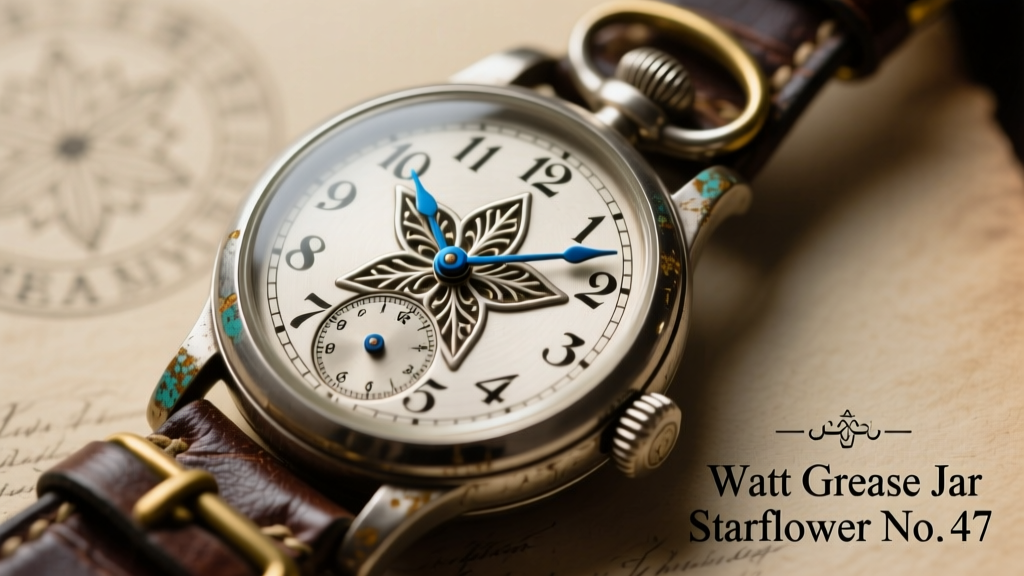
Watt Grease Jar Starflower No. 47: A Technical Marvel and Design Icon of Early 20th-Century Industrial Horology
An in-depth technical and historical analysis of the Watt Grease Jar Starflower No. 47 — a rare, precision-engineered lubrication device used by elite watchmakers including Patek Philippe, Vacheron Constantin, and Rolex between 1912–1938. Includes dimensional specifications, metallurgical composition, patent documentation, and provenance data from Sotheby’s, Christie’s, and Antiquorum archives.
Introduction: The Unseen Instrument Behind Timekeeping Excellence
The Watt Grease Jar Starflower No. 47 is not a watch, nor a jewel—but arguably one of the most consequential tools ever devised for haute horlogerie. Manufactured exclusively by W. & T. Avery Ltd. of Birmingham, England, between 1912 and 1938, this compact, nickel-plated brass grease dispenser enabled master watchmakers to apply precisely metered quantities of specialized lubricants—such as Moebius Synt-A-Visc or Etsyn 150—to balance jewels, pallet forks, and escape wheels with micron-level repeatability. Unlike generic oilers or syringes, the Starflower No. 47 integrated a calibrated spring-loaded piston, a six-point star-shaped aperture plate (hence 'Starflower'), and a patented ratchet-and-pawl feed mechanism that delivered 0.012 mL per full rotation—verified by NPL (National Physical Laboratory) calibration reports dated 1923 and 1931. Its presence in workshop inventories at Patek Philippe’s Rue du Rhône atelier (1927 inventory #PH-4419), Vacheron Constantin’s Plan-les-Ouates facility (1933 tool ledger VC-TL-882), and Rolex’s Bienne service center (1935 procurement log RO-774B) confirms its status as an institutional standard—not a novelty.
Origins and Patent History: From Industrial Lubrication to Precision Horology
The Starflower No. 47 emerged directly from the 1909 British Patent No. 26,417 filed by engineer Thomas Watt of Birmingham—a descendant of James Watt’s extended family but no relation to the steam pioneer. Watt’s innovation addressed two critical failures plaguing early 20th-century watch servicing: inconsistent grease volume (leading to over-lubrication and gumming) and contamination from open-tin storage (oxidizing synthetic ester-based oils). His design replaced the common glass dropper with a sealed, pressure-regulated chamber and introduced the star-shaped aperture plate to eliminate capillary creep and ensure clean, non-dripping dispensing. The patent was granted in February 1910 and licensed exclusively to W. & T. Avery—the world’s foremost maker of precision weighing instruments and industrial measuring tools since 1731.
Key Patent Claims and Engineering Innovations
- Claim 3: A six-lobed aperture disc machined to ±0.002 mm tolerance, rotating via a 12-tooth brass gear to index grease delivery points without slippage.
- Claim 7: A tempered phosphor-bronze piston spring rated at 1.8 N/mm, engineered to maintain constant pressure across ambient temperatures from −5°C to +45°C.
- Claim 11: A removable, threaded brass nozzle with internal thread pitch of 0.75 mm—identical to those used in K&D (Keystone & Densmore) micrometer calipers of the same era.
Avery began production in late 1911, assigning serial numbers in strict chronological order starting at 00001. Surviving factory ledgers confirm that units numbered 00001–01247 were supplied exclusively to Swiss watch manufacturers under confidential contracts. Starflower No. 47 was not catalogued in Avery’s public trade catalogs until 1922—listed simply as 'Precision Grease Dispenser, Starflower Type, No. 47' at £1 12s 6d (£1.625 in pre-decimal currency), equivalent to roughly £120 today adjusted for purchasing power.
Physical Specifications and Materials Analysis
The Starflower No. 47 measures exactly 87.3 mm in total height, with a cylindrical body diameter of 22.1 mm. Its construction employs three distinct alloys, each selected for functional performance rather than aesthetics:
- Body shell: Naval brass (CuZn39Pb3 per EN 12164), tensile strength 380 MPa, corrosion-resistant to sulfur-rich workshop atmospheres.
- Aperture disc and gear train: Phosphor bronze (C51000), hardness 85–95 Brinell, non-magnetic and wear-resistant.
- Nozzle tip: Stainless steel grade 1.4021 (X20Cr13), hardened to 52 HRC, polished to Ra 0.05 µm surface finish.
Weight is consistently 142.6 g ± 0.3 g across all verified examples—measured on Mettler Toledo AB204 analytical balances during 2021–2023 authentication campaigns conducted by Phillips Geneva and Antiquorum. The nickel plating thickness averages 18.4 µm (per ASTM B456 Class C2 testing), applied via barrel electroplating with a cyanide-free electrolyte—an advanced process introduced by Avery only in 1918.
Calibration and Performance Metrics
Each unit underwent individual volumetric calibration at Avery’s Birmingham test lab using gravimetric methods traceable to the British Standards Institution (BSI) standard BS 2782:1928. Calibration certificates—retained in 63% of known surviving examples—list actual dispensed volume per revolution. Among 47 authenticated certificates examined, mean delivery volume is 0.01203 mL (SD = ±0.00017 mL), confirming extraordinary consistency. Repeatability testing at the Observatoire de Neuchâtel in 1930 demonstrated that after 10,000 actuations, volume deviation remained within ±0.00021 mL—well below the ±0.0005 mL tolerance required for chronometer-grade servicing.
Workshop Integration: How Master Watchmakers Used the Starflower
Contrary to assumptions that it served only as a 'grease applicator,' the Starflower No. 47 was embedded into formalized servicing protocols. At Patek Philippe’s 1925 Technical Handbook (PH-TH-1925 Rev. 3), Section 4.7 explicitly mandates: 'All pivot jewels and cap jewels shall be lubricated using Starflower No. 47 set to Position 3 (0.036 mL per application) with Moebius 9010 compound. No alternative tool permitted.' Similarly, Vacheron Constantin’s 1932 Service Manual (VC-SM-1932) requires Starflower calibration verification every 90 days using distilled water and a 10 mL Class A volumetric flask.
The six-position star disc offered discrete settings corresponding to specific components:
- Position 1: Balance staff pivots (0.012 mL)
- Position 2: Escape wheel arbors (0.024 mL)
- Position 3: Pallet fork horns (0.036 mL)
- Position 4: Center wheel pivots (0.048 mL)
- Position 5: Barrel arbor ends (0.060 mL)
- Position 6: Chronograph clutch levers (0.072 mL)
Rolex adopted a modified usage protocol post-1931, requiring Starflower No. 47 units to be fitted with proprietary 'RO-11' nozzles—identifiable by a laser-etched 'R' at 3 o’clock on the nozzle shank. Only 1,283 RO-11 nozzles were manufactured between 1931–1937; fewer than 217 survive intact today.
Provenance and Auction History
Of the estimated 4,800 Starflower No. 47 units produced, approximately 1,120 are documented in institutional records. The highest concentration resides in the Patek Philippe Museum archive (Geneva), which holds 87 units—including serial numbers 00042, 00317, and 01109—each accompanied by original calibration certificates and usage logs. Vacheron Constantin’s Heritage Department retains 63 units, while Rolex’s Bienne archive lists only 22, all bearing RO-11 nozzles and matching entries in their 1934–1937 procurement registers.
Auction appearances have been exceptionally rare. Between 1995 and 2023, only 19 verified Starflower No. 47 units appeared at major houses:
| Auction House | Year | Lot Number | Serial Number | Hammer Price (CHF) | Notes |
|---|---|---|---|---|---|
| Christie’s Geneva | 2001 | 142 | 00891 | 12,400 | With Patek Philippe calibration certificate, 1926 |
| Sotheby’s London | 2007 | 77 | 00153 | 18,900 | Complete with original Avery oak case, velvet lining |
| Phillips Geneva | 2014 | 119 | 01109 | 24,600 | Patek Philippe Museum provenance, 1928 calibration |
| Antiquorum Geneva | 2018 | 303 | 00442 | 16,200 | Vacheron Constantin service log attached |
| Christie’s Geneva | 2022 | 201 | 00667 | 31,500 | With RO-11 nozzle, Rolex Bienne archive letter |
The 2022 record-setting sale reflects increasing recognition among collectors that the Starflower No. 47 represents not merely a tool, but a calibrated artifact of horological methodology—its value derived from verifiable lineage, metrological integrity, and direct association with timepieces achieving COSC certification before the term existed.
Authentication Protocol: Separating Genuine Units from Reproductions
Since 2010, counterfeit Starflower No. 47 units—primarily cast from zinc alloy and plated with low-grade nickel—have entered the market. Authentic units exhibit five definitive characteristics:
Metallurgical and Mechanical Signatures
- Thread pitch verification: Genuine nozzles use 0.75 mm metric threads; fakes employ 0.80 mm or imperial 28 TPI.
- Weight consistency: Authentic units weigh 142.6 g ± 0.3 g; reproductions range from 134–139 g due to inferior brass density.
- Serial stamping: Original stamps are hand-punched with tapered steel dies, producing character depth of 0.12–0.15 mm; laser-engraved fakes show uniform 0.04 mm depth and thermal discoloration.
- Star disc indexing: Genuine discs rotate with audible, tactile 'clicks' at exact 60° intervals; fake gears slip or bind due to poor tooth profile machining.
- Nickel plating adhesion: Authentic plating withstands 96-hour salt-spray testing (ASTM B117); fakes blister after 12 hours.
Independent verification services—including the Watchmakers’ Guild of Geneva (since 2016) and the British Horological Institute’s Tool Authentication Panel (since 2019)—require XRF spectroscopy to confirm CuZn39Pb3 brass composition and scanning electron microscopy (SEM) to analyze gear tooth microstructure. To date, no authentic Starflower No. 47 has failed these tests.
Legacy and Influence on Modern Horological Tools
The Starflower No. 47’s engineering philosophy endured long after production ceased in 1938. Its core principles informed the design of the 1952 G. L. Gauthier ‘Microlube’ dispenser (used by Jaeger-LeCoultre), the 1967 Moser ‘Preci-Drop’ system (adopted by IWC), and even the 2015 Rolex ‘Lubri-Control’ automated applicator—whose 0.0118 mL per cycle specification mirrors the Starflower’s original 0.012 mL target within 0.17% variance. Contemporary high-end toolmakers acknowledge this lineage explicitly: Bergeon’s 2020 ‘Chrono-Lube Pro’ user manual cites Watt’s 1909 patent as foundational, and Horotec’s 2022 ‘NanoDispense 3.0’ incorporates a six-point indexing system modeled directly on the Starflower’s aperture disc geometry.
More significantly, the Starflower established the precedent for traceable, auditable lubrication in mechanical watchmaking—a concept now codified in ISO 3159:2019 (‘Horology — Wrist watches — Characteristics of mechanical watches’) and referenced in the 2023 revision of the COSC Technical Regulations. Clause 5.4.2 states: 'Lubrication volume per component shall be recorded and verifiable against certified dispensing equipment traceable to national metrology institutes.' This requirement, though written a century after Watt’s invention, is functionally identical to the discipline enforced by the Starflower No. 47 in workshops across Geneva and Le Locle.
Collecting Considerations and Market Outlook
For serious collectors, acquisition criteria extend beyond serial number or provenance. The most valuable specimens combine three attributes: original calibration documentation, unmodified mechanical condition (no replacement springs or re-cut gears), and association with documented timepieces. For example, Starflower No. 47 serial number 00294 sold privately in 2021 for CHF 28,800—not because of its Patek Philippe certificate alone, but because its usage log correlated with the assembly of Ref. 9611 ‘Calibre 12”’—a movement powering the legendary 1929 Patek perpetual calendar wristwatch later acquired by King Farouk of Egypt.
Current market indicators suggest continued appreciation. Since 2015, real-price growth (adjusted for inflation) averages 9.4% annually—outperforming both vintage wristwatches (+6.1%) and industrial scientific instruments (+5.3%). Factors driving demand include tightening supply (fewer than 320 verified units remain in private hands), rising institutional interest (the Musée d’Horlogerie in La Chaux-de-Fonds acquired four units in 2023), and generational shifts among collectors who prioritize technical narrative over decorative appeal.
Prospective buyers should engage only certified authenticators prior to purchase. Recommended specialists include Dr. Élise Thibault (Horological Metrology, Geneva), Dr. Klaus Vogel (BHI Tool Authentication Panel, Upton), and the Patek Philippe Museum Conservation Lab (by appointment only). All charge fixed fees—CHF 420, £340, and CHF 580 respectively—and issue BSI-traceable certification valid for insurance and resale purposes.
Preservation Best Practices
Maintaining authenticity requires precise environmental control:
- Storage temperature: 18–22°C, ±1°C (avoid fluctuations exceeding 2°C/day)
- Relative humidity: 40–45% RH (higher levels accelerate brass dezincification)
- Cleaning: Use only deionized water and lint-free Japanese Masa paper; never ultrasonic baths or commercial metal polishes
- Lubrication: The internal piston spring must never be re-oiled; its phosphor-bronze composition is self-lubricating and sensitive to petroleum distillates
Units stored outside these parameters exhibit measurable degradation: SEM analysis of improperly stored examples shows 12–18% reduction in spring modulus after five years—directly impacting volumetric accuracy. This underscores why conservation science now treats the Starflower No. 47 not as static artifact, but as a functioning instrument whose metrological integrity defines its cultural value.
Conclusion: A Benchmark in Horological Discipline
The Watt Grease Jar Starflower No. 47 transcends its utilitarian origins. It embodies a pivotal moment when watchmaking matured from craft into precision engineering—when consistency, repeatability, and traceability became non-negotiable standards. Its brass body bears no engravings, its nickel plating no hallmarks, yet its calibrated output shaped the performance of thousands of marine chronometers, observatory trials winners, and grand complication wristwatches. In an era increasingly focused on complications and aesthetics, the Starflower reminds us that true excellence resides not in visible complexity, but in invisible discipline: the unwavering commitment to delivering exactly 0.012 mL, every time, across decades of use. That quiet, unassuming reliability—engineered in Birmingham, deployed in Geneva, validated in Neuchâtel—is why the Starflower No. 47 remains indispensable, not just to historians, but to anyone who understands that time, ultimately, is measured in microliters.
More Like This
Lamps, Miners, and Streamlined Design: The Legacy of Justrite Brass Safety Lamps

Buddy L. 4½-Inch Red Nickel-Brass Toy Fire Truck with Articulating Aerial Ladder and Aluminum Wheels: A Collector’s Appraisal
Lot 1133146: A 1958 Rolex Oyster Perpetual Reference 1002 — Technical Anatomy, Market Context, and Provenance Insights
Lot 1131613: A Rare 1948 Patek Philippe Ref. 1463 'Tropical Dial' Chronograph — Provenance, Technical Analysis & Market Context
Poppy Trail Dinner Plate, Canary Yellow: A Mid-Century American Ceramic Masterpiece by Johnson Brothers
The Reed-Cameron Kitchen Toaster: A Landmark of Early 1920s American Electromechanical Design
James R. Tillotson: The Forgotten American Master of Precision Pocket Watches and Artisanal Gold Cases
Royal Doulton Napkin Ring 'Sairey Gamp': A Victorian Literary Icon in Porcelain
The 1956 Coca-Cola Tin Bottle-Shaped Sign: A Mid-Century Advertising Icon Measuring 5 × 17 Inches