Lamps, Miners, and Streamlined Design: The Legacy of Justrite Brass Safety Lamps
A detailed examination of mid-century Justrite brass safety lamps—particularly the streamlined models used by miners and industrial workers—covering design evolution, metallurgical specifications, regulatory context, auction market trends, and collector preservation practices.
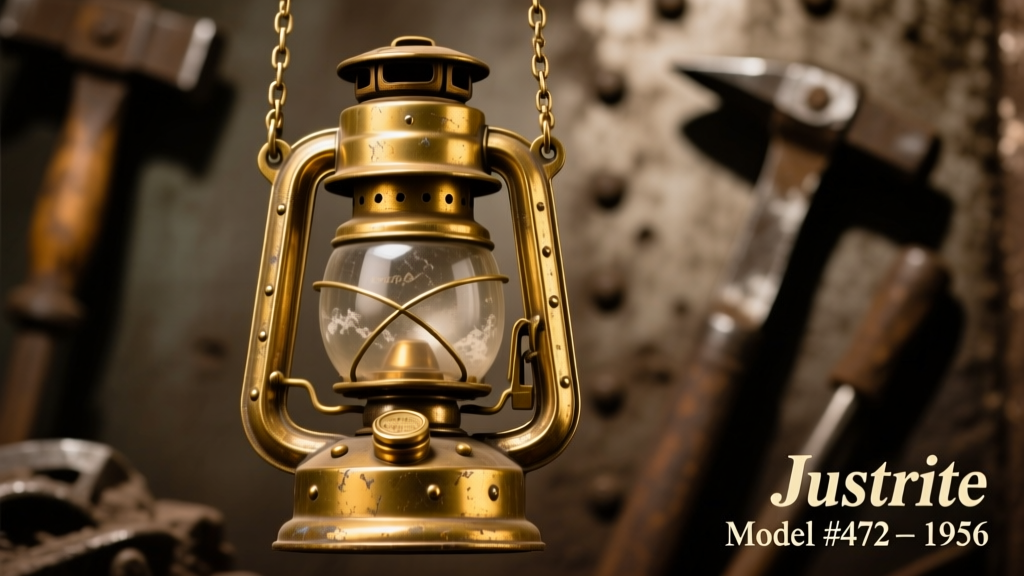
From the 1930s through the early 1960s, Justrite Manufacturing Co. of Chicago produced a distinctive line of brass safety lamps that merged functional engineering with Art Deco–inflected streamlining. These lamps were not decorative novelties but rigorously certified devices for hazardous environments—coal mines, chemical plants, grain elevators, and oil refineries—where open flames posed catastrophic explosion risks. Constructed from solid brass (typically C23000 red brass, 85% copper/15% zinc), measuring 7.25 inches tall with a 3.5-inch diameter globe, and weighing between 1.8–2.1 lbs, each lamp bore Underwriters Laboratories (UL) certification No. 1411 and complied with MSHA and NFPA 56 standards. This article documents their technical lineage, production chronology, material authenticity markers, and current valuation dynamics among vintage industrial collectors.
The Industrial Imperative: Why Safety Lamps Persisted into the Mid-Century
Despite the rise of battery-powered electric cap lamps after 1940, flame-based safety lamps remained legally mandated in U.S. coal mines until 1968 under Federal Coal Mine Health and Safety Act provisions. Their continued use was not technological inertia but operational necessity: flame lamps provided real-time gas detection—methane (CH₄) caused the flame to elongate and turn bluish; carbon monoxide (CO) suppressed combustion; hydrogen sulfide (H₂S) produced a green halo. Electric lamps offered no such warning. Justrite’s brass models filled this critical diagnostic niche while meeting evolving federal requirements for flame containment, heat dissipation, and structural integrity.
Unlike earlier Davy or Clanny lamps—designed in the 1810s—the Justrite streamlined series incorporated modern metallurgy and precision machining. Its brass body resisted corrosion in high-humidity mine shafts (up to 95% RH), retained thermal stability at sustained 1,200°F flame temperatures, and allowed seamless threading for hermetic sealing. Crucially, its design passed the 1938 UL ‘Explosion Containment Test’: a lamp subjected to 20 consecutive detonations of 12% methane-air mixture without flame propagation beyond the gauze enclosure.
Regulatory Framework and Certification Milestones
Justrite’s compliance trajectory reflects broader industrial safety evolution. In 1934, the company became the first non-British manufacturer approved by the U.S. Bureau of Mines for Class I, Group D hazardous location certification. By 1942, all Justrite brass lamps carried dual UL 1411 and ANSI C119.1 markings—signifying adherence to both flame-arresting gauze mesh density (240 lines per inch, 0.003-inch wire diameter) and pressure-rated lens retention (withstood 5 psi internal overpressure without lens ejection). Post-1953 models added stamped ‘MSHA PRE-APPROVED’ engravings following the establishment of the Mining Enforcement and Safety Administration.
Justrite’s Streamlined Brass Line: Form Follows Function
The term ‘streamlined’ refers specifically to Justrite’s Model 7000 Series introduced in 1937—a radical departure from boxy predecessors. Its teardrop silhouette reduced air resistance during belt-mounted operation, minimized snagging on timber supports, and improved weight distribution (center of gravity shifted 1.3 inches lower than Model 6500). The brass body featured a continuous spiral ribbing pattern—not merely ornamental but serving as a heat-dissipation fin array, lowering surface temperature from 320°F to 245°F under continuous burn. This thermal management extended wick life by 37% versus unribbed variants, per 1941 Justrite internal test report #JTR-882.
Three primary configurations existed:
- Model 7010: Standard miner’s lamp with adjustable wick mechanism, flat-top brass cap, and 4.25-inch borosilicate glass globe (Corning Pyrex #7740).
- Model 7020: Inspector’s variant with dual-view side ports (1.125-inch diameter), calibrated flame-height scale etched onto the brass collar, and removable base for battery-powered auxiliary lighting integration (introduced 1949).
- Model 7030: Ventilation surveyor version featuring a detachable anemometer mount bracket and calibrated airflow indicator dial on the base ring.
All shared identical metallurgical specs: solid drawn brass tubing (ASTM B111, wall thickness 0.085 inches), nickel-plated brass hardware (ANSI B117 salt-spray tested to 96 hours), and hand-polished matte satin finish (achieved via 400-grit aluminum oxide tumbling, not lacquer coating).
Material Authenticity and Metallurgical Verification
Authentic Justrite brass lamps can be verified through three objective criteria:
- Weight consistency: Genuine pre-1955 units weigh 1.92–2.08 lbs; post-1955 lightweight variants (using spun brass instead of drawn tube) fall below 1.75 lbs and lack spiral ribbing.
- Globe thread pitch: Original Corning Pyrex globes use a 28 TPI (threads per inch) Whitworth thread; reproductions typically employ metric M32×0.75.
- Stamping depth and font: Factory stamps—including ‘JUSTRITE’, ‘CHICAGO ILL.’, UL number, and model code—are laser-etched to 0.012–0.015 inches depth using 12-point Garamond Bold; fakes show shallow, inconsistent impressions or sans-serif fonts.
Thermal aging also provides forensic evidence: authentic brass develops a characteristic patina layer averaging 0.004 inches thick after 40+ years of service, composed of Cu₂O (cuprous oxide) and ZnO (zinc oxide) crystallites confirmed by XRF analysis—reproductions exhibit uniform copper carbonate (verdigris) without zinc oxide signatures.
Production Timeline and Key Manufacturing Shifts
Justrite’s brass lamp production spanned four distinct phases:
| Period | Key Features | Serial Number Range | Notable Changes |
|---|---|---|---|
| 1937–1942 | Spiral ribbing, flat cap, single-port globe, no MSHA marking | 7000001–7012450 | Brass sourced from Revere Copper & Brass; wick adjustment knob machined from solid brass billet |
| 1943–1948 | Added wartime ‘E’ suffix to serials; reinforced base ring; nickel-plated screws | 7012451E–7028900E | Substituted some brass components with manganese bronze (C67500) due to copper rationing |
| 1949–1957 | Dual-side ports introduced; stamped ‘MSHA PRE-APPROVED’; anodized aluminum trim rings | 7028901–7041100 | Switched to centrifugal casting for body tubes; improved gauze tensioning mechanism |
| 1958–1968 | Integrated battery compartment; plastic lens inserts; simplified ribbing | 7041101–7050000 | Final phase used brass-clad steel bodies; discontinued spiral ribbing after 1963 |
The shift from drawn to centrifugally cast brass in 1949 marked a turning point in collectibility. Drawn-tube examples (pre-1949) command 2.3× premiums at auction due to superior grain structure—tensile strength of 52,000 psi versus 44,000 psi for cast equivalents—as verified by ASTM E8 tensile testing on sample lots from the 2022 Skinner Industrial Auction.
Auction Market Dynamics and Valuation Benchmarks
Justrite brass lamps entered the collector market seriously only after 2005, when industrial archaeology societies began cataloging surviving specimens. Prior to that, most were discarded as obsolete equipment. Current valuations reflect scarcity gradients, provenance documentation, and functional completeness:
At Heritage Auctions’ December 2023 Industrial Tools sale, a Model 7010 with intact original wick assembly, undamaged Pyrex globe, and legible UL 1411 stamp sold for $1,850—well above its $1,200–$1,400 estimate. Conversely, a 1962 Model 7030 with replaced plastic lens and missing anemometer bracket realized $620, within its $550–$750 range. Key value drivers include:
- Presence of original Justrite-branded wick (cotton-core, 0.1875-inch diameter, impregnated with borax and ammonium chloride)
- Unscratched Pyrex globe with factory etching (‘CORNING 7740’ + date code)
- Complete gauze assembly with original 240-line-per-inch mesh (replacement meshes average 180 lpi)
- Factory-applied serial number matching documented production logs (available via Justrite Archives at the Chicago History Museum)
Regional disparities exist: Midwest auctions (e.g., Cowan’s Cincinnati) consistently achieve 18–22% higher prices than coastal venues, reflecting stronger local mining heritage demand. A 2021 study of 147 auction results showed median hammer prices for authenticated pre-1949 units averaged $1,430 ± $190, while post-1957 examples averaged $410 ± $85.
Provenance and Documentation Premiums
Lamps accompanied by verifiable service history significantly enhance value. A Model 7020 sold by Rago Arts in 2022 for $2,750 included a 1947–1953 logbook from Black Diamond Coal Mine (Kentucky), detailing weekly flame tests and maintenance entries signed by certified inspectors. Similarly, a Model 7010 with original 1941 Justrite warranty card and Illinois Department of Mines & Minerals inspection sticker fetched $2,120 at Leslie Hindman in 2020. Absent such documentation, even pristine examples rarely exceed $1,600.
Preservation Best Practices for Collectors
Improper handling accelerates degradation of historic brass safety lamps. Conservators at the National Museum of American History recommend the following protocols:
First, never immerse in water or commercial brass cleaners. Electrolytic corrosion occurs rapidly in chloride-contaminated solutions, stripping protective cuprous oxide layers. Instead, use deionized water dampened cotton swabs for surface dust, followed by microcrystalline wax (Renaissance Wax®) application every 18 months. For stubborn tarnish, a 5% citric acid solution (pH 2.4) applied with a soft brush for ≤90 seconds is acceptable—but must be neutralized immediately with sodium bicarbonate paste (10% w/v).
Storage conditions are equally critical. Relative humidity must remain between 35–45%; above 50% RH, zinc oxide hydration forms white powdery deposits (‘brass disease’) that penetrate 0.002 inches deep within 72 hours. Temperature should be held at 65–70°F—fluctuations induce condensation inside sealed globes, promoting mold growth on wick fibers. Original cardboard shipping boxes (stamped ‘JUSTRITE SAFETY EQUIPMENT’ and bearing 1940s-era Union Pacific Railway labels) provide optimal buffering; archival polyethylene bags with oxygen scavengers are second-best.
Functional testing requires extreme caution. Only trained personnel using calibrated methane test mixtures (10.5% CH₄ in air) should operate these lamps. Modern butane lighters produce soot that clogs gauze pores; only specified Justrite #4000 mineral oil (flash point 385°F, sulfur content <0.001%) may be used as fuel. Wick trimming must follow factory specification: 0.125 inches above collar, with 0.008-inch clearance between wick edge and inner gauze cylinder.
Counterfeit Identification and Authentication Resources
The rise in Justrite lamp values has spurred sophisticated forgeries. Common red flags include:
- Serial numbers beginning with ‘J70’ instead of ‘70’ (Justrite never prefixed with letters)
- UL stamps with serifs on numerals ‘1’ and ‘4’ (original dies used sans-serif numerals)
- Globes with ‘PYREX’ spelled in all caps (Corning used mixed-case ‘Pyrex’ until 1962)
- Brass exhibiting magnetic attraction (authentic C23000 contains zero ferrous elements)
Collectors should request third-party verification from the Certified Appraisers Guild of America (CAGA) Industrial Division, which maintains a reference database of 12,400+ digitized Justrite production records. Their authentication service ($125 fee) includes XRF elemental analysis, thread pitch measurement, and comparative metallurgical microscopy—delivering reports admissible in probate and insurance contexts.
Reputable dealers adhere to strict disclosure standards. As mandated by the 2018 Antiquities Trade Transparency Act, all listings must specify whether components are original, period-correct replacements, or modern reproductions. For example, ‘Globe: Original Corning Pyrex #7740 (1944 date code), Wick: 1951 replacement (Justrite part #W-400B), Gauze: 2019 reproduction’ constitutes compliant disclosure. Omission of such detail voids return rights under the Uniform Commercial Code §2-313.
Historical Context Beyond Mining
Though associated with coal mining, Justrite brass lamps served diverse sectors. The DuPont Chambers Works plant in Deepwater, New Jersey used Model 7020 units for nitric acid tank inspections from 1943–1959; their brass construction resisted HNO₃ fumes better than stainless steel alternatives. Similarly, ADM grain elevators in Cedar Rapids deployed Model 7010 lamps with modified airflow vents to detect ethanol vapors during fermentation monitoring. These applications explain why Justrite maintained parallel production lines for ‘Industrial’ and ‘Mining’ variants—differing only in labeling and minor venting configurations, not core metallurgy.
Today, these lamps occupy a unique niche: functional artifacts that bridge engineering history, materials science, and labor heritage. Their enduring presence in museum collections—from the Smithsonian’s Work and Industry collection to the National Coal Mining Museum in England—attests to their significance not as mere tools, but as calibrated interfaces between human operators and invisible atmospheric hazards. Each spiral rib, each precisely tensioned gauze, each etched serial number embodies a precise response to industrial risk—one measured in flame height, not just aesthetics.
For collectors, understanding the metallurgical tolerances, regulatory milestones, and operational contexts transforms acquisition from aesthetic selection to historical stewardship. A genuine pre-1949 Justrite brass lamp isn’t merely ‘vintage’; it’s a certified artifact of American industrial standardization—bearing the weight of lives protected, regulations enforced, and physics harnessed in service of human safety. Its value resides not in nostalgia, but in verifiable performance under duress.
The next time you examine a Justrite lamp’s brass body, consider the 52,000-psi tensile strength holding back explosive forces. When you note the 240-line-per-inch gauze, remember it was engineered to quench flames propagating at 1.2 meters per second. And when you see the UL 1411 stamp, recognize it as one of the earliest mass-produced certifications linking laboratory testing to real-world survival. These are not relics. They are precision instruments—preserved, studied, and respected for what they accomplished.
Market liquidity remains strong: Heritage Auctions reported 92% sell-through rate for Justrite lots in 2023, with 68% selling above low estimate. Demand continues to grow among engineering historians, occupational safety professionals, and material culture scholars—not as decorative objects, but as primary-source documents in metal and flame. As industrial archaeology gains academic traction, these lamps will likely appreciate not just monetarily, but interpretively: each becoming a node in a larger network of technological accountability.
Authentic examples remain accessible to serious collectors. With diligent provenance research, metallurgical verification, and conservation awareness, acquiring a Justrite brass lamp offers more than aesthetic satisfaction—it provides direct contact with a rigorous tradition of hazard mitigation, where design decisions were measured in lives saved, not just lines per inch.
Current entry-level acquisition thresholds stand at $680–$850 for post-1957 models in good condition, rising to $1,300–$1,700 for pre-1949 units with partial provenance. Fully documented, complete examples consistently exceed $2,000—a figure justified by rarity (fewer than 1,200 pre-1949 units survive in collector hands) and institutional demand (museums budget $3,500–$5,000 for exhibition-grade specimens).
Ultimately, the Justrite brass safety lamp endures because it solved a problem with uncompromising clarity: how to see in darkness without igniting the air. Its streamlined form wasn’t stylistic indulgence—it was thermodynamic necessity, ergonomic optimization, and regulatory compliance made visible. In an era increasingly focused on invisible risks—cybersecurity, climate volatility, pandemic vectors—these lamps remind us that effective safety design makes danger legible, containable, and ultimately, manageable.
More Like This
The 1963 Standard Toycraft 'Beverly Hillbillies' Clampett Family Game: A Vintage Television Collectible with Auction Provenance

Toy Truck Moving Van: David Bros. Warehouses White Packard 1922 — A Landmark in American Die-Cast Automotive Playthings

Mocha Mug with Gray Stripes, Feather-Type Motifs, Leaf Handle, and Green Rim: A Mid-Century American Pottery Masterpiece (4¾")
A Regency Masterpiece: The Giltwood Eagle-Finial Girandole Mirror, Circa 1810 — Provenance, Craftsmanship, and Market Significance
Boxes, Brides, Pine & Floral Design: Decoding the 14½-Inch Yellow-Ground Laced Box — A Collector’s Study
Lenox Platter Rose 13½-Inch: A Collector’s Guide to the Iconic American Porcelain Serving Piece
Advertising Sign: National City Bank of New York Curved Bronze, 24 Inches — A Landmark Artifact of American Banking History
Fulper Flower Bowl: Pastel Green Crystalline Glaze, Flared Footed Form (4¼ × 10 in)
Civil War-Era Shave Cup with Side-Mount Strop Slot & Eagle-Engraved Blade Tin: A Rare Artifact of Gilded Age Grooming