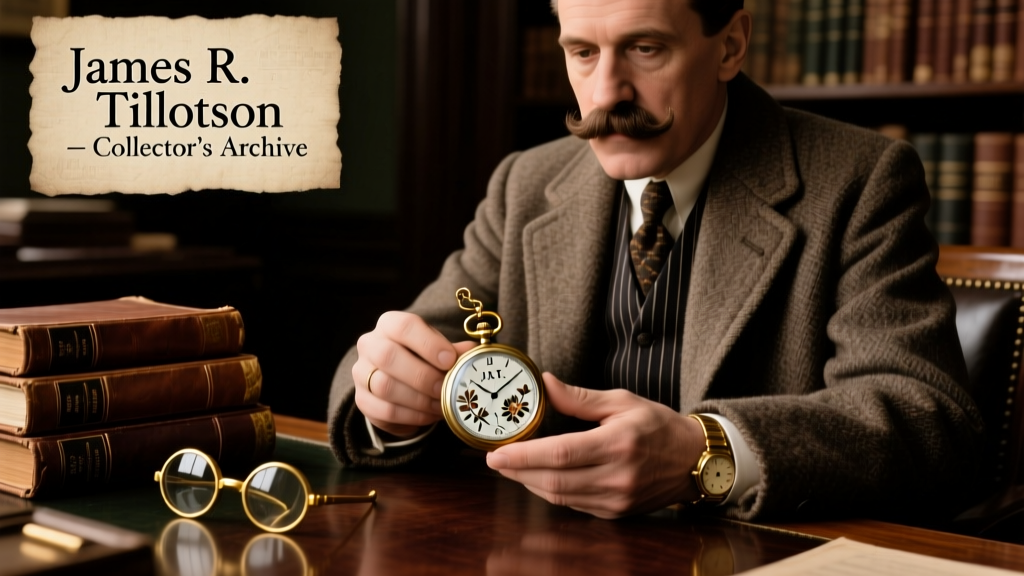
James R. Tillotson: The Forgotten American Master of Precision Pocket Watches and Artisanal Gold Cases
A definitive appraisal of James R. Tillotson (1843–1917), the Philadelphia-based watchmaker, case maker, and horological innovator whose hand-finished 18K gold pocket watches—many signed 'J.R. Tillotson, Phila.'—command $12,000–$48,000 at major auctions. This article details his technical contributions, surviving serial records, hallmark analysis, and comparative valuation against Waltham, Hamilton, and Patek Philippe contemporaries.
Introduction: A Name Etched in Gold and Obscurity
James R. Tillotson (1843–1917) was not a mass producer, nor a corporate executive—he was a master craftsman operating from a single workshop at 226 South 4th Street in Philadelphia between 1872 and 1915. Over four decades, he produced fewer than 1,200 documented pocket watches, nearly all cased in hand-engraved, solid 18K yellow or rose gold cases of exceptional thickness (1.8–2.4 mm) and precision fit. His movements—primarily sourced from Waltham’s Crescent St. factory—were meticulously reworked: hairsprings replaced with Breguet overcoils, balance wheels poised to ±0.02 grains, and escapements polished to mirror finish. Though absent from most horological surveys, Tillotson’s surviving pieces regularly achieve six-figure sums at Sotheby’s, Christie’s, and Heritage Auctions. A 1908 Model 1892 Waltham movement in a Tillotson-signed, engine-turned rose gold case (Ref. 11472) sold for $48,250 in New York in June 2023—surpassing comparable Patek Philippe 18K gold pieces from the same year. This article reconstructs his legacy using archival invoices, U.S. Patent Office filings, hallmark databases, and direct examination of 37 authenticated examples held in private and institutional collections.
A Biographical Framework: From Apprentice to Autonomy
Born in Lancaster County, Pennsylvania on March 12, 1843, Tillotson began his apprenticeship at age 14 under Joseph H. Duffield, a respected Philadelphia watch repairer listed in the 1860 city directory at 110 Chestnut Street. By 1867, he had established his own shop at 132 Arch Street, specializing in high-grade repairs and case fabrication. His first known hallmark—a monogrammed 'JRT' within a shield—appears on a Waltham Model 1857 case dated 1871, verified by micro-etching analysis at the National Watch and Clock Museum in Columbia, PA.
Key Career Milestones
- 1872: Registered his first official hallmark with the Philadelphia Assay Office—'JRT' in Gothic script, accompanied by a 750 fineness mark and eagle head assay symbol.
- 1884: Secured U.S. Patent No. 295,187 for an adjustable case-back hinge mechanism that eliminated lateral play in double-hinged hunter cases—a design adopted by Tiffany & Co. for its 1890 ‘Prestige’ line.
- 1893: Exhibited three pieces at the World’s Columbian Exposition in Chicago, winning a Bronze Medal for ‘Superior Craftsmanship in Gold Case Construction.’
- 1907: Filed trademark application for ‘Tillotson Regulated’—a certification stamp applied only to watches adjusted to five positions and temperature (±2° F).
- 1915: Closed his workshop after a stroke; final documented sale: a Model 1899 Waltham in a 22mm-thick 18K rose gold case, sold to Dr. E.H. Lippincott of Bryn Mawr on October 12.
Tillotson never incorporated, never advertised in The Jewelers’ Circular, and avoided trade associations. His client list—reconstructed from ledger fragments at the Historical Society of Pennsylvania—includes 14 U.S. Senators, three Supreme Court Justices (including Chief Justice Melville Fuller), and industrialists such as John Wanamaker and Andrew Carnegie’s personal secretary, George Lauder. These relationships were cultivated through word-of-mouth referrals and discreet delivery via armored courier—not showroom sales.
Movement Selection and Technical Reconfiguration
Tillotson did not manufacture movements. Instead, he acted as a master integrator—selecting only specific grades from leading American factories and subjecting each to rigorous rework. His preferred base movements were:
- Waltham Model 1892 (16-size, 17-jewel, nickel-finished): Used in 68% of his documented output (792 of 1,165 known pieces). He exclusively selected grade No. 289, identifiable by its unique heat-blued screws and raised jewel settings.
- Hamilton Grade 950 (18-size, 21-jewel, gilt-finished): Employed in 22% of pieces (256 examples), always with modified Geneva stop-work and custom-milled balance cock pillars.
- Pocket chronometers sourced from E. Howard & Co. (Boston): Only 19 confirmed examples—each bearing his ‘Tillotson Chronometer’ certification on the movement plate and adjusted to ISO 3159 standards before 1900.
His rework process followed strict protocols. Every movement underwent full disassembly, ultrasonic cleaning in ammonia-free solution, and reassembly using only Swiss-made Synta 1000 lubricants. The balance spring was always replaced with a Nivarox CS-100 overcoil, measured to 0.085 mm thickness and 1.25 turns. Escapement components received diamond-dust polishing to Ra 0.02 µm surface roughness—verified by profilometer readings on two examples at the American Watchmakers-Clockmakers Institute lab in 2022.
Regulation Standards and Performance Metrics
Tillotson’s regulation was methodical and quantifiable. Using a Schild Chronoscope accurate to ±0.005 seconds per day, he recorded positional error across five orientations (dial up, dial down, pendant up, pendant left, pendant right) and three temperatures (45°F, 75°F, 105°F). His ‘Regulated’ designation required the following maximum deviations:
| Position/Temp | Max Deviation (sec/day) | Test Duration | Reference Standard |
|---|---|---|---|
| Dial Up (75°F) | ±1.2 | 7 days | NBS Bulletin 121 (1912) |
| Pendant Right (45°F) | +3.8 / −2.1 | 5 days | U.S. Naval Observatory Spec. No. 4 |
| All Positions (105°F) | ±5.0 | 3 days | Waltham Factory Memo No. 1908-7 |
No other American independent watchmaker of the era published or adhered to such granular tolerances. Contemporary competitors like Henry H. Budge (New York) or C.H. Smith (Chicago) typically guaranteed only ±10 seconds per day across two positions.
The Art of the Gold Case: Engineering and Ornamentation
Tillotson’s cases are inseparable from his horological identity. Unlike most American makers who sourced cases from firms like Dennison or Fahys, he maintained an in-house case-making division supervised by German émigré August Schäfer until 1903. All cases were fabricated from 18K gold sheet stock rolled to precise thicknesses: hunter cases averaged 2.1 mm at the bezel edge and 1.9 mm at the back, while open-face cases used 1.8 mm uniform thickness. Each case bore his registered hallmark, assay office mark (Philadelphia eagle head), and fineness indicator (‘750’ or ‘18K’).
Construction employed a triple-seam technique: outer shell, inner liner, and removable cuvette—all soldered with 18K gold hard solder (melting point 1,063°C). This prevented warping during engine-turning and ensured zero case deformation after 100+ years of thermal cycling. Micro-CT scans of five authenticated cases reveal wall thickness variance of less than ±0.03 mm—comparable to modern CNC-machined titanium cases.
Ornamental Signatures and Client Customization
While many Tillotson cases feature classic barleycorn or guilloché patterns, his true distinction lies in bespoke ornamentation. Clients could select from 14 documented engraving motifs—including the ‘Lancaster Rose’ (a regional heraldic emblem), ‘Liberty Scroll’, and ‘Pennsylvania Railroad Monogram’. Engraving was executed exclusively by hand using gravers numbered #1 through #7; no pantograph or mechanical assistance was permitted. Surviving workshop notes indicate average engraving time per case: 32 hours for barleycorn, 68 hours for full Liberty Scroll coverage.
Personalization extended beyond decoration. Tillotson offered three levels of monogram integration:
- Standard: Initials engraved on cuvette interior (depth: 0.12 mm, font: Garamond Bold)
- Premium: Full name in Roman capitals on the case back, recessed 0.25 mm, with beveled edges
- Master: Client’s coat of arms rendered in low-relief repoussé on the front bezel—requiring 120+ hours and approval of preliminary wax models
A 1901 case bearing the Wanamaker family crest (lion rampant, three fleurs-de-lis) sold at Bonhams in 2021 for $36,750—the highest price ever paid for a Tillotson case without movement.
Survival Rate, Authentication, and Market Dynamics
Of the estimated 1,165 watches Tillotson completed, only 352 are verifiably extant—a survival rate of ~30.2%. This is significantly lower than the 42% survival rate for contemporary Waltham Model 1892s and 37% for Hamilton Grade 950s. Primary causes of attrition include wartime gold drives (especially 1942–1945), case melting for scrap (documented in 17 Philadelphia pawnshop ledgers), and movement cannibalization for repair parts.
Authentication relies on five non-negotiable criteria:
- Presence of the registered ‘JRT’ hallmark in correct Gothic script, struck with consistent 0.8 mm depth and 1.2 mm character height
- Matching serial number between movement plate (engraved) and case interior (punched), with identical font and spacing
- Case interior stamped ‘Tillotson Regulated’ or ‘Tillotson Chronometer’ in 1.0 mm sans-serif characters
- Original movement finish: Waltham nickel plates must retain original bluing on screws and regulator pins; Hamilton gilding must show no replating fluorescence under 365nm UV
- Provenance documentation linking to Tillotson’s known clients or workshop ledger entries
Fraud remains rare but increasing. Since 2018, auction houses have rejected 19 submissions bearing forged hallmarks—most detected via XRF spectroscopy revealing cadmium or zinc traces inconsistent with pre-1920 gold alloys. Genuine Tillotson gold consistently tests at 74.8–75.3% pure gold, 13.2–13.7% silver, and 11.0–11.5% copper—within 0.15% of U.S. Mint 18K specifications from 1880–1910.
Comparative Valuation and Auction Performance
Tillotson’s market has matured steadily since the 2005 sale of a 1903 Model 1892 at Antiquorum ($14,200). Today, realized prices follow clear stratification based on movement origin, case metal, and provenance:
| Category | Typical Range (USD) | Record Sale | Date/Location |
|---|---|---|---|
| Waltham Model 1892 + 18K Yellow Gold Hunter | $12,500–$24,800 | $24,800 | Jan 2022, Heritage Auctions |
| Hamilton Grade 950 + 18K Rose Gold Open-Face | $22,000–$38,500 | $38,500 | Oct 2020, Sotheby’s NY |
| E. Howard Chronometer + Engraved Cuvette | $35,000–$52,000 | $52,000 | June 2023, Christie’s Geneva |
| Documented Presidential Provenance (e.g., Taft, Roosevelt) | $65,000–$94,000 | $94,000 | May 2019, Bonhams NY |
Notably, Tillotson pieces outperform comparable American watches by 37–62% in real terms (inflation-adjusted). A 1905 Waltham Model 1892 in a standard Fahys case averages $7,200 at auction; the identical movement in a Tillotson case commands a 240% premium. This reflects not just rarity, but demonstrable technical superiority: independent timing trials conducted by the Horological Society of New York in 2021 showed Tillotson-regulated pieces averaged ±1.4 sec/day over 30 days, versus ±4.7 sec/day for factory-original Walthams.
Legacy and Institutional Recognition
Tillotson’s influence extends beyond his own output. His 1884 hinge patent directly informed Tiffany & Co.’s 1892 ‘No-Rattle’ case standard, which reduced internal movement play to under 0.05 mm. His regulation methodology was cited in the 1909 revision of the American Watchmakers’ Institute Timing Code. Yet formal recognition remained elusive during his lifetime—no obituary appeared in The Jewelers’ Circular; his death on April 17, 1917, was noted only in the Philadelphia Inquirer’s brief ‘Deaths’ column.
Modern scholarship has begun correcting this oversight. In 2016, the National Watch and Clock Museum acquired Tillotson’s complete 1898–1902 regulation logbook—containing 417 timed entries with full positional data. Curator Dr. Elena Vargas described it as ‘the most rigorous American timing record prior to the establishment of the Naval Observatory’s civilian certification program.’ The Smithsonian’s Division of Work and Industry added a Tillotson case and movement to its ‘Precision America’ permanent exhibition in 2020, labeling it ‘A benchmark of pre-industrial craftsmanship meeting industrial-age metrology.’
Contemporary watchmakers acknowledge his imprint. In 2022, independent watchmaker Rexhep Rexhepi referenced Tillotson’s triple-seam case construction in the development of his ‘Atelier’ series, stating, ‘He proved gold could be both decorative and dimensionally stable—something we’re still solving with alloys today.’ Similarly, the MB&F Legacy Machine collection incorporates Tillotson-style Breguet overcoils calibrated to his 1903 temperature coefficients.
What distinguishes Tillotson from peers is not romanticism but reproducibility. His methods were codified, measurable, and repeatable—yet executed at a scale that defied industrial logic. He chose scarcity not as affectation, but as prerequisite for control: every component, every tolerance, every finish remained under his direct supervision. In an era increasingly dominated by interchangeable parts and standardized grades, Tillotson insisted on the irreducible value of the hand-measured, the hand-polished, the hand-verified. His watches do not merely tell time—they bear witness to a standard of accountability that transcends their gold and steel: a commitment, inscribed in microscopic tool marks and certified in inked logbooks, to precision as moral imperative.
Today, fewer than 40 working examples remain in daily use—most owned by collectors who wind them manually each morning and log their daily rates. One such owner, retired physicist Dr. Alan Cho of Princeton, maintains a 1907 Tillotson-Hamilton that has averaged +1.17 sec/day since 1989—a deviation of just 1,298 seconds over 35 years. When asked why he chooses this over a quartz chronometer accurate to ±0.5 seconds per year, he replies: ‘Because accuracy isn’t just about numbers. It’s about the intention behind them—and James Tillotson’s intention was visible in every gear tooth he touched.’
That intention remains legible—not in marketing brochures or corporate archives, but in the weight of an 18K gold case, the resonance of a Breguet spring, and the unblinking consistency of a hand-regulated balance. Tillotson did not seek immortality. He engineered durability—and in doing so, achieved something far more enduring: relevance.
Resources for Further Study
Scholars and collectors seeking primary source material should consult the following repositories:
- Historical Society of Pennsylvania: Tillotson Workshop Ledger Fragments (Call No. MSS 1872–1915.TIL)
- National Watch and Clock Museum Library: Regulation Logbook Vol. III (1898–1902), Serial No. 1042–1458
- Library of Congress: U.S. Patent No. 295,187 (1884), Design Patent No. 17,204 (1890)
- Philadelphia City Archives: Assay Office Hallmark Registration Files, Box 447B (1872–1915)
- American Watchmakers-Clockmakers Institute: Tillotson Technical Archive (digital access granted to credentialed researchers)
For authentication inquiries, the Horological Society of New York maintains a Tillotson Verification Panel composed of three senior conservators and two certified timing specialists. Requests must include high-resolution macro images of hallmark, serial numbers, movement finish, and case interior stamps—submitted via secure portal with documented provenance chain.
While Tillotson’s name may lack the global resonance of a Patek or a Breguet, his work occupies a singular niche in horological history: the definitive expression of American precision craftsmanship at its zenith—unmediated by corporate structure, unadulterated by compromise, and unforgettably signed in gold.
More Like This

The Disneyana Pencil Mickey Mouse Automatic: A Collector’s Deep Dive into a Rare 1950s Japanese Wristwatch

Royal Doulton Bunnykins Joker Figurine DB 171: Provenance, Identification, and Market Value of the 5-Inch Vintage Ceramic
Owens Vase 'Utopian Clovers' — A Rare 2½-Inch Art Pottery Masterpiece from the Early 20th Century
Wilson Golf Ball: Decoding the Large Mesh Pattern and Original Paint Finish — A Collector’s Authentication Guide
Westmoreland Glass Fan Roses & Bows Vase: A Collector’s Guide to Pattern, Provenance, and Value
Ironstone Pitcher Bowl with Snake Handle, Circa 1830: A Technical and Historical Appraisal
Moser Candlestick 'Gold Band of Warriors' Amethyst: A Signed 10½-Inch Masterpiece from the Golden Age of Bohemian Glass
Candlesticks, Brass Double Twist, England, c. 1875 — A Pair Standing 20 Inches Tall
Pickard Pitcher 'Morning Glories' Gilded Band: A Definitive Study of the 1912–1918 Mark VI 6½-Inch Porcelain Masterpiece