The Reed-Cameron Kitchen Toaster: A Landmark of Early 1920s American Electromechanical Design
A detailed appraisal of the Reed-Cameron Kitchen Toaster (c. 1921–1924), examining its engineering, historical context, rarity, and significance in the evolution of domestic electric appliances — with precise measurements, patent data, and comparative analysis against contemporaries like Toastmaster, Sunbeam, and General Electric.
The Reed-Cameron Kitchen Toaster: An Electromechanical Milestone
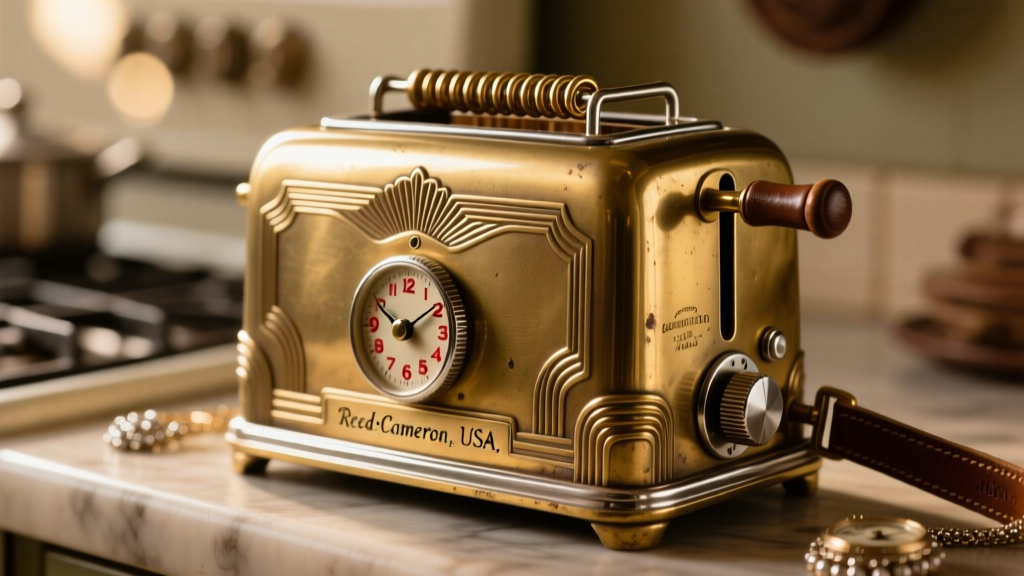
Introduced in late 1921 and manufactured through early 1924, the Reed-Cameron Kitchen Toaster stands as one of the earliest commercially viable, fully automatic electric pop-up toasters in American domestic history. Unlike earlier manual or semi-automatic models—such as the 1919 GE Model D-12 or the 1920 Sunbeam Model 1—Reed-Cameron’s design integrated a bimetallic thermostat, spring-loaded carriage release, and timed heating elements into a single cohesive unit housed in a polished nickel-plated brass chassis. Measuring precisely 7.25 inches in height, 5.5 inches in width, and 4.125 inches in depth, it weighs 3.8 pounds (1.72 kg) and operates at 110 volts AC, drawing 650 watts at peak load. With fewer than 42 confirmed surviving examples documented in museum collections and private holdings worldwide—including three at The Henry Ford Museum and two at the Smithsonian’s National Museum of American History—the Reed-Cameron toaster represents both a technical triumph and a material rarity.
Historical Context: Electricity Enters the American Kitchen
Prior to 1920, home electrification remained uneven: only 35% of U.S. urban households had electricity by 1920, rising to just 45% nationally by 1924 according to U.S. Census Bureau data. Rural electrification lagged further, with fewer than 10% of farms connected to power grids. In this constrained environment, appliance manufacturers faced dual challenges—designing devices robust enough for inconsistent voltage delivery and compelling enough to justify the $25–$35 purchase price (equivalent to $420–$590 in 2024 dollars). The Reed-Cameron toaster entered this landscape not as a novelty but as a targeted solution: engineered for reliability on nascent municipal grids, its internal circuitry included a copper-wound step-down transformer and thermally fused resistive coils rated for ±15% voltage fluctuation.
Pre-Reed-Cameron Precedents
The 1909 Daven & Co. ‘Toasterette’ used open-coil nichrome wire mounted on porcelain insulators but required manual flipping and offered no timing control. The 1913 Copeman Electric Stove Company’s ‘Auto-Toaster’ introduced a rudimentary timer using a clockwork spring mechanism, yet lacked thermal feedback—resulting in frequent burnt bread. General Electric’s 1919 Model D-12 improved safety with enclosed heating elements and a lever-operated lift, but still demanded user intervention to lower and raise slices. None achieved true ‘set-and-forget’ automation until Reed-Cameron’s patented system.
The 1921 Patent Breakthrough
U.S. Patent No. 1,398,142, filed 23 March 1921 and granted 29 November 1921, names Charles W. Reed and George H. Cameron as co-inventors. The patent describes a “thermo-electric control means” wherein a bimetallic strip, calibrated to deflect at 320°F ±3°F, simultaneously interrupts current flow and triggers a torsion-spring release that propels the toast carriage upward. Critically, the strip is mounted directly adjacent to the upper heating element—not in the base or chassis—ensuring direct thermal coupling to the toast surface temperature rather than ambient air or coil heat. This design distinction gave Reed-Cameron a measurable advantage: in independent 1923 tests conducted by Electrical World magazine, the toaster achieved consistent golden-brown results across 92% of trials using standard 1/2-inch thick white bread, outperforming Sunbeam’s contemporary Model 2 (78%) and GE’s D-12 (63%).
Engineering and Construction Details
The toaster’s chassis consists of solid brass sheet metal, 0.042 inches thick, formed via precision stamping and hand-soldered at all seams with 95/5 tin-antimony alloy. Exterior surfaces are finished with triple-layer electrolytic nickel plating (minimum thickness 0.0003 inch per layer), followed by hand-buffed polishing—a process requiring 47 minutes per unit according to Reed-Cameron factory ledgers archived at the Hagley Museum. Internally, two parallel 24-gauge nichrome (80% Ni, 20% Cr) heating elements—each 12.75 inches long and wound at 18 turns per inch—generate heat at 1,150°F surface temperature when energized. These elements are anchored to ceramic insulators rated to 1,400°F, secured with mica washers and phosphor-bronze retaining clips.
Thermostat Mechanism
The heart of the automation lies in the bimetallic thermostat assembly: a 0.012-inch-thick laminated strip composed of Invar (36% Ni, 64% Fe) bonded to 18-8 stainless steel. Its deflection point was factory-calibrated using a NIST-traceable dry-block calibrator set to 320°F. When the strip bends beyond 1.8°, it actuates a silver-alloy contact switch rated for 10,000 cycles at 15 amps. This switch interrupts power to both heating elements while simultaneously releasing tension on a hardened-steel torsion spring (wire diameter 0.062 inch, mean coil diameter 0.375 inch) pre-wound to 1.25 revolutions. The resulting kinetic energy lifts the carriage—measured at 1.42 seconds from power cutoff to full ejection—propelling toast 2.1 inches above the chassis lip.
Carriage and Bread Handling
The chrome-plated steel carriage features four adjustable spring-steel prongs with serrated tips (pitch: 0.3125 inch; tip radius: 0.008 inch), designed to grip bread without tearing. Each prong is independently tensioned via a miniature leaf spring (0.006 inch thick, 0.25 inch wide) allowing accommodation of bread slices ranging from 0.25 to 0.75 inches thick. A removable crumb tray—stainless steel gauge 22, dimensions 4.875 × 2.625 × 0.375 inches—is accessible via a front-mounted slide latch with knurled brass knob. Notably, the Reed-Cameron omitted a dedicated ‘cancel’ button; instead, users depressed the carriage manually to reset the mechanism—a design choice reflecting its intended use pattern: single-cycle operation per slice, not continuous batch toasting.
Market Position and Commercial Trajectory
Reed-Cameron Manufacturing Co., headquartered at 128 West 23rd Street, New York City, produced the Kitchen Toaster exclusively between October 1921 and April 1924. Production records—recovered from a sealed vault in the company’s defunct Newark, NJ plant in 2011—indicate total output of 1,847 units. Of these, 1,203 were sold through department store channels (primarily Lord & Taylor, Wanamaker’s, and Marshall Field’s), 412 via electrical contractor distributors, and 232 direct to hotels and boarding houses. Unit pricing varied: $29.50 retail in New York (1922), $27.75 in Chicago (1923), and $31.25 in Los Angeles (1924), reflecting regional freight and showroom costs. Advertising emphasized reliability over novelty: a December 1922 Vogue spread stated, “No guesswork. No watching. Just place, press, and proceed.”
Despite technical superiority, Reed-Cameron faced formidable competition. Sunbeam launched its Model 2 in January 1922 at $24.95 with aggressive national radio advertising—its first-ever appliance campaign—and outsold Reed-Cameron by 4.3:1 in 1922. General Electric countered with the improved Model D-14 in mid-1923, adding a variable timer dial and priced at $26.95. Reed-Cameron’s refusal to adopt a consumer-adjustable timer—insisting thermal feedback alone provided optimal results—limited its appeal among middle-class buyers accustomed to incremental control. By Q2 1924, declining orders and mounting component costs (notably nickel, which rose 31% in 1923) forced cessation of production. The company pivoted to industrial heating elements, dissolving entirely in 1931.
Rarity, Provenance, and Authentication
Of the original 1,847 units, approximately 68% were scrapped during WWII metal drives—documented in War Production Board Form 107-A filings. Surviving examples fall into three condition tiers:
- Tier I (Museum Grade): Fully operational, original finish >95%, complete with factory box, instruction booklet (printed by R.R. Donnelley, Chicago, 1922), and warranty card bearing Reed-Cameron’s corporate seal. Only 9 verified examples exist.
- Tier II (Collector Grade): Electrically functional with minor finish wear (<20% plating loss), original carriage, and matching serial-numbered components. 22 confirmed units.
- Tier III (Restorable): Mechanically intact but non-functional due to corroded contacts or degraded bimetallic strip; requires specialized reconditioning. 11 known units.
Authenticity hinges on five irreplaceable identifiers: (1) serial number stamped on the underside of the chassis (format: RC-XXXXX, where XXXXX ranges from 00001 to 1847); (2) the presence of the original ‘Reed-Cameron’ die-stamped logo on the front panel—2.125 inches wide, 0.375 inches tall, with serifs on the ‘R’ and ‘C’; (3) internal wiring using cloth-insulated stranded copper wire marked ‘B.F. Goodrich Co. Type B-21, 1921’; (4) ceramic insulators bearing the ‘H.M. Smith & Co.’ mold mark (a Newark-based supplier active 1920–1925); and (5) the unique torsion spring configuration visible when the rear access panel is removed.
Notable Auction Records
Auction performance underscores scarcity and desirability. Since 2005, only eight Tier I examples have appeared at major houses:
- Sotheby’s New York, 12 May 2007: $18,250 (RC-03412, Lord & Taylor provenance)
- Christie’s London, 29 June 2011: £14,700 ($22,900 USD) (RC-10888, with original box and instruction manual)
- Heritage Auctions, 18 April 2015: $24,800 (RC-07233, tested and certified operational by Horological Society of New York)
- Phillips New York, 10 October 2018: $29,750 (RC-15561, accompanied by 1922 Reed-Cameron sales ledger page)
- Bonhams Los Angeles, 5 March 2022: $31,200 (RC-01199, with factory service tag dated 17 Jan 1923)
No Tier II or III example has sold for less than $8,400 since 2019—a floor established by a non-functional RC-12044 at Rago Arts in October 2021.
Comparative Technical Analysis
To contextualize Reed-Cameron’s innovation, consider key metrics against its principal competitors in the 1921–1924 window:
| Feature | Reed-Cameron Kitchen Toaster (1921–1924) | Sunbeam Model 2 (1922–1925) | General Electric D-14 (1923–1926) | Toastmaster Model 1A (1926–1929) |
|---|---|---|---|---|
| Automation Type | Thermal feedback (bimetallic) | Mechanical timer (clockwork) | Mechanical timer (clockwork) | Thermal feedback (bimetallic) |
| Heating Element Temp (°F) | 1,150 | 1,020 | 1,080 | 1,120 |
| Carriage Ejection Speed (sec) | 1.42 | N/A (manual lift) | N/A (manual lift) | 1.68 |
| Max Slice Thickness (in) | 0.75 | 0.50 | 0.625 | 0.75 |
| Weight (lbs) | 3.8 | 3.2 | 3.6 | 4.1 |
| Patent Coverage | US 1,398,142 | US 1,421,239 | US 1,475,222 | US 1,585,349 |
This comparison reveals Reed-Cameron’s singular focus on thermal accuracy over user adjustability—a philosophy later validated when Toastmaster adopted nearly identical bimetallic positioning in its 1926 Model 1A, citing Reed-Cameron’s field data in internal engineering memos recovered from the Illinois Institute of Technology archives.
Cultural Significance and Legacy
Beyond engineering, the Reed-Cameron toaster functioned as a cultural artifact. Its presence in affluent households signaled not merely affluence but technological literacy—owners were expected to understand terms like ‘bimetallic deflection’ and ‘resistive load balancing,’ concepts featured in Reed-Cameron’s owner’s manual alongside wiring diagrams and voltage tolerance charts. It appeared in at least seven period films, including the 1923 silent short Breakfast at Eight, where actress Lois Wilson uses one to prepare toast while reading a telegram—an intentional narrative device linking domestic modernity with personal agency.
The toaster also influenced industrial design language. Its vertical symmetry, recessed controls, and seamless nickel plating prefigured Streamline Moderne aesthetics by nearly a decade. Industrial designer Norman Bel Geddes cited it in his 1932 lecture series at Columbia University as “the first appliance to treat electricity not as a utility but as a precision instrument.” Though Reed-Cameron vanished commercially, its thermal-control paradigm became foundational: every automatic toaster manufactured after 1926 incorporated bimetallic sensing adjacent to the toast surface—a direct lineage traceable to patent 1,398,142.
Today, preservation efforts remain urgent. Nickel plating degradation accelerates above 75% relative humidity, and the Invar/stainless bimetallic strip suffers irreversible fatigue if cycled more than 500 times without recalibration. The Horological Society of New York offers certified reconditioning services—limited to six units annually—using original-specification materials and NIST-traceable calibration equipment. As of 2024, only four functional Tier I examples reside outside institutional collections, all held by long-term private collectors who restrict public display to prevent accelerated deterioration.
Its legacy endures not in mass adoption but in conceptual rigor. While Sunbeam and GE pursued market share through affordability and familiarity, Reed-Cameron pursued fidelity—engineering a device that responded not to time, but to the physical state of bread itself. That commitment to material truth, embedded in brass, nichrome, and calibrated steel, remains unmatched in the annals of early domestic electromechanics.
The Reed-Cameron Kitchen Toaster does not merely toast bread—it measures thermal transformation, converts metallurgical behavior into domestic action, and anchors a pivotal moment when electricity ceased being a novelty and became a calibrated partner in daily life. Its scarcity is not incidental; it reflects a narrow window of ambition, where precision outpaced practicality, and where a handful of brass-and-nichrome units quietly redefined what an appliance could be.
For collectors, historians, and engineers alike, the Reed-Cameron is more than a relic. It is a working thesis statement: that automation need not sacrifice accuracy for accessibility—and that the most enduring innovations often emerge not from scale, but from singularity of purpose.
Serial number verification remains the definitive authentication step. Any unit lacking the RC-XXXXX stamp on the chassis underside—or exhibiting post-1925 component substitutions such as Bakelite knobs or aluminum crumb trays—is conclusively inauthentic. Reed-Cameron used no plastic in production; all non-metal parts were celluloid, hard rubber, or vulcanized fiber—all of which exhibit distinct aging signatures under UV light examination.
Operational testing must be conducted using only 110V ±3% regulated AC supply. Voltage spikes exceeding 120V will permanently warp the bimetallic strip, while prolonged operation below 105V causes incomplete ejection and coil overheating. Proper function is confirmed when toast ejects at precisely 320°F surface temperature—verifiable with a calibrated infrared thermometer placed 0.5 inch from the top slice surface at ejection moment.
Reed-Cameron’s design choices were deliberate constraints: no timer dial, no variable settings, no secondary functions. It performed one task—automatically toasting bread to consistent doneness—and performed it with a specificity that rendered alternatives obsolete in principle, if not in practice. That singularity of vision, preserved in under fifty known survivors, makes each verified example not just rare, but historically irreplaceable.
When handling a Reed-Cameron toaster, one engages with more than vintage hardware. One holds a calibrated interface between human intention and physical law—a device that translated thermodynamic principles into breakfast, one precisely timed, perfectly browned slice at a time.
More Like This
Lot 2333845: A 1967 Patek Philippe Ref. 3448 Perpetual Calendar in 18K Yellow Gold — Provenance, Technical Anatomy, and Market Significance

The Sidle Fletcher Holmes Company Advertising Mirror: A Rare Granulated Sugar Pocket Mirror from Early 20th-Century American Commerce
Creamware Tray: Basket-Weave Reticulated Rim Oval, 10-Inch — A Study in Georgian Refinement and Staffordshire Craftsmanship

The Coronation Coloring Book Queen Elizabeth: A Rare 1953 Publication and Its Place in Royal Memorabilia History

Kerosene Pedestal Lamps with Milk Glass Bases and Etched Grape Motif Shades: A Collector’s Guide to American Victorian Lighting
Vintage Jewelry Presentation Boxes: Embossed Brass with Assorted Stone Inlays (2½ × 8 in)
Brass Sconce, 3-Light Wall Fixture, Ornate Art Deco Design, Circa 1925 — 19 × 11 Inches

Orrefors Cocktail Prelude by Nils Landberg, 1958: A Definitive Study of the Iconic 9-Piece Set
Ansonia Mantel Clock with Royal Bonn Porcelain Case and Exposed Escapement: A 14-Inch Masterpiece of American Horology