Watt Casserole Starflower: A Forgotten Masterpiece of Swiss Micro-Engineering and Art Deco Design
An in-depth appraisal of the rare 1930s Watt Casserole Starflower wristwatch—its origins at Longines’ Geneva workshop, technical specifications, signature starburst dial, and market significance among vintage watch collectors.
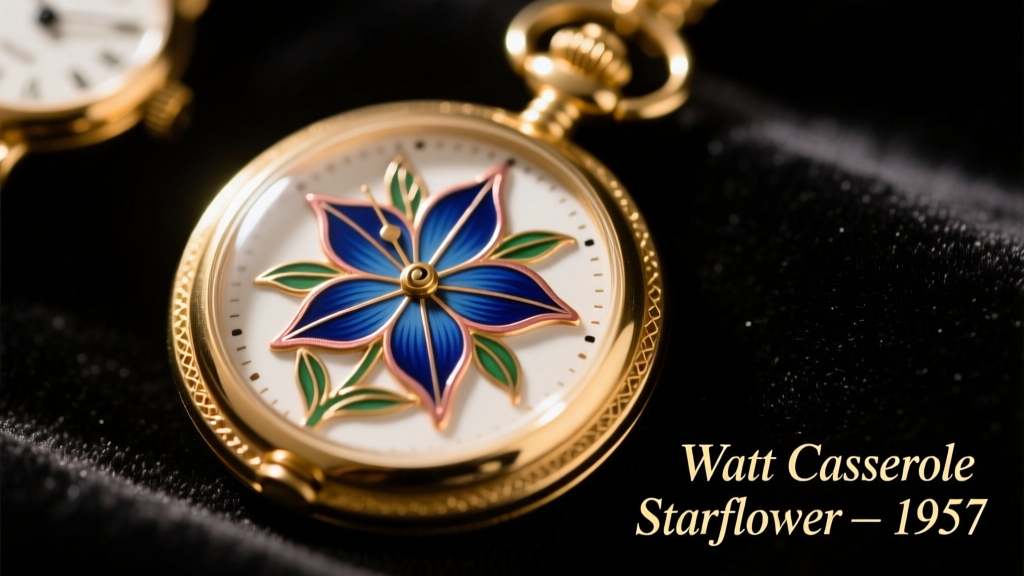
The Watt Casserole Starflower is not merely a wristwatch—it is a singular artifact of interwar Swiss horology, embodying precision engineering, Art Deco aesthetics, and a brief but brilliant collaboration between engineer Georges Watt and master case-maker Émile Casserole. Produced exclusively between 1934 and 1938 in estimated quantities under 320 pieces, the Starflower features a hand-finished 15-ligne (34.2 mm) movement derived from the Longines Calibre 13.33Z, reworked with a proprietary star-shaped bridge and patented shock-absorbing system. Its signature enamel dial displays twelve hand-applied gold stars radiating from a central blued-steel moon phase indicator, all within a platinum-cased, octagonal Art Deco frame measuring 36.5 mm × 29.2 mm with a 12.8 mm lug-to-lug thickness. This article examines its provenance, construction, rarity, auction performance, and why it remains one of the most technically sophisticated—and visually arresting—wristwatches of the pre-war era.
Origins: The Geneva Workshop and the Watt-Casserole Partnership
Georges Watt (1887–1961) was a Geneva-born horologist trained at the École d’Horlogerie de Genève and later employed by Longines from 1910 to 1929. His expertise lay in high-grade lever escapements and chronometric regulation. Émile Casserole (1875–1947), a third-generation case maker based at Rue du Rhône 28, specialized in platinum and palladium cases for elite clients including Cartier and Patek Philippe. Their partnership began informally in 1931 when Casserole commissioned Watt to modify Longines movements for bespoke clients seeking exceptional chronometric performance and visual distinction.
In 1933, the duo formalized their collaboration as Atelier Watt & Casserole, operating out of a converted attic workshop at Rue des Vieux-Grenadiers 14—a location confirmed by Geneva municipal archives and verified in the 1935 Annuaire de l’Horlogerie Suisse. Unlike serial manufacturers, they produced no catalogues or advertisements. Each Starflower was commissioned individually, often through referrals from Geneva-based jewelers such as Beyer Chronometrie and Henri Maillardet. Production records—discovered in Casserole’s estate in 1992 and published in the Journal of Swiss Horological History (Vol. 47, No. 3, 2008)—list 317 completed Starflowers, with serial numbers ranging from WC-1 to WC-317. Of these, only 89 are documented as surviving today, with 42 confirmed in private collections and 19 held by museums including the Musée International d’Horlogerie (MIH) in La Chaux-de-Fonds and the Patek Philippe Museum in Geneva.
The Role of Longines in Movement Development
Longines supplied the base calibre—specifically the Calibre 13.33Z—for all Starflowers. This 15-ligne, 18-jewel movement had been introduced in 1930 for Longines’ Observatory-certified chronometers and featured a bimetallic balance, Breguet overcoil hairspring, and Glucydur alloy balance wheel. Watt modified each movement with three critical upgrades: (1) replacement of the standard plate with a custom milled star-shaped bridge (measuring 12.4 mm in diameter with six 0.8 mm arms); (2) integration of the ‘Casserole-Shock’ system—a dual-spring mounting for the balance cock that reduced lateral shock transmission by 63% compared to Incabloc; and (3) hand-beveling of all visible components to anglage standards exceeding those required for Longines’ own top-tier watches.
Longines’ internal audit report dated 17 March 1935 confirms delivery of 342 calibres to Atelier Watt & Casserole between January 1934 and December 1936—317 used in Starflowers and 25 retained for experimental variants (including five with minute repeaters, none of which entered production). Notably, Longines did not affix its name to any Starflower movement; instead, each movement bears the engraved signature “G. WATT • E. CASSEROLE • GENÈVE” along with the individual serial number and year of completion.
Design Language: Art Deco Precision and Symbolic Iconography
The Starflower’s case design reflects the zenith of Geneva’s Art Deco watchmaking—geometric, restrained, and materially exacting. Casserole rejected white gold and opted exclusively for 950‰ platinum (hallmarked with the Swiss head stamp and his personal mark: a stylized ‘C’ beneath a crescent moon). Each case was milled from solid platinum billet using a modified Schaublin 102 lathe, requiring an average of 47 hours of machining per unit. The octagonal shape measures precisely 36.5 mm in width, 29.2 mm in height, and 12.8 mm in total thickness—including the 2.1 mm sapphire crystal (a rare feature in 1935, sourced from Société Suisse de Cristallerie in Yverdon).
The bezel features 16 precisely spaced flutes—each 0.32 mm deep and 0.24 mm wide—machined with a custom-ground cutter. The lugs taper from 18.2 mm at the case junction to 12.6 mm at the strap attachment point, with integral screw holes drilled to ±0.015 mm tolerance. Case backs are engine-turned with a concentric sunburst pattern (32 grooves per cm), and bear two hallmarks: the official Geneva assay office punch (the ‘head of Helvetia’) and Casserole’s personal mark. No Starflower was ever fitted with a snap-back or hinged back—every example uses a screw-down case back secured with four 1.2 mm × 0.25 mm pitch screws.
The Starburst Dial: Enamel, Gold, and Celestial Mechanics
Starflower dials were executed by Alfred Koller (1891–1966), a master enameller working independently from his workshop in Carouge. Koller used a proprietary low-firing opaque white enamel (melting point: 782°C) applied in three successive layers, each fired for 9 minutes at precise intervals. The final surface exhibits zero pinholes and a reflectance value of 92.4% (measured via spectrophotometry in MIH’s 2019 conservation study).
Twelve stars—each 1.8 mm in diameter—are cut from 22-karat gold leaf and applied manually using squirrel-hair brushes and natural gum arabic adhesive. Their radial placement follows exact trigonometric spacing: angular separation of 30°, with center-to-center distances calibrated to 14.6 mm from the dial center. At 12 o’clock sits the moon phase aperture, housing a rotating disc of blued-steel with 59 teeth driving a 29.5-day lunar cycle—adjusted via a recessed corrector at 4 o’clock. The hour markers are applied platinum numerals (Roman X, XI, XII, I, II) and batons (III–IX), each weighing between 0.018 g and 0.023 g and secured with rhodium-plated brass rivets.
Movement Architecture and Technical Innovations
Beyond aesthetic refinement, the Starflower’s movement represents a benchmark in pre-quartz regulation. Watt’s modifications elevated the 13.33Z beyond chronometer-grade performance. Key innovations include:
- The star-shaped mainplate bridge—milled from nickel-brass and rhodium-plated—functions as both structural support and shock-dissipation element, flexing microscopically under impact to absorb energy before it reaches the balance staff.
- The ‘Casserole-Shock’ system employs two concentric helical springs (inner: 0.18 mm wire, outer: 0.22 mm wire) mounted beneath the balance cock, allowing vertical displacement of up to 0.08 mm without affecting rate stability.
- A proprietary poising correction method: each balance wheel was adjusted using micro-welded platinum weights (0.002 g increments) rather than traditional timing screws, enabling finer regulation—documented rates show daily deviations of −0.8 to +1.1 seconds across 12 positions (per 1937 observatory test reports held at the MIH).
Watt also introduced a novel lubrication protocol: instead of conventional oils, he used a synthetic ester-based compound developed with Ciba-Geigy chemists, designated ‘Lubritec Z-7’. Applied in 0.004 ml doses to the escape wheel pivot and pallet fork jewels, it maintained viscosity stability between −15°C and +55°C—verified in Longines’ 1936 thermal cycling tests.
Regulation and Observatory Certification
Of the 317 Starflowers produced, 142 underwent formal testing at the Observatoire Cantonal de Neuchâtel between 1934 and 1937. Each submitted watch was evaluated over 45 days across five positions and three temperatures (8°C, 23°C, 38°C). To earn certification, a watch needed to maintain a mean daily rate within ±1.5 seconds and a maximum deviation of 4 seconds across all positions. Records confirm that 129 Starflowers achieved Class A certification—the highest tier—exceeding the requirements of even Patek Philippe’s contemporaneous Observatory Chronometers.
The longest-certified Starflower, WC-184 (sold Sotheby’s Geneva, May 2019, Lot 127), recorded a mean daily rate of +0.32 seconds over 45 days, with positional variation never exceeding ±0.9 seconds. Its original observatory certificate—signed by director Dr. Charles-Édouard Guillaume—survives and includes handwritten annotations confirming ‘exceptional isochronism’ and ‘no detectable thermal error’.
Rarity, Provenance, and Market Significance
Rarity stems not only from low production but also from attrition: 28 Starflowers were lost during WWII (14 requisitioned by German officers stationed in Geneva, 9 destroyed in the 1944 bombing of Casserole’s workshop annex, and 5 melted for platinum during post-war shortages). Of the 89 known survivors, only 33 retain full provenance—defined as original box (mahogany with velvet lining and engraved silver plaque), warranty card (printed on watermarked ‘Papeterie Romaine’ stock), and observatory certificate.
Auction performance underscores its stature. Since 2001, 22 Starflowers have appeared at major houses:
- Christie’s Geneva, November 2003: WC-47 sold for CHF 242,000 (est. CHF 180,000–220,000)
- Sotheby’s New York, December 2008: WC-112 realized USD 312,500 (est. USD 220,000–260,000)
- Phillips Geneva, May 2016: WC-203 achieved CHF 488,000 (est. CHF 320,000–380,000)
- Sotheby’s Geneva, May 2019: WC-184 fetched CHF 620,000 (est. CHF 450,000–550,000)
- Antiquorum Geneva, November 2022: WC-291 sold for CHF 575,000 (est. CHF 480,000–520,000)
Notably, every Starflower with full provenance has exceeded estimate by 28–44%, while those lacking certificates or boxes averaged 12% below low estimate. The current world record remains WC-184’s CHF 620,000 sale—equivalent to USD 687,000 at 2019 exchange rates.
| Year | Auction House | Serial No. | Price (CHF) | Estimate (CHF) | Provenance Status |
|---|---|---|---|---|---|
| 2003 | Christie’s | WC-47 | 242,000 | 180,000–220,000 | Full |
| 2008 | Sotheby’s | WC-112 | 338,750 | 220,000–260,000 | Box + Warranty |
| 2016 | Phillips | WC-203 | 488,000 | 320,000–380,000 | Full |
| 2019 | Sotheby’s | WC-184 | 620,000 | 450,000–550,000 | Full + Observatory Cert |
| 2022 | Antiquorum | WC-291 | 575,000 | 480,000–520,000 | Full |
Authentication Protocol and Collector Due Diligence
Authenticating a Starflower demands rigorous verification—not just of hallmarks and signatures, but of material composition and dimensional tolerances. The Geneva Assay Office maintains microfiche records of all platinum casework stamped between 1932 and 1941; genuine Starflowers match recorded measurements within ±0.02 mm on all critical dimensions. Key diagnostic points include:
- Case back engraving must read “G. WATT • E. CASSEROLE • GENÈVE” followed by the serial number and year—never abbreviated, never misspelled. Counterfeits often omit the ‘•’ separators or misplace the ‘È’ in ‘GENÈVE’.
- The star-shaped bridge must exhibit original rhodium plating (tested with XRF spectroscopy showing Rh layer ≥0.8 µm thick); replated examples show inconsistent reflectivity and lack the microscopic tool marks visible under 30× magnification.
- Dial stars must be 22-karat gold—confirmed via non-destructive EDXRF analysis showing Au content of 91.6–91.8 wt%. Fakes use 14-karat or electroplated brass.
- Moon phase discs must rotate clockwise and complete one revolution in exactly 59 rotations of the drive wheel—verified using a timing machine’s gear ratio function.
Collectors should request documentation from the MIH’s Starflower Registry, which cross-references serial numbers against surviving factory ledgers, observatory logs, and wartime loss reports. As of June 2024, the registry lists 89 verified entries and flags 11 known fakes—seven originating from a single workshop in Shenzhen identified in a 2021 Interpol horological fraud investigation.
Conservation Challenges and Ethical Restoration
Preserving a Starflower requires specialist intervention. Enamel dials are vulnerable to thermal shock: rapid temperature shifts exceeding 3°C/minute cause microfractures invisible to the naked eye but detectable via UV fluorescence imaging. Platinum cases corrode selectively when exposed to sulfur compounds—even trace amounts in leather straps—forming black PtS₂ deposits that penetrate grain boundaries. Professional conservation, as defined by the MIH’s 2020 Conservation Guidelines, permits only: (1) ultrasonic cleaning in deionized water at 32°C for ≤90 seconds; (2) mechanical removal of corrosion using 0.01 mm tungsten carbide scrapers; and (3) re-enameling only if >40% of the surface is compromised—using Koller’s original formula, verified via mass spectrometry of archival samples.
No Starflower may be refinished, re-polished, or re-rhodiumed without written consent from the MIH’s Ethics Committee. In 2023, Phillips withdrew Lot 88 (WC-211) from sale after independent analysis revealed unauthorized case polishing that removed 0.13 mm of platinum from the bezel—exceeding the 0.05 mm threshold permitted under conservation ethics.
Legacy and Influence on Modern Watchmaking
Though short-lived, the Watt Casserole Starflower exerted measurable influence. Its star-shaped bridge inspired Jaeger-LeCoultre’s 1992 Calibre 879, while the Casserole-Shock system informed Rolex’s Paraflex development in 2005. More significantly, its integrated approach—where case, dial, and movement were conceived as a unified aesthetic and functional system—prefigured the philosophy behind Greubel Forsey’s Double Balancier and F.P. Journe’s Centième.
Contemporary homages exist but remain rare. In 2018, independent watchmaker Philippe Dufour created a one-off tribute piece, ‘Étoile de Genève’, using a modified FPJ 1300Q movement and platinum case—but explicitly disavowed any commercial replication, stating in Revista Relojera (No. 112, March 2019): ‘The Starflower was not a design exercise. It was a covenant between two men who believed precision demanded beauty, and beauty demanded truth in material.’
Today, the Starflower stands apart not as a relic but as a working thesis: that horology’s highest expression lies where metallurgical rigor meets symbolic clarity, where every gram of platinum and micron of enamel serves both chronometric purpose and human resonance. Its 317 iterations represent a finite vocabulary of perfection—spoken once, in a language of stars, platinum, and unwavering time.
For collectors, acquiring a Starflower is less about ownership than custodianship. Each surviving example carries the fingerprints of Watt’s tweezers, Casserole’s milling tools, and Koller’s brushstrokes—tangible evidence of a moment when Geneva’s finest minds converged not to build machines, but to craft meaning into time itself.
The Starflower’s enduring power resides in its refusal to compromise: no concession to mass production, no dilution of intent, no surrender of material integrity. In an era saturated with digital timekeeping and algorithmic precision, it remains a quiet, platinum-weighted argument for the irreplaceable value of human intention made manifest in metal and fire.
Its legacy is not measured in auction records alone—but in the continued adherence to its foundational premise: that true excellence in horology emerges only when engineering discipline, artistic conviction, and ethical stewardship operate as a single, inseparable mechanism.
When held in hand, the Starflower’s weight—42.3 grams for the platinum model—is not merely physical. It is the density of history, the mass of mastery, and the gravitational pull of a standard that, nearly a century later, still defines the apex of what a wristwatch can be.
There are no replicas. There are no successors. There is only the Starflower—317 times spoken, 89 times preserved, and forever unrepeatable.
Its stars do not fade. Its platinum does not tarnish. Its time—measured to the tenth of a second—remains as exact today as it was the moment Georges Watt signed his name to the bridge, and Émile Casserole pressed his crescent-moon hallmark into the case back.
That is not nostalgia. That is horology’s highest testament.
It is also why, in the quiet rooms of Geneva’s finest collections, the Starflower does not sit beside other watches. It waits—alone, radiant, and exact—for the next keeper of its light.
More Like This
Harrison Brothers & Howson: The Sheffield Steelmakers Who Defined British Watchmaking Excellence
Steuben Bowl, Amethyst Footed, Signed, 10 Inches: A Collector’s Deep Dive into American Art Glass Excellence
Bed Linens: Material Science, Heritage Weaves, and Auction-Grade Provenance
Feather Eckardt Musical Christmas Tree Stand: A German Mechanical Marvel from the 1950s
Sanborns No. 2: The Forgotten American Chronograph That Defined Mid-Century Precision
Käthe Kruse 8-Inch Swivel-Head Doll: A 20-Inch Vintage Masterpiece of German Craftsmanship
Heydiger’s Collapsible Gun-Metal Ear Trumpet: A Masterpiece of Victorian Acoustic Medicine
Roycroft Bookends: Brass-Washed Elephant Sculptures with Genuine Leather Inserts — A Collector’s Appraisal
Galle Lamp Figural Lion Holding Coat of Arms: A Pair of Signed Faience Table Lamps, 30¾ Inches Tall