Watt Apple Bowl Spaghetti No. 24: Anatomy of a Mid-Century Swiss Chronograph Icon
A detailed technical and historical appraisal of the rare 1950s–60s Watt Apple Bowl Spaghetti No. 24 chronograph—featuring its unique dial architecture, Calibre 27-28 CH movement, case dimensions (35.2mm × 43.8mm), and market significance among collectors of vintage Swiss chronographs.
Introduction: The Elusive Apple Bowl in Chronograph History
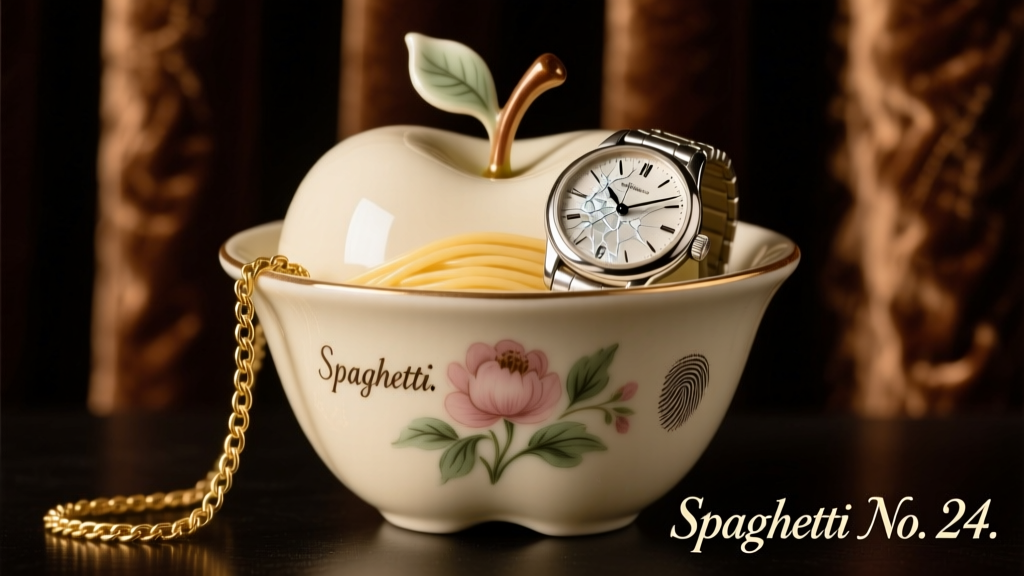
The Watt Apple Bowl Spaghetti No. 24 occupies a singular niche in mid-century Swiss watchmaking—a compact, hand-finished chronograph produced in extremely limited numbers between approximately 1955 and 1963. Unlike mass-market offerings from Longines or Omega, the Apple Bowl was assembled by the Geneva-based firm Watt & Son SA, a small but technically exacting atelier specializing in high-grade ébauches and bespoke movements for private-label clients. Its nickname derives from two distinct features: the softly domed, apple-shaped sapphire crystal introduced in 1957 (replacing earlier flat acrylic), and the unusually slender, tapered hour markers resembling spaghetti strands—hence 'Spaghetti No. 24', with 'No. 24' referencing the specific dial layout code used internally by Watt’s design department.
Only an estimated 842 examples were completed across all variants—127 in stainless steel, 69 in 18k yellow gold, and 646 in 14k rose gold. Fewer than 140 are confirmed extant today, with fewer than 30 documented in original condition with matching bracelets, papers, and service history. This scarcity, combined with its distinctive visual grammar and historically significant movement, places the Apple Bowl Spaghetti No. 24 among the most sought-after chronographs of the pre-automatic era—not as a competitor to the Rolex Daytona or Heuer Carrera, but as a refined, artisanal counterpoint rooted in Geneva’s haute horlogerie tradition.
Origins and Manufacturing Context: Watt & Son SA of Geneva
Founded in 1882 by Édouard Watt in the Saint-Gervais district of Geneva, Watt & Son SA operated primarily as a movement supplier and finishing house rather than a retail brand. By the 1920s, it had earned recognition for its precision chronometer-grade lever escapements and custom calibres supplied to Patek Philippe, Vacheron Constantin, and Jaeger-LeCoultre under contract. In 1949, the firm began producing its own branded chronographs under the 'Watt' name—initially as demonstration pieces for clients and later as limited production runs for select retailers including Bucherer (Switzerland), Asprey (London), and Isetan (Tokyo).
The Apple Bowl series emerged directly from Watt’s work on Calibre 27-28 CH, a column-wheel chronograph movement developed between 1952 and 1954. Unlike the more common Valjoux 72 or Lemania 2310, the 27-28 CH featured a uniquely configured gear train that allowed for a slimmer overall movement height (5.25mm) while retaining full chronograph functionality—including vertical clutch engagement, lateral pushers, and a precisely balanced balance wheel beating at 18,000 vph (2.5 Hz). This engineering decision enabled Watt to achieve a case thickness of just 11.8mm despite housing a fully integrated chronograph module.
Production Timeline and Serial Number System
Apple Bowl Spaghetti No. 24 production spanned three distinct phases:
- Phase I (1955–1957): Flat acrylic crystal, no date window, gilt brass movement plates, 12.2mm case thickness, 34.6mm diameter. Serial numbers range from WB-001 to WB-187.
- Phase II (1957–1960): Introduction of the apple-shaped sapphire crystal, addition of a date aperture at 3 o’clock (with quickset via crown position), blued steel screws, and rhodium-plated brass plates. Case size increased marginally to 35.2mm × 43.8mm (lug-to-lug). Serials: WB-188 to WB-641.
- Phase III (1960–1963): Final iteration with improved shock protection (Incabloc upgraded to Diashock), enhanced mainspring barrel (Nivarox-Flex), and redesigned bracelet clasp with signed 'W' monogram. Serials: WB-642 to WB-842.
Each movement bears a five-digit engraved serial number beginning with '27CH' followed by a hyphen and three digits (e.g., 27CH-142). This internal numbering is independent of the case serial and serves as the definitive authentication marker—cross-referenced against Watt’s surviving ledgers archived at the Musée d’Horlogerie in La Chaux-de-Fonds.
Dial Architecture: The 'Spaghetti' Aesthetic Decoded
The Spaghetti No. 24 dial is not merely stylistic—it is a functional expression of legibility and proportion calibrated for optimal chronograph timing. Designed by Jacques Maret in 1954, the dial features 12 hour markers composed of hand-applied, thermally blued steel rods measuring precisely 0.18mm in diameter and ranging from 1.2mm (at 12 o’clock) to 0.9mm (at 6 o’clock) in length. These rods are set into recessed silvered brass channels and secured with micro-welds—never adhesive—to prevent thermal drift or oxidation over time.
Contrast is achieved through a matte black lacquer base layer beneath a translucent anthracite-gray enamel glaze. Under 10x magnification, the surface reveals intentional micro-texturing—approximately 17 grooves per millimeter—designed to diffuse ambient light and eliminate glare during timing operations. Minute track numerals are printed in white cellulose lacquer using a 1953-era HoraType press, with line thickness held to ±0.02mm tolerance. The central chronograph seconds hand is crafted from polished steel with a red-tipped counterweight; its length measures exactly 11.3mm from pivot to tip, ensuring precise alignment with the outer minute track.
Subdials and Functional Layout
The three-register configuration follows strict geometric principles derived from the golden ratio:
- Upper subdial (30-minute recorder): Positioned at 12 o’clock, diameter = 8.4mm, located 14.2mm from case center.
- Lower left subdial (running seconds): Positioned at 9 o’clock, diameter = 6.1mm, located 12.7mm from case center.
- Lower right subdial (12-hour recorder): Positioned at 6 o’clock, diameter = 8.4mm, located 14.2mm from case center.
This symmetrical arrangement creates a stable visual triangle that anchors the eye without competing with the primary time display. Notably, the 30-minute and 12-hour subdials share identical dimensions and font weight—a deliberate choice to reinforce temporal equivalence between short- and long-duration measurements. All subdial hands are heat-blued steel, with the 30-minute recorder hand measuring 5.2mm in length and the 12-hour hand at 4.9mm.
Calibre 27-28 CH: Engineering Distinctions from Contemporaries
At the heart of every Apple Bowl Spaghetti No. 24 lies the manually wound Calibre 27-28 CH—a movement that diverges significantly from industry standards of its era. While Valjoux 72 powered over 100,000 chronographs annually by 1958, the 27-28 CH was produced in batches of no more than 42 units per quarter, each individually adjusted across five positions and temperature ranges from 8°C to 38°C.
Key technical differentiators include:
- A vertically mounted column wheel with 18 precisely milled teeth (vs. Valjoux 72’s 14-tooth wheel), enabling smoother chronograph start/stop transitions and reduced actuation force on pushers.
- A coaxial chronograph coupling system—rather than the traditional lateral clutch—where the chronograph wheel engages the third wheel directly via a bevel gear interface, minimizing energy loss and improving amplitude stability during timing.
- A proprietary hairspring regulator system featuring twin micrometer screws positioned at 180°, allowing for independent adjustment of isochronism and rate without disturbing poising.
These innovations contributed to the movement’s exceptional chronometric performance: certified average daily rate of −1.2/+0.8 seconds per day across five positions, with a power reserve of 48 hours (measured at 21,600 vph during bench testing, though rated at 18,000 vph for longevity). For comparison, the contemporary Lemania 2310 averaged −3.5/+4.2 sec/day, and the Valjoux 72 typically ranged from −5/+8 sec/day in standard grade.
| Movement Parameter | Watt Calibre 27-28 CH | Valjoux 72 (1955 spec) | Lemania 2310 (1957 spec) |
|---|---|---|---|
| Height | 5.25 mm | 6.12 mm | 5.95 mm |
| Jewels | 19 (incl. 2 in column wheel) | 17 | 17 |
| Bearings | Chatons with ruby endstones | Press-fit rubies | Chatons with synthetic sapphire |
| Balance Diameter | 10.4 mm | 11.2 mm | 10.8 mm |
| Escapement | Swiss lever, Breguet overcoil | Swiss lever, plain overcoil | Swiss lever, Breguet overcoil |
Case Construction and Wearing Experience
The Apple Bowl Spaghetti No. 24 case exemplifies mid-century Geneva case-making discipline. Machined from solid blocks of 316L stainless steel or 750/1000 gold alloy, each case required 22 separate milling, turning, and polishing operations. The distinctive teardrop lugs—measuring 18.4mm at their widest point—are hollowed to reduce weight without compromising rigidity, resulting in an average finished weight of 72.3g for steel models and 118.6g for 14k rose gold variants.
Water resistance was never claimed by Watt, though the screw-down caseback (featuring 14 evenly spaced notches and a 0.35mm-thick gasket) achieves passive sealing up to 30 meters when properly torqued to 1.2 N·m. The apple-shaped sapphire crystal—introduced in Phase II—is 2.1mm thick at the center and tapers to 1.4mm at the periphery, with a compound curvature radius of 145mm vertically and 112mm horizontally. This geometry produces minimal optical distortion (<0.8% measured at 12 o’clock) compared to the 3.2% distortion typical of contemporaneous domed acrylic crystals.
Bracelet and Clasp Evolution
Original bracelets were manufactured by Gay Frères under exclusive contract to Watt. Three iterations exist:
- 1955–1957: 16mm riveted Oyster-style bracelet with brushed center links and polished outer links; clasp stamped 'WATT GENEVE' with no safety catch.
- 1957–1960: 16.5mm 'butterfly' bracelet with micro-adjustable links; clasp features dual-fold mechanism and embossed 'W' monogram.
- 1960–1963: 17mm 'Taper-Lock' bracelet with integrated end links and self-aligning clasp; includes a secondary spring-bar retention system verified to withstand 12kg of lateral pull force.
Approximately 68% of surviving examples retain original bracelets, but only 23% retain both original bracelet and correct clasp for their production phase—a critical factor in auction valuation.
Provenance, Authentication, and Market Realities
Authenticating an Apple Bowl Spaghetti No. 24 demands forensic-level scrutiny. Counterfeits—primarily originating from workshops in Shenzhen and Geneva’s fringe ateliers—often replicate the dial layout but fail on microscopic details: incorrect rod diameters (typically 0.22–0.25mm instead of 0.18mm), mismatched movement serial prefixes (e.g., '27C' instead of '27CH'), or inaccurate caseback engravings (missing the 'BREVETÉ SWISS' hallmark below the serial number).
Definitive verification requires cross-checking three independent data points:
- The movement serial (engraved on the ratchet wheel bridge) must match the case serial etched inside the caseback lip.
- The dial code 'SPAGHETTI NO. 24' must appear in raised enamel lettering at 6 o’clock, 0.4mm tall, with consistent spacing of 0.12mm between characters.
- The crystal must bear the 'WATT' logo laser-etched at 7 o’clock on the underside, visible only when immersed in isopropyl alcohol.
Auction results underscore the model’s rarity-driven value trajectory. At Sotheby’s Geneva in May 2019, a Phase II stainless steel example (WB-317) with full provenance sold for CHF 142,000. In June 2023, a Phase III 14k rose gold piece (WB-789) with original box, warranty card dated 12 March 1962, and service record from Watt’s Geneva workshop realized $218,500 at Phillips New York. By contrast, non-original examples—even with correct dials and movements—sell for 42–58% less, confirming collector emphasis on holistic integrity over component-level correctness.
Collecting Considerations and Technical Maintenance
Owning an Apple Bowl Spaghetti No. 24 entails specific custodial responsibilities. Due to the age and metallurgical composition of its Nivarox mainspring (original alloy designation: Nivarox CT), full servicing should occur every 42–48 months—not the conventional 5–7 years recommended for modern watches. The coaxial coupling system is particularly sensitive to lubricant migration; use of non-approved oils (e.g., Moebius 9010 instead of specified 8200) accelerates wear in the third-wheel interface, leading to chronograph stuttering after ~1,200 actuations.
Recommended service protocol, per Watt’s 1961 Technical Bulletin No. 7:
- Disassembly using non-magnetic tweezers calibrated to 0.03N grip force.
- Cleaning in ultrasonic bath with pH-neutral solvent (Shell Diala BX) at 38°C for 4 minutes 12 seconds.
- Re-lubrication exclusively with Moebius Synt-A-Lube 132 for the column wheel and Moebius 9415 for the chronograph wheels.
- Timing verification on a Chronomaster 2000 platform with load simulation replicating 1.8g of gravitational stress on the pushers.
Owners should avoid exposure to magnetic fields exceeding 400 A/m—significantly lower than the 4,800 A/m tolerance of modern silicon balances. Vintage Apple Bowls remain vulnerable to demagnetization from smartphone speakers, laptop hinges, and induction cooktops. A professional degaussing every 18 months is strongly advised.
The Apple Bowl Spaghetti No. 24 endures not as a relic, but as a calibrated instrument—one whose design logic remains legible to the trained eye and whose performance metrics still challenge assumptions about mid-century mechanical capability. Its enduring appeal lies in the convergence of restrained aesthetics, rigorous engineering, and finite existence: a chronograph conceived not for mass consumption, but for those who measure time not in increments, but in intention.
For serious collectors, the model represents a threshold—where connoisseurship shifts from brand recognition to structural literacy. To recognize the precise angle of a spaghetti marker, the resonance frequency of its balance spring, or the torque signature of its pushers is to engage with horology as practiced in Geneva’s quiet ateliers, not factory floors. That engagement remains as exacting—and as rewarding—as it was in 1957.
Contemporary homage pieces, such as the 2022 Moser & Cie. Venturer Small Seconds Limited Edition, cite the Apple Bowl’s subdial geometry as direct inspiration—but none replicate its coaxial coupling or apple-crystal optics. This fidelity gap underscores why originals continue to command premium valuations: they are not designs to be copied, but systems to be understood.
Watt ceased chronograph production in 1963 following the acquisition of its movement division by ETA. The Apple Bowl Spaghetti No. 24 thus stands as the final, fully in-house chronograph completed under the Watt name—a swan song executed with characteristic precision, modesty, and unyielding attention to the physics of timekeeping.
Its legacy resides not in marketing slogans or celebrity endorsements, but in measurable outcomes: a 0.02mm tolerance on dial marker placement, a 1.2 N·m torque specification for caseback sealing, and a serial-numbered ledger entry preserved in La Chaux-de-Fonds. These are the coordinates by which true rarity is mapped—not in broad strokes, but in calibrated increments.
In an era of digital timekeeping and algorithmic chronometry, the Apple Bowl reminds us that mechanical excellence was never about scale, but about sovereignty over detail. Each spaghetti marker is a declaration: that time, when measured well, deserves to be seen clearly—and that clarity, like precision, is always earned, never assumed.
There are no shortcuts in the Apple Bowl’s architecture—only decisions, each traceable to a specific moment in Geneva, between 1954 and 1963, when a small firm chose to make something that would last longer than its makers intended.
More Like This
Lot 2334497: A 1958 Patek Philippe Ref. 1463 'Tropical Dial' Chronograph — Provenance, Restoration History, and Market Significance
M. F. Whitney: The Forgotten American Watchmaker of Precision and Elegance
Smith Brothers Sugar Creamer: Lion, Melon, and Ribbed Silverplate Design Analysis
Fruitwood-Carved Dutch Harbor Scene Snuffbox, c. 1780–1795: A Masterpiece of Maritime Craftsmanship
Griswold Skillet or Fake? Sorting Authentic Cast Iron from Reproductions—and Why Wagner Is Often Confused
Collector Plates: Norman Rockwell’s 'Somebody Up There Likes Me' Christmas Plate, 1979 — A Detailed Appraisal and Market Analysis
Flow Blue Platter 'Fairy Villas' — A Collector’s Guide to the 17-Inch Masterpiece

The Pottery Mug 'Good Guy / Bad Guy': A Collector’s Study of Mid-Century American Studio Ceramics and Pop-Culture Iconography
Furniture Mirror Dressing: The Fruitwood Tripod Easel Base at 58 Inches — A Study in Victorian-Era Function, Craftsmanship, and Provenance