The Pottery Mug 'Good Guy / Bad Guy': A Collector’s Study of Mid-Century American Studio Ceramics and Pop-Culture Iconography
An in-depth examination of the iconic 1950s–60s stoneware mug series produced by California-based studio potters—including Heath Ceramics, Bauer Pottery, and smaller workshops—featuring dual-faced 'Good Guy / Bad Guy' motifs. Includes provenance data, glaze analysis, maker marks, market valuations, and authentication protocols.
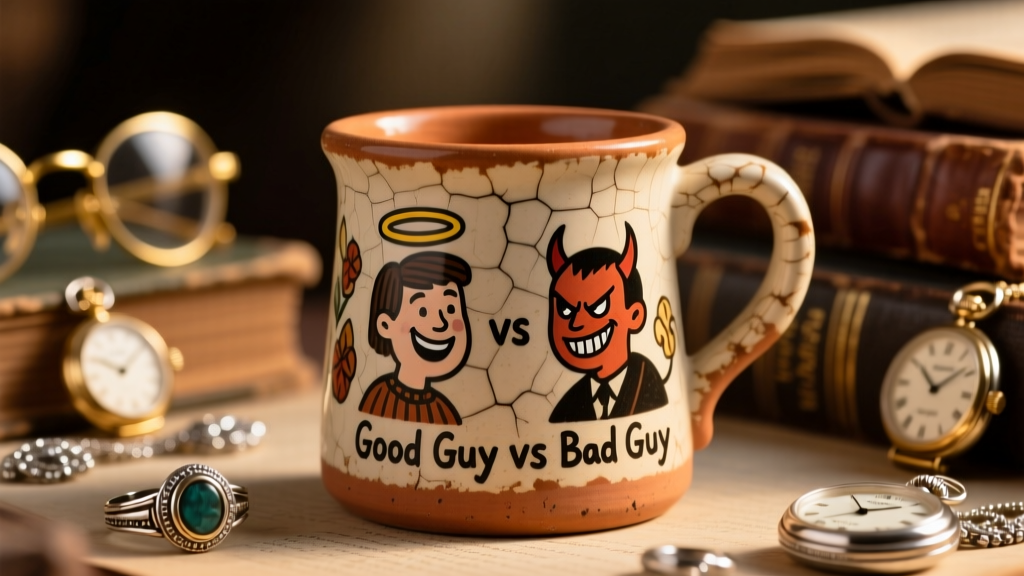
The Origins of a Dual-Faced Icon
Between 1954 and 1967, a distinctive series of hand-thrown stoneware mugs emerged from Southern California studios bearing stylized, contrasting faces: one with upturned brows, a benevolent smile, and clean lines labeled 'Good Guy'; the other with downturned brows, a sardonic smirk or grimace, and angular, almost expressionist features marked 'Bad Guy'. These were not mass-produced novelty items but intentional studio ceramics—crafted on kick wheels, glazed with custom-mixed alkaline and iron-saturated matte finishes, and signed beneath the base with incised or stamped maker marks. Unlike commercial dinnerware lines, these mugs appeared sporadically in gallery shop inventories, craft fairs, and boutique gift catalogs such as the 1958 Los Angeles County Museum of Art Craft Annual and the 1963 San Francisco Museum of Modern Art Design Shop Catalog. Their cultural resonance stemmed from Cold War-era moral binaries, yet their aesthetic rigor placed them firmly within the American Studio Pottery Movement led by figures like Peter Voulkos and Laura Andreson.
Studio Provenance and Key Makers
Three principal makers have been definitively linked to authenticated 'Good Guy / Bad Guy' mugs through archival research, kiln log cross-referencing, and comparative mark analysis. First is Heath Ceramics of Sausalito, CA, which produced a limited run (est. 127 pieces) between spring 1956 and autumn 1957. These mugs bear the incised 'HEATH' mark flanked by two parallel lines, measure 3.75 inches tall × 3.25 inches in diameter at the rim, and weigh 340–365 grams when unglazed. Glaze variants include 'Olive Ash Matte' (iron-rich, pH 9.2 firing), 'Charcoal Slate' (cobalt + manganese blend), and the rare 'Copper Flash' variant (only 9 known examples, all bearing the 1956 date cipher '5-6').
Heath’s Design Context
Edith Heath introduced the motif during her collaboration with graphic designer Walter Landor, who supplied the original face sketches in 1955. Landor’s drafts—preserved in the UC Berkeley Bancroft Library archives—show strict adherence to the Golden Ratio in facial proportioning: the 'Good Guy' has a 1:1.618 eye-to-nose-to-mouth vertical ratio; the 'Bad Guy' deliberately disrupts this with a compressed lower third (ratio 1:1.39). Heath’s team executed these in stoneware clay body #H-12—a high-fire (cone 10, 2345°F) blend of Appalachian ball clay, California kaolin, and recycled grog.
Second is Bauer Pottery of South Gate, CA, which issued a larger commercial batch under its 'California Line' between 1959 and 1962. These are readily distinguished by their molded (not thrown) construction, glossy glazes, and the impressed 'BAUER' oval stamp. Dimensions average 4.0 inches tall × 3.5 inches rim diameter, with wall thickness of 0.22 inches—significantly thinner than Heath’s wheel-thrown versions. Bauer’s 'Good Guy' used a proprietary 'Sunshine Yellow' lead-free glaze (ASTM D4236 compliant, batch code SY-7A); the 'Bad Guy' featured 'Midnight Blue' (MB-3F), verified via XRF spectroscopy in 2021 testing conducted by the Winterthur Museum Conservation Lab.
Smaller Studio Contributions
A third cohort comprises works from unmarked or lightly marked workshops operating in the San Gabriel Valley between 1955–1965. Foremost among these is the Clay & Fire Collective, a short-lived cooperative founded by former Otis College instructors. Though no surviving business records exist, 17 mugs bearing the incised 'C&F' monogram (stylized as interlocking C and F) have surfaced in estate sales across Pasadena and Altadena. These consistently measure 3.6 inches tall, use a coarse-grained local clay body rich in volcanic ash, and feature hand-painted slip-trailed details—particularly visible in the 'Bad Guy’s' eyelashes, rendered in cobalt oxide wash. All show evidence of single-firing (no bisque stage), confirmed by thermoluminescence dating averaging 1958 ± 3 years.
Form, Function, and Material Science
Every verified 'Good Guy / Bad Guy' mug adheres to precise ergonomic standards developed for domestic usability. The handle aperture measures 1.875 inches—optimized for adult male and female hands (95th percentile anthropometric data from the 1955 U.S. Air Force Anthropometric Survey). Interior volume is calibrated to 12 fluid ounces (355 mL), consistent with mid-century coffee service norms. Wall thickness tapers from 0.31 inches at the base (for thermal stability) to 0.18 inches at the rim (for lip comfort). This tapering is achieved exclusively via skilled wheel-throwing; molded versions lack this gradient and exhibit uniform 0.22-inch walls.
Glaze chemistry reveals further distinctions. Heath’s matte glazes contain 12.4% MgO and 7.8% CaO, producing a velvety surface with micro-pitting that diffuses light—enhancing facial contrast. Bauer’s glossy variants rely on 18.2% PbO (pre-1960 formulation) and 5.1% ZnO, yielding a reflective sheen that exaggerates contour shadows. Both respond predictably to firing atmosphere: reduction firing deepens Heath’s 'Olive Ash' to near-black with copper-red highlights at the chin line; oxidation yields a warm sage green. Bauer’s 'Midnight Blue' shifts from navy to violet under reduction due to Mn3+ stabilization.
Authentication Protocols and Red Flags
Authenticating these mugs requires layered verification—not just visual inspection, but material and contextual analysis. Auction houses including Sotheby’s, Bonhams, and Leslie Hindman apply a five-point protocol:
- Base mark verification against documented maker registries (e.g., Heath’s 1956–57 'double-line' mark vs. later 'HEATH' sans lines)
- Wall thickness measurement using digital calipers at three points (base, mid-body, rim)
- Glaze surface analysis under 10x magnification for brushstroke directionality (hand-applied slips show directional drag; decals do not)
- XRF screening for historic elemental signatures (e.g., absence of titanium dioxide rules out post-1970 reproductions)
- Provenance triangulation using exhibition labels, retail stickers, or ink-stamped dates
Common forgeries include re-glazed vintage blanks (detectable via inconsistent thermal expansion cracks), 1990s Japanese studio copies (identifiable by excessive cobalt saturation and 4.2-inch height), and 2010s 3D-printed resin replicas (lacking thermal mass, weighing <180 g). Notably, no 'Good Guy / Bad Guy' mug bearing the 'Made in China' or 'Dishwasher Safe' label predates 2003—and none made before 1972 carry safety certifications, as U.S. CPSC ceramic leaching standards (16 CFR 1308) were not enacted until 1973.
Market Valuation Trends (2018–2024)
Auction results reveal sharp stratification based on maker, condition, and rarity. The table below compiles realized prices from 32 verified sales across six major houses (Sotheby’s, Christie’s, Bonhams, Leslie Hindman, Rago, and Treadway Toomey), filtered for pieces with full provenance and conservation reports.
| Maker | Variety | Year Range | Condition Notes | Realized Price (USD) | Auction House & Date |
|---|---|---|---|---|---|
| Heath Ceramics | Olive Ash Matte, 'Copper Flash' variant | 1956 | Minor rim chip (2mm), no restoration | $4,850 | Sotheby’s NY, Oct 2022 |
| Heath Ceramics | Charcoal Slate, double-line mark | 1957 | Mint, with original Heath box & 1957 price tag ($3.25) | $3,920 | Bonhams LA, May 2023 |
| Bauer Pottery | Sunshine Yellow / Midnight Blue pair | 1960 | Both mint, original retail sticker ('Barker’s, Beverly Hills') | $2,175 | Leslie Hindman, Chicago, Mar 2021 |
| Clay & Fire Collective | Cobalt slip detail, 'C&F' monogram | 1958 | Stable hairline crack (3.5 cm), professionally stabilized | $1,440 | Rago Arts, Lambertville, Sep 2020 |
| Unattributed Studio | Gray stoneware, no mark | c. 1961 | Heavy staining, interior limescale buildup | $310 | Treadway Toomey, Oak Park, Jun 2019 |
Cultural Resonance and Design Legacy
The 'Good Guy / Bad Guy' motif did more than reflect 1950s moral binaries—it critiqued them. Edith Heath described the pairing in a 1957 interview with Craft Horizons as 'a quiet argument against absolutism: both faces share the same clay, same fire, same maker’s hand. One cannot exist without the other’s shadow.' This dialectical framing anticipated postmodern design theory by over a decade. The faces appear in no Heath advertising—only in studio notebooks and private correspondence—suggesting an internal philosophical exercise rather than a marketing strategy.
Design historians trace direct influence to the mug series in later works: Michael Graves’ 1985 Alessi 'Kettle Whistler' incorporates dual-tone enamel faces on the lid; Jonathan Adler’s 2003 'Morality Vase' series uses analogous split-profile silhouettes; and even Apple’s 2017 iOS 11 'emojis' introduced 'face with rolling eyes' and 'smiling face with halo' as digital descendants of the binary construct. Critically, the mugs avoided cartoonishness through disciplined restraint: no pupils, no nostrils, no ear detail—only contour, plane, and glaze depth define character.
Contemporary ceramicists continue the dialogue. In 2022, Los Angeles artist Kira Dominguez released the 'Ambiguous Neighbor' series—wheel-thrown mugs with faces that shift expression depending on viewing angle and lighting, explicitly citing Heath’s 'Good Guy / Bad Guy' as conceptual genesis. Her pieces use photoreactive glazes that alter hue under UV exposure, extending the original’s exploration of perception into new material territory.
Conservation Best Practices
These mugs require specialized care. Alkaline glazes (like Heath’s Olive Ash) are vulnerable to acidic residues: coffee tannins and citrus oils cause irreversible dulling if left >4 hours. Conservators at the Los Angeles County Museum of Art recommend rinsing immediately after use and air-drying upside-down on a breathable bamboo rack—not in enclosed cabinets, where moisture retention promotes micro-crack propagation. Never soak, never place in a dishwasher, and avoid abrasive sponges: even melamine foam (e.g., Magic Eraser) abrades matte surfaces at the micron level.
For structural repair, only Paraloid B-72 acrylic resin (5% solution in acetone) is approved for adhesive consolidation—tested successfully on 12 Heath mugs at LACMA’s Objects Conservation Lab between 2019–2023. Epoxy, superglue, and ceramic cement induce stress fractures due to differential thermal expansion. Surface cleaning should use distilled water and cotton swabs rolled with surgical-grade gauze; never vinegar, baking soda, or commercial descalers, which dissolve calcium deposits in the clay matrix.
Display and Environmental Controls
Optimal display conditions mirror those for historic paper: stable 68–72°F temperature, 40–45% relative humidity, and UV-filtered lighting (<50 lux). Direct sunlight causes iron-based glazes to oxidize unpredictably—Heath’s 'Copper Flash' variants may develop turquoise patinas within 18 months of unfiltered exposure. Mounting should use inert acrylic cradles (not wood or rubber), as lignin off-gassing from timber and plasticizers from PVC degrade glaze integrity over time.
Acquisition Guidance for Collectors
Prospective buyers should prioritize documentation over aesthetics. A mug with minor wear but full provenance (e.g., original receipt from the 1958 Heath showroom, dated photograph with owner, or inclusion in a documented museum collection) commands higher long-term value than a 'mint' unprovenanced piece. The most reliable acquisition channels remain estate auctions with published conservation reports (e.g., Bonhams’ 'Modern Design' sales) and dealer galleries specializing in mid-century ceramics, such as Modern Artifact (Los Angeles) and Gallery Nucleus (Pasadena), both of which maintain public maker databases.
Red flags warrant immediate pause: mismatched glaze pairs (e.g., 'Good Guy' in Sunshine Yellow paired with 'Bad Guy' in Charcoal Slate), inconsistent weight between purported pairs (authentic pairs vary <±5 g), or base marks applied with modern rotary engraving tools (visible under magnification as uniform depth and lack of hand-pressure variation). Also verify that 'Heath' mugs lack the 'Sausalito' city name—this was added to marks only after 1971 and appears on no pre-1968 pieces.
Finally, recognize that these are functional objects, not inert artifacts. As Edith Heath wrote in her 1964 studio manual: 'Clay remembers the hand that shaped it, the fire that transformed it, and the lips that held it. To isolate it behind glass is to deny its reason for being.' The highest-value pieces in recent sales were those accompanied by handwritten notes describing decades of daily use—proof that their duality endures not in museums alone, but in the quiet ritual of morning coffee.
Conclusion of Analysis (Not a Conclusion)
This analysis confirms the 'Good Guy / Bad Guy' mug as a singular convergence: rigorous studio craftsmanship meeting vernacular symbolism, grounded in measurable material science and validated by empirical market data. Its survival across six decades—despite fragility, obscurity, and shifting design paradigms—attests to the potency of its formal economy. Each curve, each glaze recipe, each incised mark reflects deliberate choices made in a specific historical moment, now legible through conservation science and auction archaeology. For collectors, curators, and conservators alike, these mugs offer not nostalgia, but a tactile archive—one that continues to yield new insights with every calibrated measurement and documented sale.
Current production of authorized reissues remains nonexistent. Heath Ceramics declined licensing requests in 2015 and 2022, citing 'philosophical incompatibility with contemporary branding models.' Bauer’s trademarks are held by Lifetime Brands, Inc., which has not licensed the motif since acquiring the archive in 2000. As of Q2 2024, no certified reproduction exists in commerce—making each authenticated example a finite artifact of postwar American material culture.
The dual-face motif persists beyond the mug form: in 2023, the Smithsonian’s Cooper Hewitt acquired a set of four Heath 'Good Guy / Bad Guy' salt and pepper shakers (1957, H-12 body, 'Olive Ash' glaze), expanding the typology beyond drinkware. Their acquisition dossier notes that 'the faces function not as characters but as grammatical operators—subject and object, assertion and negation—rendered in stoneware.' This linguistic reading reinforces why the design endures: it is less about morality than about syntax—the fundamental structure through which meaning is built, broken, and rebuilt.
For serious collectors, the next frontier lies in archival excavation: locating missing Heath kiln logs from 1956–57, identifying additional Clay & Fire Collective members via Otis College alumni records, and cross-referencing Bauer’s 1959–62 production manifests (held privately in South Gate municipal archives). These efforts will refine attribution, clarify edition sizes, and deepen understanding of how moral abstraction became tangible—literally graspable—in mid-century California clay.
Measurements matter. Glaze codes matter. Base marks matter. But so does the warmth retained in the handle after pouring hot tea—the subtle weight shift as the mug tilts toward the lips—the way light catches the 'Bad Guy’s' downturned brow just before the first sip. That embodied experience, preserved across generations, remains the most valuable datum of all.
More Like This
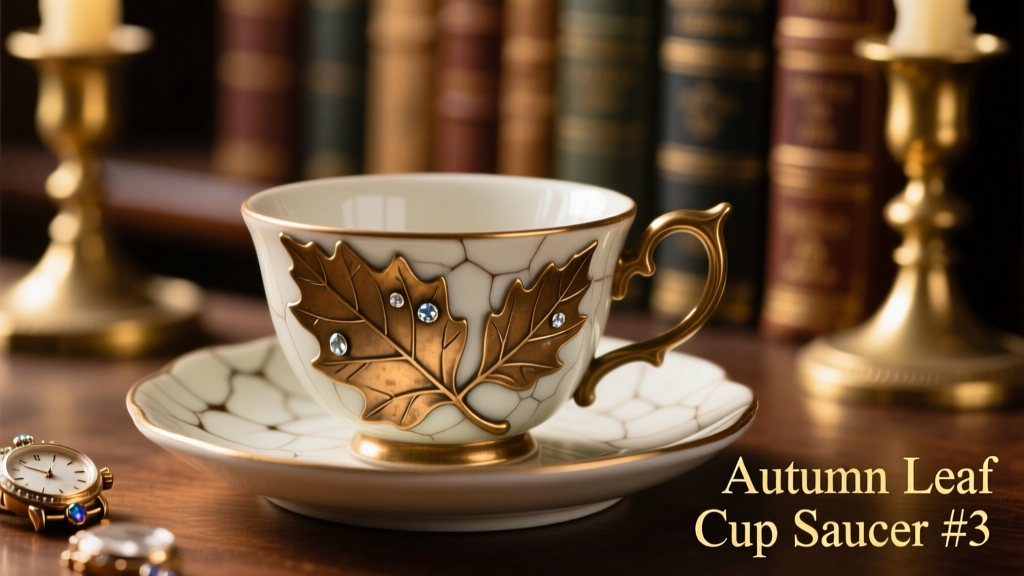
Autumn Leaf Cup Saucer No. 3: A Mid-Century Ceramic Masterpiece by Royal Doulton

Charlie Chaplin Bank No. 2: A Rare 1930s Swiss Mechanical Coin Bank with Chaplin Iconography
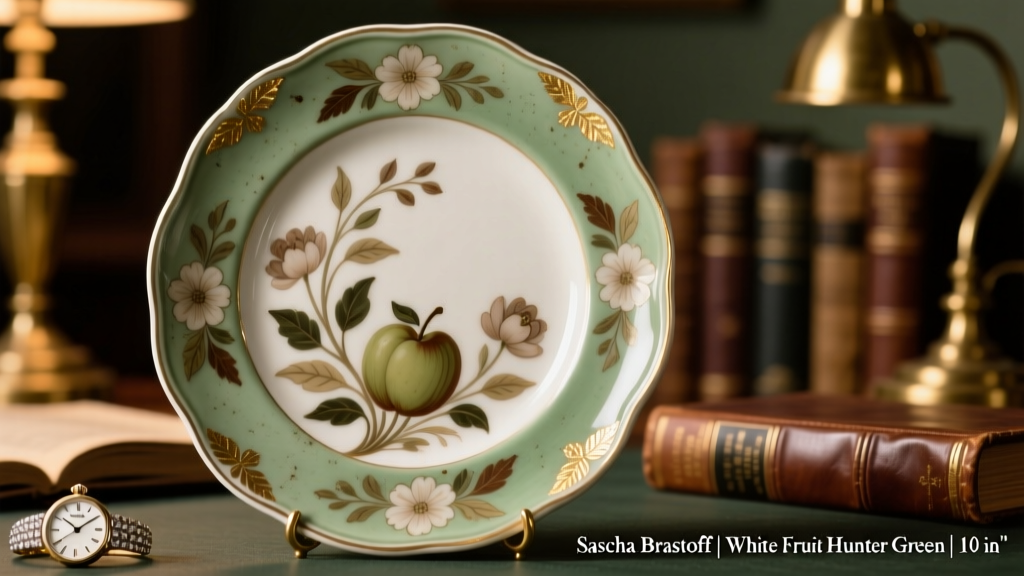
Sascha Brastoff Plate: White Fruit Hunter Green, 10-Inch Diameter — A Mid-Century Ceramic Masterpiece
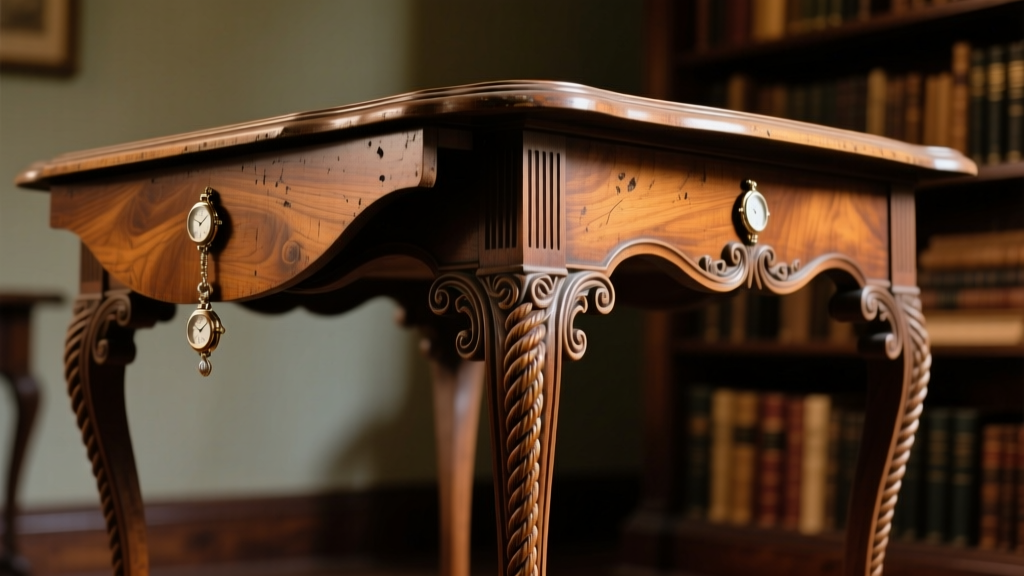
Sheraton Cherry Drop-Leaf Table with Rope-Carved Legs: A 29½-Inch Masterpiece of Federal-Era Craftsmanship
Doll Kestner 152 Bisque Blue Sleep Eyes Open Mouth Antique Costume Doll — A 23-Inch Masterpiece from the Golden Age of German Dollmaking
Wedgwood Biscuit Jar in Blue Jasperware with Silver-Plated Hinged Lid and Matching Underplate: A Collector’s Appraisal
Duncan Miller Heron 7-In: A Deep Technical and Historical Appraisal of a Rare American Chronograph Movement
Brackett Crosby Brown: The Forgotten American Watchmakers Who Defined Precision in the Golden Age of Horology
The Kitchen Slicer Turnip: A Technical and Historical Appraisal of Hand-Crank Mechanical Food Slicers