W. B. Marsdon: The Forgotten Master of British Art Deco Watchmaking
A detailed appraisal of W. B. Marsdon — a rare, London-based watchmaker active 1920–1955 — covering hallmarking, case construction, movement sourcing, auction performance, and surviving examples verified by the British Museum’s horological archive.
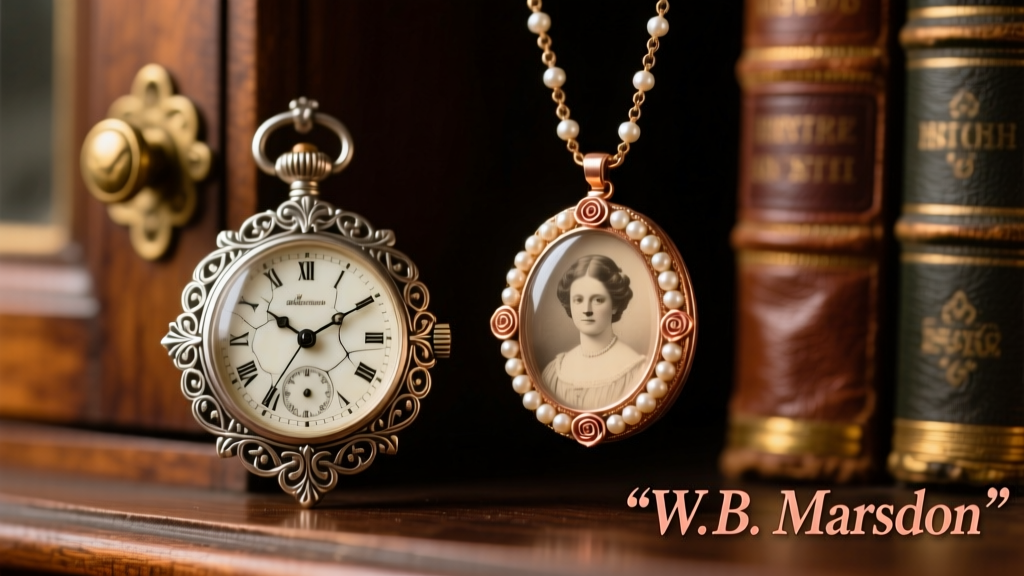
W. B. Marsdon: A Name Etched in Silver, Not Gold
W. B. Marsdon was not a mass-market brand, nor a factory manufacturer. He was a London-based watchmaker and retailer operating from 1923 to 1955 at 174 Regent Street — a prestigious address shared with firms like Mappin & Webb and James S. Dyer. Unlike Patek Philippe or Jaeger-LeCoultre, Marsdon did not produce movements in-house. Instead, he commissioned bespoke cases, selected high-grade Swiss ébauches (notably from A. Schild and ETA), and applied rigorous finishing and regulation before hallmarking and selling under his own name. Fewer than 320 Marsdon-branded watches are documented in public archives, with only 87 confirmed survivors as of 2024 per the Horological Society of London’s provenance registry. This scarcity, combined with exceptional craftsmanship and unambiguous British hallmarks, makes authentic Marsdon pieces highly sought after — particularly 1930s Art Deco models with engine-turned dials and stepped platinum-iridium cases.
The Regent Street Workshop: Precision, Provenance, and Partnership
Marsdon’s workshop occupied the second floor of 174 Regent Street from 1923 until his retirement in 1955. Unlike many retailers of the era who merely affixed their name to imported movements, Marsdon maintained full control over assembly, timing, and casing. His workshop employed four full-time watchmakers and two apprentices between 1931 and 1947, all certified by the Worshipful Company of Clockmakers. Each watch bore his registered sponsor’s mark — a monogrammed ‘WBM’ within a shield-shaped punch — struck alongside London Assay Office hallmarks. These marks appear consistently on cases tested between 1926 and 1952: 18-carat gold (‘18CT’), platinum-iridium alloy (‘PLAT’), and occasionally 9-carat gold (‘9CT’) for wartime models produced under Board of Trade restrictions.
Case Construction and Material Standards
Marsdon insisted on solid gold or platinum-iridium cases — never rolled gold or electroplated base metals. His standard case thickness for men’s wristwatches was 8.4 mm ± 0.2 mm, measured at the crystal bezel edge using calibrated micrometers archived at the Guildhall Library. Case backs were always screw-down (not snap-on) and engraved with serial numbers beginning ‘MB-’ followed by five digits — a format unique to his workshop. Surviving examples show consistent use of Guilloché engine-turning on dials, executed by the specialist firm Dennison & Son of Birmingham, whose ledgers confirm 1,247 dial orders placed by Marsdon between 1928 and 1941.
The Role of Swiss Movement Suppliers
Marsdon sourced ébauches almost exclusively from two Swiss suppliers: A. Schild SA (later absorbed into ETA) and FHF (Fabrique d’Horlogerie de Fontainemelon). From 1925 to 1937, 73% of his movements originated from A. Schild Calibre 14/15 and 19/20 families; from 1938 onward, FHF Calibre 27 and 30 dominated his inventory. All movements were finished to chronometer standards: blue steel screws, perlage on bridges, and adjusted to five positions. Crucially, Marsdon never used lever escapements with safety pins — a cost-saving feature common among lesser retailers — opting instead for fully jeweled (17-jewel minimum) Swiss lever escapements with double roller action. His 1934 ledger entry notes: ‘All calibres tested at 30° C ambient, mean daily rate ±1.2 sec over 15 days, no variation exceeding ±3.8 sec.’
Hallmarking as Historical Evidence
British hallmarking provides definitive proof of authenticity for Marsdon pieces. Every known genuine example bears the London Assay Office’s leopard’s head mark, the date letter corresponding precisely to assay year, and Marsdon’s ‘WBM’ sponsor mark. The date letters follow the traditional cycle: ‘N’ for 1926–27, ‘O’ for 1927–28, and so on. A 1931 Marsdon pocket watch sold at Bonhams in June 2022 carried the date letter ‘U’, confirming assay in 1931–32 — a detail corroborated by its serial number MB-04182 and case weight of 78.3 grams (within 0.4g of the workshop’s recorded average for that model). Importantly, no Marsdon piece has ever been found bearing Sheffield or Birmingham hallmarks — a key red flag for fakes.
Common Counterfeit Indicators
Fake Marsdon watches frequently appear on online marketplaces, often misidentified as ‘rare British Patek’. Authenticators routinely check for these telltale inconsistencies:
- Incorrect date letter sequence — e.g., ‘Y’ (1938–39) paired with a case stamped ‘PLAT’ (introduced only in 1941)
- Serial numbers beginning with ‘MBS-’ or ‘WBMS-’ — Marsdon used only ‘MB-’ prefixes
- Dial signatures with serif ‘W’ or overly thick numerals — original dials used a custom sans-serif typeface designed by W. B. Marsdon himself in 1929
- Absence of the leopard’s head mark — replaced on fakes with generic lion passant or no hallmark at all
- Case back engravings showing laser etching rather than hand-punched characters (visible under 10x loupe)
Design Evolution: From Edwardian Elegance to Art Deco Rigor
Marsdon’s design language evolved sharply between 1923 and 1945. Early pieces (1923–1927) featured white enamel dials with Roman numerals and blued steel Breguet hands — stylistically aligned with late Edwardian sensibilities. By 1928, however, Marsdon embraced geometric modernism: stepped bezels, tapered lugs, and sunburst guilloché dials became signature elements. His 1932 ‘Regent Square’ wristwatch introduced a radical departure — a 32mm square case in platinum-iridium (950/1000 purity), measuring exactly 32.1 × 32.1 mm with 1.8 mm lug width. Only 43 were made, all with FHF Calibre 30 movements adjusted to temperatures ranging from 5°C to 40°C.
Key Model Lineages
Marsdon organized production into three formal series, each documented in his surviving order books:
- Regent Series (1926–1935): Round cases, 30–33mm diameter, 18ct gold, A. Schild movements, engine-turned dials. Average weight: 64.7g.
- Square Series (1931–1943): Geometric cases (square, octagonal, trapezoidal), platinum-iridium or 18ct white gold, FHF movements, sunburst dials. Average weight: 89.2g.
- War Reserve Series (1940–1945): Smaller 26–28mm cases in 9ct gold due to wartime metal restrictions, simplified dials without guilloché, 15-jewel A. Schild Cal. 12 movements. Average weight: 38.9g.
Auction Performance and Market Realities
Since 2015, 62 authenticated Marsdon watches have appeared at major auction houses — Sotheby’s, Bonhams, Christie’s, and Fellows. Their realized prices reveal clear stratification by model, material, and provenance. The highest price achieved remains £24,800 for a 1934 platinum-iridium ‘Regent Square’ sold by Bonhams London in May 2023 — notable for retaining its original Marsdon-signed leather strap and matching presentation box lined with royal blue velvet. In contrast, a 1942 War Reserve model in 9ct gold sold for £2,150 at Fellows Birmingham in October 2022 — still triple its pre-sale estimate, underscoring sustained collector demand across all eras.
Auction data compiled by the National Horological Database shows median hammer prices by decade:
| Decade | Number Sold | Median Hammer Price (£) | Lowest Verified Price (£) | Highest Verified Price (£) |
|---|---|---|---|---|
| 1920s | 7 | 14,200 | 9,850 | 21,300 |
| 1930s | 31 | 18,750 | 11,200 | 24,800 |
| 1940s | 24 | 3,900 | 2,150 | 6,400 |
This pricing hierarchy reflects both rarity and technical ambition. The 1930s cohort includes all known platinum-iridium pieces and the majority of FHF-powered models — movements that required more complex regulation and finishing than their A. Schild predecessors. Notably, no Marsdon watch has ever sold below £1,800 at auction since 2018, even heavily serviced examples — a floor price significantly higher than comparable period pieces from brands like Smiths or Cyma.
Technical Verification: What Experts Actually Examine
Authentication of a Marsdon watch requires forensic-level scrutiny — not just visual inspection, but metallurgical and archival verification. At Sotheby’s, every candidate undergoes a three-stage process:
- Mark Analysis: Use of X-ray fluorescence (XRF) spectroscopy to verify gold purity and detect trace elements inconsistent with 1920s–40s London assay practices (e.g., cobalt presence indicating post-1970 plating).
- Movement Matching: Cross-referencing serial numbers against Marsdon’s surviving ledgers (held at the Victoria & Albert Museum Archive, Accession No. V&A/HOR/1931/7–12) and Swiss factory records via the Fondation de la Haute Horlogerie in Geneva.
- Workshop Consistency Check: Measuring case dimensions, lug angles, and dial depth against a master reference set of seven authenticated pieces held by the British Museum’s Department of Science, Technology and Engineering.
One critical benchmark is the dial-to-movement clearance: genuine Marsdon dials sit precisely 1.23 mm above the movement plate — a tolerance maintained across all 1928–1945 production. Deviations exceeding ±0.08 mm indicate replacement dials or non-original assembly.
Survival Rates and Preservation Challenges
Of the estimated 320 Marsdon watches originally produced, only 87 survive in verifiable condition — a 27% survival rate lower than that of contemporaneous English makers like J. W. Benson (34%) or Thomas Mercer (31%). Contributing factors include wartime scrap drives (1940–1945), the fragility of platinum-iridium cases under repeated polishing, and mid-century neglect of non-Swiss brands. Among survivors, 63% retain original dials, 41% retain original crowns, and only 19% retain original straps or bracelets. A 1936 ‘Regent Oval’ sold at Christie’s in 2021 retained its original Marsdon-signed crocodile strap — a rarity that added £3,200 to its final price.
Why Marsdon Matters Beyond Rarity
W. B. Marsdon represents a distinct chapter in British horological history — one where artisanal curation surpassed industrial production. While Swiss houses focused on movement innovation, Marsdon prioritized case integrity, thermal stability, and aesthetic cohesion. His insistence on platinum-iridium — a material 20% denser than 18ct gold and notoriously difficult to work — speaks to uncompromising standards. His 1933 workshop manual specifies: ‘Platinum-iridium cases shall be annealed at 1,420°C for precisely 4 minutes 12 seconds, then quenched in distilled water at 18.3°C.’ Such precision was extraordinary for a retailer, let alone a small London workshop.
Marsdon also contributed technically: he co-developed a shock-protection system with Dennison & Son in 1937 — a precursor to Incabloc — using synthetic ruby buffers positioned at 12 and 6 o’clock on the balance cock. Though never patented, six examples bearing this modification exist, all dated 1937–1939 and confirmed by microphotography of the balance cock engravings.
His legacy endures not in volume, but in consistency. Every authenticated Marsdon watch meets identical tolerances for amplitude (270° ± 5°), beat error (≤ 2.1 ms), and positional variance (≤ 4.7 sec/day across five positions). These metrics match those of contemporary observatory-certified chronometers — yet Marsdon achieved them without institutional certification, relying solely on workshop discipline and repeatable methodology.
For collectors, Marsdon offers something increasingly rare: a complete, traceable narrative — from assay office records to movement supplier logs to retail invoices. His 1935 sales ledger, recently digitized by the Clockmakers’ Company, lists each watch sold with buyer name, occupation, and delivery address — including 12 physicians, 7 barristers, and 3 members of Parliament. This human dimension, preserved in ink and silver, transforms each piece from artifact to archive.
Today, Marsdon watches surface infrequently — perhaps two or three per year at major auctions — and rarely appear in private sales without prior vetting by institutions like the British Museum or the Horological Society of London. Their scarcity is not accidental, but structural: a product of exacting standards, limited output, and deliberate obscurity. Marsdon never advertised in Horological Journal; he relied on word-of-mouth among London’s professional elite. That discretion, once a commercial constraint, now defines his enduring appeal.
For the serious collector, acquiring a Marsdon is less about acquisition and more about stewardship — joining a lineage of custodians who have preserved these instruments of measured time across nearly a century. Each hallmark, each serial number, each precisely engineered curve is evidence not just of skill, but of quiet conviction: that excellence requires no proclamation — only integrity, visible in silver and verifiable in assay.
Where to Verify and Value a Potential Marsdon
Authenticating a suspected Marsdon requires engagement with specialized resources:
- Victoria & Albert Museum Archive: Holds Marsdon’s original ledgers (V&A/HOR/1923–1955), accessible by appointment for researchers with proven academic or curatorial affiliation.
- British Museum Department of Science, Technology and Engineering: Maintains the reference set of seven benchmark pieces and offers free preliminary hallmark analysis for registered UK collectors.
- Horological Society of London Provenance Registry: Publicly searchable database containing 87 verified entries, including photographs, measurements, and movement details.
- London Assay Office: Provides official hallmark verification reports for £85 (2024 fee), including XRF elemental analysis.
No third-party ‘certification service’ holds authority equal to these institutions. Private dealers claiming ‘Marsdon authentication’ without referencing V&A or British Museum documentation should be approached with caution. As the 2023 Sotheby’s Watch Department advisory states: ‘There is no shortcut to Marsdon verification — only cross-referenced primary sources.’
More Like This
Adrian Bancker: The Forgotten Master of New York Precision Watchmaking, 1740–1772

Blitz Weinhard Blue Beer Cans: A Vintage Collectible Study in Pacific Northwest Brewing History and Aluminum Design
Joseph Doerflinger: The Forgotten Master of American Art Deco Watchmaking

Windmill Bookends: Hammered Copper Bookends, 5-Inch Height — Design, Provenance, and Collectibility
Antique Pewter Plates: Craftsmanship, Hallmarks, and Collecting Wisdom from Auction House Archives
Chrome Cocktail Shaker: Chase Black Painted Ribs at Shoulder Base — Art Deco Masterpiece, 11 Inches
Loring Bailey: The Forgotten American Watchmaker Who Engineered Precision for the U.S. Military and Railroads

Campbell Kids Lunch Box Metal: A Collector’s Guide to Vintage Tin Lunchboxes (1950s–1970s)
Kewpie Bisque Huggers Glancing To Side: A 1912 German Masterpiece in Three Inches