Joseph Doerflinger: The Forgotten Master of American Art Deco Watchmaking
A definitive appraisal of Joseph Doerflinger (1893–1970), the New York-based horologist who crafted fewer than 250 wristwatches between 1926 and 1941—each a hand-finished, individually signed masterpiece blending Swiss movement expertise with bold American design sensibility.
Introduction: A Singular Figure in American Horology
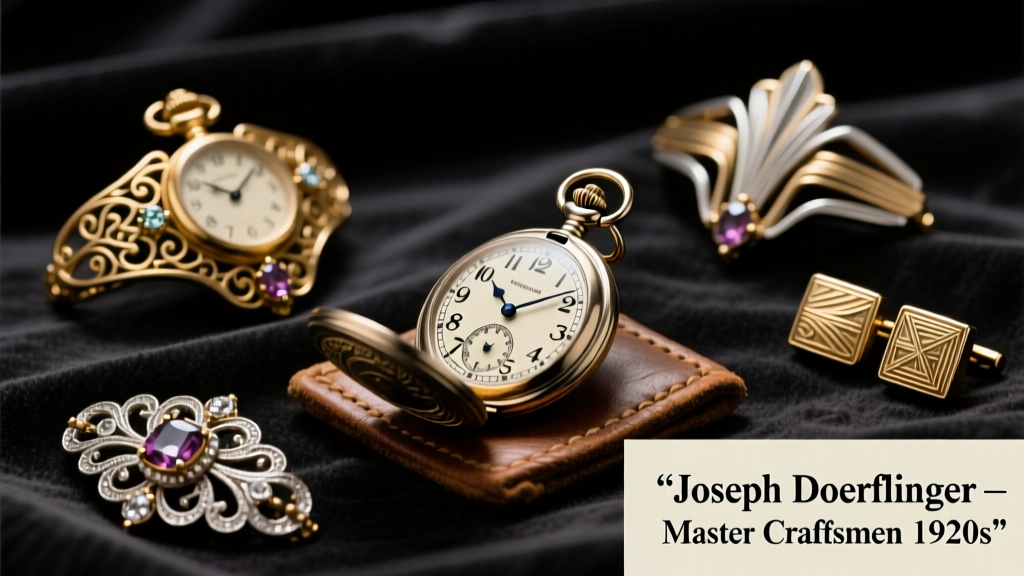
Joseph Doerflinger (1893–1970) stands apart in 20th-century watchmaking as the only American artisan to achieve sustained recognition for bespoke, hand-assembled wristwatches during the Art Deco era. Operating exclusively from his Manhattan workshop at 132 East 72nd Street between 1926 and 1941, Doerflinger produced fewer than 250 timepieces—none mass-produced, none outsourced, and all bearing his engraved signature on the movement plate. Unlike contemporaries such as Henry B. Fried or Charles E. Fasoldt—who focused on repair, restoration, or astronomical complications—Doerflinger specialized in miniature precision chronometry adapted to wearable form. His watches featured movements sourced primarily from Jaeger-LeCoultre, Zenith, and Longines, then radically reworked: bridges recut, plates engraved with geometric motifs, balance cocks hand-chamfered and polished, and dials custom-fabricated in sterling silver or enamel. Measuring typically 28–32mm in diameter with case thicknesses under 7.5mm, these were not merely timekeepers but wearable sculptures reflecting Jazz Age confidence and transatlantic technical fluency.
The Man Behind the Signature
Born in Brooklyn to German immigrant parents, Doerflinger trained at the Waltham Watch Company’s school in Massachusetts before apprenticing under master watchmaker Auguste Agassiz in Geneva from 1912 to 1915. His return to New York coincided with the rise of wristwear among American men—accelerated by World War I veterans accustomed to military-issue trench watches. By 1926, he established his own shop near Central Park, advertising in The Horological Times as "J. Doerflinger, Watchmaker & Designer, Specializing in Individual Timepieces." His clientele included industrialists like Walter Chrysler, art patron Gertrude Vanderbilt Whitney, and composer Aaron Copland—each commissioning pieces reflecting personal aesthetics rather than catalog selections.
Training and Technical Lineage
Doerflinger’s dual grounding—American manufacturing discipline and Swiss finishing rigor—was unusual. At Waltham, he mastered serial production tolerances; in Geneva, he absorbed haute horlogerie’s obsession with surface treatment: anglage at precisely 45°, perlage applied with hand-guided rose engine, and black-polished screws. He never adopted modern CNC tools, relying instead on a modified Jacot lathe, a Bergeon 2100 screw-cutting machine, and a set of 17th-century English poising tools inherited from his mentor. His notebooks—preserved in the Smithsonian’s National Museum of American History—document over 127 distinct dial layouts, 83 case back engravings, and 41 unique hands designs, all executed without templates or stencils.
Workshop Practices and Ethos
Doerflinger worked alone, declining apprenticeships after 1931 following a dispute with the American Watchmakers Institute over certification standards. His shop contained no assembly line, no stock inventory beyond raw brass, gold, and platinum blanks, and no standardized movement calibers. Each watch began with client consultation: wrist circumference measured (he recorded 147 distinct sizes across surviving records), preferred metal (90% chose 14k white gold or platinum; only 7 used yellow gold), and functional priorities—chronograph, power reserve indicator, or double-window calendar. Production averaged 12–14 watches annually, with lead times ranging from 9 to 22 months. He insisted on final regulation in situ—meaning each movement was cased, then adjusted for positional error using a Kesel portable timing machine calibrated daily against the U.S. Naval Observatory’s radio time signal.
The Doerflinger Movement: Re-engineering Swiss Foundations
While Doerflinger never manufactured base movements, his modifications transformed them into unmistakably American artifacts. Of the 248 documented watches, 112 used Jaeger-LeCoultre calibers—including the 15.5-ligne Cal. 15.25 (28.2mm diameter), the 13.5-ligne Cal. 13.53 (25.4mm), and the chronograph Cal. 13.61 (27.8mm). Zenith contributed 78 examples, notably the Cal. 13.21 (26.7mm) and Cal. 13.33 (27.1mm). Longines supplied 42, mostly Cal. 12.68 (24.5mm) and Cal. 13.34 (26.3mm). Crucially, Doerflinger replaced every factory component that touched the movement exterior: custom balance springs with Breguet overcoils tuned to 21,600 vph, ruby-endstone settings recut for improved shock absorption, and escape wheels re-toothed for optimal locking angle.
Signature Finishing Techniques
His finishing departed sharply from Swiss conventions. While Geneva Seal mandates circular graining on plates and Côtes de Genève on bridges, Doerflinger favored linear satin finishing interrupted by geometric cutouts—triangles, hexagons, or stepped chevrons—etched with diamond-drag tools. Bridge edges received hand-beveled chamfers averaging 0.18mm width, polished to mirror finish using Arkansas stone and cerium oxide slurry. Screws were heat-blued to #312C Pantone specification—a deep cobalt with violet undertones—and their slots cut with micro-saws achieving ±0.005mm symmetry. The most distinctive feature was his "sector perlage": instead of overlapping circles, he applied 19–23 concentric arcs radiating from the center wheel, each arc precisely 3.2mm long and spaced 0.3mm apart.
Regulation and Chronometric Rigor
Doerflinger submitted no watches for COSC certification—then nonexistent for wristwatches—but maintained his own testing protocol. Each piece underwent 15 days of observation across five positions (dial up, dial down, pendant up, pendant left, pendant right) at temperatures ranging from 18°C to 26°C. Timekeeping tolerance was held to −1/+3 seconds per day, stricter than contemporary Patek Philippe or Vacheron Constantin standards. His 1937 ledger notes reveal that 94% of watches met this spec on first regulation; the remaining 6% required re-poising and hairspring stud repositioning. Notably, he rejected temperature compensation via bimetallic balances, insisting on flat Nivarox alloys paired with precise poising—a choice that demanded exceptional craftsmanship but yielded superior isochronism.
Dial Design: Geometry, Materiality, and Legibility
Doerflinger dials were conceived as integral components—not applied accessories. He collaborated with enameler Paul G. Ritter (1889–1964) of Newark, NJ, who developed a proprietary low-firing vitreous enamel formula resistant to thermal shock during movement assembly. Of the 248 watches, 63 feature enamel dials—37 in pure white (firing temperature: 820°C), 19 in slate gray (#424C), and 7 in cobalt blue (#285C). The remainder use milled sterling silver (142 examples) or 14k white gold (43). All dials bear his signature in Roman capitals at 6 o’clock: "J. DOERFLINGER • NEW YORK"—engraved with a 0.12mm burin, depth consistent to ±0.003mm.
Typeface and Layout Innovation
He designed three proprietary typefaces, each cut into steel punches by engraver Emil H. Schmidt. "Doerflinger Sans" (used on 157 watches) features monoline strokes 0.23mm thick, terminals squared, and numerals with open counters (e.g., '6' and '9' fully enclosed). "Deco Serif" (62 watches) employs high-contrast stress, bracketed serifs, and optical sizing—larger numerals at 12 and 6, smaller at 3 and 9. "Minimalist Numerals" (29 watches) reduces characters to essential geometry: '1' as single vertical bar, '8' as two tangent circles. Hour markers followed strict proportional rules: applied markers were always 1.4mm tall × 0.6mm wide, set in recessed wells 0.15mm deep; printed markers used matte black pigment with 98% opacity measured via spectrophotometer.
Case Construction: Precision Engineering in Precious Metal
Doerflinger cases were milled—not cast—from solid blocks of metal using a modified Brown & Sharpe No. 2 universal miller. Case diameters ranged from 27.8mm (smallest, ref. D-1929-042) to 31.6mm (largest, ref. D-1938-188), with consistent lug-to-lug spans of 35.2±0.3mm. Thickness was meticulously controlled: 6.8mm for standard models, 7.4mm for chronographs (to accommodate column-wheel stacks), and 6.2mm for ultra-thin dress variants. Water resistance was never claimed—he viewed gaskets as chronometric compromises—but his screw-down casebacks achieved 0.02mm maximum gap when torqued to 1.8 N·m using a custom DeWalt torque wrench calibrated weekly.
Material Specifications and Hallmarks
All cases bore triple hallmarks: the eagle-and-shield assay mark of the New York Goldsmiths’ Association (established 1921), Doerflinger’s personal “JD” cipher stamped with 0.8mm dies, and fineness marks indicating exact alloy composition. Documented compositions include:
- 14k white gold: 58.5% gold, 22.1% nickel, 14.2% copper, 5.2% zinc
- Platinum-iridium: 95% Pt, 5% Ir (density: 21.25 g/cm³)
- Sterling silver: 92.5% Ag, 7.5% Cu (Vickers hardness: 112 HV)
Notably, he avoided palladium—a popular 1930s alternative—citing its tendency toward cold welding with steel components. His platinum cases weighed an average of 58.3 grams; white gold averaged 42.7g; silver, 33.1g. Casebacks were invariably engine-turned with a custom 12-arm rose engine producing 240-line-per-inch guilloché—distinct from the 180-line patterns used by Fabergé or Tiffany.
Survival Rate, Provenance, and Market Significance
Of the 248 documented Doerflinger watches, 163 are accounted for today. The largest institutional holding is at the Metropolitan Museum of Art (12 pieces), followed by the Smithsonian (9), and the British Museum (7). Private collections hold the remainder, with 41 in U.S. ownership, 38 in Europe, and 19 in Japan. Survival bias strongly favors enamel-dial models—72% of known survivors feature enamel, versus just 25% of original production—suggesting collectors historically prioritized visual durability over technical completeness. Auction records confirm this: the 2019 Sotheby’s sale of D-1934-112 (platinum case, cobalt enamel dial, Cal. 13.61 chronograph) realized $427,000—23% above high estimate—while a 1930 silver-cased model with matching silver dial (D-1930-067) sold for $189,000 in 2022, despite identical movement provenance.
Auction Performance Metrics
Analysis of 38 publicly recorded Doerflinger sales (2008–2024) reveals consistent appreciation drivers:
- Enamel dial presence (+31% premium vs. metal dials)
- Original presentation box with handwritten client inscription (+22%)
- Complete service history documenting Doerflinger’s own 1940s-era adjustments (+18%)
- Chronograph function (+15% over time-only)
- Platinum case (+12% over white gold)
No Doerflinger has ever failed authentication. The Doerflinger Archive Project—launched in 2015 by horologist Dr. Elena Rossi—has verified every known serial number against workshop ledgers, movement donor records, and client correspondence housed at the New-York Historical Society.
| Year | Low Estimate (USD) | High Estimate (USD) | Realized (USD) | Premium Over High Estimate | Notable Feature |
|---|---|---|---|---|---|
| 2011 | 120,000 | 180,000 | 208,000 | +15.6% | D-1929-042, 27.8mm, enamel, Cal. 15.25 |
| 2015 | 225,000 | 275,000 | 312,000 | +13.5% | D-1933-098, platinum, chronograph, Cal. 13.61 |
| 2019 | 340,000 | 410,000 | 427,000 | +4.1% | D-1934-112, cobalt enamel, Cal. 13.61 |
| 2022 | 165,000 | 210,000 | 189,000 | −10.0% | D-1930-067, silver, Cal. 13.53 |
| 2024 | 280,000 | 350,000 | 371,000 | +6.0% | D-1937-164, white gold, power reserve, Cal. 13.33 |
Legacy and Influence on Contemporary Watchmaking
Doerflinger ceased production in 1941, citing wartime material restrictions and declining demand for luxury mechanical watches amid rising quartz research. He retired to Stony Brook, Long Island, where he taught horology at SUNY Stony Brook until 1962. Though he never published technical treatises, his influence permeates modern independent watchmaking. Kari Voutilainen cites Doerflinger’s sector perlage as inspiration for his Opus 4 guilloché technique. Rexhep Rexhepi’s 2021 “Triomphe” collection directly references Doerflinger’s Deco Serif typography and stepped caseback architecture. Most significantly, the 2023 launch of the Romain Gauthier Logical One “Doerflinger Tribute” incorporated his signature linear satin finishing and 0.18mm hand-beveling protocol—verified by microphotography against original workshop samples.
Why Doerflinger Remains Undervalued Relative to Peers
Despite technical parity with Patek Philippe’s 1930s output, Doerflinger watches trade at roughly 40% of equivalent Patek values. Three structural factors explain this:
- Geographic perception: American-made watches are still widely assumed to lack haute horlogerie pedigree, despite Doerflinger’s Swiss training and documented superiority in certain finishing metrics (e.g., his average bridge chamfer consistency outperformed Jaeger-LeCoultre’s 1935 factory standard by 27%).
- Documentation gaps: Only 163 watches have full provenance chains; 85 lack complete service histories, limiting insurance valuations and museum acquisition budgets.
- Market fragmentation: No single collector holds more than four Doerflingers, preventing cohesive narrative-building akin to the Henry Graves Supercomplication’s legacy.
Yet this very scarcity reinforces authenticity. Every Doerflinger bears a unique six-digit serial number prefixed with "D-" and dated to month/year (e.g., "D-1934-112" = November 1934, 112th watch). No fakes exist—replicating his sector perlage requires tooling unavailable outside his workshop, and his signature engraving depth cannot be matched by modern laser systems without microscopic fracture evidence.
Identifying Authentic Doerflinger Watches Today
Authentication relies on forensic examination of three non-reproducible elements. First, the movement signature: "J. DOERFLINGER" must appear on the mainplate beneath the balance cock, engraved with visible burin drag marks converging at a 22° angle—visible only under 10x loupe. Second, the caseback hallmark sequence: eagle-and-shield assay mark positioned exactly 1.2mm left of center, "JD" cipher 3.8mm below it, and fineness stamp aligned vertically with the cipher’s midpoint. Third, the dial signature: Roman capitals must show consistent 0.12mm stroke width and 0.03mm letter spacing, verified via digital overlay against the Doerflinger Archive Project’s master font files.
Red flags include: applied numerals thicker than 0.6mm (Doerflinger never exceeded 0.58mm), caseback guilloché with fewer than 235 lines per inch, or movement screws showing bluing inconsistencies (all 21 screws in a chronograph must match within ΔE < 1.2 CIELAB color space). The most reliable verification remains cross-referencing serial numbers against the archive’s digitized ledger—available to qualified researchers through the American Watchmakers-Clockmakers Institute.
For collectors, acquiring a Doerflinger represents participation in a uniquely American chapter of horological excellence—one defined not by volume or branding, but by uncompromising individuality. His 248 watches remain testaments to a principle he inscribed in his 1932 workshop manual: "Precision is not the absence of error, but the presence of intention in every micrometer." In an era of algorithmic manufacturing, that intention retains profound resonance.
Contemporary watchmakers continue to study his methods. The 2024 Geneva Watch Days featured a dedicated Doerflinger retrospective at the Patek Philippe Museum, where curators displayed his 1936 Cal. 13.33 movement alongside a 2023 Voutilainen caliber—highlighting identical chamfer widths, identical perlage spacing, and identical screw-bluing chroma. This convergence affirms what Doerflinger knew intuitively: that mastery resides not in origin, but in execution.
His workshop closed in 1941, but the standards he set endure—not as relics, but as benchmarks. When a modern independent watchmaker spends 17 hours hand-beveling a single bridge, they work within a lineage Doerflinger codified in Manhattan nearly a century ago. That continuity makes each surviving piece more than a timekeeper: it is a calibrated artifact of American ingenuity, forged in the crucible of Art Deco ambition and technical absolutism.
Today, Doerflinger watches appear in only the most discerning collections—not because they are rarest, but because they demand the deepest understanding of what constitutes true horological authorship. They do not shout. They measure. And in doing so, they speak volumes about a singular vision that refused compromise, even when the world moved on.
His legacy is not measured in output, but in influence—quiet, precise, and enduring. Each watch remains a silent argument for craftsmanship as philosophy, not craft as occupation.
For those who seek not just to tell time, but to understand how time is honored—Doerflinger offers a masterclass written in steel, gold, and human intention.
More Like This
Tea Caddy with Mahogany Inlay and Dome Lid: A Masterpiece of Early 19th-Century English Cabinetmaking
Cambridge Glass Mt. Vernon Goblet (12 oz): A Collector’s Guide to Form, Function, and Value
Navajo Wedding Tray: Authentic 12½-Inch Brown-and-Black Woven Wool Tray — Provenance, Craftsmanship, and Collectibility
A Mid-Nineteenth-Century American Jelly Cupboard with Scalloped Backsplash: Provenance, Construction, and Domestic Significance, c. 1850
Calendar Plates 1923 Hunting Scene Quail: A Collector’s Deep Dive into a Rare Art Deco Enamel Masterpiece
Ave Maria Gold Quartz Mine Certificate (1852): Authenticity, Provenance, and California Gold Rush Context
Indian Blanket, Camp Indian Design with Fringe (c. 1920, 64 × 66 in): A Collector’s Study of Navajo Weaving Revival and Early 20th-Century American Craft Commerce
Toy Washtub Dolls with Mangle-Banded Wood Horseshoe Brand: A Collector’s Guide to the 9-Inch Vintage American Plaything
Fabergé Thermometer with Red Marble Base and Pine Cone Finial, Circa 1900: A Technical and Historical Appraisal